Week 6 HW: Genetic Circuits Part 1
Part 1: DNA Assembly
- What are some components in the Phusion High-Fidelity PCR Master Mix and what is their purpose? Phusion High-Fifelity PCR Master Mix offered by New England Biolabs is a product that contains a DNA polymerase with high fidelity useful for cloning and amplification of difficult amplicons. Phusion DNA polymerase contains proofreading activity (3’ -> 5’ exonuclease) and a higher fidelity 50X greater that Taq polymerase. Thermo Fisher Scientific Phusion High-Fidelity PCR Marter Mix is composed of a HF Buffer or GC Buffer; both buffers are used to reduce the error rate of the DNA polymerase. HF Buffer contains a lower error rate (4.4 x 10⁷) than GC Buffer (9.5 x 10⁷), however GC buffer can improve the performance of the polymerase on some difficult or long templates with high GC-rich templates or with secondary structures. The master mix is also provided with a optimized concentration of MgCl2 which is an essential cofactor that stabilizes the DNA double helix and facilitates primer annealing. High Fidelity PCR reaction can also include DMSO that is used to reduce the melting temperature through its association with Cytosine residues that changes the conformation of the DNA template.
- What are some factors that determine primer annealing temperature during PCR? Primer annealing temperature is affected by the Primer melting temperature, annealing temperature is usually 3-5 °C below the primer Tm this temperatura depends on the GC content of the primers or primer length and the prescense of secondary structures. Another factor that can modify the Ta is the MgCl2 concentration indicating the higher concentrations can increase the Ta.
- There are two methods from this class that create linear fragments of DNA: PCR, and restriction enzyme digests. Compare and contrast these two methods, both in terms of protocol as well as when one may be preferable to use over the other. PCR is a laboratory method often used to increase the amount of a desired DNA sequences, it uses primer to determine the boundaries of the fragment and uses a DNA polymerase that can be genetically engineered to get different results. PCR is often used to amplify sequences for other analysis like sequencing or cloning. Resctriction enzyme digest used restriction endonucleases that recognize specific palindromic sequences and cuts these sites, it doesn’t not amplify the target sequence and is often used for its integration in a cloning vector for recombinant technologies.
- How can you ensure that the DNA sequences that you have digested and PCR-ed will be appropriate for Gibson cloning? To ensure that the DNA sequences will be appropiate for Gibson cloning the regions must have overlaping regions that can be used to connect correctly with the vector. The digested vector mus be linear and it must be purified to prevent re-ligation with the vector.
- How does the plasmid DNA enter the E. coli cells during transformation? The era multiple transfection methods use to insert a target DNA sequence inside the E. coli cells different methods can be used, one method called electroporation uses an electric shock to disturb the membrane and insert the DNA vector, another method uses a heat shock to disturb and insert the desired vector.
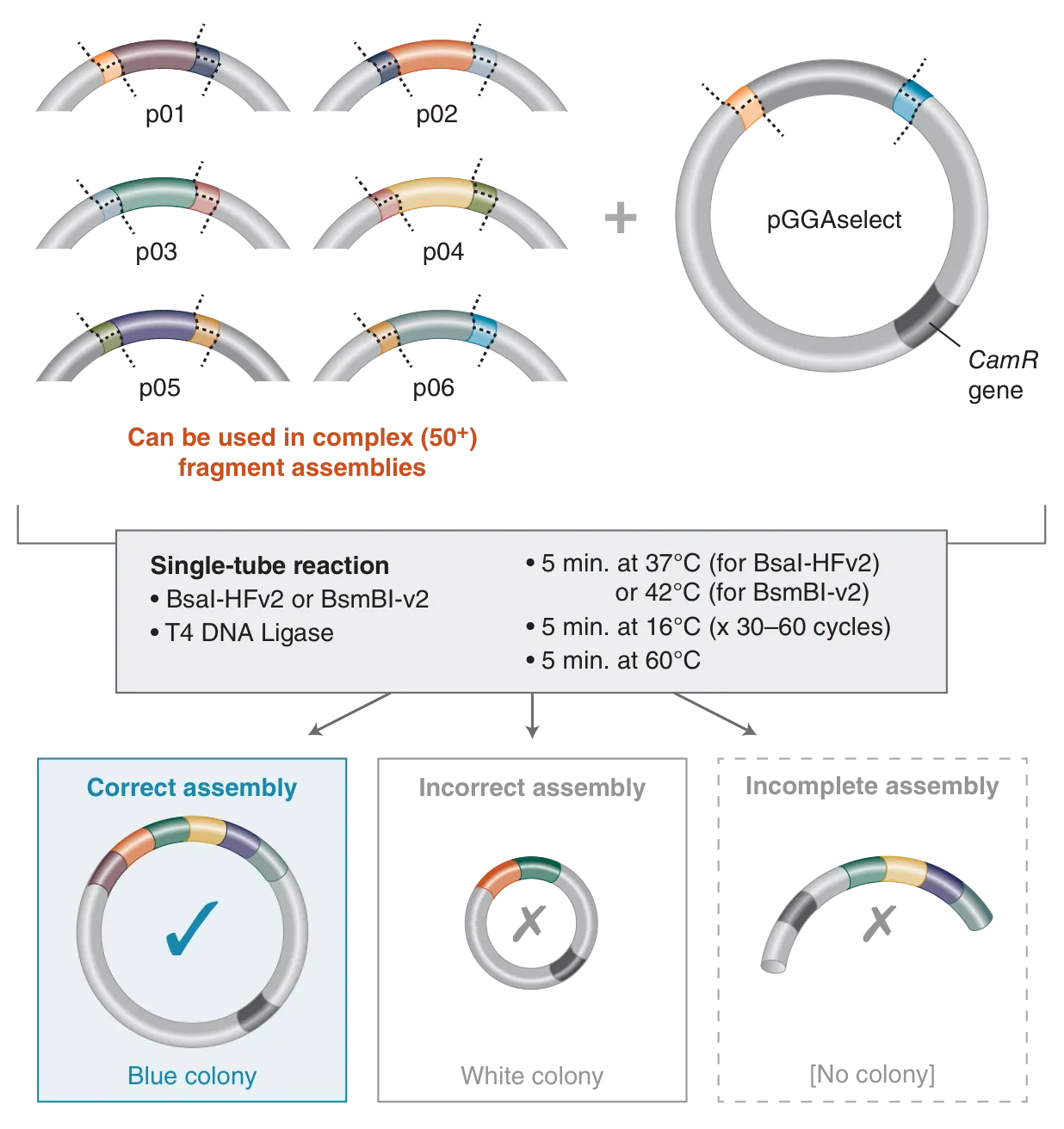
- Describe another assembly method in detail (such as Golden Gate Assembly) Golde Gate Assembly uses Type IIS restriction enzyme and T4 DNA ligase that cuts outside their recognition sequence, this allows to desing overhangs that can be ligated later, later this recognition sites are removed during assembly. Golden gate method allows assembling up to nine fragments at a time in a recipient plasmid. This can be done in a single tube that contains the donors, the recipient vector, a type IIS restriction enzyme and ligase (Engler & Marillonnet,. 2013)
Some advantages of the Golden Gate Assembly are:
- The overhang sequence creates is not dictated by the REase, so no scar sequence is introduced
- The fragment-specific sequence of the overhangs allows orderly assembly of multiple fragments simultaneously
- The restriction site is eliminated from the ligated product, so digestion and ligation can be carried out simultaneously
References:
- Engler, C., & Marillonnet, S. (2013). Golden gate cloning. In DNA cloning and assembly methods (pp. 119-131). Totowa, NJ: Humana Press.
Part 2: Asimov Kernel
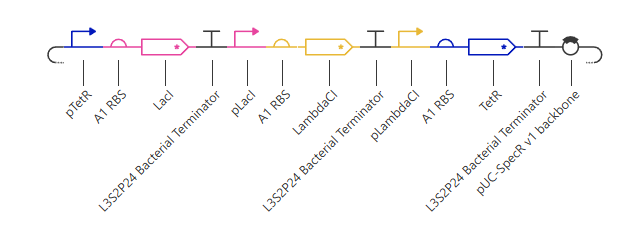
- Represilator Recreation To test the different parts of the Kernel options a recreation of the Demo Repressilator was made (Figure 2). The repressilator consists in three genes LacI, LambdaCI and TetR and their following repressor sequence pTetR that supress LacI expression in the presence of TetR, pLacI that supress LambdaCI expression in the presence of LacI and pLambdaCI that supress the expression of TetR. The logic inside this construct is that at the beginning LacI, LambdaCI and TetR are expressed, the expression of these three proteing will supress the expression o the other proteins. The presence of a protein can modify the expression of the the other protein following a domino effect that could be used to control de expression of a protein depending the input introduced to the system
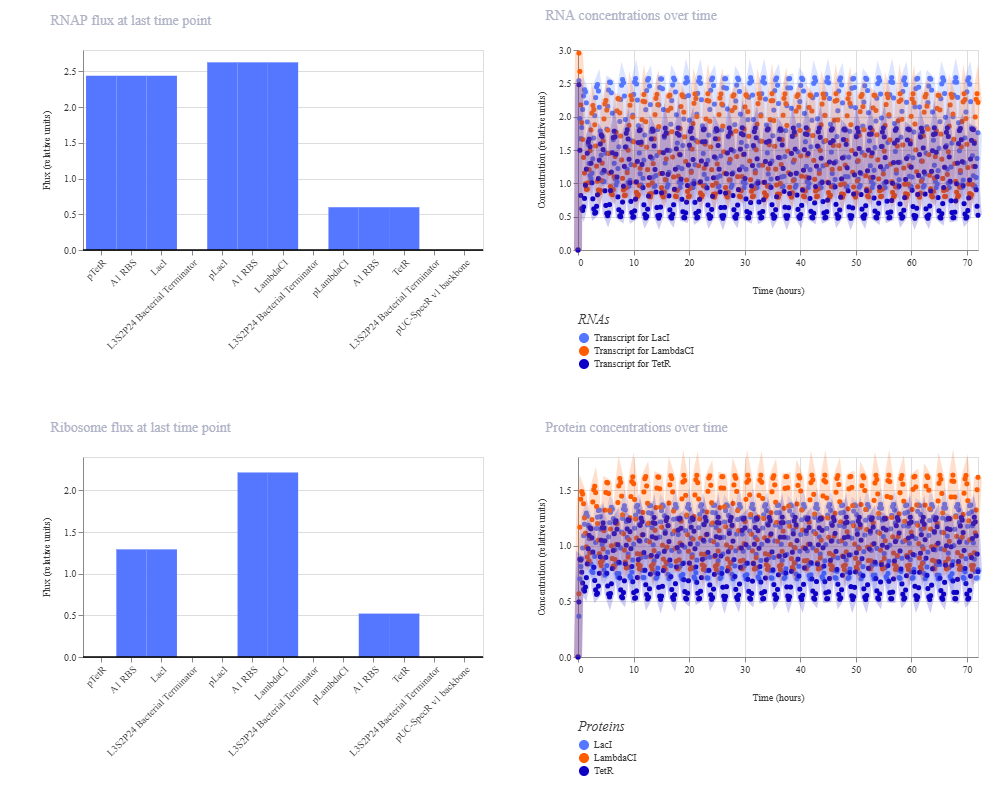
Simulation of the genetic circuit can be observed in figure 3. RNA and Protein concentrations varies over time having peak when it relative repressor expression is lower. For example LambdaCI concentrations increases when LacI increases and TetR concentrations are higher, but increasing the concentration of LambdaCI decreases the concentration of TetR over time and Increases LacI concentration that ends reducing LambdaCI, this result shows the ciclic nature of this genetic circuit making them useful to control de expression of these proteins over time
- Own Constructions
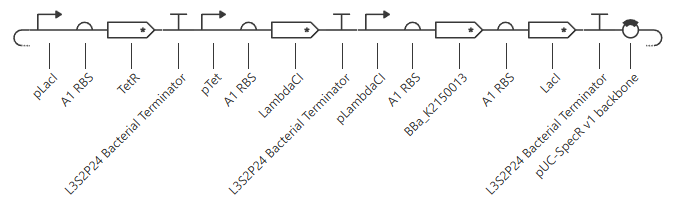
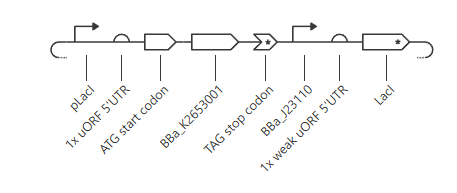
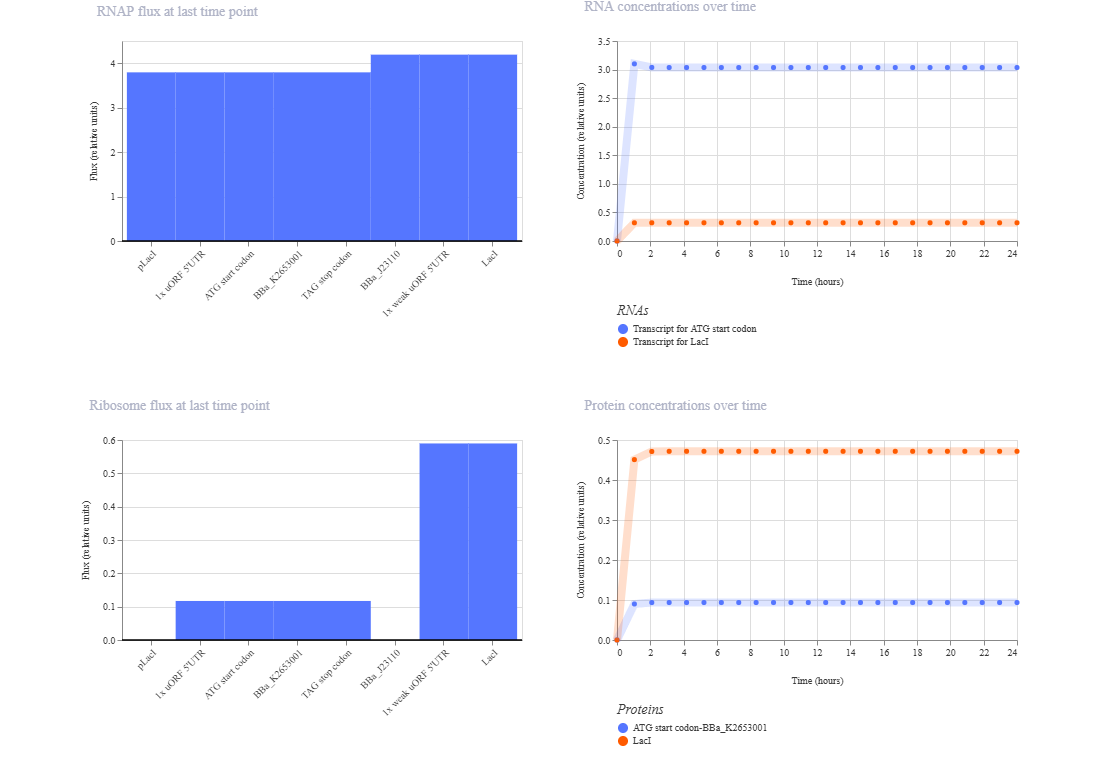
- LacI progressive repressor The objective of this construct was to creater a circuit that proggressively reduced the expression of a protein. For that purpose a LacI promoter was selected and build with and test BBa test protein, then a weaker promoter was added with the LacI sequence. The results obtained shows a weak repression of the test protein however I coudn’t see if the repression could increase progressively until the expression of the test protein decreases completely, this is because of the absence of RBS regions making it difficult to express the desire proteins (Figure 4, 5)
- Double Repressor A lac activator was built as genetic circuit, this circuit consists in three proteins TetR, LamdaCI y BBa_K2150013 as the targe protein. The expression of the target protein is suppressed by the pLamdaCI sequence in the presence of the LabmdaCI protein. The expression of LambdaCI is suppressed by TetR that is suppressed by a LacI protein. The logic of this circuit is that at the beginning when no LacI is addedd to the system the expression of the target protein is off caused by the presence of LambdaCI but the addition of LacI or TetR to the system can supress the expression of the target protein, with this construct I aim to suprress the expression of the target protein depending the presence of to supressors or only one and investigate if the can affect the yield of the expression.
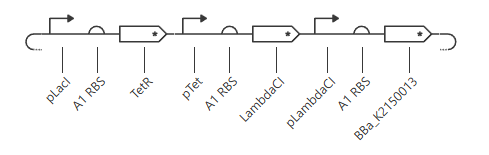
- Gradual expression of a targe protein The following genetic circuit consist in three parts, a TetR protein that is regulated by a pLacI repressor, a LambdaCI protein controlled by a TetR suppressor and a BBa_K125013 that acts as the target protein followed by another LacI protein. The logic of this circuit is to produce a circuit that starts with the expression of the target protein, TetR and LacI. The expression of LacI along with the target protein slowly reduces the expression of the TetR protein, increasing the expression of LamdaCI that switch off the expression of the target protein and LacI, the reduced espression of LacI activaes the expression of TetR regenerating the genetic circuit. This circuit aims to produce the target protein at fixed amount by controlling is expression using the LacI protein.