Week 7 HW: Genetic Circuits Part II
Genetic Circuits Part II: Neuromorphic Circuits
Part 1: Intracellular Artificial Neural Networks (IANNs)
- What advantages do IANNs have over traditional genetic circuits, whose input/output behaviors are Boolean functions? One characteristic of IANNs is that they can process continuous inputs rather than only discrete boolean data, this resembles with the natural process of a living system that is composed of a complex network of molecular interactions. Boolean login can simplify complex living activities making it difficult to process and engineer systems with this logic but IANNs uses complex analysis that can be used to reproduce complex process in living beings that uses millions of parameters. By training an IANN is possible to simulate complex genetic activities that resemble more to the living processes than only using boolean functions (Nilsson et al, 2022)
Because IANNs works with continous data they can work better where a system have more molecular noise and context effect thant Boolean switches making them useful in therapetic context where there is a high amount of molecular noise that must be processed to produce a suitable answer (Müller et al., 2025)
- Describe a useful application for an IANN; include a detailed description of input/output behavior, as well as any limitations an IANN might face to achieve your goal.
Proposal: Intracellular articial neural networks for close monitoring and pain modulation in rheumatoid arthritis
The goal of this proposal is to evaluate the implementation of a cell-based system that implements IANNs logic to detect inflammatory signals in tissues affected by rheumatoid arthritis, computed a graded pain/inflammation state, and regulate de release of neuromodulatory or anti-inflammatory effectos to reduce pain and tissue damage.
Input molecular: Molecules related with rheumatoid arthritis like IL-1, TNF-alpha, IL-6. Also some other conditions related with proinflammatory conditions like local pH and specific neurotransmissors
Sensors: Promoter or riboswith that can detect each input and transform it into signals that can be processed by the neural network. For example Choi et al (2021) used carlaginous implants that contain a series of genetic circuits that detect inflammatory factor of the K/BxN model of inflammatory arthritis in the figure below
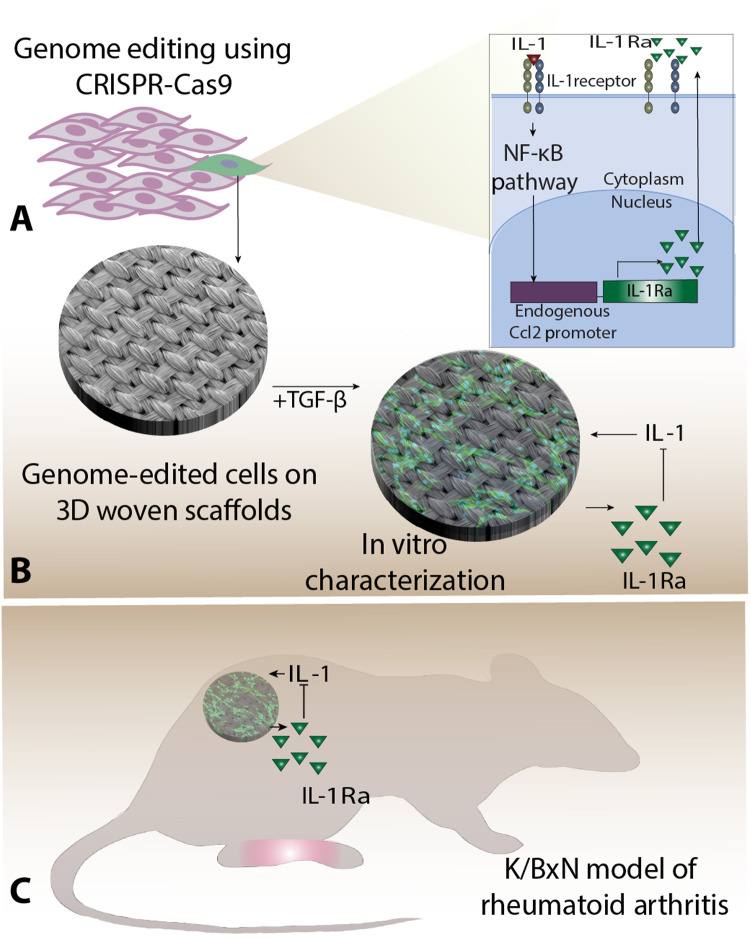
- Output: Controlled expression an secretion of anti-inflammatory factor or neuromodulatory peptides for local pain modulation. The evaluation of the model can be performed through fluorescent reporters that can be measured experimentally
Part 2: Fungal Materials
- What are some examples of existing fungal materials and what are they used for? What are their advantages and disadvantages over traditional counterparts? Fungal materials can have the following applications:
Mycelium-based composites (MBCs): This type of materials is composed of bio-composite waste bonded with dense mycelium to generate a material that can be used in constructions, insulating material or packaging. The importance of these type of materials is that can replace materials that used fossil fuels for their manufacturing offering a ecological alternative. However these materials require optimization studies that for the correct growth of the material (Camilleri et al., 2025). Additionally MBCs can have biomedical application as biocompatible drug delivery systems of scafolds.
Mycellium foams: Mycellium foams uses the properties of chitin and chitosan, polysaccharide found in fungus. This mycellium foams can resist strenghts of up to 25 MPa and up to 200 MPa and have high performance as natural insulators. Becuase of these characteristics Mycellium foams can be used replacing thermoplastics in insulation foams, furniture, decking, etc (Majib et al 2025).
Mycellium Leather: Mycellium can be used to produce a fungal-based leather-like material that can be used in the production of chlotes and other leather articles. However this alternative faces the lack of internationally recognized standards such as ISO making them difficult to implement commercially yet (Elsacker et al., 2023).
Fungal materials face some challenges like the limited documentation available which indicates the need of further studies for these alternatives. Fungal materials also have high water absorption making them unsuitble for huming environments and the have a slower production cycle since Fungi growth takes many days.
- What might you want to genetically engineer fungi to do and why? What are the advantages of doing synthetic biology in fungi as opposed to bacteria?
For Mycellium-based composites (MBCs) would require the genetic modification of the fungi species to increase improve their growth and reduce the time it take to proudce the materials, aditionally more resistant fungi would be require for materials because of the constant interaction of these materials with harsh environmental conditions.
One advantege of fungi over bacteria is their capacity of expressing proteins with post-translational modifications and proper folding making them more suitable for the production of animal-based molecules. Also their capacity to produce large amounts of enzyme makes them more useful for biomass degradation.
Part 3: Final Project Expression Cassette Design
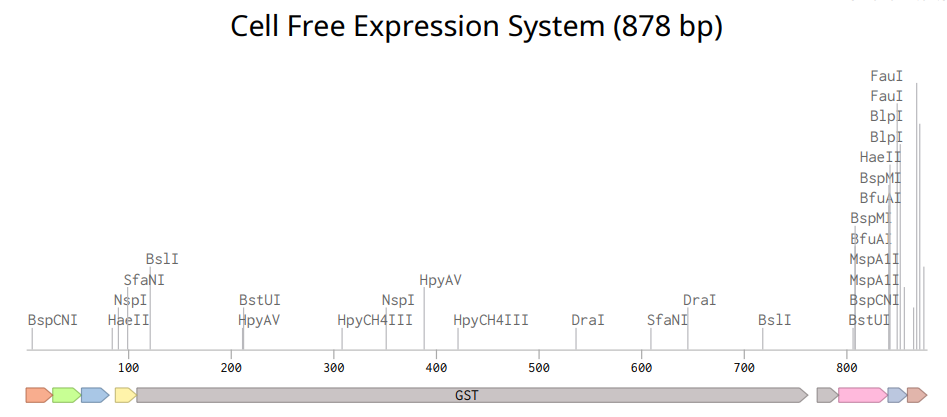
A DNA linear expression cassette was produced for the final project. This expression cassette was designed in Benchling using sequences from several scientific papers. The expression cassette contains some protective 5’ and 3’ sequences to prevent the degradation of the cassette in the cell-free system, a T7 promoter and terminator with, a Ribosome Binding Site, and a His-Gst taq for its purification and improve the folding of the protein binders. Figure 2 presents the DNA expression cassette made in Benchling.
References:
- Nilsson, A., Peters, J. M., Meimetis, N., Bryson, B., & Lauffenburger, D. A. (2022). Artificial neural networks enable genome-scale simulations of intracellular signaling. Nature Communications, 13(1), 3069.
- Müller, M. M., Arndt, K. M., & Hoffmann, S. A. (2025). Genetic circuits in synthetic biology: broadening the toolbox of regulatory devices. Frontiers in Synthetic Biology, 3, 1548572.
- Choi, Y. R., Collins, K. H., Springer, L. E., Pferdehirt, L., Ross, A. K., Wu, C. L., … & Guilak, F. (2021). A genome-engineered bioartificial implant for autoregulated anticytokine drug delivery. Science Advances, 7(36), eabj1414.
- Camilleri, E., Narayan, S., Lingam, D., & Blundell, R. (2025). Mycelium-based composites: An updated comprehensive overview. Biotechnology Advances, 79, 108517.
- Majib, N. M., Yaacob, N. D., Ting, S. S., Rohaizad, N. M., & Azizul Rashidi, A. M. (2025). Fungal mycelium-based biofoam composite: A review in growth, properties and application. Progress in Rubber, Plastics and Recycling Technology, 41(1), 91-123.
- Elsacker, E., Vandelook, S., & Peeters, E. (2023). Recent technological innovations in mycelium materials as leather substitutes: a patent review. Frontiers in Bioengineering and Biotechnology, 11, 1204861.