Week 1 HW: Principles and Practices
1. Biological Engineering Application
Engineered Lichen Symbioses as Urban Biochemical Interfaces for Pollutant Sequestration and Surface-Mediated Viral Inactivation
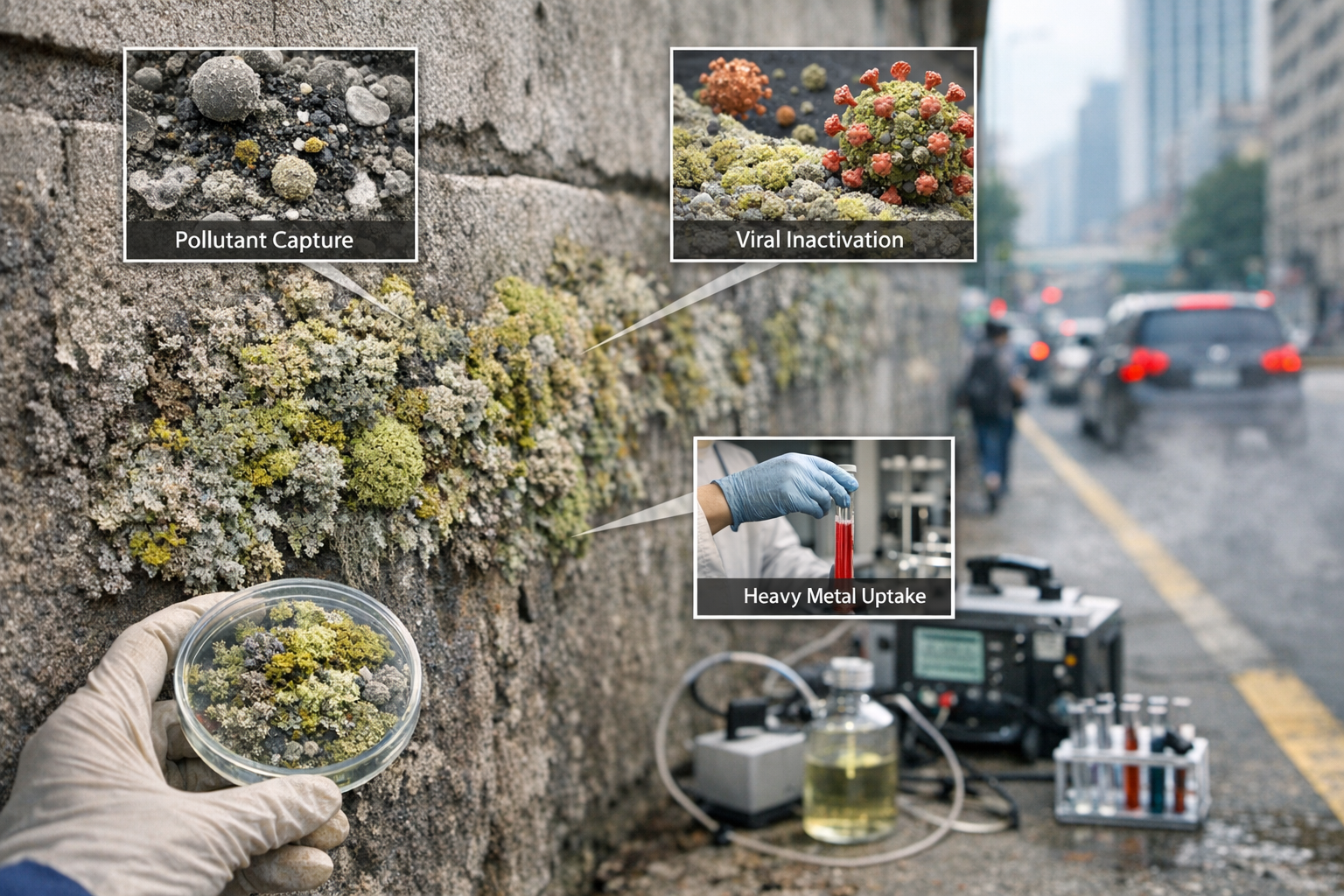
I propose to engineer lichen symbiotic systems as living biochemical interfaces capable of modifying urban atmospheric surface chemistry to both (1) sequester pollutants and (2) create microenvironments that reduce viral persistence on exposed surfaces.
Lichens are stable symbioses between a fungal partner and a photosynthetic partner, forming highly resilient surface-colonizing communities. They are well stablished as bioaccumulators of heavy metals and sinks for air pollutants such as SO2, NOx and polyaromatyc hydrocarbons. They produce secondary metabolites also useful because of their medical potential. They dominate on urban biochemical surface engineering.
The engineering strategy requieres making four separate modifications. Total consortium resistance to stresses city stresses to improve and enhance their growth and metabolite production Pollutant sequestration enhancement via overexpression of metallothioneins and enhanced extracelluar polysaccharide matrixes for particulate material capture Engineering of pathways to repurpose contaminants into active metabolites Viral surface inactivation mechanisms improvement, as lichens capture and inactivate capsides they have the engineering potential to reduce their numbers via trapping specific capside proteins of respiratory viruses.
2. Governance Goals
Goal 1 - Environmental and ecologica safety Prevent ecological displacement of naive lichens or microbial communities Prevent horizontal gene transfer to environmental microbes
Goal 2 - Biosecurity Prevent misuse of engineered stress-resilient organisms Prevent unintended environmental spread beyond deployement zones via killswitch
Goal 3 - Responsible innovation Ensure transparency and traceability of environmental releases Enables benefitial urban health applications Enables knowledge about microorganisms consortium engineering
3. Governance Actions
Option 1: Mandatory Genetic Biocontainment Standards
Purpose: Genetically modified environmental organisms are currently evaluated case-by-case. I propose that any engineered lichen intended for outdoor deployment be required to incorporate validated genetic confinement systems to reduce environmental persistence and horizontal gene transfer risk.
Design:
Synthetic auxotrophy dependent on non-natural metabolites
Multi-layer kill-switch circuits responsive to environmental chemical or photoperiod signals
Regulatory approval contingent on evolutionary stability testing and escape-rate modeling
Assumptions:
Safeguard circuits remain genetically stable over ecological timescales
Escape mutation rates are sufficiently low to reduce risk meaningfully
Risks of Failure & Success: Evolutionary bypass of containment systems Overreliance on molecular safeguards reducing ecological monitoring Increased R&D costs limiting participation from smaller research groups
Option 2: Environmental Deployment Licensing and Ecological Monitoring
Purpose: There is no standardized framework for tracking environmental synthetic symbioses post-deployment. This option establishes traceability and ecological oversight.
Design:
Site-specific deployment permits
Monitoring via environmental DNA (eDNA) and genetic barcoding
Periodic ecological impact assessments of microbial and lichen communities
Assumptions:
eDNA methods are sensitive and specific enough for detection
Authorities have capacity to enforce monitoring
Risks of Failure & Success: Monitoring gaps in low-resource regions False confidence if surveillance is incomplete
Option 3 - Responsible Innovation Incentive & Transparency FrameworkResearch incentive & Transparency Framework
Purpose: Shift governance from purely restrictive to incentivizing responsible research design and transparency.
Design:
Funding preference for projects including ecological modeling and risk assessment
Open publication of environmental interaction datasets (metagenomics, transcriptomics)
Interdisciplinary ethics and ecology review panels
Assumptions:
Researchers respond to funding and recognition incentives
Transparency improves accountability
Risks of Failure & Success: Sensitive environmental genomic data misused Compliance becomes performative rather than substantive Administrative overhead discourages participation
4. Scoring Matrix
| Criteria | Option 1 | Option 2 | Option 3 |
|---|---|---|---|
| Prevent incidents (biosecurity) | 1 | 2 | 3 |
| Aid response | 1 | 2 | 2 |
| Prevent ecological harm | 1 | 2 | 3 |
| Aid ecological response | 2 | 1 | 2 |
| Low burden | 3 | 1 | 2 |
| Feasible | 2 | 2 | 1 |
| Doesn’t impede research | 3 | 2 | 1 |
| Promotes constructive uses | 2 | 2 | 1 |
5. Recommendation
Option 1 and Option 3 Ensure Responsible Innovation Incentives durying environmental deployement phases. Genetic confinement via kill switches reduce probability that engineered lichens persist or evolve uncontrollably in ecosystems. Their containment must be biologically intrinsic. Incentive based policies encourage ecological information recovery, open data, knowledge and embed responsibility.
| Trade-off | Resolution |
|---|---|
| Innovation vs precaution | Favor built-in safeguards + incentives instead of prohibitions |
| Monitoring vs research agility | Emphasize monitoring during deployment, not early R&D |
| Technical containment vs ecological uncertainty | Combine molecular safeguards with ecological oversight |
6. Ethical Reflection
Target Audience National environmental biotechnology regulators. NIH Environmental protection agency
This week we refraimed synthetic biology as an activity embedded within ecological, social, and security systems. Concerns on this project emerged particularly relevant to my proposed project.
Engineered lichens would be deployed in open urban ecosystems. Lichens are long-lived , slow-growth, stress-tolerant organisms capable of dispersal via spores and fragmentation. Once released its recall is impossible. Introducing a temporal ethical asymmetry having a long term ecological alteration. Altough the project benefits surpass usual methods for decontamination , ecological systems operating on evolutionary and geolocial timescales could prove a greater risk. Governance must account for an intergenerational risk.
The governance response should ensure long-term eclogical modeling before deployement and politically resistant regulation ensuring the effect and improve of the initial planning in this type of projects. The release strategy must be modular, from a contained lab, to a mesocosm to restricted field zones and isolated areas to prove the security profiles of the modified consortia.
Lichens function as micro-ecosystems involving fungi, algae, bacteria and associated microbiota. The truth is, we yet do not know at a molecular level how do they work at all. Engineering one component may alter nutrient fluxes , nitrogen, carbon , metal cycling or microbial community copmosition. Perturbation could cascade through trophic and biogeochemical networks. Systems-level-ecology interactions must be ensured safe to deploy the organisms.
Homework Questions from Professor Jacobson:
- Nature’s machinery for copying DNA is called polymerase. What is the error rate of polymerase? How does this compare to the length of the human genome. How does biology deal with that discrepancy?
The error rate for Polymerase gamma and epsylon is about 10-6 errors per base. The exonuclease proofreading reduce error rate in cells. Many polimerases have proofreading domains, removing incorrect nucleotides right after mis incorporation. Lowering the error rate to 10-8 per base. Other mechanisms as mismatch repair detect and excise mismatches reducing the overall error rate to 10^-10 per base per cell division. The human genome size is 3*10⁹ base pairs , raw polymerase fidelity alone would generate tens of thousands of mutations per replication, but proofreading and repair reduce this to only a few mutations per genome copy. Genome stability is maintained by a multilayered fidelity system including proofreading, mismatch repair, base excision repair, nucleotide excision repair, and double-strand break repair.
- How many different ways are there to code (DNA nucleotide code) for an average human protein? In practice what are some of the reasons that all of these different codes don’t work to code for the protein of interest?
An average human protein can be encoded by an enormous number of DNA sequences due to codon degeneracy. Since most amino acids have multiple synonymous codons (average degeneracy ≈3.1), the number of possible coding sequences is about 3.1468 ≈ 10192. Most sequences are not biologically functional. Constraints include codon bias linked to tRNA abundance, mRNA secondary structure affecting translation initiation and elongation, splicing regulatory elements embedded in coding regions, GC content and CpG effects on genome stability, regulatory RNA-binding motifs, and the influence of translation speed on co-translational protein folding. Only a small fraction of theoretically possible sequences are compatible with efficient expression, correct folding, and proper regulation in a given organism.
Homework Questions from Dr. LeProust:
- What’s the most commonly used method for oligo synthesis currently? Why is it yes yes yesdifficult to make oligos longer than 200nt via direct synthesis? Why can’t you make a 2000bp gene via direct oligo synthesis?
Solid phase synthesis is the most common synthesis method. DNA chains are made fragment by fragment on support via cycles having a higher coupling efficiency than traditiional methods. Longer oligos are difficult to synthesize because of physicochemical limitations, reducing the coupling efficency having a lower couping efficiency each instance.
Direct oligosynthesis can not be made directly, truncation products dominate and base damage is also introduced. Also sequence errors become unmanageable and each small repair proves to be unviable at longer sequences.
Homework Question from George Church:
- Choose ONE of the following three questions to answer; and please cite AI prompts or paper citations used, if any. What are the 10 essential amino acids in all animals and how does this affect your view of the “Lysine Contingency”?
The essential aminoacids with no possible synthesis in animals are Histidine , Isoleucine, Leucine, Lysine , Methionine , Phenylalanine, Threonine, Tryptophan , Valine. The lysine contingency concept suggest that designing organisms dependent on external lysine supply as a biocontainment strategy. Such as the mechanism used in Ames Test, IN this spsecific project environmental microbes can synthetize lysine via diaminopimelate pathways among other ecological availability
- What code would you suggest for AA:AA interactions?
This are encoded via base pairing. It must represent how aminoacid side chain recognize each other having specific physicochemical interactions. Proteins operate at a more complex dimensions. The code at a functional scale should represent the previously modeled proteins in history and be analogous on how base pairing encodes bonding and geometry.. RFDiffusion is an example of using greater databases to predict how would an interaction go, supported by other software we can start examining interactions on different levels and perspectives such as frustration region functions , whose activity remain enigmatic.
- Given the one paragraph abstracts for these real 2026 grant programs sketch a response to one of them or devise one of your own:
BioStabilization Systems are an interesting idea for a common logistic process, i believe is an interesting idea for low-equiped zones around the world to increase the shelf life of medicines. I believe it could be expanded too for highly vulnerable materials or sensitive devices. If demonstrated rehydration viability it could improve the viability of biological drugs difficult to process eliminating costs on transport and strenghtening biosafety readiness.