Week 7: Neomorphic Circuits
Intracellular Artificial Neural Networks
What advantages do IANNs have over traditional genetic circuits, whose input/output behaviors are Boolean functions?
IANNs allow for less prescriptive circuit method, whereas traditional genetic circuits need to be specified at each step, making it a target specific circuit by finding signalling patterns across a vast dataset. Traditional genetic circuits are limited to simpler action/reaction function simulations to create an mRNA therapy.
Describe a useful application for an IANN; include a detailed description of input/output behavior, as well as any limitations an IANN might face to achieve your goal.
IANNs can be very useful for biomaterials that depend on growth based on the specific conditions of each material batch. For example, if you wanted to make a stained glass using biopigments that stains relative to the colors around it, it could be useful to create a series of relative inputs (ex: high presence of red, medium presence of blue, and no presence of black) that could generate a very specific output (purple gene expression) without manually or preemtively determining color expression. The limitation of the IANN approach is that it has a ‘blackbox’ in reasoning, and doesn’t always present a clear reasoning, unlike traditional genetic circuits. When the reasoning is hidden, it could be making decisions from the wrong signals or not following a genetically safe order of operations, potentially leading to unforseen outcomes.
Below is a diagram depicting an intracellular single-layer perceptron where the X1 input is DNA encoding for the Csy4 endoribonuclease and the X2 input is DNA encoding for a fluorescent protein output whose mRNA is regulated by Csy4. Tx: transcription; Tl: translation. Draw a diagram for an intracellular multilayer perceptron where layer 1 outputs an endoribonuclease that regulates a fluorescent protein output in layer 2.
Fungal Materials
What are some examples of existing fungal materials and what are they used for? What are their advantages and disadvantages over traditional counterparts?
There are headphones designed by Aivan that use mycelium in an experimental synbio headphone design for the leather ear cushion covers. This product is a beautiful example of the multitude of characteristics that bio-based materials like mycelium, silk proteins, and PLA could embody instead of using plastics to make these parts of the headphones. The issue with this product at this time goes partly into user trust and long-term durability of each component. User’s may not feel comfortable having fungus pressed against their ears, and the materials are more susceptible to degredation when exposed to water, heat, sun, etc than a traditional plastic object would be. Headphones are also often tossed into a backpack, worn over earrings, or worn during exercise, leading to a whole range of user habits that could degrade each layer over time. Traditional plastics are also more easy to control and form at this time, when even simple glues may not act as expected with fungal materials over time.
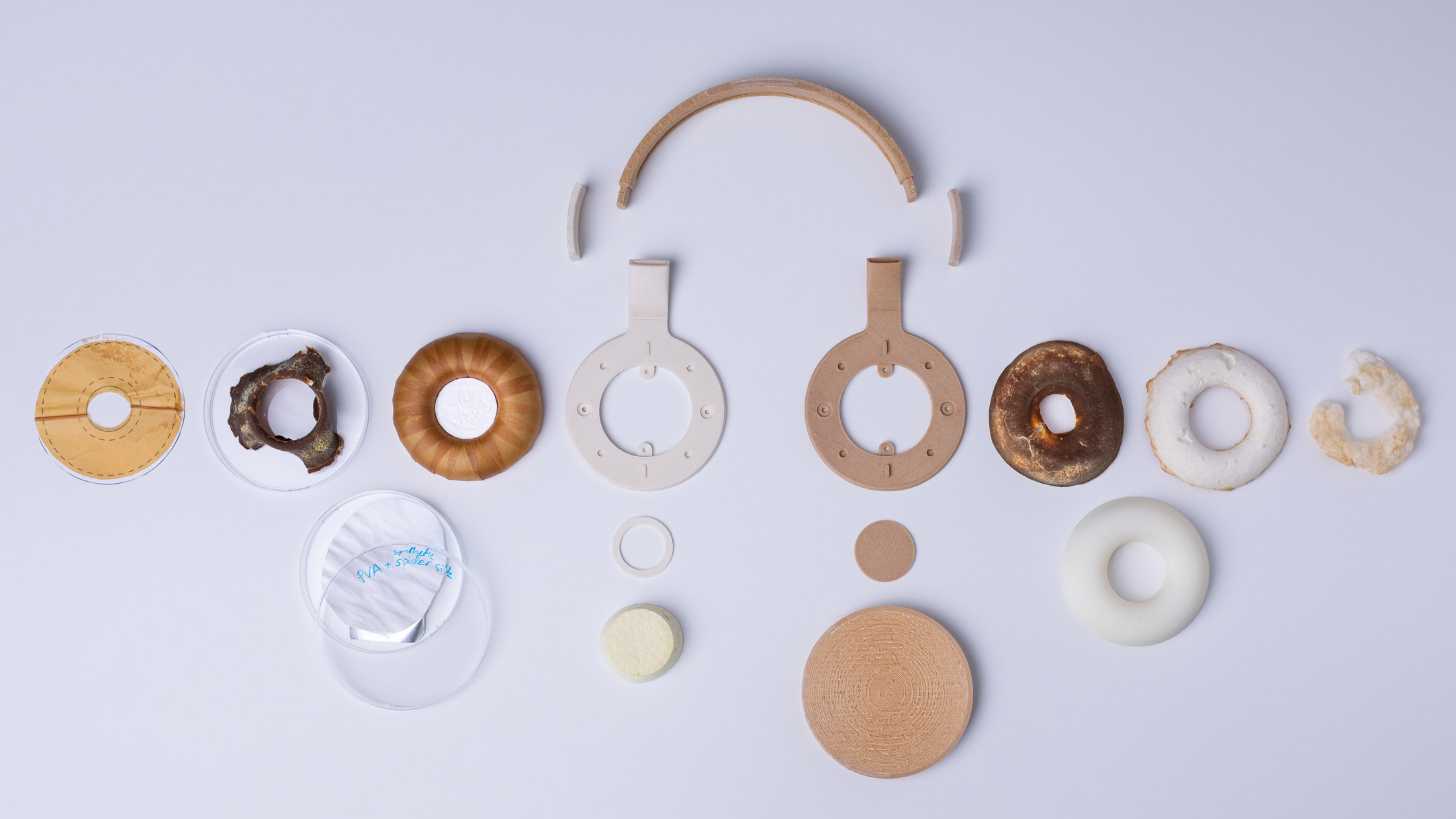
(source: https://www.dezeen.com/2019/05/24/korvaa-headphones-bioplastic-fungus-yeast-materials-aivan/)
What might you want to genetically engineer fungi to do and why? What are the advantages of doing synthetic biology in fungi as opposed to bacteria?
Fungi feed on simple sugars very well, but this also means that it is easy for mycelium products (before they are fired) to get contaminated during the growth cycle of the fungal products. It would be very useful to have a mycelium product that grows using a specalized sugar source over simple glucose to mitigate the issues of contamination. However this may also create a dependency on a narrow stream of sugar sources that could be used reliably for mycelium fabrication, and potentially limit the accessibility of lo-fi mycelium explorations. Instead it would be cool to have a strain of mycelium with an anti-mold protein, preventing mold from growing in mycelium products whereever mycelium spores are present. Each option would need to be tested for any side effects such changes could have on the mycelium in use. One key advantage of fungi synthetic biology is the speed of growth and visibility of the fungal spores. They are easy to notice by the human eye (larger scale), and still have a high replication rate.