Week 11: Bioproduction and Cloud Labs
Part A: Pixel Art Canvas
For the HTGAA pixel artwork, I really enjoyed that the experiment was a playful approach to both a large-scale group project and to cloud-based bio projects. I added a blue dot and a yellow dot to a flower-like design that was absorbed into other designs as the artwork developed, but it was cool to try to predict the interests of the other users and contribute to what I thought the pattern would need to have to be completed.
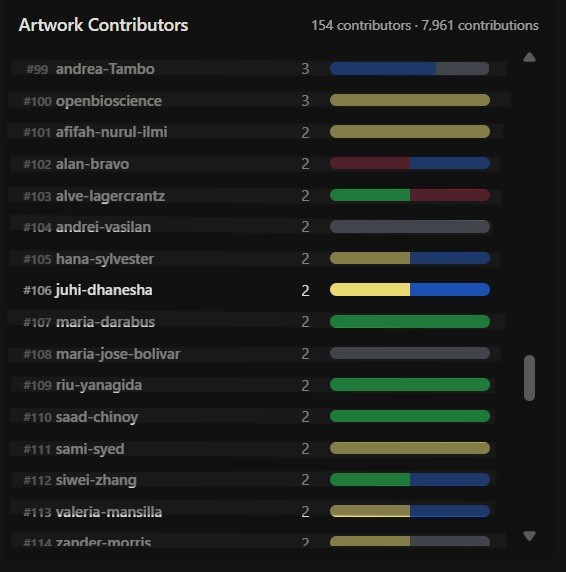
For the future, it could be interesting to have artwork that has space designated per node perhaps to just see the character of each node as well and how they choose to use those limited pixels to connect to the larger HTGAA community.
Part B: Cell-Free Protein Synthesis
Role of each component
• e.coli lysate: this is still necessary to read DNA for protein synthesis
• salts/buffer: maintain the right environment (pH, certain minerals, etc)
• energy/nucleotide system: provide the energy for the synthesis to be conducted
• translation mix: provides base amino acids necessary for synthesis
• additives: supports the systems environment
• backfill: adjust the volume of the reaction to match the experiment needs
The 1 hour and 20 hour incubation master mixes for cell-free systems have some similarities in salts (with some variations) and translation mixes, however the energy system and additives are completely different. Since the 1 hour incubation mix is a PEP-base system, it is composed for immediate energy, while the ribose-based 20 hour incubation mix uses indirect energy sources like NMPs and ribose for more sustained energy sources to match the extended incubation period.
Part C: Global Experiment
- sfGFP - an optimized green florescent protein that matures rapidly.
- mRFP1 - red florescent with slow maturation and low acid sensitivity
- mKO2 - orange florescent with moderate acid sensitivity
- mTurquoise2 - cyan florescence that matures rapidly and has very low acid sensitivity
- mScarlet_I - red florescent protein with moderate acid sensitivity
- Electra2 - basic blue florescence
For my slot (B20), I played with the composition for Electra2, introducing GMP and reducing the nuclease-free water. GMP supports high speed protein production so it could help the synthesis occur faster, and floresce faster.