Week 11 HW: Bioproduction & Cloud Labs
Part A: The 1,536 Pixel Artwork Canvas | Collective Artwork
1. Contribute at least one pixel to this global artwork experiment before the editing ends on Sunday 4/19 at 11:59 PM EST.
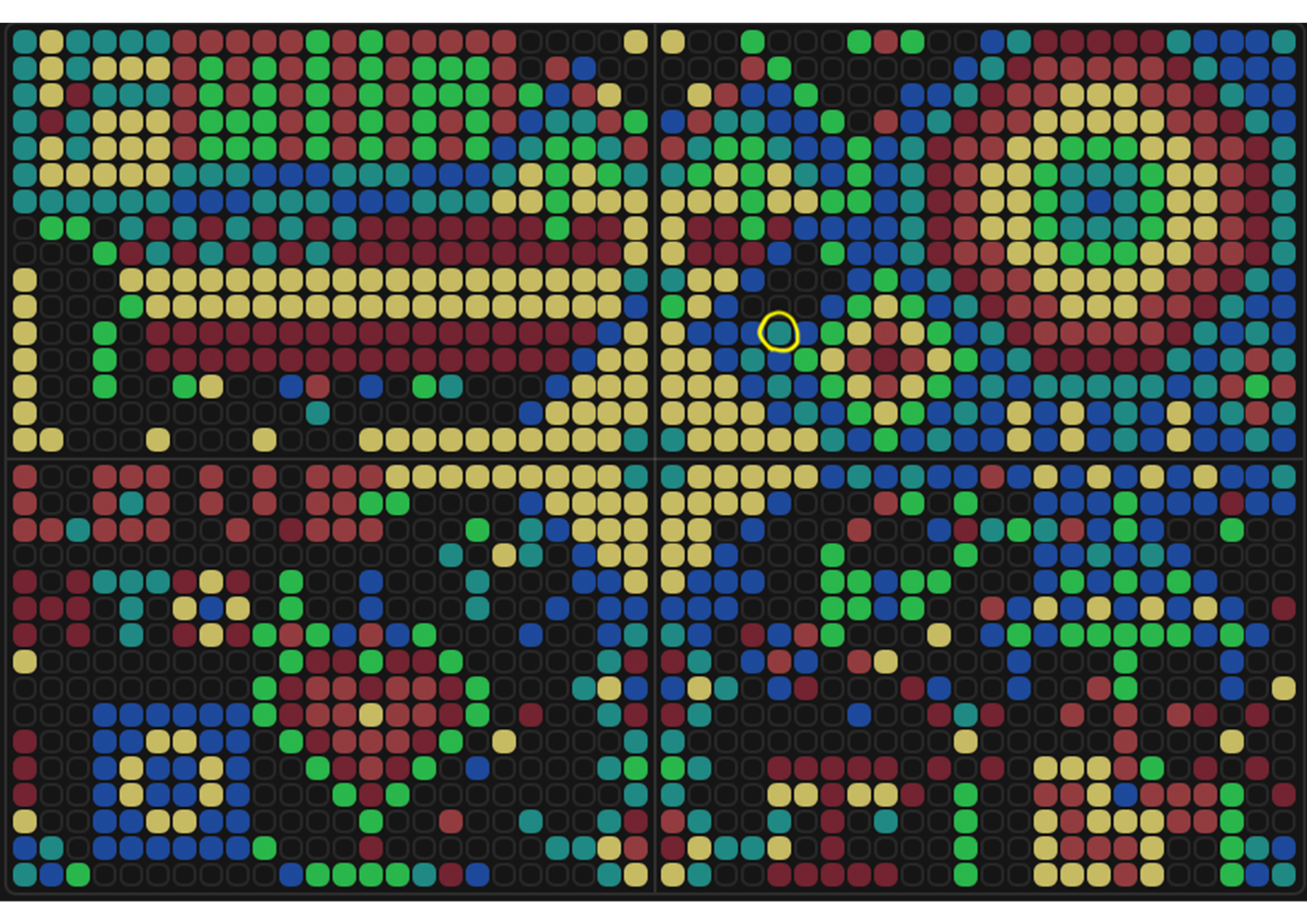
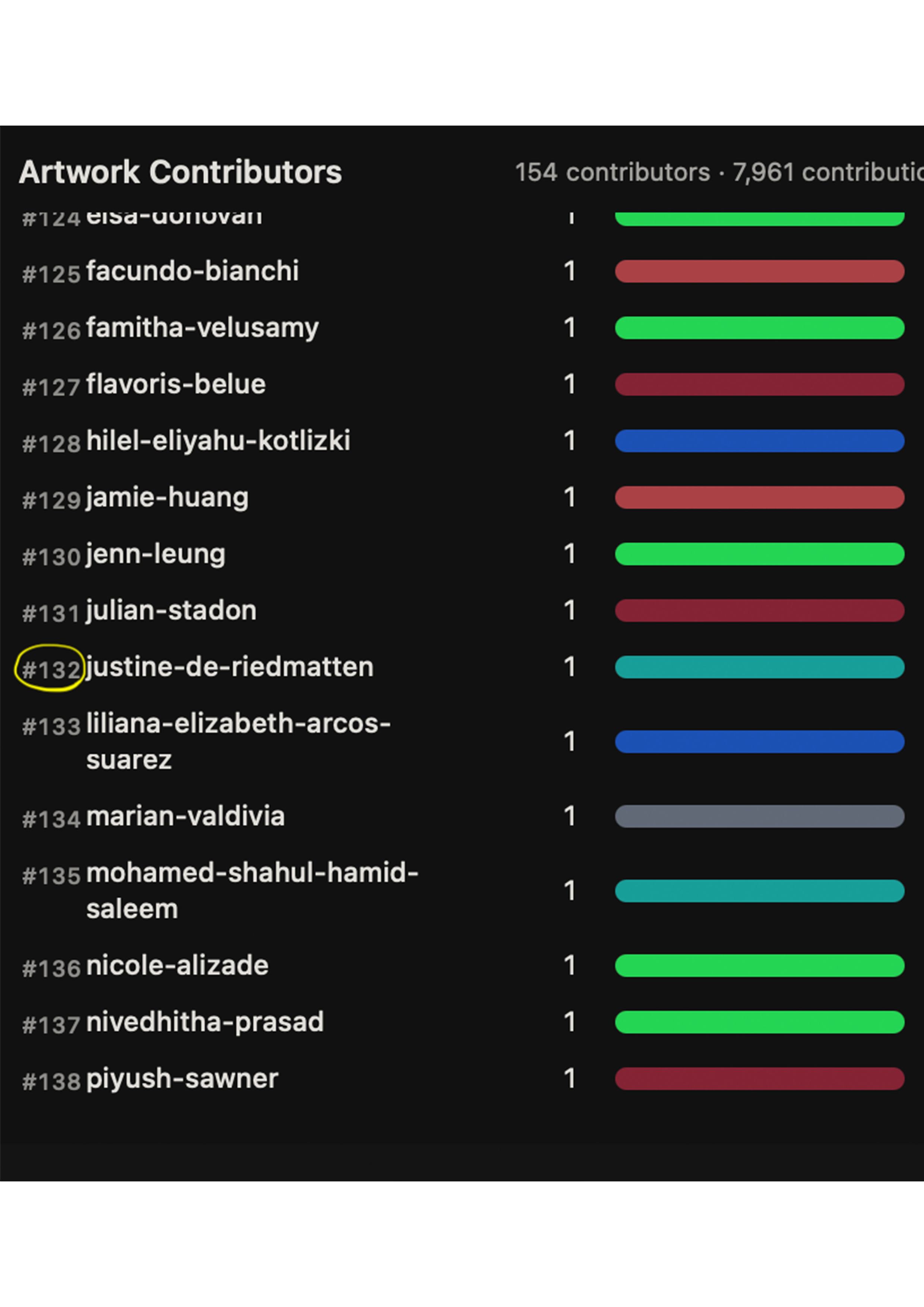
Well: Q2L5Placement number: 1297The pixel I contributed I circled in yellow:
2. Make a note on your HTGAA webpages, including:What you liked about the projectWhat about this collaborative art experiment could be made better for next year?
What I liked about this project was visualising the change through time, although my final contribution didn’t make it to the final drawing, it was lovely to see it actively changing form, shape and colour. My suggestion would be to have more colours for next year.
Part B: Cell-Free Protein Synthesis | Cell-Free Reagents
Referencing the cell-free protein synthesis reaction composition (the middle box outlined in yellow on the image above, also listed below), provide a 1-2 sentence description of what each component’s role is in the cell-free reaction.
E. coli Lysate
BL21 (DE3) Star Lysate (includes T7 RNA Polymerase): The core element for transcription and translation for the reaction to synthesise protein outside of the cell.Salts & Buffers
Potassium Glutamate: Maintains ionic strength and osmotic balance to enhance enzyme activity and translation.HEPES-KOH pH 7.5: Acts as the buffering system for the reaction at a physiological pH where ribosomes and enzymes are most stable and active.Magnesium Glutamate: A magnesium supplier that is essential for many enzymes involved in transcription and translation.Potassium phosphate monobasic: Aids the phosphate buffer system, which aids in controlling pH and supplying phosphate to nucleotides.Potassium phosphate dibasic: Works with phosphate monobasic (they work as a buffer pair).Energy/Nucleotide System
Ribose: A sugar precursor that supports nucleotide pools and the energy metabolism of the lysate.Glucose: The main carbon and energy source. Endogenous enzymes of the lysate use it to regenerate ATP and sustain protein synthesis.AMP: Provides adenine nucleotides that are phosphorylated up to ATP as well as building RNA.CMP: Provides cytidine nucleotides that are converted to higher-phosphates and incorporated into RNA during transcription.GMP: Provides guanosine nucleotides that can be used to form GTP during translation.UMP: Provides uridine nucleotides, which can be phosphorylated to UTP and used in RNA synthesis.Guanine: Acts as a nucleobase precursor to maintin guanine containing nucleotide pools.Translation Mix (Amino Acids)
17 Amino Acid Mix): Supplies most of the amino acids required as building blocks for polypeptide synthesis (translation stage).Tyrosine: Essential amino acid, but usually added individually to control its stability.Cysteine: Essential amino acid, but usually added individually due to its high reactivity.Additives
Nicotinamide: A precursor for NADH to support metabolic reactions and regenerate energy.Backfill
Nuclease-Free Water: To achieve the desired final volume for the reaction, whilst avoiding the use of nucleases that may degrade the DNA or RNA.References:
Gregorio, N.E., Levine, M.Z. and Oza, J.P. (2019). A User’s Guide to Cell-Free Protein Synthesis. Methods and Protocols, 2(1). doi:https://doi.org/10.3390/mps2010024.Miguez, A.M., McNerney, M.P. and Styczynski, M.P. (2019). Metabolic Profiling of Escherichia coli-Based Cell-Free Expression Systems for Process Optimization. Industrial & Engineering Chemistry Research, 58(50), pp.22472–22482. doi:https://doi.org/10.1021/acs.iecr.9b03565.Tuckey, C., Asahara, H., Zhou, Y. and Chong, S. (2014). Protein Synthesis Using a Reconstituted Cell‐Free System. Current Protocols in Molecular Biology, 108(1). doi:https://doi.org/10.1002/0471142727.mb1631s108.2. Describe the main differences between the 1-hour optimized PEP-NTP master mix and the 20-hour NMP-Ribose-Glucose master mix shown in the Google Slide above. (2-3 sentences)
The 1-hour PEP-NTP master mix already contains the NTPs (ATP, GTP, CTP, and UTP) along with PEP, which acts as a quick energy source. This lets the system start making proteins fast, but the reaction doesn’t last very long. On the other hand, the 20-hour NMP-Ribose-Glucose mix starts with simpler building blocks like ribose, glucose, and nucleoside monophosphates (AMP, CMP, UMP, etc.). The lysate gradually converts these into NTPs over time, so protein production starts more slowly but can continue for many hours.
Part C: Planning the Global Experiment | Cell-Free Master Mix Design
1. Given the 6 fluorescent proteins we used for our collaborative painting, identify and explain at least one biophysical or functional property of each protein that affects expression or readout in cell-free systems. (Hint: options include maturation time, acid sensitivity, folding, oxygen dependence, etc) (1-2 sentences each)
sfGFP: Superfolder GFP is an engineered green fluorescent protein for robust folding even under stressful conditions. It is also reported to be a very rapidly maturing weak dimer.mRFP1: A basic red fluorescent protein known as a slow-maturing monomer with low acid sensitivity.mKO2: A basic orange fluorescent protein that has a moderate acid sensitivity and has a long maturation time.mTurquoise2: A basic turquoise fluorescent protein which is rapidly matures and has a very low acid sensitivity.mScarlet_I: A basic red fluorescent protein that has a moderate acid sensitivity and a slow maturation.Electra2: A basic blue fluorescent protein, published in 2022, it overcomes generally lower sensitivity in the blue channel, therefore making it easier to detect in cell-free systems in comparison to previous blue fluorescent proteins.References
Lambert, T. (n.d.). FPbase: The Fluorescent Protein Database. [online] FPbase. Available at: https://www.fpbase.org.2. Create a hypothesis for how adjusting one or more reagents in the cell-free mastermix could improve a specific biophysical or functional property you identified above, in order to maximize fluorescence over a 36-hour incubation. Clearly state the protein, the reagent(s), and the expected effect.
For mScarlet_I, which matures pretty slowly and is somewhat sensitive to acidic conditions, I hypothesise that increasing the amount of HEPES-KOH buffer (pH 7.5) and adding a potassium phosphate buffer (monobasic and dibasic) to the mastermix could help keep the pH more stable. This could reduce acid-related loss of the red fluorescence signal and help maintain brightness over time. I also hypothesise that slightly increasing the ribose and glucose levels could improve ATP/NTP regeneration. This may give more of the newly made mScarlet_I enough time and energy to fully mature its chromophore, potentially leading to stronger fluorescence at later time points
References
Calhoun, K.A. and Swartz, J.R. (2005). Energizing cell-free protein synthesis with glucose metabolism. Biotechnology and Bioengineering, 90(5), pp.606–613. doi:https://doi.org/10.1002/bit.20449.Lambert, T. (n.d.). mScarlet at FPbase. [online] FPbase. Available at: https://www.fpbase.org/protein/mscarlet/.Lazzari-Dean, J.R., Maria Clara Ingaramo, John C.K. Wang, Yong, J. and Ingaramo, M. (2022). mScarlet fluorescence lifetime reports lysosomal pH quantitatively. [online] Github.io. Available at: https://andrewgyork.github.io/mScarlet_lifetime_reports_pH/.3. The second phase of this lab will be to define the precise reagent concentrations for your cell-free experiment. You will be assigned artwork wells with specific fluorescent proteins and receive an email with instructions this week (by April 24). You can begin composing master mix compositions here.
I chose the mScarlet_I protein and decided to base my experiment on my hypothesis from question 2 (above). Below are the alterations I made for my master-mix experimentation:
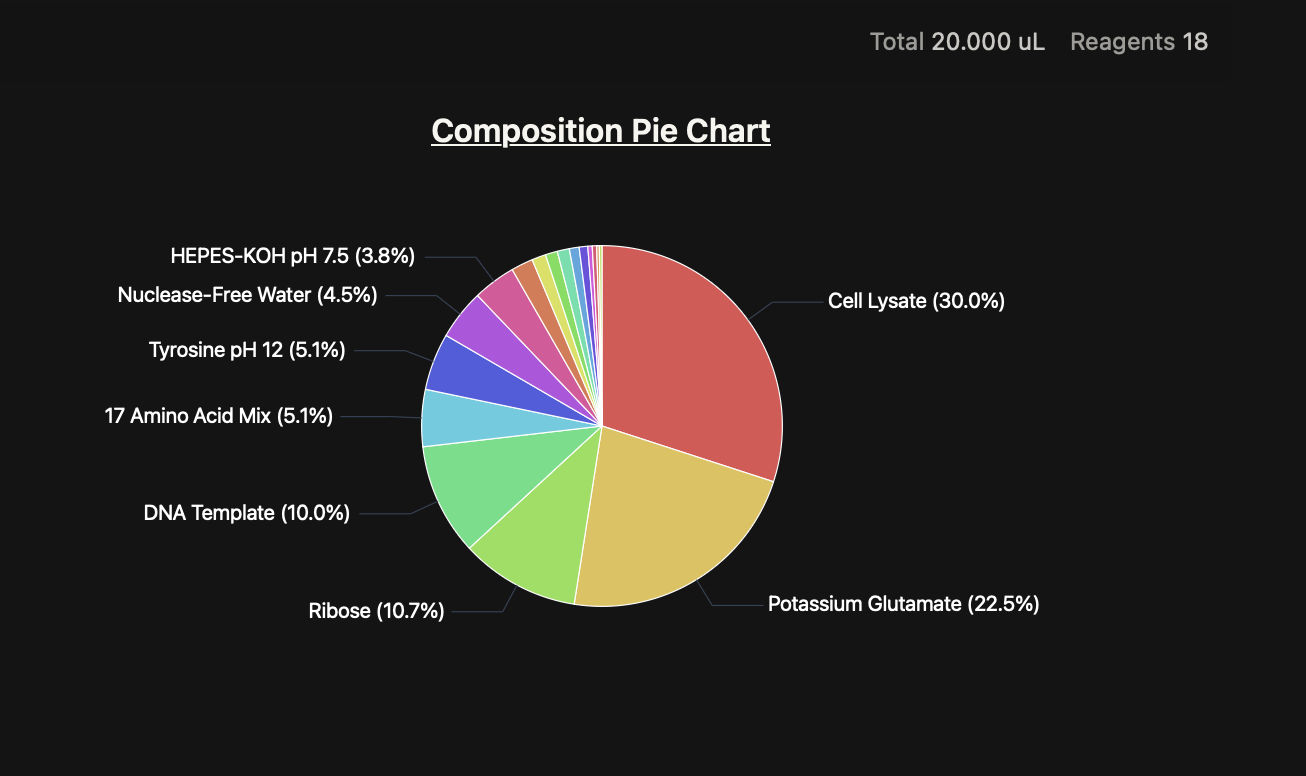
HEPES-KOH pH 7.5: increased from 45mM to 55mM (+ 10.000 mM).Potassium phosphate mono/dibasic: increased from 5.625mM to 7.500mM each (+ 1.875 mM).Ribose: increased from 11.625g/L to 15 g/L (+3.375).Glucose: increased from 1.25g/L to 2g/L (+0.750).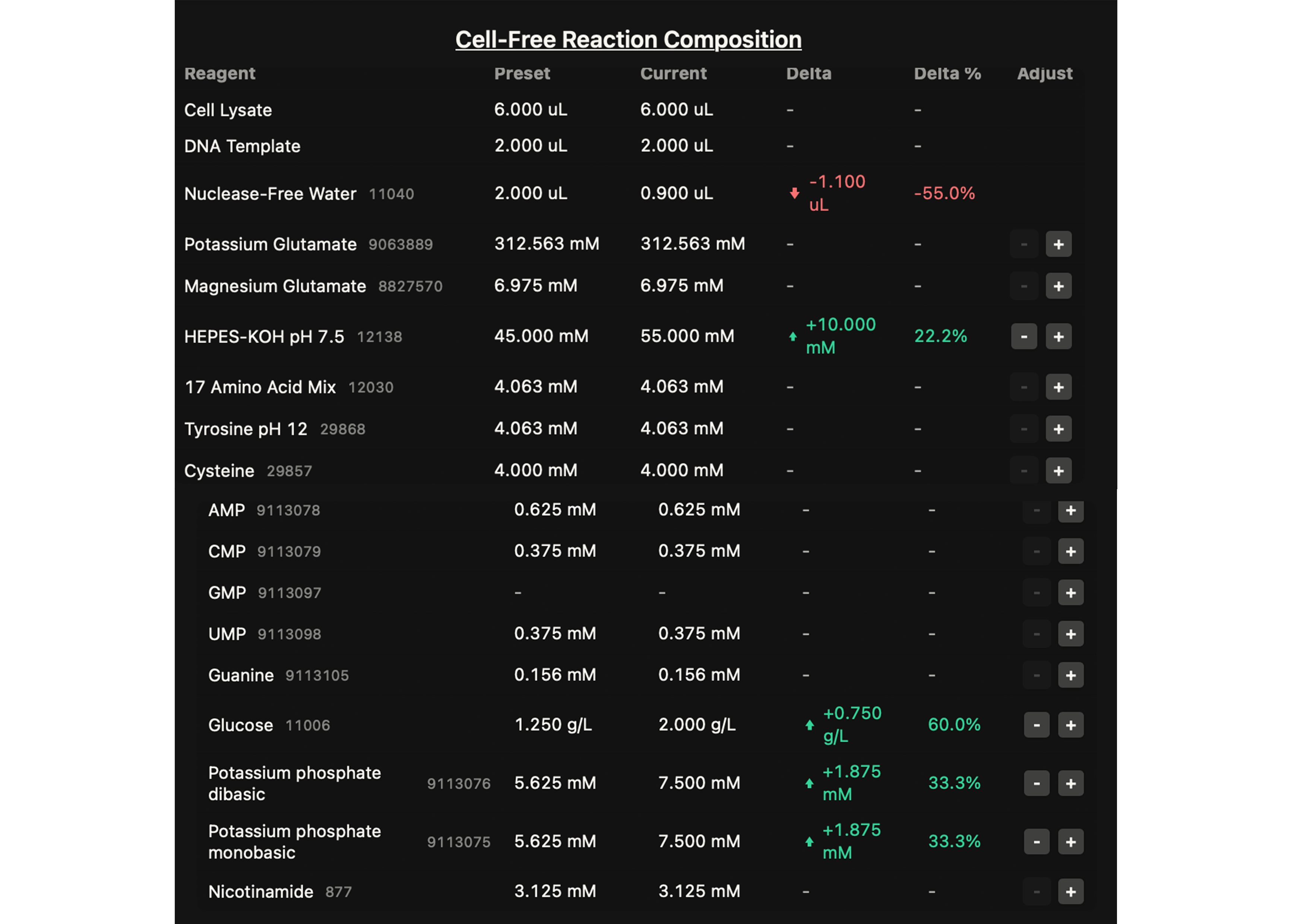
References
Angelo Cardoso Batista. Enabling and optimizing cell-free systems for synthetic biology applications. Molecular biology. Université Paris-Saclay, 2022. English. ⟨NNT : 2022UPASL030⟩. ⟨tel-04147740⟩Moon, B.-J., Lee, K.-H. and Kim, D.-M. (2018). Effects of ATP regeneration systems on the yields and solubilities of cell-free synthesized proteins. Journal of Industrial and Engineering Chemistry, 70, pp.276–280. doi:https://doi.org/10.1016/j.jiec.2018.10.027.www.aatbio.com. (n.d.).Potassium Phosphate (pH 5.8 to 8.0) Preparation and Recipe | AAT Bioquest. [online] Available at: https://www.aatbio.com/resources/buffer-preparations-and-recipes/potassium-phosphate-ph-5-8-to-8-0 [Accessed 22 May 2026].4. The final phase of this lab will be analyzing the fluorescence data we collect to determine whether we can draw any conclusions about favorable reagent compositions for our fluorescent proteins. This will be due a week after the data is returned (date TBD!). The reaction composition for each well will be as follows:6 μL of Lysate10 μL of 2X Optimized Master Mix from above2 μL of the assigned fluorescent protein DNA template2 μL of your custom reagent supplementsTotal: 20 μL reaction
This question isn’t applicable, but if I were to receive the fluorescence data, I would compare both the fluorescence time courses and endpoint intensities of mScarlet_I across wells with different buffer and energy compositions. I hypothesise that my modified mix will produce higher fluorescence at later time points compared with the course default formulation.