Week 07 HW: Genetic Circuits Part II: Neuromorphic Circuits
Part 1: Intracellular Artificial Neural Networks (IANNs)
- What advantages do IANNs have over traditional genetic circuits, whose input/output behaviors are Boolean functions?
Traditional genetic circuits operate like a light switch (0 or 1). IANNs, however, behave like a signal processor, offering several critical advantages:
Analog vs. Digital Processing. Boolean circuits only detect if a signal is “present” or “absent.” IANNs process signals analytically, so they can distinguish between low, medium, and high concentrations. This allows the cell to respond to gradients, which is much closer to how natural biological systems actually function.
Multivariable Pattern Classification. A Boolean circuit (using AND/OR gates) becomes incredibly complex and “brittle” as you add more inputs. By using a neural network architecture, IANNs can integrate multiple signals simultaneously (e.g., 5 different microRNAs). Instead of a simple “yes/no” gate, the IANN creates a complex decision boundary. This allows a cell to identify a specific state (like a cancer cell) with much higher precision, filtering out false positives that a simple Boolean circuit would miss.
Programmable “Weights” (Tunability). In a traditional circuit, if you want to change the behavior, you often have to re-engineer the entire genetic architecture. IANNs allow you to tune behavior simply by adjusting the weights of the connections (e.g., changing an RBS strength or a protein’s binding affinity). This makes the system modular and reprogrammable without changing the basic “wiring” of the circuit, allowing the same biological “brain” to be adapted for different tasks.
Robustness to Biological Noise. In Biology is “noisy”—molecule levels fluctuate randomly. Boolean circuits are sensitive to this noise and can “misfire” easily. IANN Advantage: By using ReLU activation functions and Sequestron mechanisms (molecular sequestration), IANNs act as filters. They can ignore small fluctuations (noise) and only “fire” a response when the weighted sum of signals is clear and consistent.
Multi-layer Composition (Deep Logic). IANN Advantage: IANNs are inherently multi-layer. This allows for sophisticated behaviors like Bandpass filters (activation only within a specific middle range), which are extremely difficult to achieve with pure Boolean logic. This “layered” capability allows biological computation to be much deeper and more “intelligent.”
- Describe a useful application for an IANN; include a detailed description of input/output behavior, as well as any limitations an IANN might face to achieve your goal.
In my HTGAA Final Project, I am exploring the use of an Intracellular Artificial Neural Network (IANN) as a sophisticated control strategy for a system designed for autonomous cell lysis. The core objective is to ensure that E. coli cells only undergo self-destruction and release their contents when they have reached a specific “Peak Harvest” state. To achieve this, the IANN acts as a biological classifier that integrates three distinct analog inputs: temperature-sensitive riboswitches to align with the fermentation phase, phosphate sensors to detect nutrient depletion, and membrane-tension riboswitches that signal high internal polymer accumulation.
- Input 1: Thermal Stress (Temperature). Using riboswitches that respond to temperature shifts. This ensures the lysis “arm” is only primed during the specific thermal phase of the industrial fermentation.
- Input 2: Phosphate Levels. A sensor for low phosphate (a common signal for the end of the growth phase), ensuring the bacteria don’t explode while they are still actively replicating.
- Input 3: Membrane Tension / Stress. Riboswitches or promoters that sense the physical stretching of the cell membrane or metabolic stress caused by high PHA/PHB (polymer) accumulation.
- The output: activation of the lysis cassette
The primary advantage of using an IANN over a simple Boolean “AND” gate is its ability to perform a weighted sum of these signals. By tuning the “weights” of the network—specifically the Translation Initiation Rate (TIR) of the RBS for each sensor—I can program the cell to ignore minor “leakiness” or noise from a single sensor. This ensures that the lysis cassette (SRRz) only triggers when the combined mathematical score of all three inputs crosses a precise threshold, preventing the premature loss of the batch.
However, implementing an IANN for this goal presents significant engineering challenges. The most critical limitation is the metabolic burden; producing multiple repressors and “decoy” binding sites to maintain the network’s logic consumes ATP and ribosomes that would otherwise be used for bioplastic synthesis. Furthermore, maintaining orthogonality among multiple sensors to avoid cross-talk is complex. While a simpler circuit might be more efficient, the IANN offers a level of programmable robustness that could be vital for scaling Bioplastix (the startup that would incorporate the auto-lysis strategy in its Bioprocess) to industrial-level bioreactors where environmental conditions are constantly fluctuating and are not homogeneous.
- Draw a diagram for an intracellular multilayer perceptron where layer 1 outputs an endoribonuclease that regulates a fluorescent protein output in layer 2.
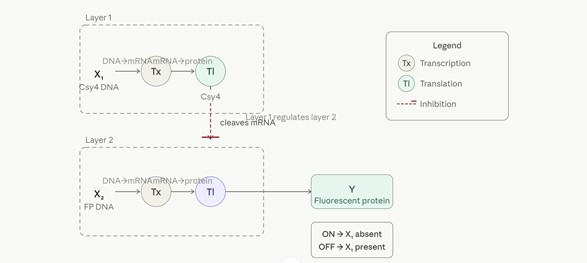
Intracellular Multilayer Perceptron — Layer 1 endoribonuclease regulates Layer 2 fluorescent protein output
The diagram depicts a two-layer intracellular artificial neural network (IANN) built on post-transcriptional regulation. Layer 1 receives X₁, a DNA input encoding the Csy4 endoribonuclease. X₁ undergoes transcription (Tx) to produce mRNA, which is then translated (Tl) into the Csy4 protein — the output of Layer 1. Layer 2 receives X₂, a DNA input encoding a fluorescent protein (FP). X₂ is likewise transcribed (Tx) into mRNA. However, translation (Tl) of this mRNA into the fluorescent protein is regulated by the Csy4 endoribonuclease produced in Layer 1: when Csy4 is present, it cleaves the fluorescent protein mRNA, preventing its translation.
Output Y (fluorescent protein) therefore follows AND-NOT logic: • ON when X₁ is absent — no Csy4 is produced, the FP mRNA is translated normally. • OFF when X₁ is present — Csy4 cleaves the FP mRNA, blocking translation. Layer 1 thus acts as a regulatory gate over Layer 2, with the endoribonuclease serving as the molecular signal passed between layers — analogous to a weighted connection in a classical artificial neural network.
Part 2: Fungal Materials
- What are some examples of existing fungal materials and what are they used for? What are their advantages and disadvantages over traditional counterparts? Fungal materials are primarily made from mycelium, the underground root-like network of a fungus. This mycelium acts as a natural “glue” that can bind agricultural waste into solid structures.
Mushroom Packaging: Companies like Ecovative grow mycelium around husks or stalks in molds to replace Styrofoam. It is used for shipping everything from electronics to wine. Mycoleather: Textiles like Mylo or Reishi mimic the look and feel of animal leather. High-end fashion brands are using it for bags and garments as a sustainable alternative. Fungal Bricks and Insulation: Experimental architecture uses mycelium blocks for their natural fire resistance and acoustic insulation properties. Acoustic Panels: Mycelium-based tiles are used in interior design to absorb sound in offices or studios.
- Pros: They are biodegradable, carbon-negative (they sequester carbon as they grow), fire-resistant, and non-toxic. Production requires very little energy compared to plastic or leather tanning.
- Cons: They are often hydrophilic (absorb water), which can lead to rot if not properly coated. They generally have lower tensile strength than synthetic plastics or traditional leather and can vary in consistency.
It is crucial to clarify that mycelium is not a species or a family, but an anatomical part of a fungus. It consists of a dense, branching network of thread-like filaments called hyphae. In the field of biomaterials, this network acts as a natural binder to create structural composites.
Key Filamentous Fungi (Mycelium-based):
- Ganoderma lucidum (Reishi): Widely used in the production of mycoleather. Its hyphae grow extremely dense, creating a flexible and durable material that serves as a sustainable alternative to animal hides.
- Pleurotus ostreatus (Oyster Mushroom): The standard for bio-packaging. It is a fast-growing, aggressive colonizer that can quickly turn agricultural waste into molded shapes, replacing expanded polystyrene (Styrofoam).
- Trametes versicolor (Turkey Tail): Frequently studied for bioremediation. It produces powerful extracellular enzymes (laccases) capable of breaking down complex chemical toxins and dyes in environmental applications.
Unicellular Fungi (Yeasts): Beyond complex mycelial networks, yeasts represent a vital category of unicellular fungi. Saccharomyces cerevisiae: This is perhaps the most industrially significant fungus. Beyond its traditional roles in baking and brewing, it is a primary “chassis” in synthetic biology for the large-scale production of bioethanol and high-value recombinant proteins (like insulin). Its well-understood genetics make it an ideal eukaryotic model for metabolic engineering.
- What might you want to genetically engineer fungi to do and why? What are the advantages of doing synthetic biology in fungi as opposed to bacteria? If we apply synthetic biology to fungi, we can transform these materials from “passive” objects into “living” materials:
- Self-Healing Materials: Engineering fungi to remain dormant within a structure and “wake up” to grow and seal cracks when moisture is detected.
- Sensing and Reporting: Modifying fungi to change color or glow in the presence of environmental toxins (like heavy metals in soil).
- Enhanced Secretion: secrete specific enzymes.
Advantages of Fungi vs. Bacteria: While E. coli is the workhorse of synthetic biology, fungi offer unique engineering advantages:
- Macro-scale Structure: Unlike bacteria, which are unicellular, fungi form massive, interconnected multicellular networks. This allows for the creation of large-scale physical materials that hold their shape.
- Eukaryotic Processing: Fungi are eukaryotes. They can perform complex post-translational modifications on proteins that bacteria cannot, making them better for producing specialized enzymes or human-like proteins.
- Superior Secretion: Fungi are natural “secretory machines.” They can pump out vast quantities of proteins and metabolites into their environment, which is much more efficient for industrial harvesting than lysing bacteria.
- Environmental Resilience: Fungi thrive in harsh, acidic, or low-moisture environments where most lab bacteria would die. This makes them ideal for “out-of-lab” applications like bioremediation or outdoor construction.