Week 1 HW: Principles and Practices
IDEA
Through art, design, biology, and apparel, I am interested in exploring how wearers can become more attuned to their identity by expressing their unique microbial genomes and ecosystems that make up their bodies through a bio-engineered second-skin-like textile. This project explores clothing as a custom, an expression, and a living interface that evolves with the body, offering an alternative to the rapid cycles of novelty and replacement characteristic of fashion today. The garment becomes a second skin that is not consumed or discarded, but lived with, every day, shifting gradually and meaningfully over time (National Institutes of Health).
I am drawn to the skin microbiome as a dynamic and richly complex ecosystem that continuously evolves in response to environmental stimuli, material contact, and everyday life. The skin absorbs and interacts with everything it encounters—from air and surfaces to residues such as microplastics—while remaining in constant dialogue with its own microflora. I envision a bespoke “second skin” generated through the bioengineering of an individual’s genomic profile and cutaneous microbiome, translated into algorithmically encoded, chromatically responsive pattern systems.
This work is inspired by Neri Oxman’s approach to material ecology, particularly her use of modularity, gradience, and unity to integrate biological processes directly into design (Marvin, J.). In this project, patterns within the material are speculated to evolve gradually as the wearer’s skin ecosystem undergoes microbial succession in response to environmental exposure, climate, and daily interaction. Bioengineered, non-pathogenic microbial consortia or biologically derived, metabolically active materials are embedded within the textile architecture, functioning as living intermediaries between the body and its environment. These systems respond to localized changes in the skin’s microenvironment, such as pH, moisture, temperature, and biochemical flux, through controlled shifts in pigmentation, pattern density, and material morphology (Atallah, C.).
Rather than interpreting or evaluating bodily states, the garment becomes a living material archive, reflecting a healthy, dynamic relationship among the wearer, their microbial ecosystem, and the world they move through. In this way, fashion becomes a site of ongoing exchange and evolution, replacing short-term satisfaction with a deeply personal, evolving form of embodiment.
In a previous exploratory project, “SECOND-SKIN”, I sampled and analysed skin-associated microbial communities from distinct anatomical regions, observing that different areas of the body host unique microbial ecologies. This work focused on translating the otherwise invisible microbiome of the human body into an expressive, artistic language.
In this project, I extend this inquiry by proposing a modular design and material system that reflects the evolution of an individual’s skin microbiome over time. The textile functions as a responsive biological interface or living biologically active material that registers changes in microbial composition, metabolic activity, or by-products present on the skin’s surface. These shifts are translated into gradual changes in colour, texture, or pattern, allowing the textile to act as a temporal record of the wearer’s ever-evolving microbial life.
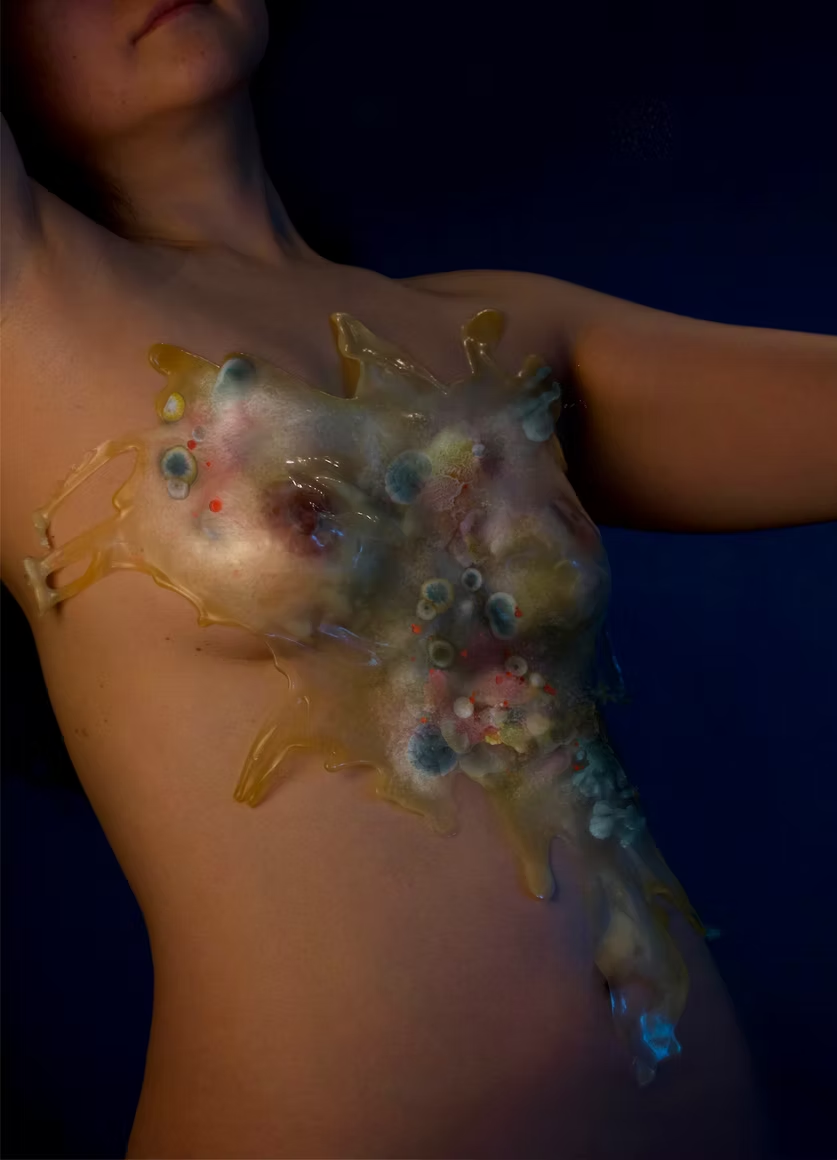
Project “SECOND-SKIN” 2020
GOVERNANCE POLICY GOALS:
GOAL 1: Prevent Harm and Ensure Safety Because this textile directly interfaces with the body and incorporates living or biologically active components, governance must prioritise physical, biological, and environmental safety throughout design, experimentation, and use.
Sub Goal 1: Biological Safety Ensure the safety of the wearer’s skin and microbiome by regulating the use of non-pathogenic organisms, fully contained or controlled living systems, and biocompatible materials. Prevent adverse skin reactions and unintended microbial transfer during use, experimentation, and prolonged wear.
Sub Goal 2: Prevent Environmental Contamination Establish controlled experimental conditions, follow appropriate laboratory protocols, and ensure safe containment, deactivation, or disposal of biological components at the end of the material’s lifecycle to prevent unintended environmental release.
Sub Goal 3:Clarification and Communication Clearly communicate the material’s biological components, symbiotic role, and limitations to users and research participants. Avoid misclassification of the textile as a diagnostic, therapeutic, or medical technology by framing it explicitly as an expressive, cultural, and experiential material system.
GOAL 2: Protecting Autonomy, Consent and User Agency Working with microbiome-derived data and living materials raises ethical concerns related to bodily autonomy, consent, and ownership of biological information.
Sub Goal 1: Informed Consent Users should clearly understand what biological information is being used (e.g. abstracted microbiome composition), how it is translated into material form, and what is not being measured or inferred. Consent should be explicit, ongoing, and revisitable as the material evolves.
Sub Goal 2: Time, Control and Lifecycle Awareness Ensure users understand the material’s temporal nature, how it may evolve, change, or age and provide clear mechanisms for disengagement, pausing, or material retirement. Users should be informed about how environmental exposure may influence material behaviour.
Sub Goal 3: Protect Biological Data and Privacy While microbiome data may be used to generate initial material patterns, governance should ensure abstraction, anonymisation, and minimisation of biological data. Prevent misuse, re-identification, or unintended interpretation of microbiome information during research, development, or documentation.
GOAL 3: Design Collaboration and Material Interface This project treats biological systems not as tools, but as collaborators in material expression.
Sub Goal 1: Encourage Interpretive Ambiguity Frame material expression in a way that remains open and personal, avoiding fixed meanings or biological judgments. Patterns, colors, and textures should be experienced as aesthetic and reflective rather than explanatory, allowing wearers to form their own understanding over time.
Sub Goal 2: Fostering Long Term Embodied Relationships Encourage design approaches that support lasting engagement with the garment. The material should evolve gradually with the wearer and their environment, promoting attachment, care, and continuity rather than novelty or performance monitoring.
Sub Goal 3: Respecting Living Organisms and Collaborators Ensure that biological organisms involved in the design process are treated as collaborators rather than passive tools. This includes designing with respect for uncertainty, emergence, and biological behavior, and valuing learning and responsiveness over control.
GOAL 4: Diversity and Social Value
Sub Goal 1: Avoid Biological Hierarchies Design the system to celebrate microbial diversity and variation rather than framing certain biological compositions as superior, healthier, or more desirable.
Sub Goal 2: Inclusive and Contextual Design Account for diverse bodies, skin types, climates, cultures, and environmental contexts. Recognise that microbiomes vary widely and meaningfully across individuals and environments.
Sub Goal 3: Innovation and Long-Term Social and Cultural Value Promote designs that cultivate appreciation for inner biological diversity and interdependence with the environment, positioning fashion as a medium for ecological awareness and long-term reflection rather than critique or correction of the body.
GOVERNANCE ACTIONS AND EVALUATION
Governance Action 1: Abstraction and Use of Microbiome Data
Purpose: Currently, biological data, especially DNA, is often treated as a source for identity and diagnosis. This governance action proposes using microbiome data solely to reflect and generate material patterns for a “custom skin design,” rather than as a health monitor. The goal of the design is to enable personalisation of wearables to complement identity through one’s personal microflora without reinforcing medicalised interpretations of the body’s health states over time (Nuffield Council on Bioethics).
Design: Through a design lens, this would require that microbiome data is reduced to high-level non-identifying parameters and indicators, before translating material forms, textures and colours. Academic researchers and designers would document this abstraction process through an ethical review, and institutions or collaborators would approve projects only with clear boundaries between the user and their biological content being used to drive material changes and custom patterns.
Assumptions: This approach assumes that abstraction can preserve the richness of biological variation without revealing sensitive or identifying information. It also assumes users can connect with such a textile and material without it immediately reflecting some information related to the state of their health and microflora. There is also an assumption that the material will not be contaminated by other genetic material upon exposure, thereby triggering changes in its material codes.
Risk of Failure and Success: This governance action can fail if the abstraction is not clearly communicated to viewers, and if viewers view the material as a marker revealing biological truths subject only and specifically to their genetic skin material. If successful, the material will invite an understanding of one’s microbiome, and one will feel connected to the material through their identity reflected in their own personal ‘second skin’ with encoded patterns.
Governance Action 2: Consent and Awareness Over Time
Purpose: As this textile is designed to reflect, react and evolve with one’s microflora over time, consent needs to surpass time rather than a one-time agreement. This governance action aims to ensure that users are always informed and in control of their own genetic material as it interacts, changes, and reveals patterns of their skin over time (Nuffield Council on Bioethics).
Design: Users should be clearly informed about how the material of their genomic and microbial makeup is used and how it may change over time. They should also be informed of the factors related to those changes like triggers in the environment, temperature, ph, and even their diets. Users should understand consent as ongoing, with the opportunity for disengagement over time in relation to material evolution.
Assumption: This assumes that users are engaging with the material over time and are interested in transparency through evolution rather than at a first-time basis in a finished product or object. It also assumes the designer understands most possible changes, allowing them to clearly communicate material changes with users. It also assumes most users will reflect similar patterns without understanding all potential microbiome reflections in a material, and that changes to material patterns are limited by encoded engineered material.
Risk of Failure and Success The action’s failure is indicated if the user feels overwhelmed by their personal information and biological data and disengages with their custom skin. If successful, the material is always engaging and evolving, inspiring surprise, wonder, and a sense of a “custom” look, without the need for other satisfactory components, as in “fast fashion”.
Governance Action 3: Design for Long-Term Biological Relationship rather than one-time use / Rapid Consumption
Purpose: Fashion systems today value speed, novelty, and constant replacement, encouraging users to constantly change and seek satisfaction. This governance action proposes an alternative model in which biointeractive textiles are designed to evolve slowly with the wearer and form a long, healthy, symbiotic relationship, rather than providing short-term satisfaction. The purpose of this textile is to form a personalised system rooted in biological time, where changes are driven by the constant dialogue between the body’s microbiome and its environment.
Design: This requires the design to be bioengineered to reflect data from the microbiome first as a template for a custom DNA fingerprint, and then as a gradual system that transforms over use and time. This enables the user to grow a deeper relationship with the material over time. This reflects the design philosophy of patina, where ageing with the material becomes more valuable than a static material or object. Cultural institutions, as well as Art and Design communities and academic institutions, could support this design approach and change the language and cultural dialogue in how materials are approached. Evaluating success through longevity, attachment, and stewardship should be the leading criteria when designing responsibly, rather than focusing on scalability.
Assumptions: This assumes that wearers have the ability to care for slower forms of engagement over time rather than shift from one-time use excitement and satisfaction. It also assumes that the fashion system can function on individual personalised systems rather than consumable production cycles and that biological change over time can be experienced as meaningful rather than unpredictable and inconvenient.
Risks of Failure and Success: Failure could be seen where users could expect instant personalisation and are impatient with gradual changes over time. There is also the risk of market pressures reintroducing fast fashion logic and trying to accelerate production in biological processes that take time and are not scalable. If successful, the approach is culturally accepted and appreciated through a patina philosophy of design lens. The approach also challenges existing fashion paradigms and shifts into a niche that longs for custom-fitting products targeting individuals’ ecosystems rather than the masses.
POLICY GOALS RUBRIC
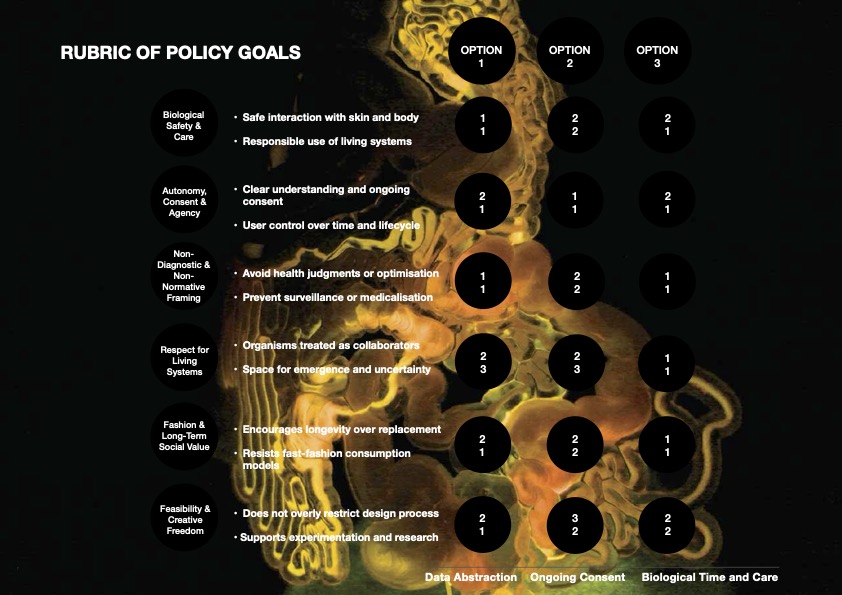
Rubric Backgroung Image Credit: Jonathan Williams and Paula Aguilera https://awomensthing.org/blog/neri-oxman-organic-design/#google_vignette
PRIORITIZED GOVERNANCE OPTIONS, TRADE-OFFS AND RECOMMENDATIONS
Drawing on the rubric, I would prioritise Option 3: Designing for a Long-Term Biological Relationship (Biological Time and Care), supported by Option 1: Abstraction First Use of Microbiome Data (Abstraction Data) and Option 2: Ongoing Consent and Lifecycle Transparency as essential safeguards (Ongoing Consent). Option 3 emerges as the strongest core strategy because it most directly supports the project’s fashion-specific and cultural goals: encouraging longevity over replacement, resisting fast-fashion consumption models, and framing the garment as a living system that gains meaning through time and use. By embedding biological time and co-evolution into the design, this option aligns with respect for living systems and positions fashion as a practice of care and stewardship rather than optimisation or novelty.
However, Option 3 alone would be insufficient without the protections offered by Options 1 and 2. Option 1 is critical in preventing health judgments, biological hierarchies, or genetic determinism by ensuring that microbiome data is abstracted before use and never interpreted diagnostically. Option 2 complements this by protecting user agency over time, recognising that consent must remain ongoing as the material evolves and as the relationship between wearer and garment deepens.
The primary trade-off in prioritising Option 3 is feasibility and scalability. Designing garments that evolve slowly and unpredictably may challenge existing fashion production models and limit immediate commercial adoption. There is also uncertainty around how users will respond to gradual biological change rather than instant personalisation. Nevertheless, these limitations are consistent with the project’s intent to change how we approach design as a living and growing system rather than a mass-market solution.
One key ethical concern is the risk of biological over-interpretation, particularly how easily biological data, especially DNA, can be read as defining identity, health, or value. Even when design intent is non-diagnostic, audiences may project meaning onto biological materials, raising concerns around determinism and surveillance.
Another concern involves time and consent. Working with living or evolving materials challenges traditional notions of informed consent, which are often treated as one-time agreements. This raises questions about how users remain informed and empowered as materials evolve over time.
Finally, the project highlights tensions between care and control in the design of living systems. Treating organisms as collaborators rather than tools requires accepting uncertainty and resisting extractive design instincts, an ethical shift that challenges dominant engineering and fashion paradigms as well as approaches to design.
To address these concerns, the governance actions proposed, particularly abstraction-first data use and ongoing consent, serve as mechanisms to limit overreach, preserve user agency, and maintain ethical boundaries around interpretation. Additionally, clearly framing bio-interactive textiles as cultural and expressive systems rather than medical or wellness technologies helps protect both users and designers from unintended misuse or misclassification.
This project aims to redefine textile paradigms by reframing how we understand and engage with what we wear. By connecting wearers to their own living micro-universe and genetic codes, the garment invites a deeper appreciation of both who they are and how they are evolving. Through daily use, the material develops its own patina, not through wear alone but through biological change, encouraging an ongoing relationship with the textile. In doing so, the project fosters care and respect for the body as a dynamic system, and for the microbial worlds that support our skin’s rich ecosystem and for the environments that continuously shape it.
REFERENCES:
Atallah, C., El Abiad, A., El Abiad, M., Nakad, M. and Assaf, J.C. (2025) ‘Bioengineered Skin Microbiome: The Next Frontier in Personalized Cosmetics’, Cosmetics, 12(5), p. 205. doi: 10.3390/cosmetics12050205.
Marvin, J. (2016) Between the Chisel and the Gene: Neri Oxman’s Organic Design. A Women’s Thing. Available at: https://awomensthing.org/blog/neri-oxman-organic-design/
National Institutes of Health (NIH) (2026) Human Microbiome Project. Available at: https://hmpdacc.org
Nuffield Council on Bioethics (2026) Nuffield Council on Bioethics. Available at: https://www.nuffieldbioethics.org
USE OF AI
“(IDEA) Give me a list of good governance policy goals to think about according to my idea”
“Polish my governance policy goals”
“Feedback on a good rubric for governance policy goals”