Week 3 HW: Lab Automation
OPENTRON GEL ART
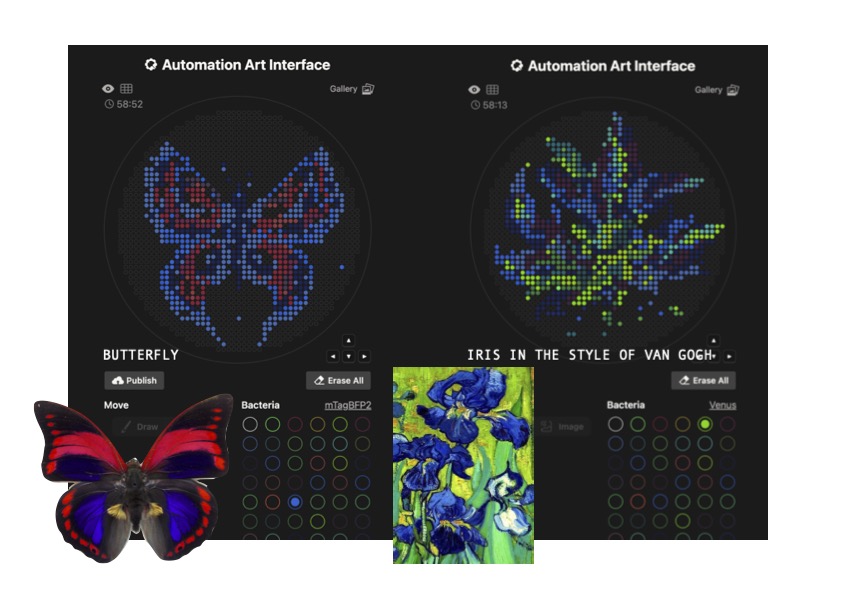
Figure 1
I tried creating a butterfly using the OpenTron drawing tool, with 4 different colours, dark blue, light blue, red and purple, which are some of the available colours in Lifefabs.
I also tried to create an Iris in the style of Van Gogh. As this is a more fluid and asymmetrical design, it would be harder to achieve, given the complexity of the multiple colours in organic scaddered shades, rather than in small units. Moreover, the dots and spaces are quite compact, which would make it harder to achieve a clean result.
After a few attempts on Google Collab and speaking back and forth with Google Gemini, I was finally able to get my Iris. For some reason, however, the Iris came out multi-coloured (Figure 2), and there are way more colours than originally used in my Ginkgo drawing board. Not sure if it’s because I added all these colours to the working space below as seen in (Figure 1).
Figure 2 “Colourful Iris”
This was my first attempt at getting my Iris.
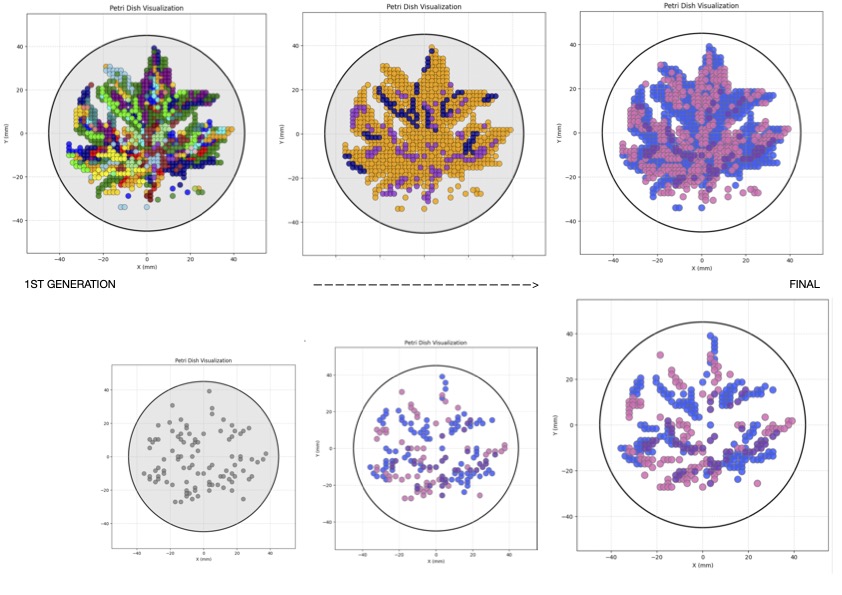
Figure 3
After many attempts (Figure 3), I was finally able to get my Iris. Although it’s not in the colours I used and made it with on Ginkgo, I made sure to prioritise getting them in the colours of Lifefabs, for the Opentron printing. It is also good practice as an artist in a real lab setting to work with the mediums available.
Maximising the scientific resources available is important as an artist in this space, and the beauty of cross-disciplinary work, where beauty is found even when an artist doesn’t have an unlimited colour palette. With this in mind, I wanted to maximise on the colours given to us by Lifefabs, so I also coded a butterfly inspired by the “Prepona Praeneste” from Peru, and the “Papilio Ulysses” butterfly from Indonesia, which I found to better resemble the colours for this exercise with its blue and red pink hues(Figure 4).
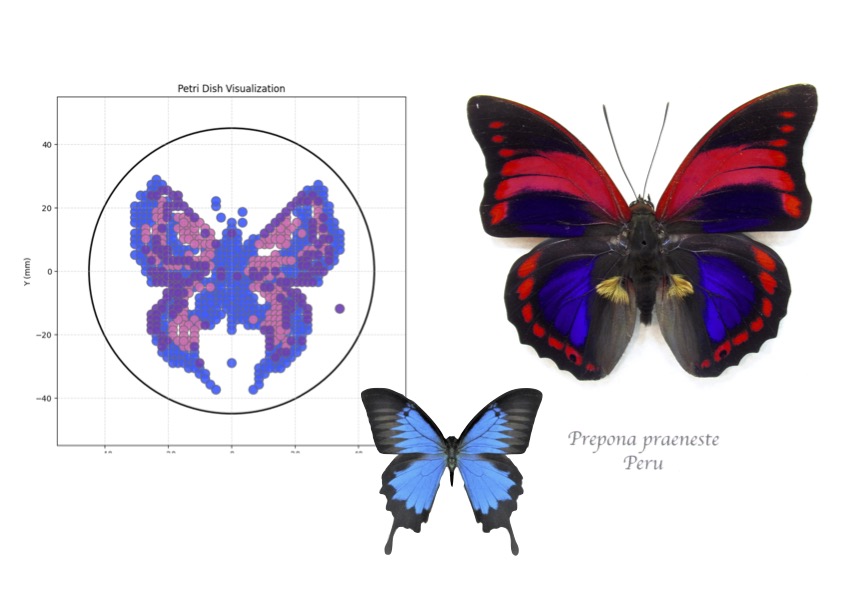
“Prepona Praeneste” butterfly Figure 4
POST-LAB QUESTIONS
The publication Semiautomated Production of Cell-Free Biosensors, published by the American Chemical Society (ACS Publications), explores the assembly of cell-free biosensors through liquid handling robotics versus manual methods commonly used in lab-scale development. The process is a combination where, “both manual and semiautomated reaction assembly approaches using the Opentrons OT-2 liquid handling platform on two different cell-free gene expression assay systems that constitutively produce colourimetric (LacZ) or fluorescent (GFP) signals,(Brown).” The designed protocols demonstrate that they perform close to expected detection outcomes in a more controlled environment (Brown).
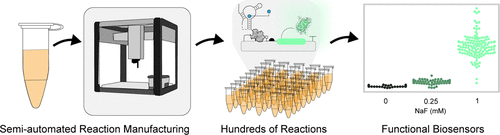
Copyright © 2025 American Chemical Society
IDEA
In my final project, I intend to use automated fabrication tools to create 3d printed templates, moulds, and matrices within the fabric, as well automating the liquid handling in the textile. Through automation, I will construct a textile embedded with patterned cavities designed to host distinct bacterial-sensing environments. The fabric’s automated structure serves as the fixed framework, while the bacteria and their metabolic activity constitute the variable component. As microbial signals interact with each cavity, dynamic changes in colour and pattern emerge, allowing the fabric to visually reflect microbial activity and ecological variation across its surface.
To do this, the following steps are needed.
1. Opentron OT-2 liquid handling and 3d Printed textile: First, I need to design the 3D mould for the hydrogel fabric textile, which will consist of a cavity matrix that will host the cell-free biosensors. I also need to 3d print a holder to lay the textile flat and dispense to OT-2 coordinates.
2. Bioprinting hydrogel: Next, I need to print the hydrogel containing the pattern cavities designed and corresponding to the OT-2 dispense coordinates. This can be done by bioprinting or mould casting the hydrogel into shape/texture.
3. Opentrol OT-2 despensing: The Opentron OT-2 will despense the DNA mixture and CFE into the bioprinted hydrogel cavities and coordinates. This will ensure accurate volume, distribution, and reproducibility across various textile matrices.
4. Sealing of textile hydrogel: The textile hydrogel will be sealed with a semipermeable layer that allows skin metabolites to permeate into the cavities and activate cell-free biosensors to reveal patterns.
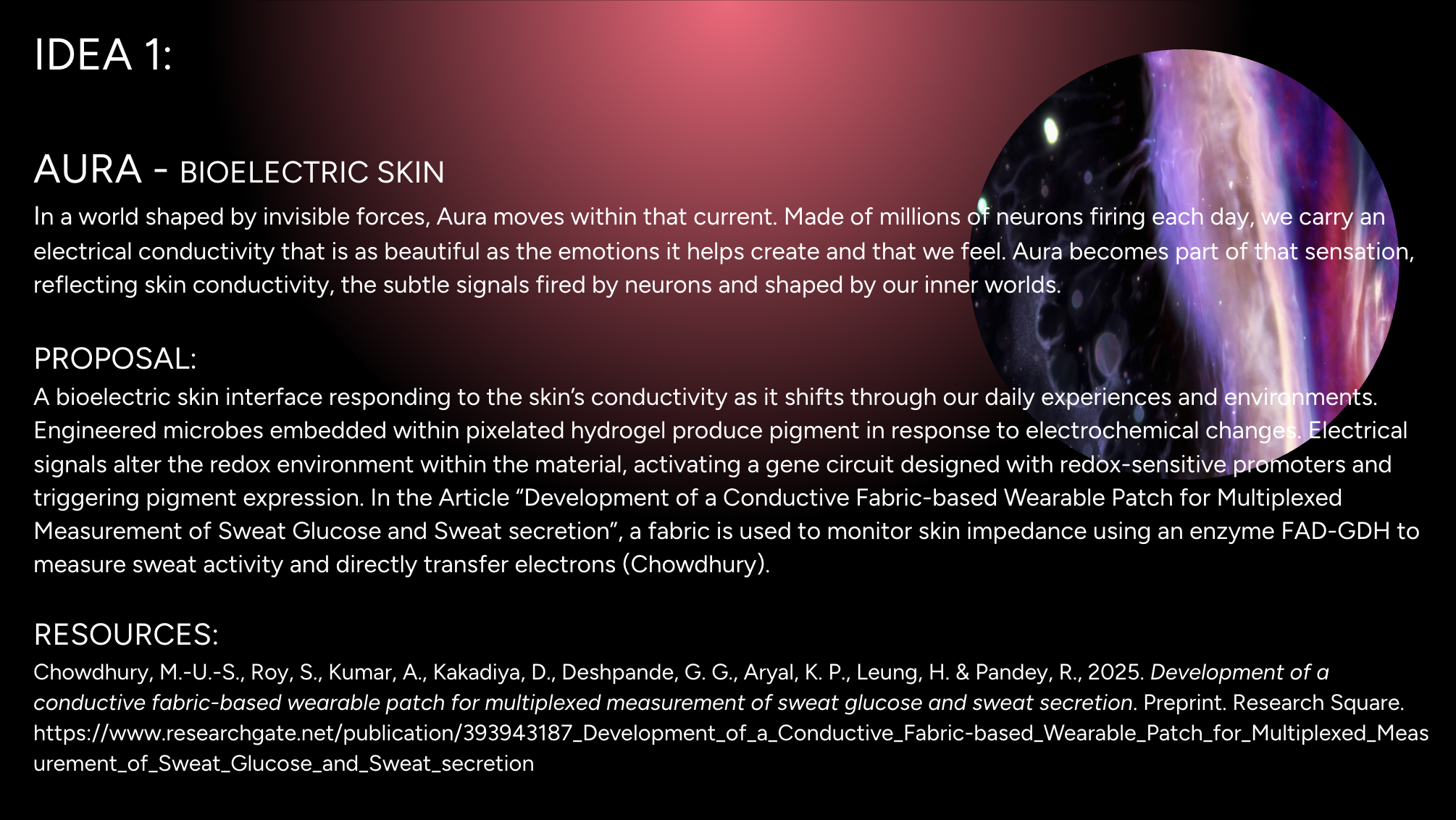
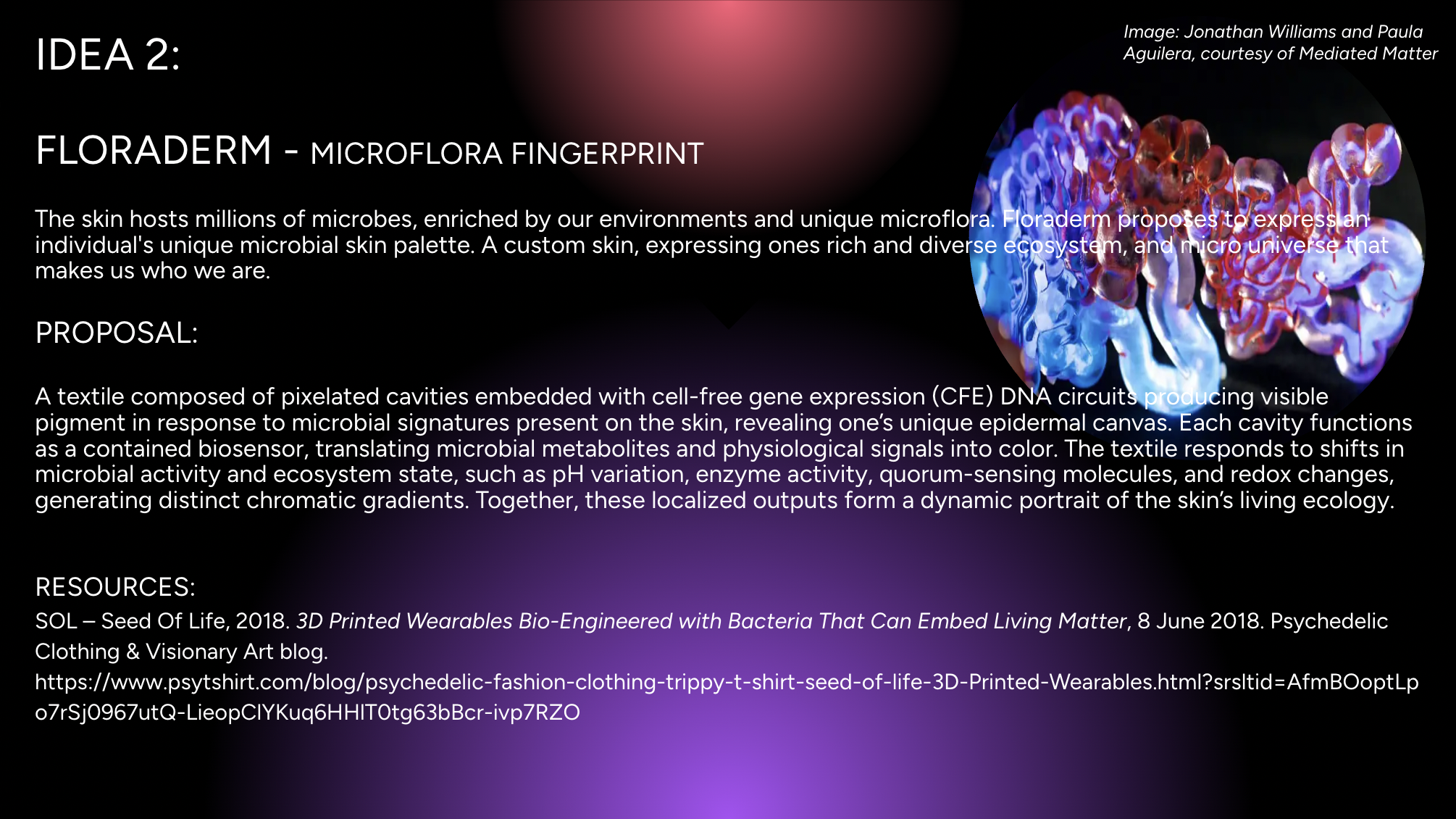
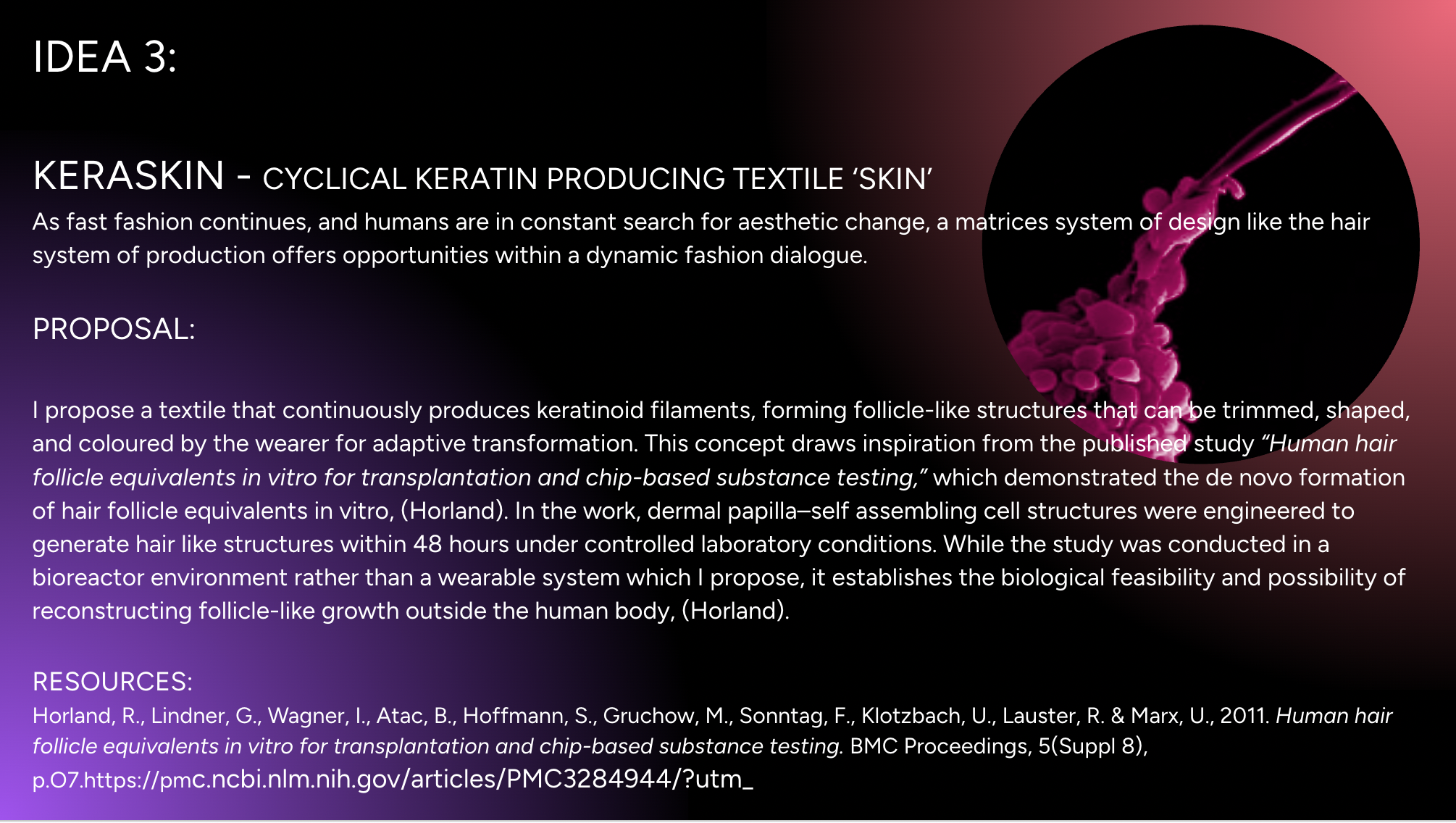
PROJECT PROPOSALS:
https://docs.google.com/presentation/d/19T22uOQz9aTvnzh426tri4xrg-ZoG1ksy6I5bswGHaw/edit?usp=sharing
RESOURCES:
Brown, D.M., Phillips, D.A., Garcia, D.C., Arce, A., Lucci, T.J., Davies, J.P., Mangini, J.T., Rhea, K.A., Bernhards, C.B., Biondo, J.R., Blum, S.M., Cole, S.D., Lee, J.A., McDonald, N.D., Wang, B., Perdue, D.L., Bower, X.S., Thavarajah, W., Karim, A.S., Lux, M.W., Jewett, M.C., Miklos, A.E. & Lucks, J.B., 2025. Semiautomated production of cell-free biosensors. ACS Synthetic Biology, 14(3), pp.979–986. doi:10.1021/acssynbio.4c00703.
Chowdhury, M.-U.-S., Roy, S., Kumar, A., Kakadiya, D., Deshpande, G. G., Aryal, K. P., Leung, H. & Pandey, R., 2025. Development of a conductive fabric-based wearable patch for multiplexed measurement of sweat glucose and sweat secretion. Preprint. Research Square.. https://www.researchgate.net/publication/393943187_Development_of_a_Conductive_Fabric-based_Wearable_Patch_for_Multiplexed_Measurement_of_Sweat_Glucose_and_Sweat_secretion
Horland, R., Lindner, G., Wagner, I., Atac, B., Hoffmann, S., Gruchow, M., Sonntag, F., Klotzbach, U., Lauster, R. & Marx, U., 2011. Human hair follicle equivalents in vitro for transplantation and chip-based substance testing. BMC Proceedings, 5(Suppl 8), p.O7.https://pmc.ncbi.nlm.nih.gov/articles/PMC3284944/?utm_
SOL – Seed Of Life, 2018. 3D Printed Wearables Bio-Engineered with Bacteria That Can Embed Living Matter, 8 June 2018. Psychedelic Clothing & Visionary Art blog. https://www.psytshirt.com/blog/psychedelic-fashion-clothing-trippy-t-shirt-seed-of-life-3D-Printed-Wearables.html?srsltid=AfmBOoptLpo7rSj0967utQ-LieopClYKuq6HHlT0tg63bBcr-ivp7RZO
USE OF AI
“Why is my opentron code multi coloured when this (insert image), is my image from Gingko, using only a few colours?”
“Help me edit the code”
“Take me step by step on the use of Opentrons in a lab”
“How can Opentrons be applied to textile making?”
“Polish my idea (idea concept) to work within an Opentron lab context”
“Help me polish my conceptual idea”