Week 7 HW: Genetic Circuits Part II: Neuromorphic Circuits
ASSIGNMENT PART 1: Intracellular Artificial Neural Networks (IANNs)
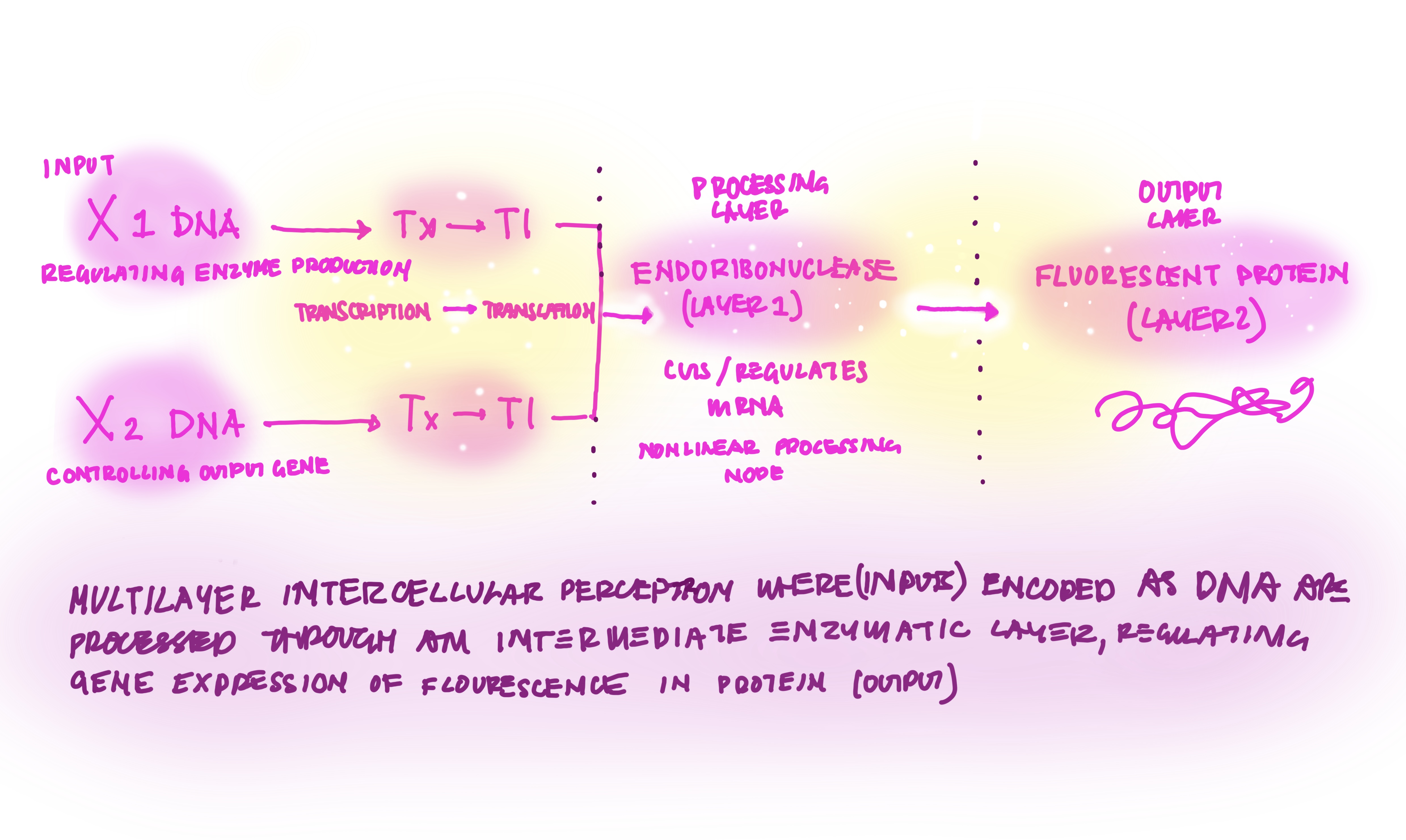
IANN ADVANTAGES VS GENETIC CIRCUITS
Intracellular Artificial Neural Networks, are genetic circuits designed with the same framework as neural networks taking from the most intelligent systems of communication that exist in our inner worlds. In traditional genetic circuits the outpus are boolean ON(1)OFF(0), however IAANs have outputs with continous analog, rather 0.2,0.5,0.75,1… The advantages of Iann vs genetic circuit logic, is the complexity of the analogue captured, combining many inputs as well as nonlinear relationships, and thus work better with biological systems with gradual changes and growth (Nilsson et al., 2022).
IANN APPLICATIONS
A common application of intracellular artificial neural networks (IANNs) is the detection of disease states within cells. For example, different fluorescent reporters can be used to represent biological signals: F1 for inflammation, F2 for metabolic activity, and F3 for pH levels. An IANN can interpret complex patterns across these inputs, such as producing a strong output when F1 is high, F2 is moderate, and F3 is low, while suppressing output when all three signals are high. This capacity to integrate and layer multiple inputs enables the system to recognise nuanced disease states, rather than relying on simple binary classifications (Nanda, 2019).
However, IANNs also have limitations. One key constraint is response time: because they rely on transcription and translation, their outputs are not instantaneous, which can hinder rapid decision-making. Additionally, biological noise presents a challenge, as gene expression levels can fluctuate, introducing variability and reducing the reliability of the system’s output (Nilsson et al., 2022).
DIAGRAM DRAWING
ASSIGNMENT PART 2: Fungal Materials
What are some examples of existing fungal materials, and what are they used for? What are their advantages and disadvantages over their traditional counterparts?
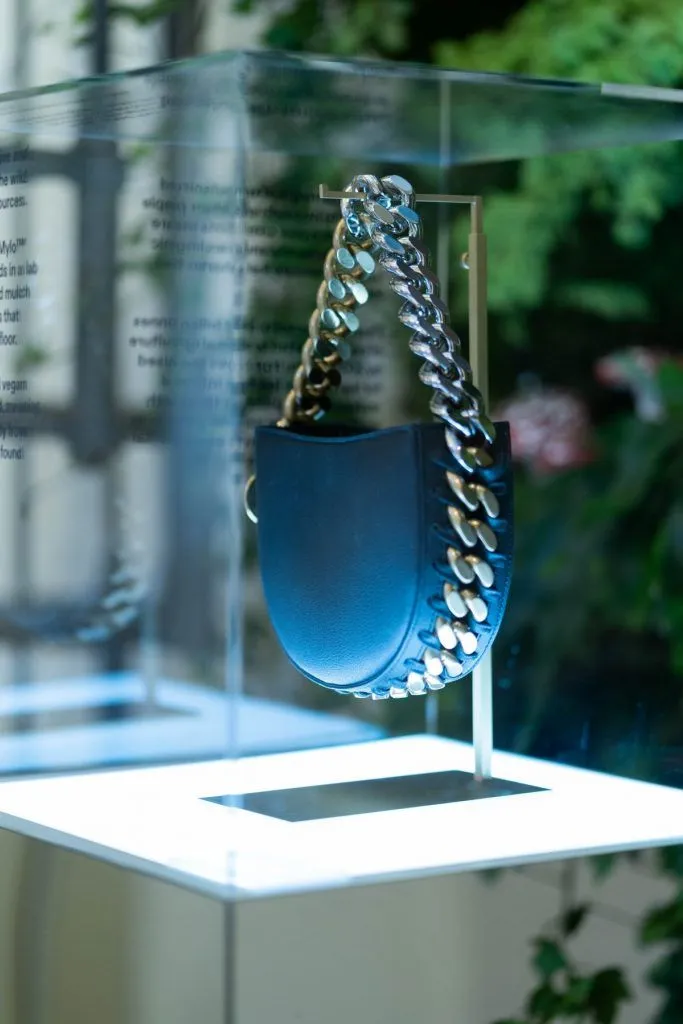
Some examples of fungal materials include mushroom leather, such as Mycoworks, which grows mycelium leather in a lab. Mycoworks applications can be seen in fashion, such as collaborations with Stella McCartney (Figure1) or even in interiors. The leather is made by first cultivating the mycelium on agricultural substrates under tightly controlled environmental conditions to form dense, interwoven sheets. Through its “Fine Mycelium” process, the growth of the fungal network is guided to create a material with structural properties similar to leather. Once the desired structure is achieved, growth is terminated, and the material is ready for tanning and finishing processes to enhance aesthetic, durability, and flexibility (MycoWorks).
What might you want to genetically engineer fungi to do and why? What are the advantages of doing synthetic biology in fungi as opposed to bacteria?
Funghi can be genetically engineered to produce stronger materials by altering the composition of the fungal cell wall. Fungal cell walls are made up of chitin, proteins, and glucans, which affect the stiffness, strength, flexibility, and permeability of the cell wall. By changing the genes involved in cell wall synthesis, one can also modify the fungal material structure and thus strength. Other genes that can be modified include growth-regulation genes, which can alter growth states, such as becoming more compact or fluffier. The fungi can also be engineered to secrete biomolecules that alter their properties, such as producing permeable coatings.
RESOURCES:
MycoWorks (n.d.) MycoWorks. Available at: https://www.mycoworks.com/ (Accessed: 29 March 2026).
Nanda, S., Sahu, P.K. & Mishra, R.K. Inverse artificial neural network modeling for metamaterial unit cell synthesis. J Comput Electron 18, 1388–1399 (2019). https://doi.org/10.1007/s10825-019-01371-x
Nilsson, A., Peters, J.M., Meimetis, N., Bryson, B. and Lauffenburger, D.A., 2022. Artificial neural networks enable genome-scale simulations of intracellular signaling. Nature Communications, 13, p.3069. Available at:
USE OF AI
“Give me good resources delving deep into the IANNs as well as Genetic Circuits”
“Is this a good diagram? Feedback on diagram”
“What are some of the fungi material makers? Give me resources for the process of making funghi leather for example”
“Polish/Edit this paragraph”