Week 2: DNA Read, Write, Edit
Class Assignment
Part I.
Example design performed in Benchling found here:
Design for lab found here:
Part II.
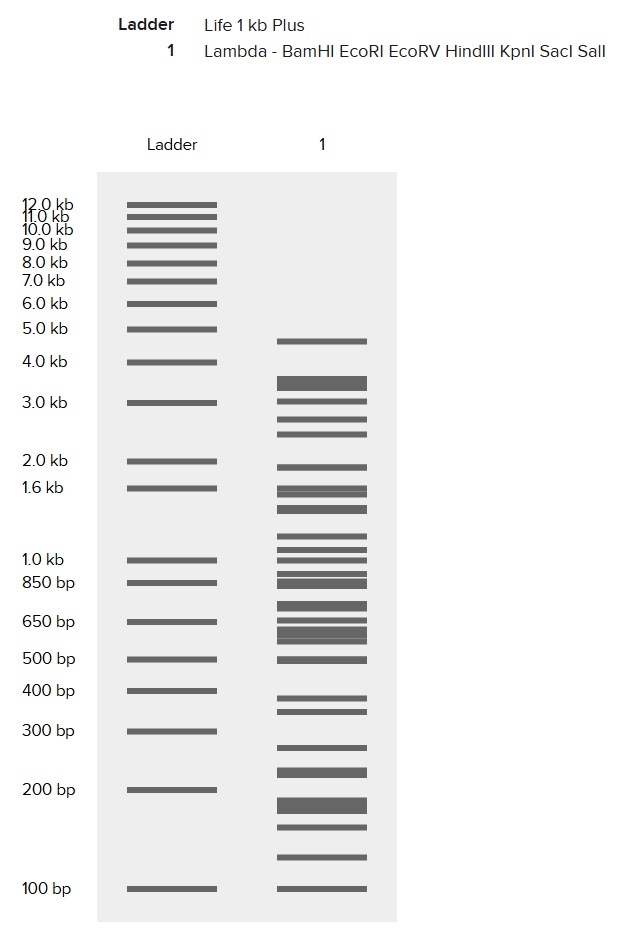
Performed in lab. Resulting Gel Image here:
Part III.
3.1
I selected the Anti-CRISPR protein AcrIF7 in Pseudomonas aeruginosa prophage as I’m fascinated by the relationship between phages and their hosts and I believe Acrs could have an important role in biosafety for their potential to serve as off-switches for CRISPR editing.
The protein sequence (as identified from NCBI accession number WAX21977) is: mttftsivtt npdfggfefy veagqqfdds ayeeaygvsv ptavveemna kaaqlkdgew lnvshea
3.2
The reverse translated DNA sequence using the Bioinformatics.org online tool and the default E. coli codon table is: atgaccacctttaccagcattgtgaccaccaacccggattttggcggctttgaattttat gtggaagcgggccagcagtttgatgatagcgcgtatgaagaagcgtatggcgtgagcgtg ccgaccgcggtggtggaagaaatgaacgcgaaagcggcgcagctgaaagatggcgaatgg ctgaacgtgagccatgaagcg
3.3
The version codon optimized for Pseudomonas aeruginosa PAO1 using the IDT codon optimization tool is: ATG ACC ACG TTC ACG AGC ATC GTG ACC ACC AAT CCC GAC TTC GGC GGC TTC GAA TTC TAC GTC GAA GCG GGC CAG CAG TTC GAC GAC TCC GCC TAT GAG GAA GCC TAC GGC GTG AGC GTC CCC ACC GCC GTG GTC GAG GAG ATG AAC GCC AAG GCC GCC CAG CTC AAG GAT GGC GAG TGG CTG AAC GTC AGC CAT GAA GCG
3.4
Electroporation of the DNA sequence on a plasmid (designed in Part IV) into P aeruginosa could enable production of the protein as the cell would utilize its own resources to transcribe and translate the sequence if an according promoter and RBS were on the plasmid with the sequence of interest. Electroporation is preferred to insert the plasmid into the cell as it is more efficient than other chemical techniques.
Part IV.
4.1
Twist account created.
4.2
Image of assembled sequence here:
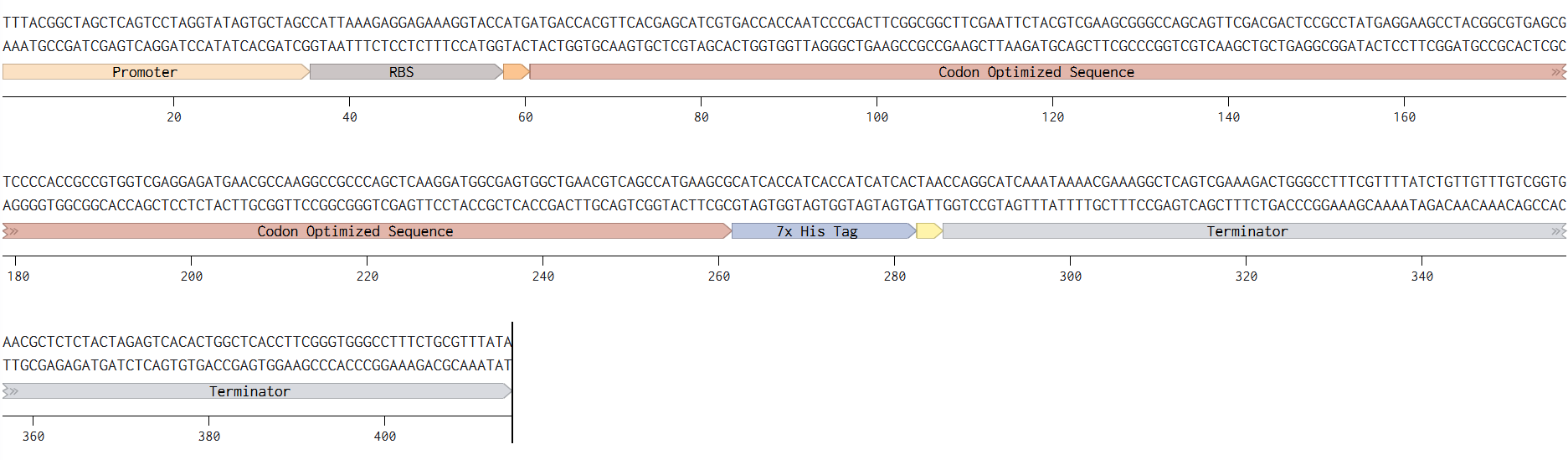
Instructions followed to create vector in Twist for parts 4.3-4.6.
Part V.
5.1
I would be interested in sequencing a metagenomic analysis from a patient with an antibiotic resistant infection being treated with phage therapy. I would be curious to sequence DNA at several courses of time across the treatment to see how the entire microbial community in the environment (say, a gut microbiome) is affected by phage therapy. I would use Illumina sequencing as I don’t need full assembled genomes of each community species, but rather the high-throuput short-read approach would ensure I can capture a wide array of variants in the community.
5.2
I would be interested in synthesizing a construct using parts of a phage satellite than can integrate into a bacterial genome with a helpful anti-virulence circuit (like a CRISPR/Cas9 cassette targeting a virulence gene) to engineer bacterial hosts (particularly mycobacteria, which have key environmental and therapeutic applications and have challenges with developing antibiotic resistance). I would likely use PCR with primers designed to amplify parts of interest from a phage satellite (as I already know the genetic sequence) and could use Twist to synthesize the additional CRISPR/Cas genetic insert. PCR includes the denaturation of the template DNA, annealing of primers, extension of the amplicon, and the repetition of many cycles to produce many copies: one advantage is this high quantity of DNA of the part produced, although it is limited in the length of amplicons it can be effectively used. Twist synthesis is highly accurate and can synthesize longer segments, but does not have as many copies.
5.3
Since we have already identified a mutation in a singular, specific gene that causes Huntington’s Disease, I would be fascinated to edit out the trinucleotide repeat mutation in that gene that causes the disorder. Already, microRNA treatments have been employed to control expression (so not a DNA editing approach), and base editing through CRISPR/Cas9 has proven success in mice at a permanent, one-time treatment. The base editing CRISPR system uses prime editors, and so uses a gRNA designed for this trinucleotide mutation in the huntingtin gene alongside a mutated Cas9 enzyme that only cuts one strand and a catalytic enzyme capable of inducing single base pair mutations. To test the realistic constrains on delivery, the input would likely by Huntington affected cells and the editing system would need to be injected and localize to the nucleus to make the DNA edits.