Week 3 HW: Lab Automation
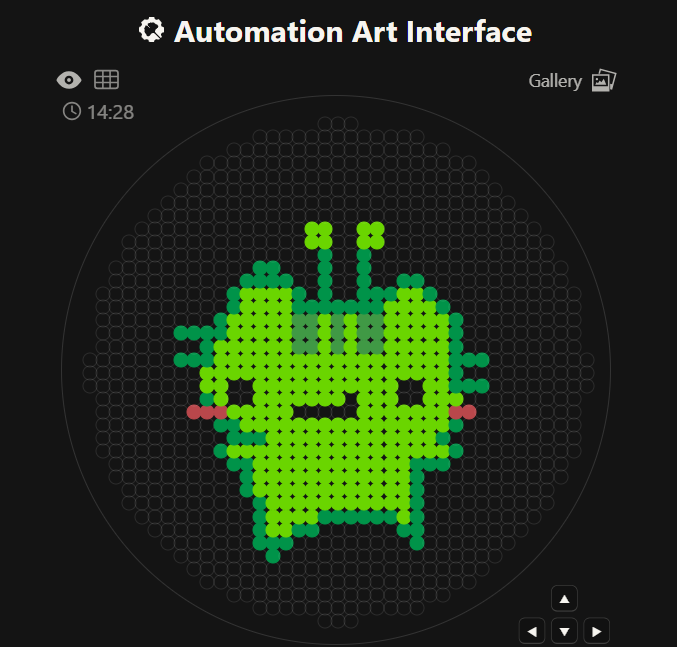
Opentron Art
Post-Lab Questions
Find and describe a published paper that utilizes the Opentrons or an automation tool to achieve novel biological applications.
Summary
This study introduces Pyhamilton, an open-source Python framework that enables flexible programming of liquid-handling robots for high-throughput biological experimentation. Unlike traditional robotic automation, which merely replicates hand-pipetting protocols, Pyhamilton allows for dynamic decision-making, asynchronous execution, and real-time feedback integration.
The authors demonstrate several novel applications:
Complex liquid transfer patterns to simulate population dynamics.
Real-time feedback-controlled turbidostats maintaining hundreds of bacterial cultures in log-phase growth.
Automated metabolic fitness landscape mapping across 100 nutrient conditions in triplicate.
Integration with plate readers to dynamically adjust media replacement based on optical density measurements.
Notably, the system enables maintenance of up to 480 parallel cultures with real-time monitoring and feedback control, transforming static protocols into adaptive experimental systems. The paper illustrates how automation becomes transformative when paired with programmable control logic, data-driven feedback, and asynchronous task execution, enabling experiments impossible to perform manually.
Citation
Chory EJ, Gretton DW, DeBenedictis EA, Esvelt KM. Enabling high-throughput biology with flexible open-source automation. Mol Syst Biol (2021).
Write a description about what you intend to do with automation tools for your final project.
Project Title: Automated Combinatorial Optimization of Programmable Host Cell Circuits for Viral Vector Manufacturing
What I Intend to Automate
The goal is to automate the tuning and validation of a programmable host-cell control circuit designed to dynamically regulate viral vector production. The automation workflow will focus on:
Combinatorial helper plasmid ratio optimization
Promoter and regulatory element tuning
Viral yield vs cell viability quantification
Iterative design–build–test cycles
Automated Workflow Overview
- Construct Assembly & Preparation
- Use Opentrons to assemble combinatorial promoter/RBS variants.
- Prepare helper plasmid ratio matrices.
- Generate condition libraries across 96-well format.
- Transfection Optimization Matrix
- Variable plasmid concentration gradients
- Helper gene ratio permutations
- Timing-dependent transfection panels
- Automated Assay Execution
- Dispense transfection mixes
- Transfer media
- Sample supernatant for viral quantification
- Perform viability assays
- Measurement Integration
- Reporter-based viral production proxy
- Cell viability (fluorescence / luminescence)
- Growth curves
This automation framework transforms viral vector manufacturing optimization from static parameter tuning into a programmable, feedback-driven engineering process aligned with scalable synthetic biology platforms.