Creating a Bacterial Painting
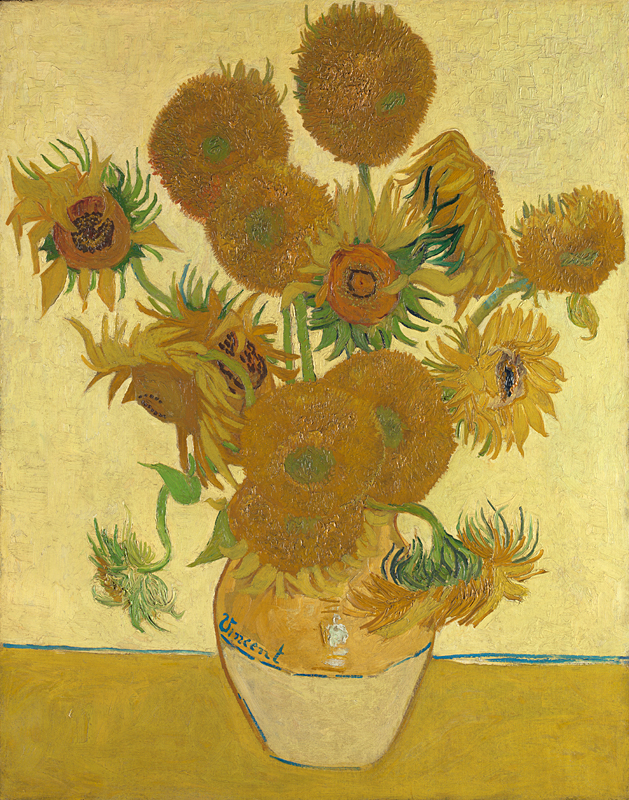
Sunflowers(1888), Vincent van Gogh
1 Project background
The project proposal is to create a bacterial painting of Vincent van Gogh’s Sunflowers (1888), which hangs in London’s National Gallery. Bacterial pigments will be applied to an agar medium inside a petri plate. The choice of which biopigments to use will be based on those whose hues best correspond to the pigments which appear in parts of the original painting.
I would like to use the art work as an example of showing how living bacteria species can produce colours that could be analogous to those which have traditionally been provided by chemical pigments. I would take time lapse photographs at different points between finishing the work and when the bacteria had died. This is meant to reflect the natural change in colours shown in the original artwork.
By using bacteria to help make the art work, I am hoping:
- it encourages people to develop an interest in micro organisms, who often goes unnoticed in our day-to-day living.
- it encourages discussions about whether microorganisms could - or should - provide a viable alternative to synthetic colourants
- it encourages people to appreciate the aspect of transience in Bioart by referring to an original artwork which itself showing transience in its colours
I would like to do this particular project for two reasons:
- bacterial painting is a well-established activity that appears to have gathered significant recommendations relating to ethics, biosafety and biosecurity.
- it is a piece of Bioart, which would seem to encounter different benefits-vs-harms issues because it balances an aesthetic rather than a utility-based outcome versus potential risks.
I’ve chosen to use van Gogh’s Sunflowers painting for the following reasons:
- its subject matter is likely to remain recognisable if it becomes more abstracted in the process of drawing it on a petri dish with a low resolution of ‘bacterial pixels’. the pigment composition of the painting is well-understood
- it is an example of an art work which is undergoing colour change, which may make it more relatable to the changing nature of a work made with living organisms.
I believe that my project is ethical. Its risks can be reduced by adopting aspects of governance which considers best practice for handling biomaterials. Its benefits include promoting an interest in viewers to learn more about microorganisms. Its benefits and risks can also be better articulated by identifying the key ethical questions involved with presenting microorganisms in art.
2 Developing a policy framework to make the project contribute to an ethical future of bioengineering
I would derive a governance framework based both on the general framework provided in the assignment and a set of ethical questions that would be specifically about microbial art. Fawcett and Dumitriu, who have collaborated as scientist and artist respectively, have produced a useful commentary outlining key questions for displaying microbiological Bioart. They are:
- What are the overall aims and potential benefits of the piece?
- Do these aims require, or are enhanced by, the use of the ‘real thing’?
- If there are risks, how can they be minimised, and how do they compare to existing public displays?
The policy goals for this project will include the following:
- Beneficence of artistic expression. As a piece of Bioart, the outcome must demonstrate some benefit borne from its aesthetic. Justification for using living microorganisms. As a piece of Bioart, the use of living microorganisms must be at least important if not necessary for creating the outcome.
- Biosecurity. As a bioengineering activity, the project must prevent harm presented by biosecurity concerns.
- Biosafety. As a bioengineering activity, the project must prevent harm presented by biosafety concerns.
- Feasibility. As a bioengineering activity, the project must be practical enough to do and not present too great an expense of resources.
3 Ideation of actions to support policy framework
3.1 Policy goal: benificence of artistic expression actions
3.1.1 Action: acquire naturally occurring bacteria which happen to produce colours that match those in the original painting.
Purpose: to use naturally occurring species of bacteria that are not genetically altered and which produce accurate analogous hues to the hues shown in Sunflowers. These bacteria contribute both to the aesthetic of the art work and provide a more interesting variety of stories of the ecosystems in which they live.
Design: Identify ethical vendors who stock naturally occurring colour-producing bacteria. Ensure that they have quantifiable hue ranges that can be matched with those of analogous pigments used in Sunflowers.
Assumptions:
- There is a great enough variety of naturally occurring bacteria that happen to produce accurate matches for Sunflower pigment colours.
Risks of Failures and Success: This action could fail if the variety of accurate colour matches with Sunflowers pigments is low.
Effectiveness: High
3.1.2 Action: share credit for the artwork with the microorganisms
Purpose: Supports raising awareness of microorganisms with the viewer.
Design: Name and describe the species and modifications to bacteria used to produce colour. In the display, describe the species of bacteria used for the artwork. Describe the genes responsible for creating the colour. Indicate if those genes were the result of genetic modification, either to a normal gene or by inserting a gene. If relevant, describe the source organisms that provide transferred genes which are used to produce the colours.
Assumptions:
- Detailed provenance for mail-ordered microbial colourants is available.
Risks of Failures and Success: Failure to provide adequate information undermines the interest of highlighting the role and importance of the organisms which contributed to the artwork.
Effectiveness: High
3.1.3 Action: acquire genetically altered bacteria which produce colours that match the original painting.
Purpose: to use genetically altered species of bacteria that are programmed to express proteins whose colours match the hues shown in Sunflowers. These bacteria contribute would mainly contribute to the aesthetic of the artwork, but would do less to promote the biodiversity of naturally occurring bacteria.
Design: Identify ethical vendors who stock bacteria which have been genetically altered to fluoresce with specific colours. Ensure that they have quantifiable hue ranges that can be matched with those of analogous pigments used in Sunflowers.
Assumptions: It is easy to obtain hue information about microbial pigment sources.
Risks of Failures and Success: Without sufficient information about the hue ranges produced by the vendor’s bacterial sources, they may not relate well to the hue ranges associated with the chemical pigments used by van Gogh.
Effectiveness: Medium
3.1.4 Action: acquire naturally occurring bacteria which happen to produce colours that match the original painting.
Purpose: to use naturally occurring species of bacteria that are not genetically altered and which produce accurate analogous hues to the hues shown in Sunflowers. These bacteria contribute both to the aesthetic of the art work and provide a more interesting variety of stories of the ecosystems in which they live.
Design: Identify ethical vendors who stock naturally occurring colour-producing bacteria. Ensure that they have quantifiable hue ranges that can be matched with those of analogous pigments used in Sunflowers.
Assumptions:
- There is a great enough variety of naturally occurring bacteria that happen to produce accurate matches for Sunflower pigment colours.
Risks of Failures and Success: This action could fail if the variety of accurate colour matches with Sunflowers pigments is low.
Effectiveness: Medium
3.2 Policy goal: minimising need for using natural resources
3.2.1 Action: use only the protein colourants produced by the bacteria rather than the bacteria themselves in the art work.
Purpose: Provides a way of producing colourant that better supports biosecurity and biosafety concerns.
Design: Order colourants which contain only the coloured byproducts of bacteria rather than the bacteria themselves. Use a normal paintbrush, bacteria-derived watercolourants and paper to reproduce van Gogh’s Sunflowers painting.
Assumptions:
- It is possible to obtain colourants which only contain the colour-producing proteins but not microorganisms themselves.
Risks of Failures and Success: This option greatly reduces the biosafety and biosecurity risks. However, the end product is unlikely to qualify as Bioart, because many artists define Bioart as working collaboratively with a living organism, not its byproducts. It might encourage people to think of bacteria-derived colourants as an alternative to chemical paints, but the project would fail to emphasise the importance or contribution of microorganisms.
Effectiveness: High
3.2.2 Action: acquire genetically altered variants of common bacteria which produce colours that match those in the original painting.
This is essentially the same as ‘Acquire genetically altered bacteria which produce colours that match the original painting’. In this context, the main reason to use it is to reduce the amount of naturally occurring bacteria that are collected, which perhaps may come from fragile overharvested environments.
Effectiveness: Medium
Action. Acquire naturally occurring bacteria which happen to produce colours that match those in the original painting.
This action has already been defined to support the Beneficence of artistic expression policy goal. However, in this context, it is the least preferable option for reducing the reliance on natural sources of bacteria.
Effectiveness: Low
3.3 Policy goal: non-malfeasance
3.3.1. Action: obtain training about biosecurity and biosafety regulations and best practices
Purpose: to ensure that I’m able to adequately implement the practices that reduce the likelihood and impact of events relating to biosecurity and biosafety.
Design: Take the required laboratory practice training class, take notes and ask to have access to a recording.
Assumptions:
- None
Risks of Failures and Success: If this step failed I would not be allowed or want to embark on the project.
Effectiveness: High
3.3.2 Action: consult laboratory supervisor to verify ongoing compliance with regulations and best practices about biosecurity and biosafety
Purpose: to have my own practices spot-checked by laboratory staff who have great expertise in safely handling microbiological materials in the lab.
Design: During labs, actively seek the advice from laboratory staff about how I can improve my techniques.
Assumptions:
- None
Risks of Failures and Success: If this step failed I would not be allowed or want to embark on the project.
Effectiveness: High
3.3.3 Action: record the ‘performance’ of the microorganisms evolving the painting rather than the painting itself
Purpose: Captures an important aspect of Bioart, which is co-development of an art work between artist and the bacteria.
Design: When the art work begins to show colour, take a sequence of pictures or ideally a time-lapsed video that lasts until all the bacteria have died. Perhaps consider slowly heating the finished product to accelerate decay so that it is more practical to film. When the bacteria have died, autoclave the petri dish and everything in it. Safely dispose of the remains of the Bioart and allow the work to live on only through a video or a sequence of timed snapshots.
Assumptions: A video camera can track the decay of the bacterial painting.
Risks of Failures and Success: If the video camera footage or still shots don’t turn out well, it may compromise the Bioart goals.
Effectiveness: Medium
3.4 Policy goal: feasibility
3.4.1 Action: prefer colour-producing bacteria that may already be in stock in the lab.
Purpose: to reduce the time needed to order new materials when I could buy materials that are already in stock.
Design: Check with the London Lab whether it already has some colour-producing bacteria in stock.
Assumptions:
- The lab retain excess stock.
- The colours will match.
Risks of Failures and Success: This action could fail if there are no bacterial sources kept in stock in the London Lab, or if the ones that are retained do not match the pigment colours shown in Sunflowers.
Effectiveness: High
3.4.2 Action: prefer colour-producing bacteria that are made in the UK.
Purpose: to reduce the time and cost associated with obtaining reagents from other countries.
Design: Try to obtain colour-producing bacteria sources from the UK.
Assumptions:
- It is cheaper to obtain desired bacterial sources from the UK than ordering it from abroad.
Risks of Failures and Success: Failure will mean the bacteria have to be obtained from sources abroad.
Effectiveness: Medium
3.4.3 Action: consider heating the bacterial painting to make it decay quickly.
Purpose: to make photographic recording of how the painting decays cheaper to do.
Design: Once the painting has been finished and begins to show colour, perhaps slowly heat it to help speed up the evolution and then decay of bacterial growth. Denaturing coloured proteins may cause them to change hue and thereby make the work relatable to the changes found in the original Sunflowers.
Assumptions:
- Heating will adequately simulate what would happen to the painting if it were left to evolve until all the bacteria died.
Risks of Failures and Success: If heating just rapidly denatures the painting, it may not have a meaningful decay and therefore would not be worth doing.
Effectiveness: Low
4 Evaluating effectiveness of actions that support policy goals
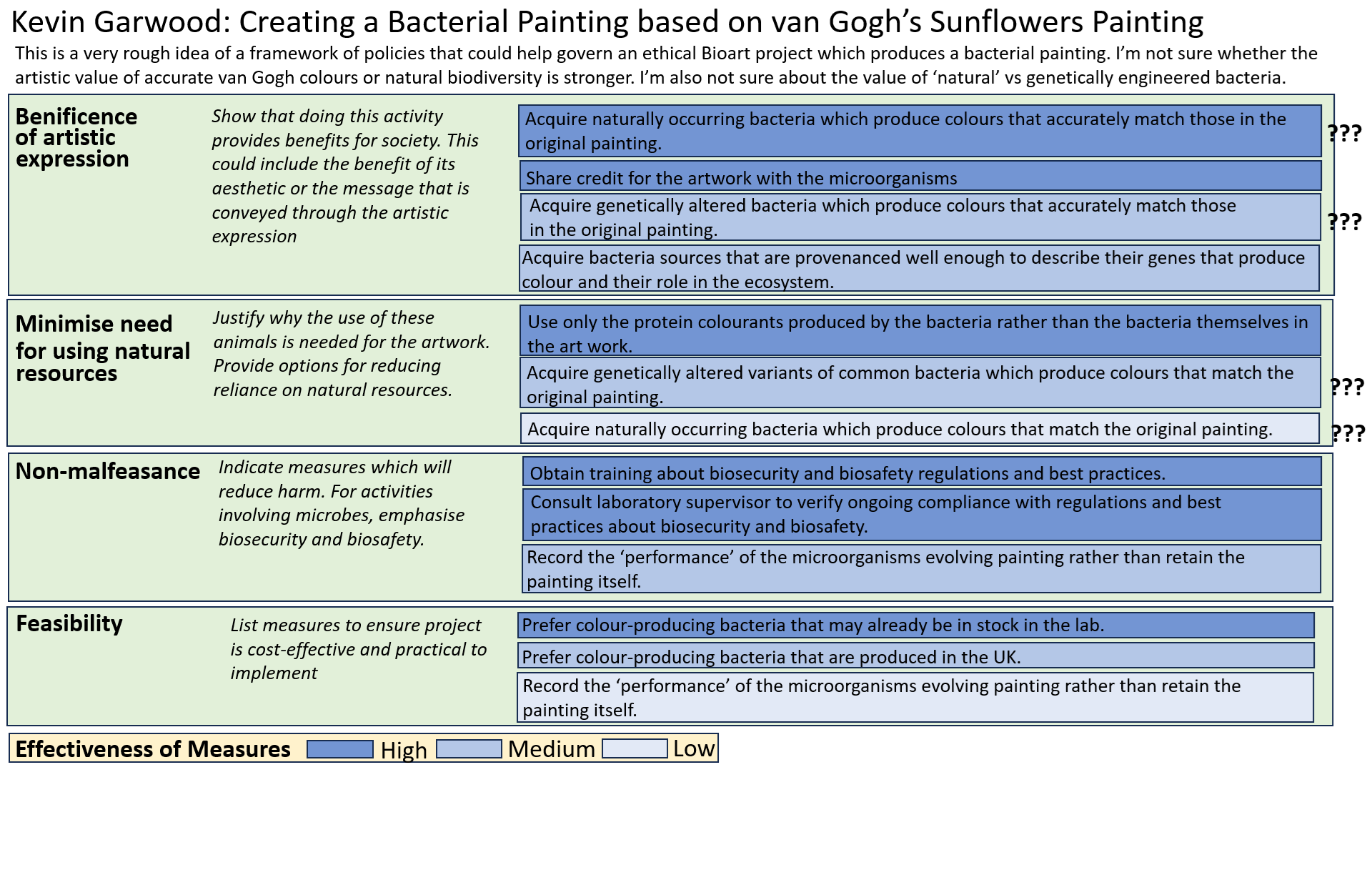
Based on these actions, I created the chart below and assigend High = 3, Medium = 2 and Low = 1.
5 Discussions of priorities and assumptions
Let’s assume that the list of prioritised actions will be viewed by a project review board that would allow me to do this project. Initially the most important part of the project is to promote the non-malfeasance policy goal. Without demonstrating those actions for minimising risks associated with biosecurity and biosafety the project should not proceed. In fact, for this exercise I’m not sure whether it makes sense to view either of these with a priority. Priority tends to suggest to me the idea of optionality and I can’t imagine a project being able to proceed without adequate training in laboratory techniques to minimise biosecurity and biosafety concerns.
Feasibility actions would be the next priority area of policy actions to consider because the project must be practical to implement in the lab. For example, I may find out that the variety of hues available through colour-producing bacteria is very limited or would be prohibitively expensive to diversify.
Beneficence of artistic expression actions would be the third most important area to prioritise. Once I become familiar with catalogues for ordering colour-producing bacterial sources, I should be able to acquire extra information about each species and at least some understanding of the genes which are responsible for making coloured proteins. I would not be suprised if matching colours with the original painting pigments may be a very rough guess! But, I do expect there would be enough basic bacterial hues to work with to make the work recognisable as a version of Van Gogh’s Sunflowers painting.
The lowest priority area is the actions for minimising the use of natural resources. I wouldn’t be going out to obtain colour-producing bacteria myself. These would be ordered from a catalogue. Let’s assume that the provider will do ethical sourcing of bacteria in a way which will not undermine fragile ecosystems. Once they obtain a sample of bacteria, presumably it is easy to replicate them as much as they want. This use of natural resources then would seem very different than for example, trying to make Bioart using loose fallen feathers gathered from endangered birds living at the edge of existence in a dwindling patch of rainforest.
In the process of identifying areas of policy that would govern the project, I encountered two issues. The first is that when I initially considered the need to minimise natural resources, I realised the ethics of using animals to produce art seems different for microbes than large animals. When Eduardo Kac produced a genetically engineered fluorescent rabbit as a piece of Bioart, it caused great controversy. However, if someone wants to use genetically engineered bacteria to produce Bioart, this seems to have already become acceptable.
From my own previous research into Bioart, I would conclude that human beings will be more empathetic about perceived harm to animals if they live at our scale of living (e.g. rabbits) and would appear to have the ability to experience pain. I also think that whereas humans have had thousands of years to work out their own sense of morality towards animals that live at their scale, they are still trying to figure out what is ethical to allow in relation to creatures that only became visible a few hundred years ago, and the world’s major religions had already long developed.
Another issue I encountered was observing a tension in goals between providing the best aesthetic outcome for bacterial pigments versus providing the most impactful message about biodiversity in the microbial world. I suspect that it is probably easier to get accurate colour matches between bacterial and oil paint pigments through genetically engineered bacteria versus using naturally occurring bacteria that produce different colours. I suspect that it is more cost effective to cultivate versions of common bacteria that have been altered in a specific gene which produces a coloured protein of a specific range of hues.
Mapping original pigments to biopigments
In the table below, the first two columns come from: Roy A. National Gallery Technical Bulletin, Volume 37. Yale University Press; 2016, p. 68.
| Painting Feature | Pigment Analysis | Potential Biopigment | Biopigment Context |
|---|---|---|---|
| The light brownish-grey ground, left-hand edge | Pb Lead white | ||
| Mid light blue of edge of table, left | French ultramarine | ||
| Intense dark blue streak on sunflower | Pb,Si,Al,Cr,Cu,Zn. Chrome yellow: French ultramarine | ||
| Intense dark blue, centre of sunflower | French ultramarine | ||
| Intense cold green of sunflower | Cr,Zn (Pb). Viridian, some chrome yellow | ||
| Mid yellow-reen petal | Cu,As,Pb,Cr,Zn Emerald green: chrome yellow | ||
| Mid yellow-green leaf | Cu, As, Pb, Cr, Zn. Emerald green:chrome yellow | ||
| Light dull greenish-yellow petal | Pb, Cr Chrome yellow | ||
| Pale yellow slightly greenish background,right-hand side | Zn Contains zinc white | ||
| Dark yellow tabletop | Pb, Cr (Zn) Chrome yellow | ||
| Dark yellow of sunflower (brighter orange-yellow below surface) | Pb, Cr (Zn) Chrome yellow (2 shades) | ||
| Dark orange-yellow of sunflower | Pb, Cr. Chrome orange(?) | ||
| Orange centre of sunflower | Chrome yellow: red lake | ||
| Reddish-ochre-coloured edge of sunflower | Pb, Cr(Zn). Chrome yellow: chrome orange(?) (zinc yellow + ochre in underlayers) | ||
| Yellow-green thickest impasto of uppermost sunflower | Pb, Cr, Zn, Fe(Mn, Al, Si). Chrome yellow: ochre | ||
| Very intense deep red glaze from sunflower, left-hand side | Red lake; red ochre; French ultramarine | ||
| Pale yellow of vase over pale pink | Traces of vermilion beneat the surface |
Notes:
- French ultramarine is also known as synthetic ultramarine.
- Viridian is also known as Hydrated chromium (III) oxide
- Emerald green is also known as copper acetoarsenite