Week 3 Lab Automation
Assignment 3
Following on from last week’s assignment, I decided to use Vincent van Gogh’s Sunflowers painting (the one hanging in the National Gallery) for my art subject. I tried to download an image of the painting and upload it to the Opentrons automated art interface. Importing it made some artistic effects I didn’t want - it flooded the background with yellow, left out the blue streaks and didn’t do much to distinguish between orange and yellows. Importing it created something that wasn’t recognisable.
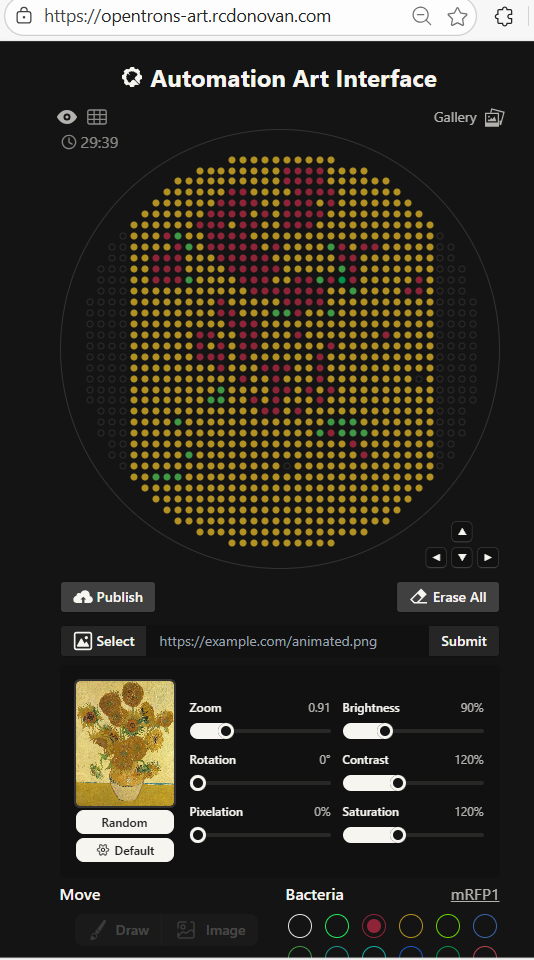
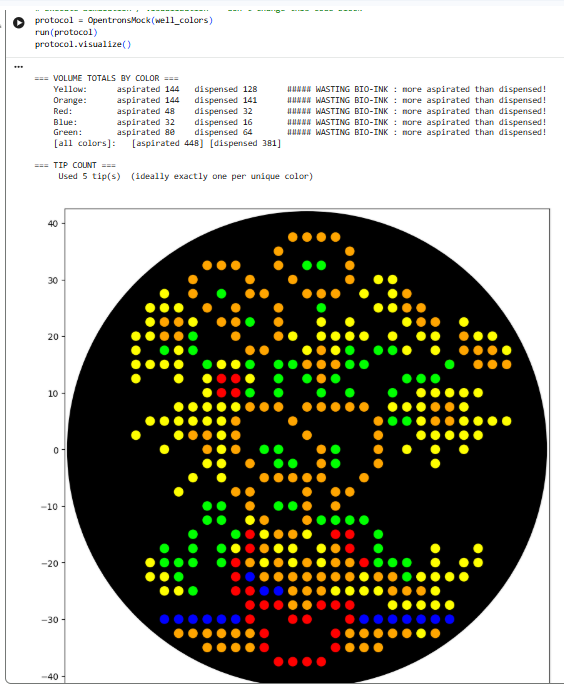
I was really impressed by the tool but opted to create my own from scratch. I made some decisions like hollowing out some of the flower petals because if I filled them all with orange and yellow they would look unrecognisable. I could have used the automation art interface to hand craft the image, but I wanted to learn more about the mechanics of how the opentrons commands would work rather than immediately rely on automatically generated code.
Like the autogenerated code, I concluded it would be more efficient to do successive passes of placing droplets by colour: first one colour, then another and the next. I spaced my droplets at 2.5 mm. I tried using a larger distance between drops, but the resolution dropped and I couldn’t make a recognisable painting of Sunflowers with the space I had available. If they bleed together, that might actually work - because the painting is itself slightly abstract and it wasn’t meant to appear to be too realistic.
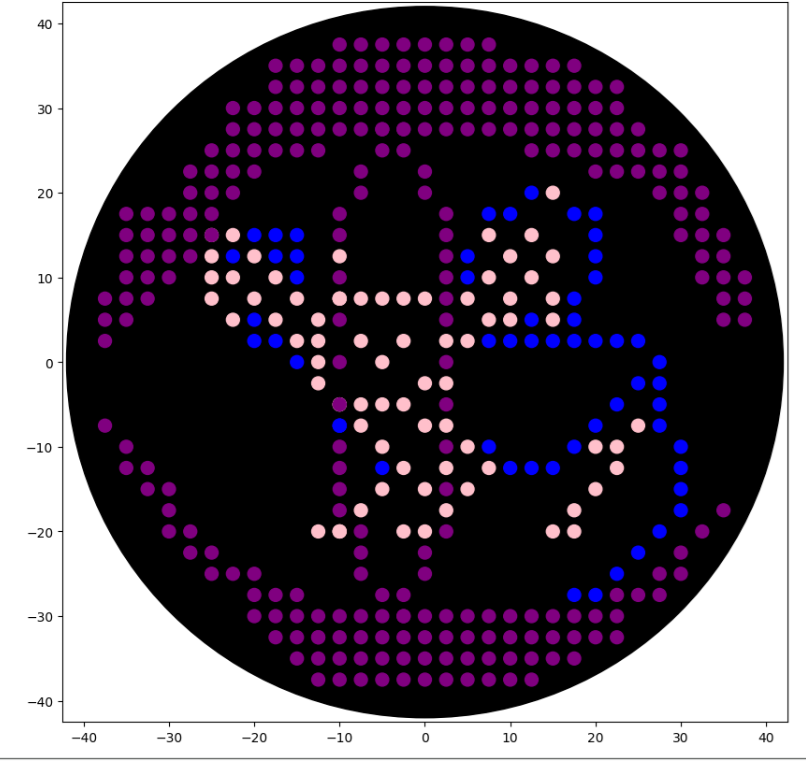
Note that because the lab only had colours for blue, pink and purple in stock, I had to rework my art. I call this one ‘Rattlesnake Dinner’ - it is meant to show how a snake might view a mouse through a thermal vision perspective.
Post Lab Questions
Find and describe a published paper that utilizes the Opentrons or an automation tool to achieve novel biological applications. The paper I chose was: Taguchi S, Matsuzawa R, Suda Y, Irie K, Ozaki H. Investigating the effects of liquid handling robot pipetting speed on yeast growth and gene expression using growth assays and RNA-seq. Micropublication Biology. 2025 May 13;2025:10-7912. Available here
The paper notes that: “.the influence of pipetting speed on biological experiments, —particularly when systematically varied using liquid-handling robots and evaluated through gene expression and cell growth—remains poorly investigated.” It conducted multiple experimental runs on an Opentrons to determine how the variation in pipetting speed influenced gene expression of Saccharomyces cerevisiae.
The authors write: “In conclusion, within the range of pipetting speeds investigated, variations in pipetting speed did not impact the maximum relative growth rate and the gene expression profiles of yeast.” The finding implies that if the Opentrons OT-2 were run at its top pipetting speed, there would not be much difference in gene expression of yeast colonies.
Write a description about what you intend to do with automation tools for your final project. You may include example pseudocode, Python scripts, 3D printed holders, a plan for how to use Ginkgo Nebula, and more. You may reference this week’s recitation slide deck for lab automation details. While your description/project idea doesn’t need to be set in stone, we would like to see core details of what you would automate. This is due at the start of lecture and does not need to be tested on the Opentrons yet.
For my final project, I plan to 3D print multiple objects based on models derived from various Green Man sculptures found in architecture (and particularly churches). I have already begun to use the application Polycam to take hundreds of pictures of Green Man figures in Ely Cathedral. I’ve been able to convert those into *.STL files which I hope to eventually print in the Lifefabs Lab. I will be experimenting with which sculpture provides the best surface properties to grow colonies of GFP-containing bacteria.