Week 11: Bioproduction and Cloud Labs
Part A: The 1,536 Pixel Artwork Canvas | Collective Artwork
Contribute at least one pixel to this global artwork experiment before the editing ends on Sunday 4/19 at 11:59 PM EST. A personalized URL was sent to the email address associated with your Discourse account, and you can discuss the artwork on the Discourse. If you did not have a chance to contribute, it’s okay, just make sure you become a TA this fall! 😉 Make a note on your HTGAA webpages including: what you contributed to the community bioart project (e.g., “I made part of the DNA on the bottom right plate”) what you liked about the project, and what about this collaborative art experiment could be made better for next year.
This is the pixel I contributed:
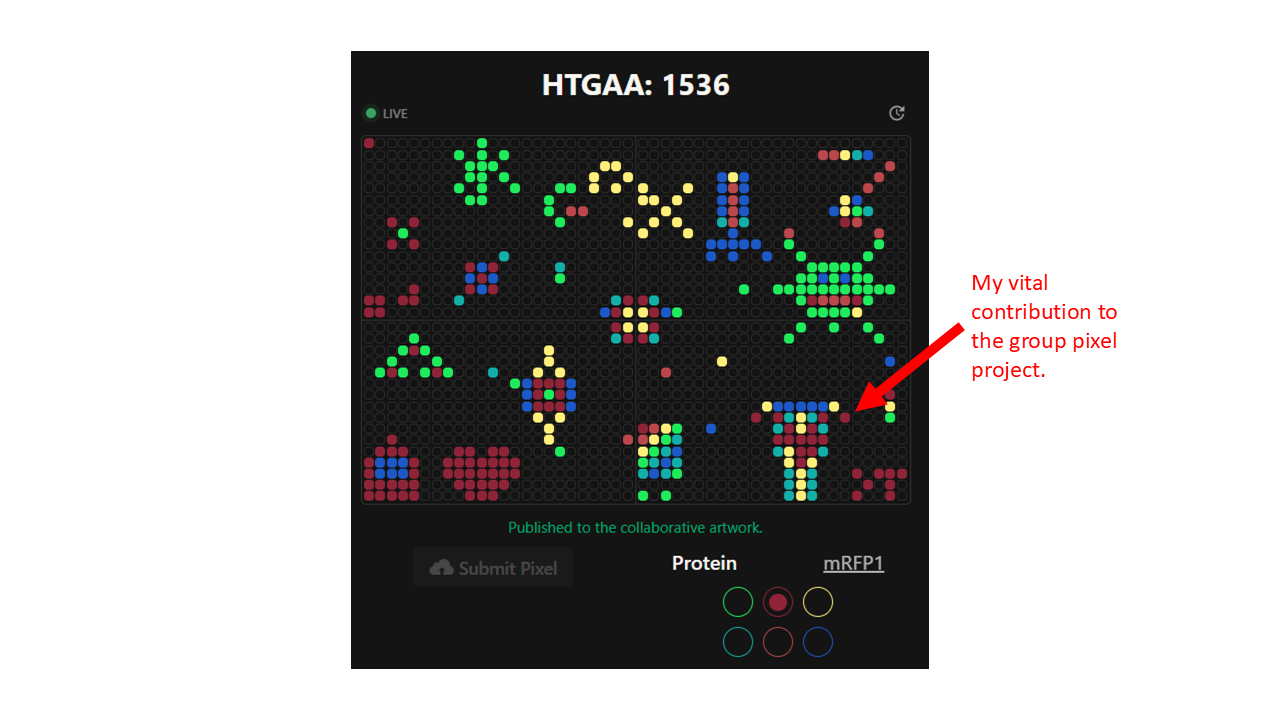
I saw that students appeared to be trying to create a person in the lower right corner and I added part of a left arm. I liked the fact that everyone could contribute a small instruction to a program that could drive an Opentrons robot remotely. Encourage art subjects to relate to the creatures that produce the fluorescent proteins.
Part B: Cell-Free Protein Synthesis | Cell-Free Reagents
1.Referencing the cell-free protein synthesis reaction composition (the middle box outlined in yellow on the image above, also listed below), provide a 1-2 sentence description of what each component’s role is in the cell-free reaction.
E. coli Lysate
- BL21 (DE3) Star Lysate (includes T7 RNA Polymerase). contains the substances that are left after the E. coli’s membrane has been broken. It provides the machinery that is necessary to support translation activities in the cell-free system. The star lysate is designed to limit activity of RNase, which are enzymes that can degrade the mRNA that influence protein yield.
Salts/Buffer
- Potassium Glutamate. Provides high concentrations of potassium ions and glutamate, which help to mimic the intracellular environment that would exist in cell-based systems.
- HEPES-KOH pH 7.5. Helps provide optimal pH to support enzymes involved with transcription and translation.
- Magnesium Glutamate. Magnesium ions help stabilise the function and structure of the ribosome, which helps translate messenger RNA into functional proteins.
- Potassium phosphate monobasic. Helps maintain a stable pH by resisting a pH increase.
- Potassium phosphate dibasic. Helps maintain a stable pH by resisting a pH decrease.
Energy / Nucleotide System
- Ribose. It is a sugar that forms the backbone of ribonucleotides such as ATP, GTP, CTP, UTP, which are used for transcription and energy transfer.
- Glucose. It is a sugar which can be used by enzymes in the lysate to create ATP, which is essential for translation and transcription.
- AMP. Adenosine monophosphate can be converted into ADP and ATP, which allows it to help recycle nucleotides that accumulate in long-running cell-free protein synthesis reactions.
- CMP. Cytidine monophosphate is one of the four monophosphates that are used to form the building blocks of RNA.
- GMP. Guanosine monophosphate serves as a precursor for synthesising GTP, which is one of the four ribonucleotide triphosphates required for mRNA polymerisation.1
- UMP.Uridine monophosphate is a precursor for UTP, which is required for mRNA synthesis.
- Guanine. It is a precursor for guanosine nucleotides that are essential for translation and transcription activities.
Translation Mix (Amino Acids)
- 17 Amino Acid Mix. Provide the building blocks of the proteins that are produced and allow translation to occur.
- Tyrosine. One of the 20 standard amino acids that cells can synthesise but which must be supplied externally in cell-free protein synthesis systems. The ribosome includes tyrosine into building polypeptide chains whenever it encounters a UAC or UAU codon.
- Cysteine. One of the 20 standard amino acids that can help form disufide bonds that are critical for protein structures.
Additives
- Nicotinamide. It is a precursor of NAD+/NADP+, which are essential cofactors for proteins that work in energy and redox reactions.
Backfill
- Nuclease Free Water. A solvent for CFPS reactions that is designed to prevent degradation of nucleic acids.
Describe the main differences between the 1-hour optimized PEP-NTP master mix and the 20-hour NMP-Ribose-Glucose master mix shown in the Google Slide above. (2-3 sentences) The 1 hour optimised master mix is supports fast, high energy reactions that are good for short experiments with small-scale expression. The 20 hour mix supports slower reactions that have more sustainable nucleotide regeneration that is best for prolonged, high-yield protein synthesis at lower cost.
Part C: Planning the Global Experiment | Cell-Free Master Mix Design
1.Given the 6 fluorescent proteins we used for our collaborative painting, identify and explain at least one biophysical or functional property of each protein that affects expression or readout in cell-free systems. (Hint: options include maturation time, acid sensitivity, folding, oxygen dependence, etc) (1-2 sentences each)
- sfGFP. It has a higher fluorescence intensity and greater photostability than GFP, making sfGFP the better protein for imaging applications. [^22]
- mRFP1. The fact that it emits in the red spectrum means it is useful for experiments that make use of multiple colours of fluorescent proteins. Red light experiences less autofluoresence in many biological systems.
- mKO2. It is suitable for long-term expression monitoring because of its ability to resist degradation when it is exposed to light (photostability).
- mTurquoise2. It has rapid chromophore formation which supports early fluorescence readout. It is ideal for short CFPS reactions.
- mScarlet_I. High expression of the protein may lead to crowding effects that reduce effective fluorescence. The crowding effects reduce the volume that is occupied by macromolecules, which can influence how well they diffuse, react or support protein folding.
- Electra2. Although it has a rapid maturation time, it still requires post-translational chromophore maturation that means for short CFPS reactions, some of the protein may not fluoresce before an experiment ends.
The amino acid sequences are shown in the HTGAA Cell-Free Benchling folder.
2. Create a hypothesis for how adjusting one or more reagents in the cell-free mastermix could improve a specific biophysical or functional property you identified above, in order to maximize fluorescence over a 36-hour incubation. Clearly state the protein, the reagent(s), and the expected effect. Consider how we might maximise fluorescence of mTurquoise2, which experiences rapid chromophore formation and supports early flourescenct readout. It is good at supporting short cell-free protein syntheses, but 36 hours of incubation is a long time and could present some problems. Adding a high concentration of amino acids will ensure that translation continues and won’t stall. ATP and GTP levels may need to be kept high to support the energy demands required for such a prolonged period of translation.
3. The second phase of this lab will be to define the precise reagent concentrations for your cell-free experiment. You will be assigned artwork wells with specific fluorescent proteins and receive an email with instructions this week (by April 24). You can begin composing master mix compositions here. I’m not sure we did this for our cell-free lab.
4. The final phase of this lab will be analyzing the fluorescence data we collect to determine whether we can draw any conclusions about favorable reagent compositions for our fluorescent proteins. This will be due a week after the data is returned (date TBD!). The reaction composition for each well will be as follows: 6 μL of Lysate 10 μL of 2X Optimized Master Mix from above 2 μL of assigned fluorescent protein DNA template 2 μL of your custom reagent supplements Total: 20 μL reaction I’m not sure we did this for our cell-free lab. I remember we were using tiny magnetic beads that would allow us to help extract proteins we wanted to make.
Guanosine Monophosphate, Science Direct, https://www.sciencedirect.com/topics/neuroscience/guanosine-monophosphate, Accessed May 22, 2026. ↩︎