Week 3 Lab Automation
Python Script for Opentrons Artwork
- Generate an artistic design using the GUI at opentrons-art.rcdonovan.com.
Here is my design with opentrons-art.rcdonovan.com.
opentrons-art.rcdonovan.com/?id=l061355i5d3bc5n

- Using the coordinates from the GUI, follow the instructions in the HTGAA26 Opentrons Colab to write your own Python script which draws your design using the Opentrons.
Here is my script from Google Colab:
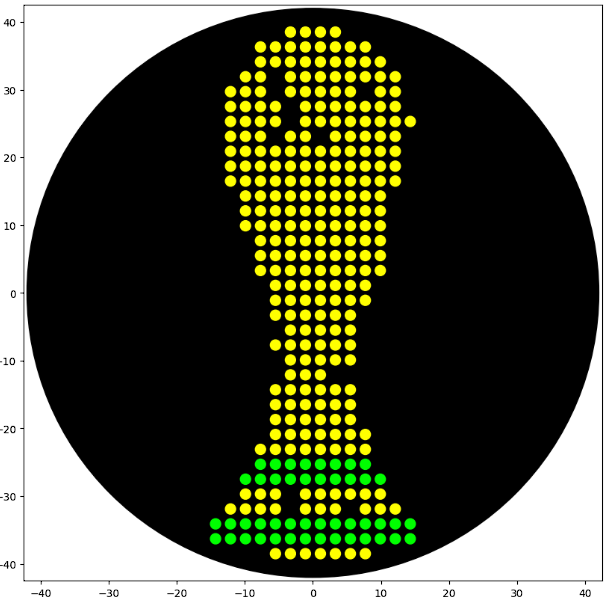
I used chat gpt to help me coding the script to produce my design.
Post-Lab Questions
- Find and describe a published paper that utilizes the Opentrons or an automation tool to achieve novel biological applications.
The paper I found is: AssemblyTron: flexible automation of DNA assembly with Opentrons OT-2 lab robots.
- What is this paper about?
This paper presents an open-soruce Python package that integrates j5 DNA design outputs with the Opentrons OT-2 to automate DNA assembly workflows. The system performs optimized PCR, Golden Gate, and homology-based assemblies with minimal human intervention. AssemblyTron reduces human error in the Build step of the Design–Build–Test–Learn (DBTL) cycle. The authors demonstrate comparable fidelity and transformation efficiency to manual cloning. This work makes automated molecular cloning more accessible and affordable for academic laboratories.
- Write a description about what you intend to do with automation tools for your final project. You may include example pseudocode, Python scripts, 3D printed holders, a plan for how to use Ginkgo Nebula, and more. You may reference this week’s recitation slide deck for lab automation details. While your description/project idea doesn’t need to be set in stone, we would like to see core details of what you would automate. This is due at the start of lecture and does not need to be tested on the Opentrons yet.
I would like to design and optimize a synthetic transcriptional biosensor that detects inglammatory biomakers, another idea was using as well a biosensor as a patch to detects muscle stress, both using cell free gene circuit. For either idea automation is necessary to enable high-throughput DNA assembly, standardized reaction set up, reproducible cell free expression assays, and measurment of circuit performance.