Week 11 HW
https://2026a.htgaa.org/2026a/course-pages/weeks/week-11/index.html
Part A: The 1,536 Pixel Artwork Canvas | Collective Artwork
Contribute at least one pixel to the global artwork experiment before editing ends. Discuss on the Discourse forum.
I missed the deadline for this, sorry!
Part B: Cell-Free Protein Synthesis | Cell-Free Reagents
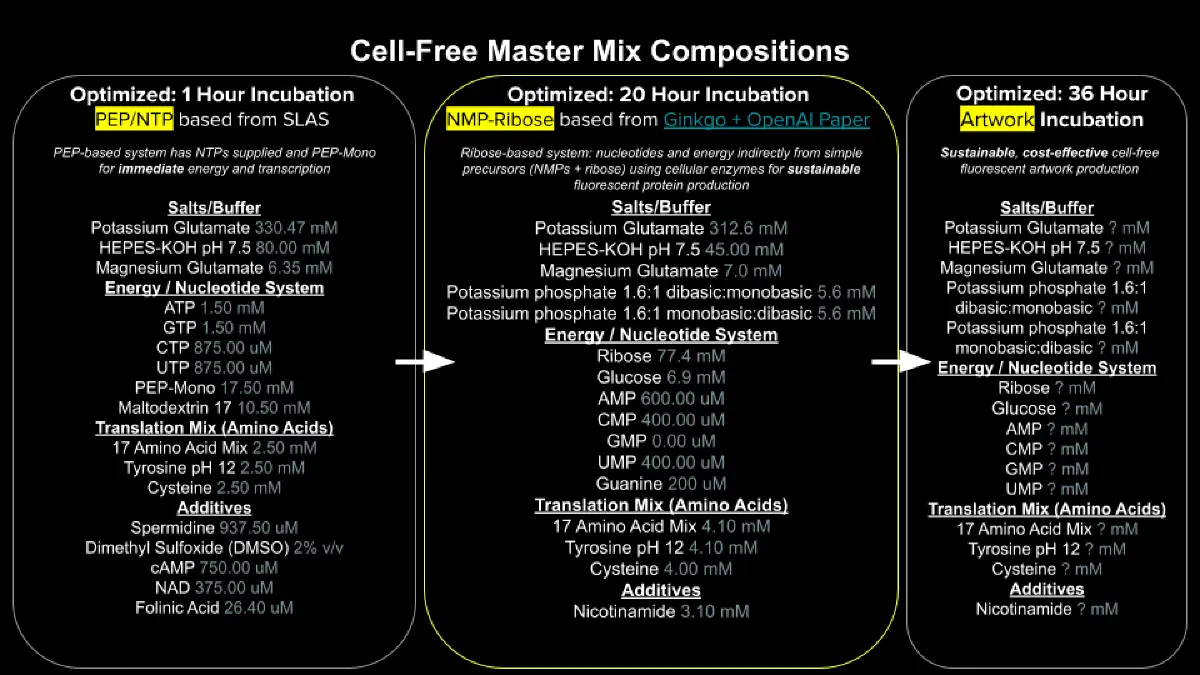
Provide 1–2 sentence descriptions of each component’s role in the cell-free reaction:
- E. coli Lysate: BL21 (DE3) Star Lysate (includes T7 RNA Polymerase)
Provides the core machinery for translation and transcription of proteins.
- Salts/Buffer: Potassium Glutamate, HEPES-KOH pH 7.5, Magnesium Glutamate, Potassium phosphate monobasic, Potassium phosphate dibasic
- Potassium Glutamate — Provides K⁺ at high concentration (~100–200 mM) to support ribosome function and translation fidelity
- HEPES-KOH pH 7.5 — Zwitterionic Good’s buffer that holds pH near the optimum for transcription/translation enzymes despite acid production
- Magnesium Glutamate — Supplies Mg²⁺, the critical divalent cofactor for ribosome assembly, tRNA structure, aminoacyl-tRNA binding, peptidyl transferase, and RNA polymerase activity
- Potassium phosphate monobasic (KH₂PO₄) / dibasic (K₂HPO₄) — Together act as a secondary phosphate buffer near pH 7 and supply inorganic phosphate that feeds the energy regeneration system
- Energy/Nucleotide System: Ribose, Glucose, AMP, CMP, GMP, UMP, Guanine
- Ribose — Sugar substrate that gets phosphorylated to ribose-5-phosphate and then to PRPP, supplying the sugar-phosphate backbone for nucleotide salvage
- Glucose — Primary carbon/energy fuel feeding glycolysis to regenerate ATP via substrate-level phosphorylation
- AMP, CMP, GMP, UMP — Cheap nucleoside monophosphate inputs that kinases phosphorylate up to NTPs for transcription and translation
- Guanine — Free base salvaged with PRPP into GMP, cheaply replenishing the heavily-consumed GTP pool used in translation
- Translation Mix (Amino Acids): 17 Amino Acid Mix, Tyrosine, Cysteine
- 17 Amino Acid Mix — Provides 17 of the 20 proteinogenic amino acids as monomers that aminoacyl-tRNA synthetases load onto tRNAs for ribosomal polymerization
- Additives: Nicotinamide
- Inhibits NAD+ consuming enzymes. NAD⁺ is required at the GAPDH step of glycolysis, so once it’s gone, ATP regeneration from glucose stalls and translation dies.
- Backfill: Nuclease Free Water
- Nuclease-Free Water — Brings the reaction to final volume while avoiding contaminating RNases/DNases that would degrade the mRNA and DNA template.
- water that’s been DEPC-treated and/or filtered, packaged sterile, and certified by the manufacturer to have no detectable RNase activity
Describe the main differences between the 1-hour optimized PEP-NTP master mix and the 20-hour NMP-Ribose-Glucose master mix (2–3 sentences).
(This is my best effort answer using Claude’s LLM!)
The whole design question of any CFPS recipe is: what’s your refueling strategy.
PEP-NTP — bring premium fuel and a pressurized recharge cartridge. PEP-NTP mix supplies pre-made high-energy substrates directly.
Glucose-NMP — bring crude oil and an onboard refinery. NMP-Ribose-Glucose mix uses glucose-fed glycolysis as a slower but sustained ATP regenerator.
Part C: Planning the Global Experiment | Cell-Free Master Mix Design
For each of the 6 fluorescent proteins used for collaborative painting, identify and explain at least one biophysical or functional property affecting cell-free expression or readout (1–2 sentences each):
Engineered “superfolder” variant with rapid, chaperone-independent folding and fast maturation (~14 min), which is why it’s the default CFPS reporter
Slow chromophore maturation (hours) plus low brightness means much of the protein made during a short CFPS reaction never becomes fluorescent inside the readout window
Combines fast maturation with comparatively low pKa for fluorescence (~5.5), making readout robust to the pH drift that occurs in glycolysis-fueled cell-free reactions as organic acids (lactate, pyruvate) accumulate
Highest quantum yield of any cyan FP (~0.93) and an unusually long fluorescence lifetime, so it gives a strong signal at low CFPS expression levels
The “I” (improved-maturation) variant trades a modest QY hit for a maturation time of ~36 min versus multi-hour for parent mScarlet,
Blue FP with excitation ~403 nm and emission ~456 nm, which collides directly with NAD(P)H autofluorescence
Create a hypothesis for adjusting one or more reagents in the cell-free mastermix to improve a specific biophysical or functional property and maximize fluorescence over 36-hour incubation. Clearly state the protein, reagents, and expected effect.
Hypothesis: For expression of eGFP in BL21(DE3) Star E. coli lysate, increasing the ATP-regeneration capacity and stabilizing redox balance will extend productive translation time, improve chromophore maturation, and increase total fluorescence over a 36-hour incubation.
Protein: enhanced green fluorescent protein, eGFP.
Reagents to adjust: increase glucose or replace part of the glucose with maltodextrin as a slower-release carbon source
Expected effect: Maltodextrin should feed glycolysis more gradually than free glucose, reducing early fuel depletion and pH stress while sustaining ATP regeneration for longer
Begin composing master mix compositions here once assigned artwork wells are received.
Final phase: analyze fluorescence data to determine favorable reagent compositions (due one week after data return). Reaction composition per well: 6 μL Lysate, 10 μL 2X Optimized Master Mix, 2 μL assigned fluorescent protein DNA template, 2 μL custom reagent supplements (20 μL total).
Not sure where data was, sorry doing this HW late!!