Homework
Weekly homework submissions:
Week 1 HW: Principles and Practices
Class Assignment A Wearable or At-Home Androgen Biosensing Platform for PCOS Diagnosis and Management I am interested in developing an easy-to-use biosensor/microfluidic kit that can detect and quantify androgen levels from blood or sweat to support the diagnosis and personalized management of Polycystic Ovary Syndrome (PCOS).
Week 2 HW: DNA Read, Write, and Edit
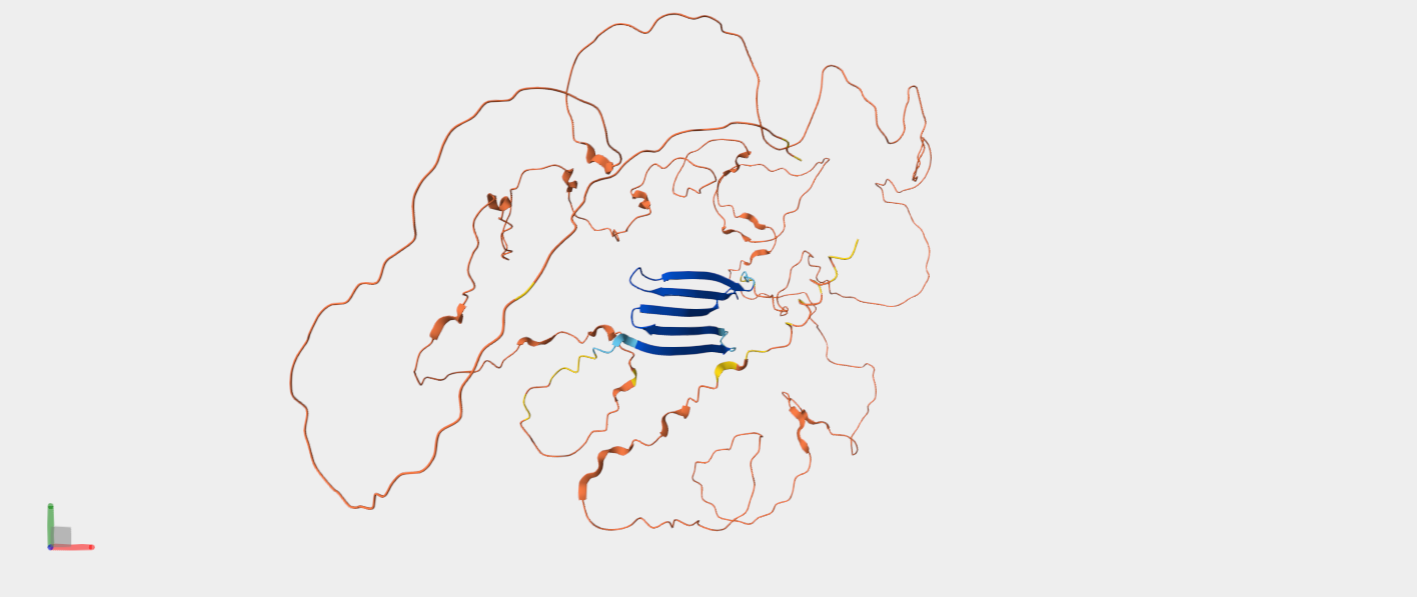
Predicted structure of Pro-resilin (Drosophila melanogaster), generated by AlphaFold and retrieved from UniProt (UniProtKB: Q9V7U0). *You can find parts 1 and 2 in the week 2 lab section! Part 3: DNA Design Challenge My protein choice: Pro-resilin! Pro-resilin is a highly elastic, rubber-like structural protein found in insects that enables efficient energy storage for jumping, flight, and sound production. About seven years ago, my biotechnology teacher in high school showed us an article about a very cool leading professor in Israel, who was doing things that seemed almost impossible. I vividly remember one of the projects he was working on: scientists had identified a protein that enables a particular spider species to jump remarkably high relative to its body size, and this scientist wanted to give humans the same ability by creating shoes with soles made from some protein similar to Pro-resilin.
*You can find the Python Script for Opentrons Artwork part in the Week 3 Lab section! Post-Lab Questions 1. Find and describe a published paper that utilizes the Opentrons or an automation tool to achieve novel biological applications.
Week 4 HW: Protein Design Part I
Part A. Conceptual Questions How many molecules of amino acids do you take with a piece of 500 grams of meat? (on average an amino acid is ~100 Daltons) Answer: On average, raw meat is ~20%-25% protein by weight, say we take it to be 20%, in the 500g sample we have, we will have 500*0.20 = 100g of protein. 1g = 6.022e+23 Daltons, so 100g = 6.022e+25, and then: # of AA = 6.022e+25/100 = 6.022e+23 AAs!