Week 7 HW: Genetic Circuits Part II
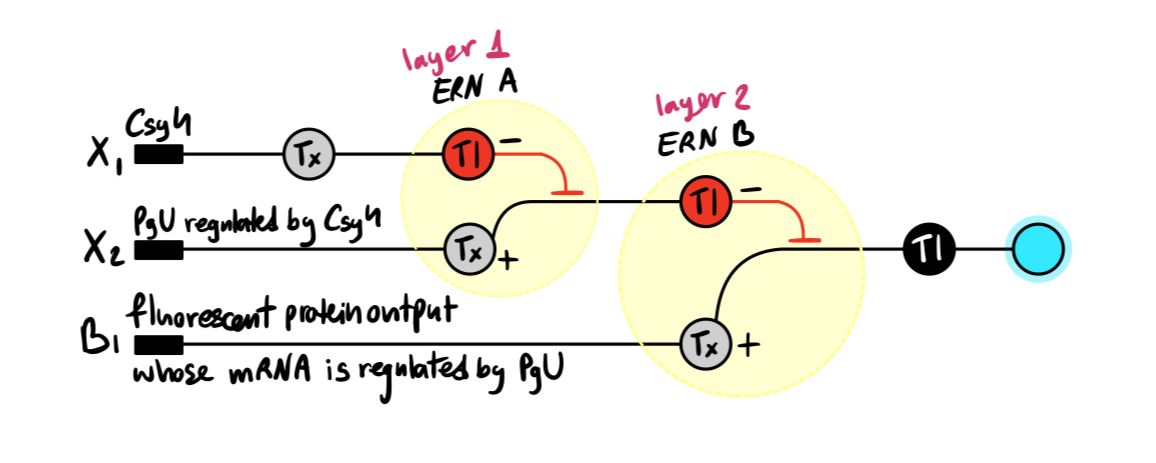
Part 1: Intracellular Artificial Neural Networks
- What advantages do IANNs have over traditional genetic circuits, whose input/output behaviors are Boolean functions?
Answer: The main advantage of IANNs over traditional genetic circuits is their ability to operate with analog (continuous) inputs and outputs, rather than being limited to Boolean (ON/OFF) behavior. This allows cells to respond more precisely to different signal levels instead of only detecting their presence or absence.
Additionally, IANNs can combine multiple inputs and balance their effects, allowing for more complex decision-making. Unlike Boolean circuits, which are limited to simple logic operations, IANNs can approximate many different types of functions, making them much more flexible for designing complex biological behaviors.
- Describe a useful application for an IANN; include a detailed description of input/output behavior, as well as any limitations an IANN might face to achieve your goal.
Answer: A useful application of an IANN is a smart therapeutic cell that releases a drug only under specific biological conditions, for example, in response to disease signals.
The inputs to the system could be concentrations of molecules such as inflammatory markers or hormones. Each of these inputs would affect the system differently (some activating, some repressing), and the IANN would combine them in a weighted way. The output would be the level of expression of a therapeutic protein, such as an anti-inflammatory drug or a cancer-targeting molecule. Instead of turning fully ON or OFF, the output could be graded, meaning the cell releases more drug when the signals are stronger or more relevant.
This allows the cell to make more precise decisions compared to traditional Boolean circuits, for example, only producing a high drug dose when multiple disease signals are present at certain levels.
However, there are several limitations. Biological systems are noisy and variable, so the same inputs may not always produce the same output. It is also difficult to precisely control the “weights” (strength of interactions), since they depend on complex factors like binding affinity and gene expression levels. Additionally, responses can be slow due to transcription and translation times, and the system may be affected by changes in the cellular environment. These challenges can make it hard to achieve reliable and predictable behavior.
Another important limitation is that the circuit exists inside a living cell, which has its own regulatory systems. Native proteins or molecules in the cell may unintentionally interact with parts of the circuit, activating or repressing it in unexpected ways. In the best case, this disrupts the intended logic of the system, and in the worst case, it could lead to incorrect levels of drug production, which may be harmful.
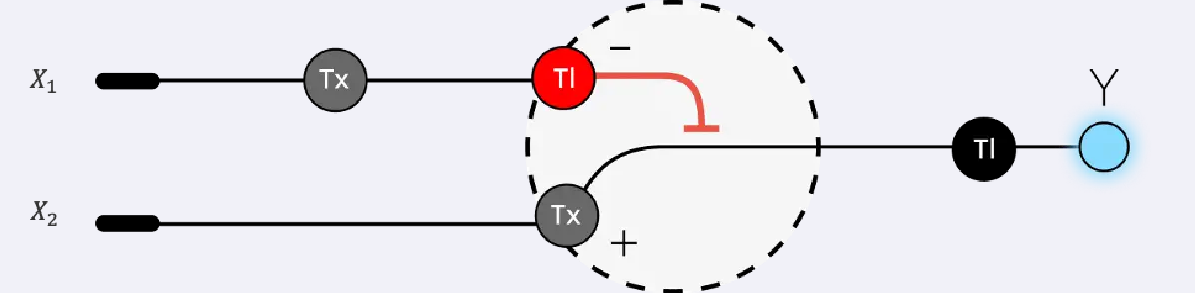
- Below is a diagram depicting an intracellular single-layer perceptron where the X1 input is DNA encoding for the Csy4 endoribonuclease and the X2 input is DNA encoding for a fluorescent protein output whose mRNA is regulated by Csy4. Tx: transcription; Tl: translation.
Draw a diagram for an intracellular multilayer perceptron where layer 1 outputs an endoribonuclease that regulates a fluorescent protein output in layer 2.
Answer:
Part 2: Fungal Materials
- What are some examples of existing fungal materials and what are they used for? What are their advantages and disadvantages over traditional counterparts?
Answer: Examples of fungal materials include mycelium-based materials and biocement. Mycelium materials are used for packaging, insulation, furniture, and building, and are even being explored by NASA for space habitats. Biocement uses microbes to bind materials like sand into solid structures.
Their advantages include being lightweight, biodegradable, moldable into many shapes, and good for thermal and acoustic insulation. They can also be grown from waste materials, making them sustainable.
However, they can be brittle and weaker than traditional materials, harder to scale, and slower to produce. Since they are biologically grown, they can also be inconsistent and sensitive to environmental conditions.
- What might you want to engineer fungi to do and why genetically? What are the advantages of doing synthetic biology in fungi as opposed to bacteria?
Answer: One goal would be to genetically engineer fungi to produce more flexible and less brittle materials so that they could be used in applications like textiles, wearable materials, or more durable building components. This could be done by modifying how the fungal cell wall is built or by introducing new proteins that change the material’s mechanical properties. Making fungal materials more flexible would expand their use beyond insulation and packaging into areas that require strength and durability.
An advantage of using fungi over bacteria is that fungi naturally grow as large, interconnected networks, which makes them well-suited for forming macroscopic materials. In contrast, bacteria are typically single cells and are better at producing molecules rather than structured materials. Additionally, fungi can grow on low-cost substrates like agricultural waste and can be easily shaped in molds as they grow, which is useful for fabrication.
Part 3: First DNA Twist Order
My final project ultimately did not involve bacterial expression or plasmid insert design - but check out what I did end up doing here!