Week 9 HW: Cell-Free Systems
Homework Part A: General and Lecturer-Specific Questions
1. Explain the main advantages of cell-free protein synthesis over traditional in vivo methods, specifically in terms of flexibility and control over experimental variables. Name at least two cases where cell-free expression is more beneficial than cell production.
Ans: Cell-free protein synthesis offers significant advantages over in vivo methods due to its open and controllable nature. It allows direct manipulation of reaction components, precise control over parameters such as pH and substrate concentration, and eliminates constraints related to cell viability. As a result, all system resources can be directed toward protein production, enabling rapid optimization and high-throughput experimentation.
CFPS is especially beneficial in cases such as (1) expression of toxic or difficult-to-express proteins, where cellular systems fail, and (2) high-throughput screening and synthetic biology applications, where rapid prototyping without cloning is required.
2. Describe the main components of a cell-free expression system and explain the role of each component.
Ans: A cell-free protein synthesis (CFPS) system contains the essential molecular machinery required for transcription and translation outside living cells.
Key components and roles
a. Cell extract (lysate): Derived from organisms like E. coli, wheat germ, or rabbit reticulocytes
Contains:
Ribosomes → protein synthesis
tRNAs → amino acid delivery
Enzymes → transcription & translation
Role: Core machinery that performs protein production
b. DNA or mRNA template:Encodes the target protein
Can be plasmid DNA or PCR product
Role: Provides genetic instructions for protein synthesis
c. Amino acids
Role: Building blocks for protein formation
d. Energy source system:ATP, GTP + regeneration components
Role: Powers transcription and translation processes
e. Nucleotides (NTPs) ATP, GTP, CTP, UTP
Role: Required for mRNA synthesis during transcription
f. Cofactors and salts Mg²⁺, K⁺, etc.
Role: Maintain optimal enzyme activity and ribosome stability
3. Why is energy provision regeneration critical in cell-free systems? Describe a method you could use to ensure continuous ATP supply in your cell-free experiment.
Ans: Protein synthesis is energy-intensive:
->ATP → transcription + tRNA charging
->GTP → translation (elongation steps)
Without regeneration: a.ATP is rapidly depleted
b.Reaction stops prematurely
c.Protein yield becomes very low
CFPS lacks metabolism, so no natural ATP recycling occurs
Method to ensure continuous ATP supply
Phosphocreatine–creatine kinase system
Addition of Phosphocreatine (energy reservoir) and creatine kinase enzyme
Mechanism:
Phosphocreatine donates phosphate → regenerates ATP from ADP
4.Compare prokaryotic versus eukaryotic cell-free expression systems. Choose a protein to produce in each system and explain why.
Ans: Below table shows the difference between the prokaryotic and eukaryotic cell-free expression systems.
| Feature | Prokaryotic (e.g., E. coli) | Eukaryotic (e.g., wheat germ, rabbit reticulocyte) |
|---|---|---|
| Speed | Fast | Slower |
| Yield | High | Moderate |
| Cost | Low | Expensive |
| Folding | Limited | Better folding |
| PTMs (post-translational modifications) | Minimal | Present (e.g., glycosylation) |
Note: Included the major features for flexible comparison
Protein I choosed.
a. Prokaryotic system → GFP (Green Fluorescent Protein)
-> Simple, no complex modifications needed
-> High yield required
Reason: E. coli CFPS is fast, cheap, and efficient for simple proteins
b. Eukaryotic system → Antibodies
Production of antibodies requires:
-> Proper folding
-> Disulfide bonds
-> Sometimes post-translational processing
As Eukaryotic systems better mimic cellular conditions for complex proteins, one can use Eukaryotic system to produce antibodies.
5.How would you design a cell-free experiment to optimize the expression of a membrane protein? Discuss the challenges and how you would address them in your setup.
Ans: Challenges included in designing a cell-free experiment to optimize the expresion of a membrane protein:
Membrane proteins are:
-> Hydrophobic
-> Prone to aggregation
-> Difficult to fold correctly
Remedies of challenges:
a. Add membrane mimetics: Liposomes or nanodiscs - Detergents (mild, non-denaturing)
Purpose: Provide a membrane-like environment
b. Optimize reaction conditions : By adjusting Mg²⁺, temperature, and redox conditions.
c. Include chaperones: Assist folding and insertion
d. Continuous exchange system (dialysis CFPS): ->Removes toxic byproducts
-> Extends reaction time
6. Imagine you observe a low yield of your target protein in a cell-free system. Describe three possible reasons for this and suggest a troubleshooting strategy for each.
Ans: Low protein yield: causes and troubleshooting
Problem 1: Poor DNA template quality
Reason:
Degraded DNA or weak promoter
Solution:
a.Use high-quality plasmid
b.Optimize promoter and RBS
Problem 2: Energy depletion
Reason:
ATP runs out quickly
Solution:
a. Use efficient regeneration system (e.g., PEP or glucose-based)
b. Optimize energy substrate concentration
Problem 4 : Inhibitory byproducts
Reason:
Accumulation of phosphate or waste
Solution:
Use continuous exchange CFPS
Homework question from Kate Adamala
Design an example of a useful synthetic minimal cell as follows:
Pick a function and describe it.
What would your synthetic cell do? What is the input and what is the output?
Could this function be realized by cell-free Tx/Tl alone, without encapsulation?
Could this function be realized by genetically modified natural cell?
Describe the desired outcome of your synthetic cell operation.
Ans: A useful function for a synthetic minimal cell would be detecting bisphenol A (BPA) released from plastic food packaging and producing a visible signal. The synthetic cell would act as a small biosensor: the input would be BPA molecules diffusing into the cell, and the output would be production of a blue chromoprotein that creates a visible color change. This function could be partially achieved using cell-free transcription/translation alone without encapsulation, because the sensing and reporter system can work in a test tube; however, encapsulation improves stability, protects the reaction components, and creates a defined membrane barrier that makes the system more practical as a portable biosensor patch. The same function could also be realized using a genetically modified natural cell such as Escherichia coli engineered with a BPA-responsive reporter system, but living cells raise concerns about containment, safety, and storage. The desired outcome of this synthetic cell is that when BPA is present in food packaging, the synthetic cell responds by turning blue, giving a rapid and easy visual indication of contamination.
Design all components that would need to be part of your synthetic cell.
What would be the membrane made of?
What would you encapsulate inside? Enzymes, small molecules.
Which organism your Tx/Tl system will come from? Is bacterial OK, or do you need a mammalian system for some reason? (hint: for example, if you want to use small molecule modulated promotors, like Tet-ON, you need mammalian)
How will your synthetic cell communicate with the environment? (hint: are substrates permeable? or do you need to express the membrane channel?)
Ans: i. Membrane composition
The synthetic minimal cell membrane would be made of:

POPC (phosphatidylcholine) – main phospholipid forming the vesicle

Cholesterol – improves membrane stability and strength

DSPE-PEG2000 (optional) – helps protect the vesicle and increases shelf life
These lipids form a liposome-like membrane around the internal components.
ii. What would you encapsulate inside?
Inside the synthetic cell:
Cell-free transcription/translation (Tx/Tl) system
-> Ribosomes
-> RNA polymerase
-> tRNAs
-> Amino acids
-> ATP/GTP/UTP/CTP
-> Magnesium and potassium salts
DNA construct
-> BPA-responsive promoter
-> Ribosome binding site
-> amilCP blue chromoprotein reporter gene
-> Terminator sequence
Small molecules
-> Energy source (phosphoenolpyruvate/PEP)
-> Buffer solution
-> Cofactors needed for protein synthesis
iii. Which organism will the Tx/Tl system come from?
A bacterial system is sufficient.
Recommended source:
Escherichia coli cell extract
Reason:
-> low cost
-> fast protein production
-> compatible with bacterial promoters and reporter genes
A mammalian system is not required because BPA sensing and chromoprotein expression can be controlled using bacterial genetic parts.
iv. How will the synthetic cell communicate with the environment?
Input communication
-> BPA is a small hydrophobic molecule
-> It can diffuse through the lipid membrane naturally
-> No membrane transporter needed
Output communication
-> Blue chromoprotein stays inside the vesicle
-> Color becomes visible from outside
Result:
-> No BPA → vesicle remains colorless
-> BPA present → vesicle turns blue
This allows the synthetic cell to detect contamination and show a clear visible response.
Experimental details
List all lipids and genes. (bonus: find the specific genes; for example, instead of just saying “small molecule membrane channel” pick the actual gene.)*
How will you measure the function of your system?
Ans: Experimental details
Lipids used for the synthetic cell membrane
-> POPC (1-palmitoyl-2-oleoyl-sn-glycero-3-phosphocholine): Main phospholipid forming the vesicle membrane
-> Cholesterol : Stabilizes membrane structure and reduces leakage
-> DSPE-PEG2000 (optional): Improves vesicle durability and increases shelf life
Genes used
-> Sensor gene / regulatory element
BPA-responsive promoter / engineered BPA riboswitch
Detects BPA molecules
Activates transcription only when BPA is present
-> Reporter gene
amilCP
Encodes blue chromoprotein
Gives visible blue color as output
- Cell-free system source
From Escherichia coli lysate:
Contains:
ribosomes
RNA polymerase
tRNAs
amino acids
ATP regeneration enzymes
- Small molecules encapsulated
ATP
GTP
UTP
CTP
Magnesium ions (Mg²⁺)
Potassium ions (K⁺)
Phosphoenolpyruvate (PEP) for energy regeneration
Buffer solution
How will the function be measured?
Visual observation
No BPA → no color
BPA present → blue color appears
Dose-response experiment
Example:
| BPA concentration | Expected result |
|---|---|
| 0 nM | no color |
| 10 nM | faint blue |
| 100 nM | moderate blue |
| 1 µM | strong blue |
Homework question from Peter Nguyen
Freeze-dried cell-free systems can be incorporated into all kinds of materials as biological sensors or as inducible enzymes to modify the material itself or the surrounding environment. Choose one application field — Architecture, Textiles/Fashion, or Robotics — and propose an application using cell-free systems that are functionally integrated into the material. Answer each of these key questions for your proposal pitch:
- Write a one-sentence summary pitch sentence describing your concept.
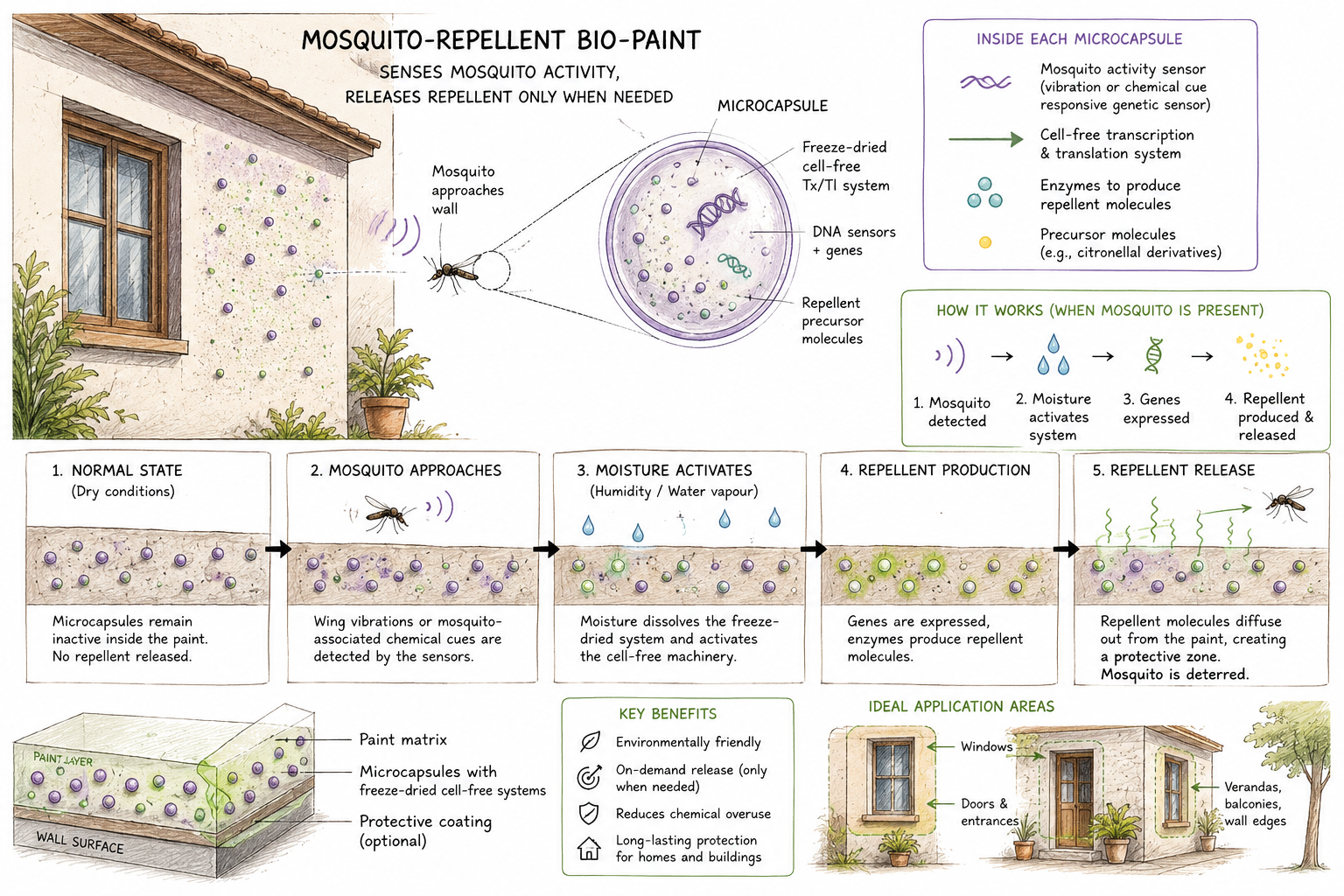
Ans: A mosquito repellent bio-paint containing freeze-dried cell-free systems that senses mosquito activity near walls and releases repellent molecules only when mosquitoes are present.
- How will the idea work, in more detail? Write 3-4 sentences or more.
Ans: The bio-paint would contain microcapsules filled with freeze-dried cell-free transcription/translation systems integrated into wall paint. These biosensors are designed to detect mosquito wing vibrations or mosquito-associated chemical cues when mosquitoes approach painted surfaces. Once activated by environmental moisture or humidity, the cell-free system begins producing mosquito-repellent compounds such as citronella-derived volatile molecules. The repellent is released only when mosquitoes are detected, creating targeted protection around windows, walls, and entry points instead of continuous chemical release.
This makes the paint responsive and reduces unnecessary use of repellents.
- What societal challenge or market need will this address?
Ans: Mosquito-borne diseases such as dengue, malaria, and chikungunya remain major public health concerns, especially in warm and humid regions. Conventional mosquito repellents require repeated application or constant spraying, which may be expensive and inconvenient.
This bio-paint could help by:
Reducing mosquito entry into homes
Providing continuous passive protection
Lowering chemical exposure compared with constant spraying
Supporting disease prevention in residential and public spaces
Potential applications:
homes
schools
hospitals
outdoor waiting areas
- How do you envision addressing the limitation of cell-free reactions (e.g., activation with water, stability, one-time use)?
Ans: Activation with water
Use environmental humidity or occasional light spraying with water
Paint remains inactive while dry and activates only when moisture is present
Stability
Freeze-dry the cell-free system inside protective hydrogel/polymer microcapsules
Add stabilizers such as trehalose to improve shelf life
One-time use
Design paint with many distributed microcapsules
Only activated capsules release repellent, while unused capsules remain available
Controlled release
Repellent produced only when mosquito activity is detected
Prevents continuous release and increases efficiency
This makes the system practical for long-term architectural use while reducing waste and improving targeted mosquito control.
Homework question from Ally Huang
Freeze-dried cell-free reactions have great potential in space, where resources are constrained. As described in my talk, the Genes in Space competition challenges students to consider how biotechnology, including cell-free reactions, can be used to solve biological problems encountered in space. While the competition is limited to only high school students, your assignment will be to develop your own mock Genes in Space proposal to practice thinking about biotech applications in space!
For this particular assignment, your proposal is required to incorporate the BioBits® cell-free protein expression system, but you may also use the other tools in the Genes in Space toolkit (the miniPCR® thermal cycler and the P51 Molecular Fluorescence Viewer). For more inspiration, check out https://www.genesinspace.org/ .
- Provide background information that describes the space biology question or challenge you propose to address. Explain why this topic is significant for humanity, relevant for space exploration, and scientifically interesting. (Maximum 100 words)
A major challenge during long-duration space missions is maintaining astronaut health when medical resources are limited. In microgravity, wounds may heal more slowly, and carrying large amounts of medicine is impractical because spacecraft have strict mass and storage limits. Astronauts need lightweight systems that can produce useful biomolecules only when needed. Freeze-dried cell-free systems like BioBits® are ideal because they are portable, stable, and activated on demand. This project explores using BioBits® to produce antimicrobial proteins in space as an emergency response to infections or contaminated surfaces.
- Name the molecular or genetic target that you propose to study. Examples of molecular targets include individual genes and proteins, DNA and RNA sequences, or broader -omics approaches. (Maximum 30 words)
DNA encoding the antimicrobial protein lysostaphin and GFP as a fluorescent reporter produced using the BioBits® cell-free protein expression system.
- Describe how your molecular or genetic target relates to the space biology question or challenge your proposal addresses. (Maximum 100 words)
Lysostaphin is an antimicrobial protein that breaks down bacterial cell walls, especially harmful bacteria like Staphylococcus. Producing this protein in space could help astronauts respond quickly to infection or contamination without relying only on stored antibiotics. BioBits® can express lysostaphin directly from DNA, while GFP confirms successful protein production through fluorescence. This connects the molecular target to a practical medical need: creating treatment molecules on demand during missions. The system’s freeze-dried format also makes it suitable for storage and transport in spacecraft.
- Clearly state your hypothesis or research goal and explain the reasoning behind it. (Maximum 150 words)
My hypothesis is that the BioBits® cell-free protein expression system can successfully produce antimicrobial proteins from freeze-dried DNA templates in a space environment, creating a rapid and lightweight emergency treatment option. If BioBits® can express lysostaphin after activation, astronauts could generate useful proteins only when needed instead of carrying large medical inventories. This is important because resupply is limited during long missions, and infections could become serious if treatment is delayed. GFP fluorescence would confirm that protein expression occurred. If successful, this experiment would show that cell-free systems can serve as an on-demand biological manufacturing platform in space, supporting astronaut health and reducing dependence on stored pharmaceuticals.
- Outline your experimental plan - identify the sample(s) you will test in your experiment, including any necessary controls, the type of data or measurements that will be collected, etc. (Maximum 100 words)
Prepare BioBits® reactions with DNA encoding lysostaphin and GFP. Activate reactions with water and incubate them in the miniPCR® thermal cycler. Include three groups: lysostaphin DNA + GFP (experimental), GFP-only DNA (positive control), and no DNA (negative control). Use the P51 Molecular Fluorescence Viewer to measure GFP fluorescence and confirm protein expression. Compare fluorescence intensity across groups. The main data collected will be fluorescence levels and whether antimicrobial protein can be reliably produced after freeze-dried storage, demonstrating on-demand protein manufacturing for space missions.