Week 7 HW: Genetic Circuits Part II

Part 1: Homework Questions
- IANNs allow cells to perform analog, weighted, decision-making rather than simple binary logic. Traditional genetic circuits usually implement Boolean gates, where inputs are treaed as on/ofof signals and outputs are discrete. In contrast, IANNS use components whose activities can vary continuously, allowing inputs to contribute different weights to a final output. This allows cells to integrate multiple signals simultaneously, filter noise and produce grade responses. IANNs overall can scale more easily to complex behaviors, making them better suited for biological environments with continuos noisy signals.
- A useful application of IANN would be a smart probioitic diagnostic cell that detects complex disease states in the gut.
Inputs: The circuit could receive several molecular signals associatied with inflammation, such as nitric oxide levels, reactive oxygen species or other responsive promoters. Each input drives production of regulators that act with different weights on the expression of a reporter gene. Processing: Each regulator modifies the stability or translation of the reporter mRNA. If the combined signal exceeds a threshold, the cell expresses a fluorescent protein or therapeutic molecule. This allows the cell to classify complex physiological states, rather than triggering on a single biomarker that might fluctuate naturally.
Output: Low combined signal → little or no reporter expression.
Moderate signal → weak expression.
High combined signal → strong reporter or drug release. Limitations: There are several constraints that could limit implementation. For example, gene expression fluctuations can distort weights and thresholds, making outputs inconsistent. Promoters and translation systems may saturate, preventing precise analog weighting. Large networks can slow cell grwoth or destabilize circuits. Furhtermore, large networks could slow cell growth or dsetabilize circuits and tuning these weights rqequires iterative experimental optimization. - stuff
Part 2: Fungal Materials
- Several commercial materials are made from fungal mycelium. One example is mycelium-based packaging produced by Ecovative, which grows fungal mycelium through agricultural waste to create molded protective packaging that replaces polystyrene foam. Mycelium composites are also used for insulation panels and structural building materials, such as mycelium bricks and boards that can be grown into shape. Another emerging product is mycelium leather, developed by companies like MycoWorks and Bolt Threads, which produces flexible sheet materials that mimic animal leather for fashion products.
These fungal materials offer several advantages over traditional materials. They are renewable and biodegradable, can be grown from agricultural waste, and require much lower energy input than plastics or synthetic foams. Mycelium materials can also be grown directly into molds, reducing manufacturing steps and waste. However, they also have disadvantages: mechanical strength and durability are generally lower than plastics or synthetic composites, they can be sensitive to moisture, and scaling production with consistent material properties remains challenging. - One useful direction would be engineering fungi to produce stronger or more functional mycelium materials. For example, genes could be modified to increase chitin or glucan crosslinking in the cell wall to improve stiffness and toughness of mycelium composites used in construction or packaging. Fungi could also be engineered to produce functional biomaterials, such as mycelium that incorporates conductive proteins for bioelectronics or that secretes adhesives or antimicrobial compounds. Another application could be fungi engineered to capture pollutants, such as heavy metals or microplastics, allowing grown fungal materials to act as environmental filtration systems.
Fungi offer several advantages as engineering hosts compared with bacteria. Because fungi are eukaryotes, they perform complex post-translational modifications and protein folding, which are necessary for many enzymes and biomaterials that bacteria cannot produce efficiently. Filamentous fungi naturally grow large structural networks (mycelium), allowing them to form macroscopic materials without external scaffolds, something bacteria generally cannot do. Fungi also secrete large amounts of enzymes and proteins, making them good platforms for producing extracellular biomolecules or structural polymers.
However, fungi are generally harder to genetically manipulate than bacteria: transformation efficiencies are lower, genetic tools are less standardized, and growth is typically slower.
Part 3: Proposal
Draft Aim 1:
The first aim of my final project is to engineer and fabricate a proof-of-concept nacre-inspired layered bacterial cellulose composite that can restore cohesion after mechanical damage by utilizing bacterial cellulose growth, layer-by-layer composite assembly, embedded microbe or biomaterial healing phases, and mechanical/visual crack-healing assays.
For this aim, I will create a bioinspired “brick-and-mortar” composite in which the rigid brick phase is composed of bacterial cellulose or cellulose nanocrystal-rich sheets and the softer mortar phase contains a living or biologically derived healing component. The experimental objective is not to fully optimize a load-bearing structural material within one class term, but rather to demonstrate that a biologically fabricated layered composite can be assembled under ambient conditions and can show measurable post-damage recovery compared with a non-healing control. This makes the aim achievable while still testing the central concept of self-reinforcing nacre-mimetic materials.
The first part of the work will focus on producing the structural phase. I will culture a cellulose-producing bacterium, such as Komagataeibacter xylinus or a related strain commonly used for bacterial cellulose production, under static growth conditions to generate thin cellulose pellicles. If full bacterial cellulose growth is too slow or inconsistent for the class timeline, I will use commercially available cellulose nanocrystals, cellulose sheets, or pre-grown bacterial cellulose as a backup platform so that the layered composite architecture can still be constructed and tested. These cellulose layers will serve as the nacre-like “bricks,” and I will characterize their thickness, handling properties, and ability to be stacked into a laminated structure.
The second part of the work will focus on designing the healing-enabled mortar phase. My preferred strategy is to incorporate embedded microbes that can secrete adhesive extracellular matrix or biofilm-associated polymers after damage. A practical initial system would use a safe laboratory strain such as E. coli engineered or selected to overproduce curli, polysaccharides, or another extracellular adhesive component in response to induction or environmental stress. If engineering a full damage-responsive gene circuit is too ambitious within the course timescale, I will instead begin with a simpler proof-of-concept approach in which embedded cells constitutively produce adhesive matrix, or I will use a nonliving but biologically relevant healing phase such as alginate, gelatin, extracellular polysaccharide extracts, or secreted biofilm material harvested from cultures. This fallback preserves the core hypothesis that a soft biologically active interlayer can improve crack bridging and recovery.
To fabricate the composite, I will assemble alternating layers of cellulose “brick” sheets and soft “mortar” layers containing either living cells in a hydrogel matrix or a biologically derived adhesive phase. I plan to use simple layer-by-layer casting or lamination methods, with compression or air-drying steps to improve interfacial contact while preserving viability where needed. I will build at least three sample classes: a layered cellulose-only control, a layered cellulose composite with inert polymer mortar, and a layered cellulose composite with the healing-enabled biological mortar. This comparison is important because it will distinguish the effect of architecture alone from the effect of the active healing component.
After fabrication, I will introduce controlled damage to the samples using a reproducible method such as a razor notch, compression-induced cracking, or bending-induced delamination. I will then incubate the damaged composites under conditions that allow the biological phase to respond, such as nutrient supplementation, moisture exposure, or inducer addition if an engineered secretion system is used. Recovery will be evaluated using simple but informative readouts: optical imaging of crack closure, microscopy of the damaged interface, qualitative flexural handling tests, and, if feasible, a basic mechanical assay such as tensile strip testing, puncture resistance, or three-point bending on small samples. The key success metric for Aim 1 will be whether the bioactive composite shows better post-damage integrity, adhesion, or retained mechanical performance than the non-healing controls.
The main tools and resources I expect to use include bacterial cellulose growth protocols, hydrogel encapsulation or biofilm culture methods, sterile culture workflows, plate reader or microscopy-based visualization, simple mechanical testing setups, and DNA/protein design tools if I pursue an engineered secretion module. For design work, I may use Benchling for plasmid design, Addgene parts or literature-based extracellular matrix constructs for candidate secretion systems, and standard cloning workflows such as Gibson assembly or Golden Gate if a genetic build is included. If ordering DNA is feasible, I would prioritize a minimal construct enabling production of an adhesive extracellular component rather than a fully damage-sensing circuit, since secretion itself is the most important first milestone.
Overall, Aim 1 is designed to establish a feasible experimental foundation for the project by demonstrating that a nacre-inspired bacterial-cellulose composite can be biologically fabricated and that incorporation of a living or biologically derived healing phase improves recovery after damage. Even if the final system does not yet achieve full autonomous self-repair, successfully fabricating the layered architecture and observing enhanced post-crack cohesion would provide strong proof of concept for future iterations of a low-energy, biodegradable, self-reinforcing structural material.
Part 4: DNA Order
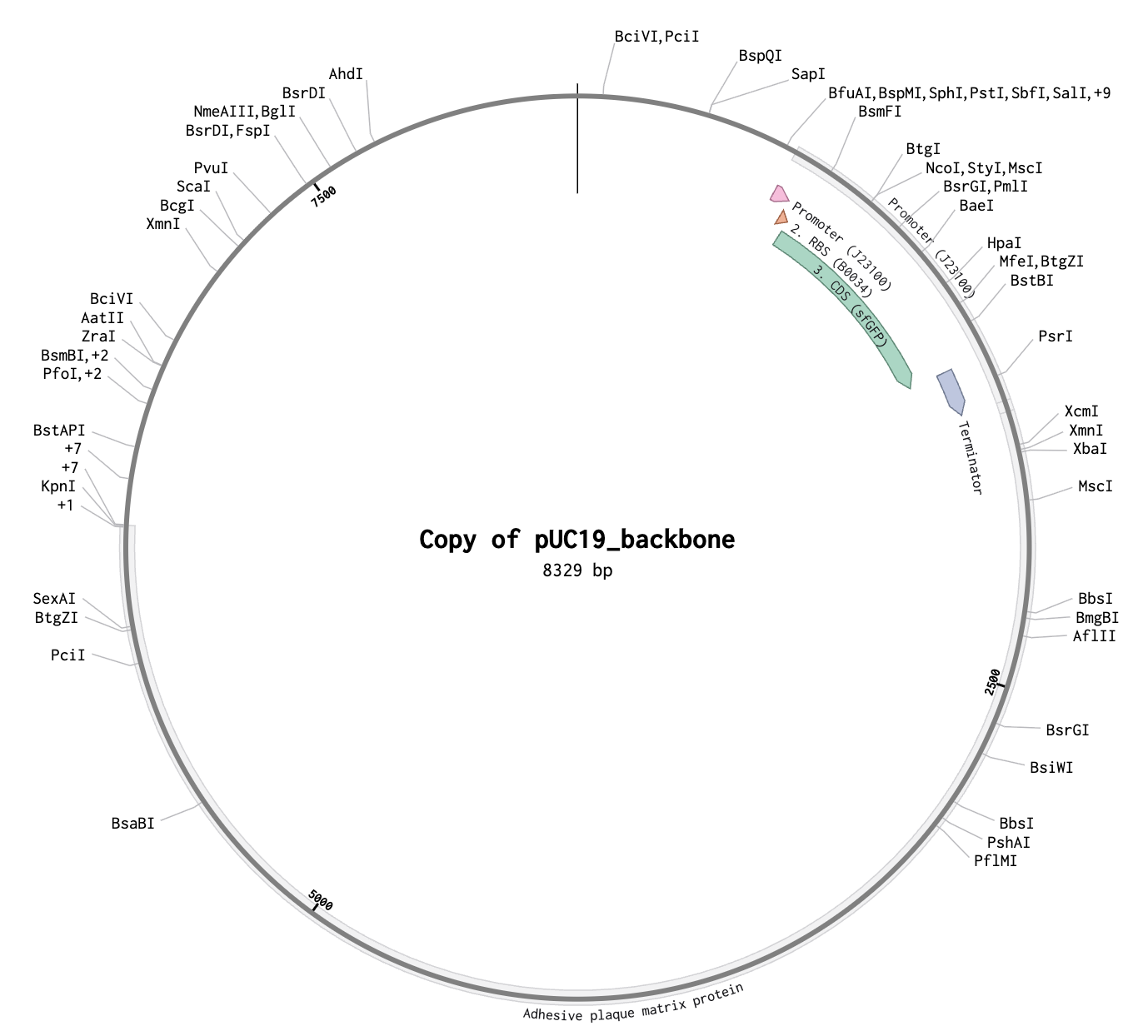
To put things together, I had to first find a simple backbone, and ended up going with the pUC19 backbone, as I found it in the directoy. A google search told me it was pretty simple and standard, so I decided to trust that. ONce I opened this backbone, I had to insert my repari circuit into the cloning region.
My genetic circuit:
promoter → RBS → repair gene → terminator
Components I chose and why:
- j23100 promoter
- RBS B0034
- Adhesive Plaque Protein (FP1) –> Provides adhesiveness to the mussel’s foot. It seems pretty related and applicable to my end goal
- Terminator