Week 1 HW: Principles and Practices
HOMEWORK 1
1.First, describe a biological engineering application or tool you want to develop and why. This could be inspired by an idea for your HTGAA class project and/or something for which you are already doing in your research, or something you are just curious about.
One of the main reasons I am interested in synthetic biology is because I see it as a real and accessible bridge between design and biology, as well as a key pathway toward the future of design applied to living systems. Throughout my experience as a designer, I have developed a growing interest in reducing the gap between what is created by humans and natural systems. Often, even when design draws inspiration from nature, it remains an exclusively human interpretation. This has led me to question what the true role of the designer should be when working with living systems and natural environments. In this context, I am deeply interested in the future exploration of synthetic morphogenesis, understood as the possibility of creating biological frameworks that allow materials or living systems to develop their own form and function autonomously through natural processes. From this perspective, the designer does not necessarily define the final outcome but rather facilitates the initial conditions that allow nature to actively participate in the creative process. I believe synthetic biology can offer tools to advance toward these kinds of practices, where our role is to design conditions rather than impose forms. However, while recognizing that this concept still requires deeper development, specific areas already exist where certain approaches and principles can begin to be explored and consolidated. As a design professional, I have always felt a strong call to action to create solutions that not only improve people’s quality of life but also contribute to a broader ecosystemic perspective on wellbeing. My interest is not limited to human benefit; rather, I aim to explore how design can help care for, regenerate, and strengthen the natural environments and living systems upon which we depend. This vision has led me to explore fields such as bio-inspired design, biomimetics, bionics, and ultimately biodesign. Throughout this trajectory, one of my main interests has been design oriented toward conservation and ecological remediation, particularly within marine ecosystems. My recent work has focused on exploring design- and material-based solutions that contribute to the regeneration of marine environments affected by climate change. In recent years, I have become particularly interested in developing proposals to mitigate the impact of ocean acidification. Ocean acidification is a global issue caused by increasing atmospheric CO₂ levels, which alter seawater chemistry and reduce pH levels. This phenomenon decreases the availability of calcium carbonate (CaCO₃), an essential component for calcifying organisms such as corals, mollusks, and crustaceans, affecting their ability to form skeletal structures through biomineralization and reducing their chances of survival. Many of these organisms play a fundamental role at the base of marine food webs and in the functional structure of ecosystems; therefore, significant alterations in their populations can trigger cascading effects, leading to systemic ecosystem losses and a progressive decline in biodiversity. To address this problem, various strategies have been developed worldwide, including artificial reefs and aquaculture systems. However, despite their progress, most approaches have focused primarily on structural design, leaving the biological potential of materiality relatively underexplored. For this reason, I would like to take this exploration to the next level. One of the biological engineering applications I would like to develop during the course How to Grow Almost Everything is a bioengineered living material that initially functions as a bioreceptor for CaCO₃ particles present in the water, attracting and concentrating them to facilitate the formation of artificial reefs in strategic locations. In alignment with my interest in synthetic morphogenesis, I would also like to explore the possibility that this material not only performs a capture function but is capable of growing, self-organizing, and adopting its own configurations through biological processes, contributing to the formation of structures that emerge from natural dynamics rather than from fully predetermined human designs. Through this approach, it would be possible to locally increase the availability of calcium carbonate, support biomineralization processes, and contribute to restoring ecological balance in areas affected by ocean acidification, generating benefits for both marine ecosystems and the human communities that depend on them.
2.Next, describe one or more governance/policy goals related to ensuring that this application or tool contributes to an “ethical” future, like ensuring non-malfeasance (preventing harm). Break big goals down into two or more specific sub-goals. Below is one example framework (developed in the context of synthetic genomics) you can choose to use or adapt, or you can develop your own. The example was developed to consider policy goals of ensuring safety and security, alongside other goals, like promoting constructive uses, but you could propose other goals for example, those relating to equity or autonomy.
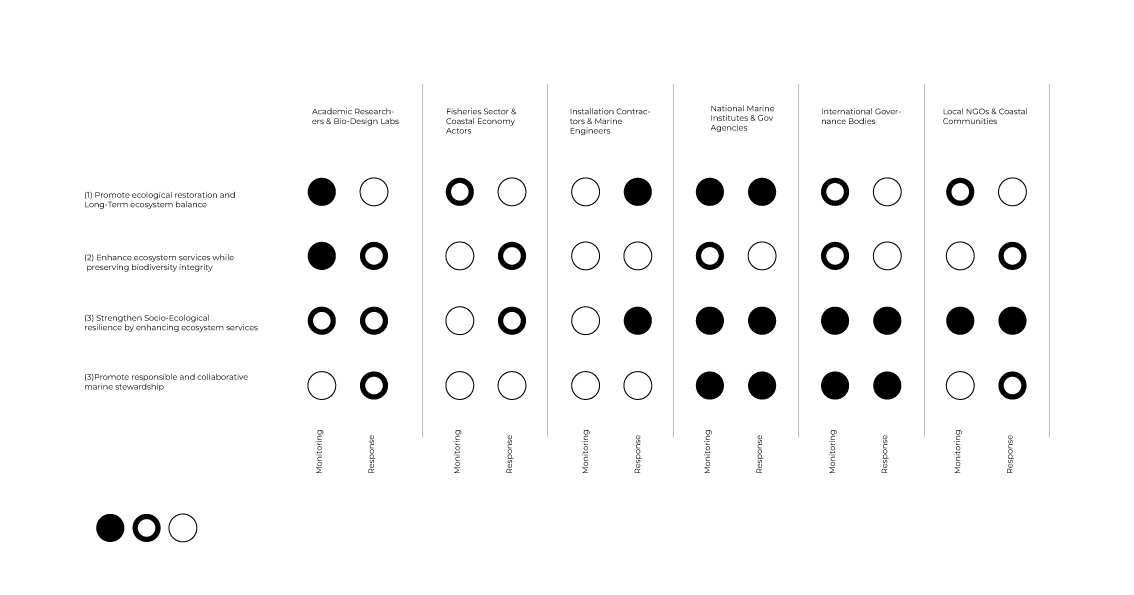
(1) Promote ecological restoration and Long-Term ecosystem balance -Ensure the material supports native calcifying organisms and does not displace or outcompete existing species. -Require ecological impact assessments prior to deployment in new marine environments. -Prioritize deployment in degraded or climate-vulnerable areas where restoration potential is scientifically justified.
(2) Enhance ecosystem services while preserving biodiversity integrity -Design materials to support habitat formation, biodiversity recovery, and coastal protection without creating monocultures. -Monitor long-term ecological outcomes such as species diversity, trophic balance, and reef resilience.
(3) Strengthen Socio-Ecological resilience by enhancing ecosystem services -Facilitate the recovery of marine food webs that sustain fisheries and coastal economies. -Improve ecosystem services such as habitat formation, biodiversity support, and climate adaptation. -Promote long-term ecological stability as the foundation for human wellbeing.
(4) Promote responsible and collaborative marine stewardship Facilitate coordinated decision-making between research institutions, environmental agencies, and coastal communities involved in marine restoration efforts. Encourage transparent monitoring, shared scientific data, and collective ecological oversight across regions. Support equitable access to knowledge and responsible deployment practices that prioritize long-term ecosystem health and social wellbeing.
- Next, describe at least three different potential governance “actions” by considering the four aspects below (Purpose, Design, Assumptions, Risks of Failure & “Success”). Try to outline a mix of actions (e.g. a new requirement/rule, incentive, or technical strategy) pursued by different “actors” (e.g. academic researchers, companies, federal regulators, law enforcement, etc). Draw upon your existing knowledge and a little additional digging, and feel free to use analogies to other domains (e.g. 3D printing, drones, financial systems, etc.).
- Purpose: What is done now and what changes are you proposing?
- Design: What is needed to make it “work”? (including the actor(s) involved - who must opt-in, fund, approve, or implement, etc)
- Assumptions: What could you have wrong (incorrect assumptions, uncertainties)?
- Risks of Failure & “Success”: How might this fail, including any unintended consequences of the “success” of your proposed actions?
1.Controlled Access and Authorized Deployment Framework
While projects focused on the implementation of artificial reefs largely aim to benefit marine ecosystems, their direct interaction with complex natural environments means that inadequate planning or mismanagement could produce outcomes contrary to those intended. This concern becomes even more significant when considering the deployment of a bioengineered living material with active interaction within marine ecosystems. For this reason, the first proposed governance action is the establishment of a controlled access and regulated deployment framework, in which the use and implementation of this material would be authorized exclusively for public research institutions operating in formal collaboration and joint monitoring with governmental environmental agencies and organizations specialized in ecological restoration. Such a model would help reduce the risk of irresponsible or insufficiently supervised applications while promoting evidence-based interventions grounded in long-term ecosystem planning. Additionally, each deployment should be subject to prior ecological impact assessments and continuous monitoring systems capable of adapting interventions according to ecosystem responses over time. Nevertheless, this approach may also face challenges, including administrative processes that could slow urgent restoration efforts or institutional limitations in sustaining long-term oversight.
2.Creation of an International Marine Bioengineering Association
Oceans are not uniform and present unique ecological, chemical, and biological characteristics depending on the regions in which they are located; however, any intervention in these systems may generate transboundary ecological effects. In this context, most marine restoration initiatives continue to be managed primarily at local or national levels, which may limit a comprehensive understanding of their impacts and reduce their effectiveness at broader scales. Therefore, the creation of an international marine bioengineering governance association is proposed to coordinate shared standards, biosafety protocols, and collaborative ecological assessment frameworks across countries. As part of this initiative, it would be essential to establish an international network of authorized laboratories and research centers with regulated access to these types of materials, facilitating collaborative monitoring of their use, the exchange of scientific data, and the planning of interventions at regional and global scales. This approach would strengthen local actions through a broader ecosystem-based perspective, promoting informed decision-making and adaptive strategies grounded in shared scientific evidence. Nevertheless, this model may also face important challenges, including difficulties in political coordination between countries and inequalities in access to the scientific and technological resources necessary for its effective implementation.
3.Biosecurity & Environmentally Controlled Activation of Living Material
Beyond regulatory and institutional frameworks, a third governance action involves integrating principles of ecological responsibility directly into the functional design of the living material from its earliest stages of development. Considering that the material’s primary objective is to act as a bioreceptor capable of attracting and concentrating calcium carbonate (CaCO₃) particles present in the water to facilitate natural biomineralization processes in nearby marine organisms, it is essential to establish clear limits on its ecological behavior and its interaction with the surrounding environment. In this regard, the material could be designed to remain functionally inert under normal environmental conditions and to activate only under specific scenarios of marine acidification, responding to defined physicochemical parameters associated with ecosystem imbalance. This conditional activation would help reduce the risk of unintended alterations to local ecological dynamics, promoting a strategy of “responsibility by design” in which researchers, biological designers, and academic institutions integrate ethical and ecosystem-based considerations from the outset of technological development.
4.Next, score (from 1-3 with, 1 as the best, or n/a) each of your governance actions against your rubric of policy goals. The following is one framework but feel free to make your own:
| Does the option: | ACTION 1 | ACTION 2 | ACTION 3 |
|---|---|---|---|
| Promote ecological restoration & long-term ecosystem balance | 2 | 3 | 1 |
| • By Supporting calcifying organisms | 1 | 2 | 1 |
| • Require ecological impact assessments | 1 | 2 | 1 |
| • By Prioritizing degraded or climate-vulnerable areas | 1 | 2 | 1 |
| Enhance ecosystem services while preserving biodiversity integrityy | 1 | 1 | 3 |
| • By protecting biodiversity | 1 | 2 | 1 |
| • By Monitoring long-term ecological outcomes | 1 | 2 | 2 |
| Strengthen socio-ecological resilience & human wellbeing | 1 | 1 | 2 |
| • By Supporting fisheries & coastal economiess | 1 | 3 | 2 |
| • By Improving ecosystem services & climate adaptation | 1 | 3 | 1 |
| Promote responsible & collaborative marine stewardship | 1 | 1 | 3 |
| • By Controlled and authorized deployment | 1 | 1 | 1 |
| • Feasibility | 1 | 3 | 2 |
| • Ethical responsibility integrated into design | 1 | 2 | 1 |
| • Promote constructive applications | 1 | 3 | 1 |
5.Last, drawing upon this scoring, describe which governance option, or combination of options, you would prioritize, and why. Outline any trade-offs you considered as well as assumptions and uncertainties. For this, you can choose one or more relevant audiences for your recommendation, which could range from the very local (e.g. to MIT leadership or Cambridge Mayoral Office) to the national (e.g. to President Biden or the head of a Federal Agency) to the international (e.g. to the United Nations Office of the Secretary-General, or the leadership of a multinational firm or industry consortia). These could also be one of the “actor” groups in your matrix.
From my personal perspective, the key element of this project lies in the strategic development of materials specifically designed to minimize the impacts of ocean acidification. Building on this foundation, a comprehensive strategic plan should be developed in collaboration with governmental entities to ensure a conscious, well-structured approach directed exclusively toward ecological restoration. Such coordination would allow for responsible implementation, clear environmental oversight, and long-term sustainability aligned with conservation priorities.