Describe a biological engineering application or tool you want to develop and why. This could be inspired by an idea for your HTGAA class project and/or something for which you are already doing in your research, or something you are just curious about.
The accelerating pace of global urbanization and transportation infrastructure development has led to an exponential increase in vehicle ownership and usage worldwide. This expansion has significantly elevated the demand for tyre manufacturing [1] With approximately 1.5 billion tires produced annually,and over 17 million tons of them are disposed of. The yearly production of discarded tires is predicted to increase to 1200 million by 2030.the management and disposal of waste tires pose significant environmental challenges worldwide. While tire recycling has the potential to mitigate some environmental issues, existing studies reveal notable gaps and associated risks to human health and the environment.[2] Tires take hundreds of years to decompose and cannot be recycled by conventional means because of a process called vulcanization - the chemical treatment that makes rubber tough and durable by creating strong sulfur bridges between polymer chains. These sulfur bridges are nearly impossible to break with heat or chemicals without destroying the material entirely.[3].
Part 0: Basics of Gel Electrophoresis Attend or watch all lecture and recitation videos. Optionally watch bootcamp.
Part 1: Benchling & In-silico Gel Art See this week’s lab protocol “Gel Art: Restriction Digests and Gel Electrophoresis” for details. Overview:
1. Describe a biological engineering application or tool you want to develop and why.
This could be inspired by an idea for your HTGAA class project and/or something for which you are already doing in your research, or something you are just curious about.
The accelerating pace of global urbanization and transportation infrastructure development has led to an exponential increase in vehicle ownership and usage worldwide. This expansion has significantly elevated the demand for tyre manufacturing [1] With approximately 1.5 billion tires produced annually,and over 17 million tons of them are disposed of. The yearly production of discarded tires is predicted to increase to 1200 million by 2030.the management and disposal of waste tires pose significant environmental challenges worldwide. While tire recycling has the potential to mitigate some environmental issues, existing studies reveal notable gaps and associated risks to human health and the environment.[2] Tires take hundreds of years to decompose and cannot be recycled by conventional means because of a process called vulcanization - the chemical treatment that makes rubber tough and durable by creating strong sulfur bridges between polymer chains. These sulfur bridges are nearly impossible to break with heat or chemicals without destroying the material entirely.[3].
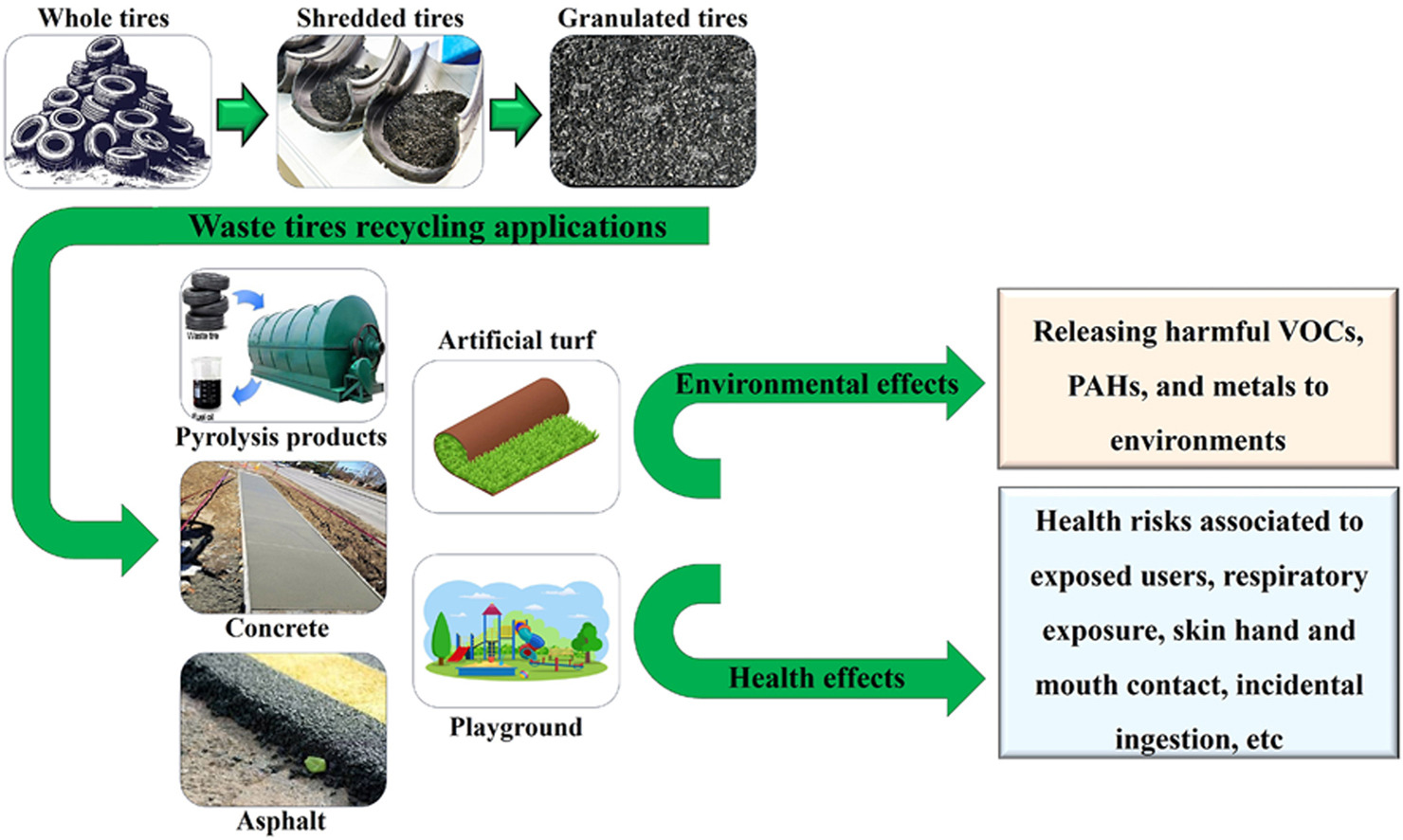
Utilization of recycled tires across diverse sectors and its environmental and health effects[2]
Apart from that, I am also interested in sustainable fashion because the fashion industry is one of the largest polluters in the world, and it is already pioneering bio-based materials. We all need clothing and accessories, so I believe it is an accessible way to help people realize the importance of STEM fields in society, as well as to change the paradigm that microorganisms are negative. Additionally, we can contribute to an industry that has not traditionally prioritized investment in research and technology.
💡 The idea I want to develop is an engineered bacterial system capable of biologically degrading and transforming vulcanized car tire rubber into reusable biopolymer materials that can be processed into sustainable textiles for fashion.
The approach has three stages:
Stage 1 — Bio-devulcanization: Use naturally occurring rubber-degrading bacteria such as Streptomyces, Rhodococcus, and Gordonia — strains already found in tire dump soils — enhanced through genetic engineering to break the sulfur crosslinks (vulcanization bonds) more efficiently. This “unlocks” the polymer structure without destroying it.
Stage 2 — Controlled depolymerization: A second bacterial step cleaves the unlocked rubber polymer chains into smaller, uniform oligomers and monomers such as isoprene units and terpenoids. These are the raw chemical building blocks.
Stage 3 — Biopolymer synthesis for textiles: Engineer the bacteria (or a partner microorganism like E. coli or yeast) to reassemble those monomers into a new biopolymer — a flexible, durable material suitable for processing into fiber, film, or coating for fashion textiles.
Things to consider:
Bacteria from the genus Streptomyces, Rhodococcus, and Gordonia have already been identified as natural rubber degraders in soil near tire dumps.[4]
In 2024, a bacterial consortium isolated from a discarded tire in the Socabaya River (Peru) was shown to degrade tire rubber without any chemical pretreatment (the dominant species was Delftia tsuruhatensis).[5]
Biological devulcanization (breaking sulfur bridges using bacteria or fungi) is an active area of research as a greener alternative to toxic chemical devulcanization methods.[3]
In 2017, researchers at the University of Minnesota produced isoprene — the key monomer in natural rubber — from corn, grass, and trees, demonstrating the viability of bio-based rubber synthesis pathways.[6]
This new material could be used in:
• Flexible, rubber-like fabric sheets for outerwear and accessories
• Sustainable shoe soles and straps made from reclaimed tire material
• Coatings for water-resistant textile surfaces
• Stretch fibers for performance wear
2. Describe one or more governance/policy goals related to ensuring that this application or tool contributes to an “ethical” future, like ensuring non-malfeasance (preventing harm). Break big goals down into two or more specific sub-goals.
Goal 1. Non-Malfeasance — Prevent Environmental and Human Harm
Engineered bacteria that degrade rubber could cause unintended damage if they spread beyond controlled industrial bioreactors to ecosystems where natural rubber-containing plants, vehicle tires in use, or other rubber materials exist.
Sub-goals:
1.1. Containment Safety: Ensure that engineered rubber-degrading bacteria cannot survive or reproduce outside of controlled industrial bioreactor conditions. Any accidental release should result in rapid die-off without ecological impact.
1.2. Human Health and Worker Safety: The bioreactor process involves industrial-scale microbial cultures working on toxic tire materials (which contain heavy metals, PAHs, zinc, and 6PPD). Workers and nearby communities must be protected from exposure to both the engineered organisms and the toxic byproducts of tire degradation.
Goal 2: Environmental and Social Justice — Ensure the Technology Helps Those Who Need It Most
The tire waste crisis is worst in low- and middle-income countries with less recycling infrastructure. The fashion industry has a long history of exploiting lower-income communities in manufacturing.
Sub-goals:
2.1. Equitable Access and Benefit Distribution: Prevent this technology from being monopolized by large corporations in wealthy countries, ensuring that communities in regions most affected by tire waste dumps — like Colombia, Peru, Nigeria, and India — can access and benefit from the technology.
2.2. Transparency and Community Consent: Require that communities living near proposed industrial bioreactor sites have a meaningful role in approving, monitoring, and benefiting from the facility, rather than simply bearing the environmental risk.
For helping me to answer part of this question I used Claude.ai with this prompt: “I am developing a bio-based material application connected to sustainable fashion and microbial biotechnology. Help me draft a strong response to the following question:“Describe one or more governance/policy goals related to ensuring that this application contributes to an ethical future, including preventing harm (non-malfeasance). Break big goals down into two or more specific sub-goals.” The response should:Focus on bioethics, environmental responsibility, and social impact. Include at least two main governance goals. Break each main goal into 2–3 specific, actionable sub-goals. Address risk prevention (biosafety, environmental release, misuse). Consider transparency, community inclusion, and equitable access.
3. Describe at least three different potential governance “actions” by considering the four aspects below (Purpose, Design, Assumptions, Risks of Failure & “Success”).
Try to outline a mix of actions (e.g. a new requirement/rule, incentive, or technical strategy) pursued by different “actors” (e.g. academic researchers, companies, federal regulators, law enforcement, etc). Draw upon your existing knowledge and a little additional digging, and feel free to use analogies to other domains (e.g. 3D printing, drones, financial systems, etc.).
Purpose: What is done now and what changes are you proposing?
Design: What is needed to make it “work”? (including the actor(s) involved - who must opt-in, fund, approve, or implement, etc)
Assumptions: What could you have wrong (incorrect assumptions, uncertainties)?
Risks of Failure & “Success”: How might this fail, including any unintended consequences of the “success” of your proposed actions?
Colombia has a unique and highly developed regulatory and industrial ecosystem for sustainable waste management and fashion innovation. [7].
Colombia already has one of the most advanced tire waste management systems in Latin America. Since Resolution 1457 of 2010, tire producers and importers are required to collect a target percentage of used tires — the recovery rate started at 20% in 2012 and is incrementally increasing by 5% annually, reaching 65% by 2028. Resolution 1326 of 2017 further strengthened these requirements through Extended Producer Responsibility (EPR) principles.
The Ministerio de Ambiente y Desarrollo Sostenible (Ministry of Environment and Sustainable Development) is the lead regulatory body. The Programa Basura Cero (Zero Waste Program), established under the 2022–2026 National Development Plan, promotes waste valorization, technological development, and socioeconomic inclusion of recycler communities.[8]
Key Colombian Regulatory Bodies:
Ministerio de Ambiente y Desarrollo Sostenible (MADS) — environmental policy and EPR oversight
Autoridad Nacional de Licencias Ambientales (ANLA) — environmental licensing for industrial facilities
Ministerio de Vivienda, Ciudad y Territorio — waste management infrastructure and municipal services
CONPES 3874 (2016) — National Policy for Comprehensive Solid Waste Management setting 30% recycling targets
Governance action 1: Biocontainment Standards
Why? Industrial microorganisms used in closed bioreactors fall into a regulatory gray zone. They are generally not subject to the same review as organisms intended for environmental release, even though bioreactor accidents, wastewater discharges, and worker exposure are realistic pathways to unintended release. There is currently no mandatory biocontainment certification standard for industrial microbes that degrade persistent environmental pollutants like vulcanized rubber. Car tires contain a complex cocktail of toxic materials: zinc, heavy metals, polycyclic aromatic hydrocarbons (PAHs), the additive 6PPD (which converts to the salmon-killing 6PPD-Q), carbon black, and synthetic rubber polymers. When bacteria degrade tire rubber, they do not simply make these compounds disappear — they break down the polymer matrix, which can release or mobilize these co-contaminants in the process effluent (liquid waste), off-gases, and solid residue. There is currently no specific regulatory standard for monitoring the toxic byproducts of biological tire degradation processes, since the technology does not yet exist at commercial scale
Lead Actor: Ministerio de Ambiente y Desarrollo Sostenible (MADS) + ANLA
In the Colombian context, MADS would develop the biocontainment certification standard for rubber-degrading microorganisms as an extension of its existing biosafety and hazardous waste regulations. ANLA would be responsible for issuing environmental licenses to pilot and commercial-scale bioreactor facilities.
Key Colombian-specific design elements:
• Integrate biocontainment requirements into ANLA’s environmental licensing process for bioreactor facilities — this already exists for chemical plants and landfills, so the regulatory pathway is established.
• Require demonstration projects at university bioengineering labs (Universidad de los Andes, Universidad Nacional, Universidad de Antioquia) before commercial scale-up.
• Establish a joint technical committee with Colciencias (now Ministerio de Ciencia, Tecnología e Innovación) to develop biosafety protocols specific to polymer-degrading organisms.
• Coordinate with regional CARs (e.g., Corporación Autónoma Regional de Cundinamarca — CAR, Área Metropolitana del Valle de Aburrá — AMVA) to enforce biocontainment monitoring at the local level.
Advantage in Colombia: Colombia already has strong EPR enforcement mechanisms for tires, so adding a biosafety certification layer to existing tire collection infrastructure is more feasible than building from scratch.[8]
Risks of Failure & Success: The certification process becomes so slow and expensive (multi-year, multi-million-dollar review) that only large corporations can afford it, preventing smaller innovators and startups in developing countries from ever commercializing the technology. Industry lobbyists weaken the containment requirements to avoid cost, leaving the two-mechanism requirement as a one-mechanism checkbox.
Governance action 2: Technology Access and Fashion Integration
Lead Actors: ProColombia + Inexmoda + Circular Economy Lab + Local Fashion Brands
Colombia’s fashion and textile industry is highly developed, centered in Medellín (Colombiamoda, Colombiatex) and Bogotá. Over 12,000 textile companies generate more than 1 million jobs, with 70% held by women. The industry already emphasizes sustainability — brands like Fibras y Biotextiles de Colombia (FIBO), Woocoa (cannabis-coconut fiber), and Patiamarillos (recycled materials) are pioneering bio-based and circular materials.[9].
Proposed Colombian-specific mechanisms:
• ProColombia (the national trade promotion agency) integrates tire-derived biopolymer textiles into its sustainable fashion export portfolio, connecting Colombian producers to international buyers (e.g., Patagonia, which already sources from Colombia).
• Inexmoda (the institute organizing Colombiamoda) creates a ‘Tire-to-Textile Innovation Track’ at the annual Colombiamoda and Colombiatex fairs, giving local designers access to tire-based materials for collection prototypes.
• The Circular Economy Lab (Ministerio de Ambiente + UNDP partnership) funds pilot projects where recicladores formalizados (formalized waste-picker cooperatives) collect tire waste and supply it to bioreactor facilities — ensuring the most vulnerable workers benefit directly.
• Universities like Universidad de los Andes (which developed Woocoa fiber) and Universidad Nacional integrate tire bioprocessing into their biodesign curricula, training the next generation of designers and bioengineers.
Woocoa — cannabis-coconut fiber innovation from Universidad de los Andes
Patiamarillos — recycled material footwear from Barichara
Wanaawaa — prison labor fashion cooperative focused on waste reduction
Competitive Advantage: Colombia has Free Trade Agreements with the U.S., EU, and 30+ countries, and the Vallejo Plan allows duty-free import of inputs used in exported goods. Tire-based textile materials could be processed in Colombia and exported globally with minimal trade barriers.
Risks of Failure & Success: A tire-to-textile bacteria platform developed with public university or government research funding will in places like U.S., Europe, and a few Asian economies, be patented and licensed to companies that will primarily serve high-income markets. The countries with the worst tire problem will be the last to access the solution or will pay the highest prices for licensed technology or that the technology transfer without local manufacturing infrastructure results in the bioreactor facilities being built by the same large foreign companies that hold the original IP.
Governance action 3. Community Monitoring and Recicladores Integration
Lead Actors: Local CAR (e.g., CAR Cundinamarca, AMVA) + Recicladores Cooperatives + Environmental NGOs
Colombia has a unique institution: recicladores (waste pickers) — an estimated 60,000+ formalized workers organized into cooperatives. Under CONPES 3874 and recent Constitutional Court rulings, recicladores have legal rights to participate in waste management value chains and receive preferential treatment in public contracts.
Proposed Colombian-specific design:
• Any tire bioremediation facility sited within 10 km of an existing tire dump must sign a Community Benefit Agreement with local reciclador cooperatives, guaranteeing: (1) preferential hiring for collection and sorting roles, (2) revenue sharing from sale of biopolymer materials, (3) independent health monitoring funded by the facility.
• Regional environmental authorities (CARs) enforce real-time effluent monitoring for 6PPD-Q, zinc, and PAHs — data is published on a public dashboard accessible via mobile app, modeled on Bogotá’s air quality monitoring network (SISAIRE).
• Community oversight committees include representatives from reciclador cooperatives, local universities (environmental engineering departments), and environmental defenders’ organizations (e.g., San Silvestre Green, which has documented landfill contamination in Barrancabermeja).
• Pilot facilities partner with existing waste management infrastructure operators like Veolia Colombia or Interaseo, but with contractual obligations to prioritize local hiring and community health safeguards.
Risks of Failure & Success:
Critical Colombian Context: Environmental activists in Colombia face severe risks — threats and assassinations are common, especially near industrial waste sites (e.g., Barrancabermeja landfill case). Any governance framework MUST include legal protections and security guarantees for community monitors and environmental defenders.
The challenge is ensuring that the technology does not replicate Colombia’s historical pattern of environmental burden falling on marginalized communities (like the Barrancabermeja landfill case) while profits flow to large corporations. The governance framework must center the voices and economic participation of recicladores, local communities, and environmental defenders from the very beginning.
For helping me to answer part of this question I used Claude.ai with this prompt: “Act as an expert in governance and help me identify the connections between institutions, legal frameworks, and regulatory mechanisms related to the following governance actions in Colombia: biocontainment standards; technology access and fashion integration; and community monitoring with recicladores integration, in the context of bio-based material applications linked to sustainable fashion and microbial biotechnology, specifically using tires and bacteria to produce new materials.””
4. Score (from 1-3 with, 1 as the best, or n/a) each of your governance actions against your rubric of policy goals.
*The following is one framework but feel free to make your own:*
Does the option:
Biocontainment Standards
Technology Access and Fashion Integration
Community Monitoring and Recicladores Integration
Enhance Biosecurity
• By preventing incidents
1
1
2
• By helping respond
2
2
2
Foster Lab Safety
• By preventing incident
1
1
1
• By helping respond
2
2
1
Protect the environment
• By preventing incidents
1
1
2
• By helping respond
1
3
2
Other considerations
• Minimizing costs and burdens to stakeholders
2
1
2
• Feasibility?
1
2
2
• Not impede research
2
2
2
• Promote constructive applications
2
2
2
5. Drawing upon this scoring, describe which governance option, or combination of options, you would prioritize, and why. Outline any trade-offs you considered as well as assumptions and uncertainties.
*For this, you can choose one or more relevant audiences for your recommendation, which could range from the very local (e.g. to MIT leadership or Cambridge Mayoral Office) to the national (e.g. to President Biden or the head of a Federal Agency) to the international (e.g. to the United Nations Office of the Secretary-General, or the leadership of a multinational firm or industry consortia). These could also be one of the “actor” groups in your matrix.*
Reflecting on what you learned and did in class this week, outline any ethical concerns that arose, especially any that were new to you. Then propose any governance actions you think might be appropriate to address those issues. This should be included on your class page for this week.
I would start with Community Monitoring and Recicladores Integration and then Biocontainment Standards and Technology Access and Fashion Integration in parallel, because fashion integration creates market pull, buyers want the material, which generates political and economic momentum for regulatory clarity.
Why this order? Trust before regulation. If communities don’t buy in, the tech dies regardless of how good the science is. Also, legislation and integration with organisations takes time.
Pilot site recommendation: Barrancabermeja — if it works there (a contested environmental justice site), it could work anywhere in the country.
Trade-offs:
Speed vs. Safety: starting with community pilots risks containment failure before formal standards exist
Equity vs. Efficiency: requiring community consent slows siting and raises costs
Important to take into account Colombia’s history: Barrancabermeja landfill, coal mining in La Guajira, palm oil expansion shows that efficiency-first infrastructure projects systematically harm poor and Indigenous communities. The tire waste crisis is worst in low-income neighborhoods — if the solution does not center those communities, it perpetuates environmental injustice. The equity trade-off is non-negotiable.
Uncertainty:
The sustainable materials market is crowded (mycelium leather, Piñatex, algae fibers, spider silk), and buyer interest is fickle. If tire-based textiles cannot compete on price or performance with existing bio-materials, commercial adoption will fail
Lab-scale containment does not guarantee industrial-scale reliability
Homework Questions from Professor Jacobson:
Nature’s machinery for copying DNA is called polymerase.What is the error rate of polymerase? How does this compare to the length of the human genome.
Taq has error rates ranging between 1 x 10⁻⁵ to 2 x 10⁻⁴ errors per base pair per doubling while Pfu has error rates of 1.3 x 10^6[]
The human genome contains about 3 × 10⁹ base pairs. At this raw error rate, tens of thousands of mutations would occur every time a human cell divides, which would be incompatible with life.
How does biology deal with that discrepancy?
Biology deals with this discrepancy during DNA replication through proofreading when it detects inaccurate nucleotides.
When the polymerase detects that an incorrect base has been added, the polymerase enzyme makes a cut in the chemical bond, releasing the incorrect nucleotide. If errors are made after replication, a mismatch repair is initiated. This is where enzymes recognize incorrectly added nucleotides and dispose of them. Nucleotide excision repair is another way nature corrects these errors. This occurs when enzymes remove and replace incorrect bases via cuts at the 3 and 5 prime ends of the incorrect base.
How many different ways are there to code (DNA nucleotide code) for an average human protein? In practice what are some of the reasons that all of these different codes don’t work to code for the protein of interest?
As each codon consists of 3 letters, rough math indicates there are approximately 3375 number of potential coding sequences, an extremely large number of combinations Some of the reasons all these different codons don’t code for the protein of interest are
Codon usage bias: Organisms preferentially use certain codons over others. Rare codons can slow translation or cause ribosome stalling.
mRNA secondary structure: Certain nucleotide sequences form stable secondary structures that hinder ribosome binding or elongation.
Translational accuracy and efficiency: Codon choice can affect misincorporation rates and protein folding during translation.
Homework Questions from Dr. LeProust:
What’s the most commonly used method for oligo synthesis currently? The most common currently used oligo synthesis method is Solid-phase phosphoramidite synthesis.[11]
Why is it difficult to make oligos longer than 200nt via direct synthesis? Make oligos longer than 200nt can be difficult via direct synthesis because coupling errors/inefficiencies compound to the point where one ends up with lots of short, incomplete fragments[12]
Why can’t you make a 2000bp gene via direct oligo synthesis? A 2000bp gene has 4000 nucleotides 15. Based on the answer to the previous question, creating a 2000bp is not currently feasible due to the accumulation of coupling errors/inefficiencies, even when stitching together smaller oligos or using novel enzymatic methods are taken into account [13][14]
Homework Question from George Church:
Choose ONE of the following three questions to answer; and please cite AI prompts or paper citations used, if any.
[Using Google & Prof. Church’s slide #4] What are the 10 essential amino acids in all animals and how does this affect your view of the “Lysine Contingency”?
Phenylalanine, valine, threonine, tryptophan, isoleucine, methionine, histidine, arginine (often required for growth/young animals), leucine, and lysine.
Animals universally lost the ability to synthesize lysine during evolution, creating a permanent metabolic dependency on external lysine sources. This represents a fundamental biological constraint.
Nutritional bottleneck - Lysine is often the limiting amino acid, especially in plant-based diets (grains are notably lysine-poor), making it a critical factor in:
Food security,Animal husbandry, Human nutrition in grain-dependent populations.
Ecosystem dynamics - Food webs are structured around organisms that can produce lysine (primary producers) supporting those that cannot (animals)
Agricultural significance - Why lysine biofortification (e.g., high-lysine corn varieties) or supplementation has outsized nutritional impact.
For helping me to answer this question I used Claude.ai with this prompt: “Explain the concept of the “Lysine Contingency,” referring to the evolutionary loss of lysine biosynthesis in animals and their dependence on external dietary sources. Discuss its evolutionary, metabolic, and ecological implications.”"
[Given slides #2 & 4 (AA:NA and NA:NA codes)] What code would you suggest for AA:AA interactions?
[(Advanced students)] Given the one paragraph abstracts for these real 2026 grant programs sketch a response to one of them or devise one of your own:
[1]. Kang, J., Liu, X., Dai, B., Liu, T., Haider, F. U., Zhang, P., Habiba, & Cai, J. (2025). Tyre wear particles in the environment: sources, toxicity, and remediation approaches. Sustainability, 17(12), 5433. https://doi.org/10.3390/su17125433
[2]. Hashamfirooz, M., Dehghani, M. H., Khanizadeh, M., Aghaei, M., Bashardoost, P., Hassanvand, M. S., Hassanabadi, M., & Momeniha, F. (2025). A systematic review of the environmental and health effects of waste tires recycling. Heliyon, 11(2), e41909. https://doi.org/10.1016/j.heliyon.2025.e41909
[3].Towell, S. E., Ratushnyy, M., Cooke, L. S., Lewis, G. M., & Zhukhovitskiy, A. V. (2025). Deconstruction of rubber via C–H amination and aza-Cope rearrangement. Nature, 640(8058), 384–389. https://doi.org/10.1038/s41586-025-08716-6
[4].Basik, A., Sanglier, J., Yeo, C., & Sudesh, K. (2021). Microbial degradation of rubber: actinobacteria. Polymers, 13(12), 1989. https://doi.org/10.3390/polym13121989
[5].Alejo, S. M. C., Meza, K. T., Valencia, M. R. V., Rodríguez, A. J. A., & Espinoza, C. J. M. (2022). Tire Ground Rubber Biodegradation by a Consortium Isolated from an Aged Tire. Microorganisms, 10(7), 1414. https://doi.org/10.3390/microorganisms10071414
[10]. Potapov, V., & Ong, J. L. (2017). Correction: Examining sources of error in PCR by Single-Molecule sequencing. PLoS ONE, 12(7), e0181128. https://doi.org/10.1371/journal.pone.0181128
[12]. Revvity (2025, December 1). Challenges in synthetic oligonucleotide production: implications for NGS adapters introduction to NGS adapter synthesis.https://www.revvity.com/blog/challenges-synthetic-oligonucleotide-production-implications-ngs-adapters-introduction-ngs
[13]. Yin, Y., Arneson, R., Yuan, Y., & Fang, S. (2024). Long oligos: direct chemical synthesis of genes with up to 1728 nucleotides. Chemical Science, 16(4), 1966–1973. https://doi.org/10.1039/d4sc06958g
[14]. Zhang, M., Hu, Y., Huang, H., & Shi, Y. (2025). Chemically synthesized ultra-long DNA as building blocks to accelerate complex gene construction in synthetic biology. Biorxiv. https://doi.org/10.1101/2025.04.02.646740
Week 2 HW: DNA read write and edit
Part 0: Basics of Gel Electrophoresis
Attend or watch all lecture and recitation videos. Optionally watch bootcamp.
Part 1: Benchling & In-silico Gel Art
See this week’s lab protocol “Gel Art: Restriction Digests and Gel Electrophoresis” for details. Overview:
Make a free account at benchling.com
Import the Lambda DNA.
Simulate Restriction Enzyme Digestion with the following Enzymes:
EcoRI, HindIII, BamHI, KpnI, EcoRV, SacI, SalI
Create a pattern/image in the style of Paul Vanouse’s Latent Figure Protocol artworks.
You might find Ronan’s website a helpful tool for quickly iterating on designs!
Part 2: Gel Art - Restriction Digests and Gel Electrophoresis
In the wet-lab perform the lab experiment you designed in Part 1 and outlined in this week’s lab protocol “Gel Art: Restriction Digests and Gel Electrophoresis”.
Part 3: DNA Design Challenge
3.1. Choose your protein.
In recitation, we discussed that you will pick a protein for your homework that you find interesting. Which protein have you chosen and why? Using one of the tools described in recitation (NCBI, UniProt, google), obtain the protein sequence for the protein you chose.
[Example from our group homework, you may notice the particular format — The example below came from UniProt]
3.2. Reverse Translate: Protein (amino acid) sequence to DNA (nucleotide) sequence.
The Central Dogma discussed in class and recitation describes the process in which DNA sequence becomes transcribed and translated into protein. The Central Dogma gives us the framework to work backwards from a given protein sequence and infer the DNA sequence that the protein is derived from. Using one of the tools discussed in class, NCBI or online tools (google “reverse translation tools”), determine the nucleotide sequence that corresponds to the protein sequence you chose above.
[Example: Get to the original sequence of phage MS2 L-protein from its genome phage MS2 genome - Nucleotide - NCBI]
Lysis protein DNA sequence
atggaaacccgattccctcagcaatcgcagcaaactccggcatctactaatagacgccggccattcaaacatgaggattacccatgtcgaagacaacaaagaagttcaactctttatgtattgatcttcctcgcgatctttctctcgaaatttaccaatcaattgcttctgtcgctactggaagcggtgatccgcacagtgacgactttacagcaattgcttacttaa
3.3. Codon optimization.
Once a nucleotide sequence of your protein is determined, you need to codon optimize your sequence. You may, once again, utilize google for a “codon optimization tool”. In your own words, describe why you need to optimize codon usage. Which organism have you chosen to optimize the codon sequence for and why?
[Example from Codon Optimization Tool | Twist Bioscience while avoiding Type IIs enzyme recognition sites BsaI, BsmBI, and BbsI]
Lysis protein DNA sequence with Codon-Optimization
ATGGAAACCCGCTTTCCGCAGCAGAGCCAGCAGACCCCGGCGAGCACCAACCGCCGCCGCCCGTTCAAACATGAAGATTATCCGTGCCGTCGTCAGCAGCGCAGCAGCACCCTGTATGTGCTGATTTTTCTGGCGATTTTTCTGAGCAAATTCACCAACCAGCTGCTGCTGAGCCTGCTGGAAGCGGTGATTCGCACAGTGACGACCCTGCAGCAGCTGCTGACCTAA
3.4. You have a sequence! Now what?
What technologies could be used to produce this protein from your DNA? Describe in your words the DNA sequence can be transcribed and translated into your protein. You may describe either cell-dependent or cell-free methods, or both.
3.5. [Optional] How does it work in nature/biological systems?
Describe how a single gene codes for multiple proteins at the transcriptional level.
Try aligning the DNA sequence, the transcribed RNA, and also the resulting translated Protein!!! See example below.
[Example shows the biomolecular flow in central dogma from DNA to RNA to Protein] Special note that all “T” were transcribed into “U” and that the 3-nt codon represents 1-AA.
Part 4: Prepare a Twist DNA Synthesis Order
4.1. Create a Twist account and a Benchling account
click through for Twist signup
click through for Twist signup
click through for Benchling signup
click through for Benchling signup
4.2. Build Your DNA Insert Sequence
For example, let’s make a sequence that will make E. coli glow fluorescent green under UV light by constitutively (always) expressing sfGFP (a green fluorescent protein):
In Benchling, select New DNA/RNA sequence
Give your insert sequence a name and select DNA with a Linear topology (this is a linear sequence that will be inserted into a circular backbone vector of our choosing).
Go through each piece of the given DNA sequences highlighted below (Promoter, RBS, Start Codon, Coding Sequence, His Tag, Stop Codon, Terminator) and paste the sequences into the Benchling file one after the other (replacing the coding sequence with your codon optimized DNA sequence of interest!). Each time you add a new piece of the sequence, make sure to annotate by right clicking over the sequence and creating an annotation that describes what each piece (e.g., Promoter, RBS, etc.) is (see image below).
Promoter (e.g. BBa_J23106): TTTACGGCTAGCTCAGTCCTAGGTATAGTGCTAGC
RBS (e.g. BBa_B0034 with spacers for optimal expression): CATTAAAGAGGAGAAAGGTACC
Start Codon: ATG
Coding Sequence (your codon optimized DNA for a protein of interest, sfGFP for example): AGCAAAGGAGAAGAACTTTTCACTGGAGTTGTCCCAATTCTTGTTGAATTAGATGGTGATGTTAATGGGCACAAATTTTCTGTCCGTGGAGAGGGTGAAGGTGATGCTACAAACGGAAAACTCACCCTTAAATTTATTTGCACTACTGGAAAACTACCTGTTCCGTGGCCAACACTTGTCACTACTCTGACCTATGGTGTTCAATGCTTTTCCCGTTATCCGGATCACATGAAACGGCATGACTTTTTCAAGAGTGCCATGCCCGAAGGTTATGTACAGGAACGCACTATATCTTTCAAAGATGACGGGACCTACAAGACGCGTGCTGAAGTCAAGTTTGAAGGTGATACCCTTGTTAATCGTATCGAGTTAAAGGGTATTGATTTTAAAGAAGATGGAAACATTCTTGGACACAAACTCGAGTACAACTTTAACTCACACAATGTATACATCACGGCAGACAAACAAAAGAATGGAATCAAAGCTAACTTCAAAATTCGCCACAACGTTGAAGATGGTTCCGTTCAACTAGCAGACCATTATCAACAAAATACTCCAATTGGCGATGGCCCTGTCCTTTTACCAGACAACCATTACCTGTCGACACAATCTGTCCTTTCGAAAGATCCCAACGAAAAGCGTGACCACATGGTCCTTCTTGAGTTTGTAACTGCTGCTGGGATTACACATGGCATGGATGAGCTCTACAAA
7x His Tag (Let’s add a 7×His tag at the C-terminus of the protein to enable protein purification from E. coli): CATCACCATCACCATCATCAC
Stop Codon: TAA
Terminator (e.g. BBa_B0015): CCAGGCATCAAATAAAACGAAAGGCTCAGTCGAAAGACTGGGCCTTTCGTTTTATCTGTTGTTTGTCGGTGAACGCTCTCTACTAGAGTCACACTGGCTCACCTTCGGGTGGGCCTTTCTGCGTTTATA
Once you’ve completed this, click on Linear Map to preview the entire sequence. If you intend to have a TA review a sequence in the future, this is a good way to verify that all sections are annotated!
This is not required for this exercise, but to share your design with others, please ensure that link sharing is turned on!(Optional) Share your final sequence link with a TA for review!
This insert sequence you built is commonly referred to as an expression cassette in molecular biology (a sequence you can drop into any vector and it’ll perform its function). Go ahead and download the FASTA file for the sequence you made.
It’s helpful to visualize DNA designs using SBOL Canvas (Synthetic Biology Open Language) to convey your designs. Here’s an example of what you just annotated in Benchling:
4.3. On Twist, Select The “Genes” Option
4.4. Select “Clonal Genes” option
For this demonstration, we’ll choose Clonal Genes. You’ll select clonal genes or gene fragments depending on your final project.
Historically, HTGAA projects using clonal genes (circular DNA) have reached experimental results 1-2 weeks quicker because they can be transformed directly into E. coli without additional assembly.
Gene fragments (linear DNA) offer greater design flexibility but typically require an assembly or cloning step prior to transformation. An advantage is If designed with the appropriate exonuclease protection, gene fragments can be used directly in cell-free expression.
4.5. Import your sequence
You just took an amino acid sequence of interest and converted it into DNA, codon optimized it, and built an expression cassette around it! Choose the Nucleotide Sequence option and Upload Sequence File to upload your FASTA file.
4.6. Choose Your Vector
Since we’re ordering a clonal gene, you will need to refer to Twist’s Vector Catalog to choose your circular backbone. You can think of this as taking your linear expression cassette for your protein of interest, and completing the rest of the circle!
The backbone confers many special properties like antibiotic resistance, an origin of replication, and more. Discuss with your node to decide on appropriate antibiotic options. At MIT/Harvard, you can use Ampicillin, Chloramphenicol, or Kanamycin resistance.
Twist vectors do not contain restriction sites near the insert fragment, so make sure to flank your design with cut sites if you are intending to extract this DNA insert fragment later.
For this demonstration, choose a Twist cloning vectors like pTwist Amp High Copy.
Click into your sequence and select download construct (GenBank) to get the full plasmid sequence:
Go back to your Benchling account. Inside of a folder, click the import DNA/RNA sequence button and upload the GenBank file you just downloaded.
This is the plasmid you just built with your expression cassette included. Congratulations on building your first plasmid!