Week 3 HW: Automation
Python Script and Design
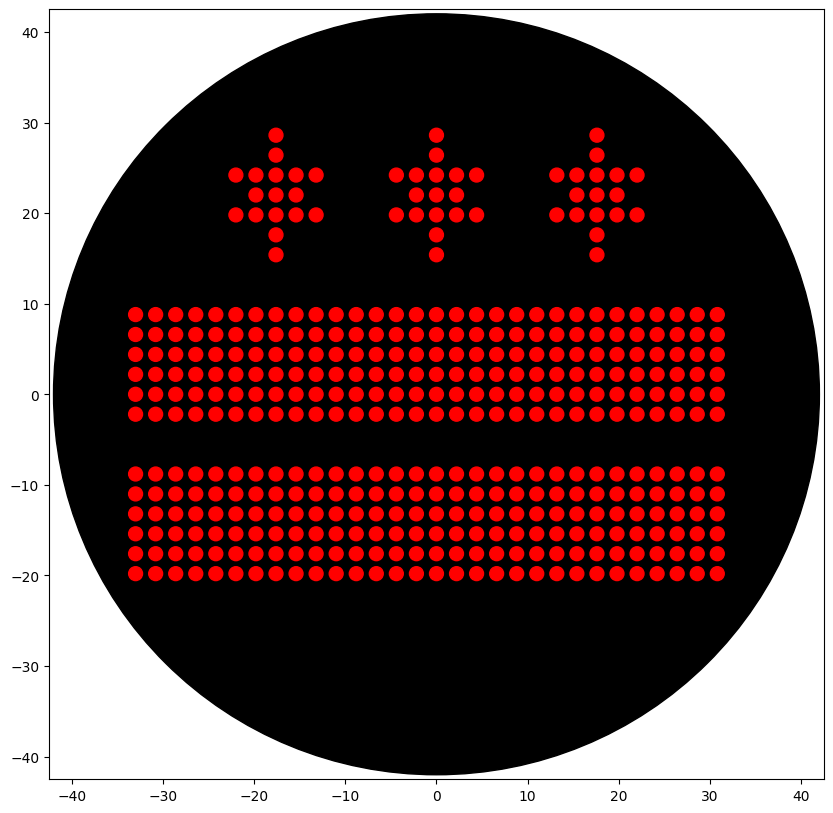
Above: My Opentron design of the Washington, DC flag
Post-Lab Questions
1) Find and describe a published paper that utilizes the Opentrons or an automation tool to achieve novel biological applications.
This paper https://pmc.ncbi.nlm.nih.gov/articles/PMC7886139/ (Lazaro-Perona et al., 2021) tests the efficacy of RNA extraction and PCR-based bulk Covid-19 testing procedures, including an Opentron method. They did not find a significant difference in the ability of the Opentron method vs. other protocols to detect Covid, however they point out that the Opentron method is cost-effective and less labor-intensive than its non-automated counterparts.
2) Write a description about what you intend to do with automation tools for your final project. You may include example pseudocode, Python scripts, 3D printed holders, a plan for how to use Ginkgo Nebula, and more. You may reference this week’s recitation slide deck for lab automation details.
I’m interested in engineering model bacteria to produce extracellular polymeric substances (EPS) similar to those of the cyanobacterium Nostoc. Nostoc’s EPS gives it natural metal-chelating abilities, high tolerance to stress, dessication, and space conditions, and high nutritional content. However, Nostoc is extremely slow-growing and very difficult to engineer, so is not an optimal chassis. Adding specific Nostoc-like properties to other species would make it possible to take advantage of these characteristics for engineering without dealing with its slow growth rate.
Automation would be most important in the testing phase of my project. To assess EPS formation in bulk, I might use an Opentron-like system to screen a portion of samples, potentially containing different versions of my circuit (or under various conditions and/or including controls that are uninduced or without a circuit present), for production of EPS, and EPS-composition (i.e., presence of carbohydrate compounds vs proteins) via chemical and colorimetric assays. These assays might involve using the opentron to add relevant reagents to each sample, then using a plate reader or spectrophotometer for downstream absorbance and fluoresence measurements.
Final Project Ideas
Engineering synthetic microbial consortia, including A. baylyi, N. commune, and Oscillatoria sp., for wastewater treatment and bioremediation
Engineering production of elements of Nostoc’s extracellular polymeric substance composition into fast-growing, genetically-tractable bacteria for applications in space travel, bioremediation, nutrition, and agriculture.
Developing a bioengineering toolkit for space travel using genes from extremophile species.