Week 3 HW: Lab Automation
Homework Submission
Design Explanation
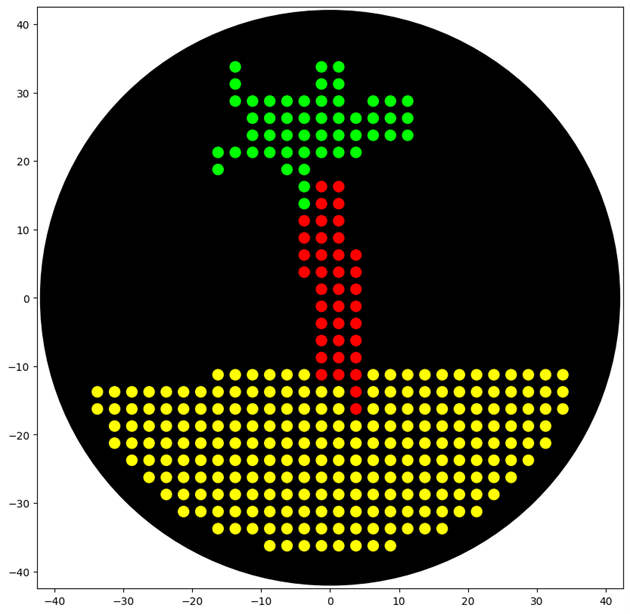
For the art, I first sketched ideas on my tablet and then tried to upload them as an image on OpenTrons. The image with birds flying through the sky was pleasing to me aesthetically, but there were limited colours available to us. I chose the following palm tree and adapted some of the colours.


Thus, I settled on this design: https://opentrons-art.rcdonovan.com/?id=4p046971r45mo4c

After using Microsoft Copilot to help me code in OpenColab, I settled on the following code and image: https://colab.research.google.com/drive/1K-qcZjtwZKHQ8mIlfLnY42qBpRsIZFts#scrollTo=pczDLwsq64mk&uniqifier=1

Furthermore, after receiving feedback on my design, I minimised colours and removed an outer edge to ensure the image is clearer and to prevent spillage
–
Homework Questions
1. Find and describe a published paper that utilizes the Opentrons or an automation tool to achieve novel biological applications.
Norton-Baker B, Denton MCR, Murphy NP, Fram B, Lim S, Erickson E, et al. Enabling high-throughput enzyme discovery and engineering with a low-cost, robot-assisted pipeline. Sci Rep. 2024;14(1):14449. http://dx.doi.org/10.1038/s41598-024-64938-0
This article by Baker et al. describes a robot-assisted pipeline for enzyme engineering. The article explains how, with the advances of AI and genome data, it is extremely taxing to manually test every permutation. There is simply too much to test using the standard laboratory methods. The main bottleneck they have found is the production, purification and characterisation of the proteins. The author’s attempt to make a generalisable protocol that is cost-effective and high-throughput to streamline enzyme discovery. Their idea is to use robot-assisted pipelines using the opentrons OT-2 liquid handling robot on a 96-well plate to scale to hundreds of proteins per week.
The workflow specifically uses the OT-2 to automate time-consuming steps like transforming E. coli with plasmids, inoculation, lysing, and protein purification using Ni-charged magnetic beads. The workflow also cleaves proteins with a protease instead of eluting to make it easier to use in downstream assays. The authors did this for PET-degrading proteins to screen for enzymes to degrade plastics. They did this using 23 published hydrolases, which were expressed and purified and then measured their thermostability and activity.

Using this pipeline, they were able to have repeatable results after doing 3 separate trials. Across replicate wells and runs, they obtained reproducible enzyme yields reaching up to 400 μg for some proteins, and verified that the samples were sufficiently pure and correctly sized using SDS-PAGE. Finally, the authors use the purified enzymes to generate a benchmark dataset by testing stability (via DSF melting temperatures) and activity across a large matrix of conditions (including different pH values, temperatures, substrates, and timepoints), which lets them rank enzyme performance in a standardised way. In their side-by-side benchmark, LCC-A2 consistently generated the largest amounts of PET breakdown products confirmed by UV-Vis and HPLC ratios, making it the strongest overall performer under their assay setup.
2. Write a description about what you intend to do with automation tools for your final project.
For my final project involving decaffeination using synthetic bacteria, automation could help in testing many enzymes and/or bacterial strains simultaneously. Similar to the article I described in the previous question, it can be helpful to use automation, such as OpenTrons, to identify the best enzyme rather than manually testing each prospective enzyme. Similar to the article by Baker et al., a 96-well screen could be done to test a different enzyme/strain condition (dose, pH, temperature, time). The OT-2 would automate all pipetting by adding tea/coffee, buffers/cofactors, enzyme/strain inputs, and pulling timed samples into a quench plate making screening faster.To ensure this doesn’t create unwanted flavour-related byproducts, I’d measure not only caffeine reduction but also methylxanthine byproducts, which can vary depending on the enzyme/strain used.
Furthermore, as for my idea regarding the biological synthesis of Salvinorin A or Paclitaxel, a common class of molecules among them is terpenes. This is a type of molecule usually derived via plant extraction. Thus, this could be a good target to screen using automation. The principle is similar to decaffeination, where an array of enzymes and pathways could be tested at the same time with an OT-2 workflow with P450 enzymes, followed by analytical tools like HPLC readouts to examine successful synthesis.