Week 6: HW genetic circuits part I
This week we learn core molecular biology tools and techniques for processing and assembling DNA, including PCR and Gibson Assembly.
Objective:
- Learn core molecular biology tools and techniques for processing and assembling DNA.
- Understand PCR and Gibson Assembly.
- Compare different ways of creating DNA fragments for cloning.
- Explore genetic circuit design and simulation using Asimov Kernel.
Assignment: DNA Assembly
Assignees for the following sections
| MIT/Harvard students | Required |
| Committed Listeners | Required |
Answer these questions about the protocol in this week’s lab.
1. What are some components in the Phusion High-Fidelity PCR Master Mix and what is their purpose?
The Phusion High-Fidelity PCR Master Mix contains a high-fidelity DNA polymerase, which copies DNA with very few mistakes. It also contains dNTPs, which are the small molecules used to build new DNA strands. The mix includes a buffer to keep the chemical conditions stable and suitable for the reaction. It also has Mg2+ ions, which help the polymerase function properly.
2. What are some factors that determine primer annealing temperature during PCR?
Primer annealing temperature depends on the primer sequence, length, and GC content. The higher the GC content, the higher the temperature is for annealing. The temperature is also affected by how well the primer matches the template. Salt and buffer conditions in the reaction can change how strongly the primer binds.
3. There are two methods from this class that create linear fragments of DNA: PCR, and restriction enzyme digests. Compare and contrast these two methods, both in terms of protocol as well as when one may be preferable to use over the other.
PCR uses primers and DNA polymerase to copy a specific DNA region, producing many copies. It is ideal when you need to amplify a fragment or introduce small sequence changes or overlaps. In contrast, restriction digestion uses enzymes to cut DNA at specific existing recognition sites. It is best when the DNA already contains the right cut sites and you want a simple, precise cut into fragments.
4. How can you ensure that the DNA sequences that you have digested and PCR-ed will be appropriate for Gibson cloning?
To make DNA suitable for Gibson cloning, the fragments need to have matching overlapping ends so they can join together correctly. The overlaps must be in the right order and orientation so the final construct assembles as planned. A crucial step is to check that the fragments are the correct size and that the DNA is clean. If there are unwanted bands or extra products, the assembly is prone to fail.
5. How does the plasmid DNA enter the E. coli cells during transformation?
Plasmid DNA enters E. coli after the cells are made competent, which means the cell membrane is prepared to allow DNA to pass through more easily. During heat shock or electroporation, the membrane becomes temporarily more permeable. This allows the plasmid DNA to move into the cell. After that, the cells recover and can begin to replicate the plasmid.
6. Describe another assembly method in detail (such as Golden Gate Assembly)
6.1 Explain the other method in 5–7 sentences plus diagrams (either handmade or online).
Golden Gate Assembly is a cloning method that joins DNA fragments together in a specific order. It uses Type IIS restriction enzymes, which cut outside of their recognition sequence instead of directly inside it. This creates short overhangs that can be designed to match only the correct neighbouring fragment. DNA ligase then joins the matching fragments together. One major advantage of Golden Gate Assembly is that the recognition site is usually removed during the process, so the final DNA product can be seamless. This method is very useful when multiple DNA fragments need to be assembled in one reaction.
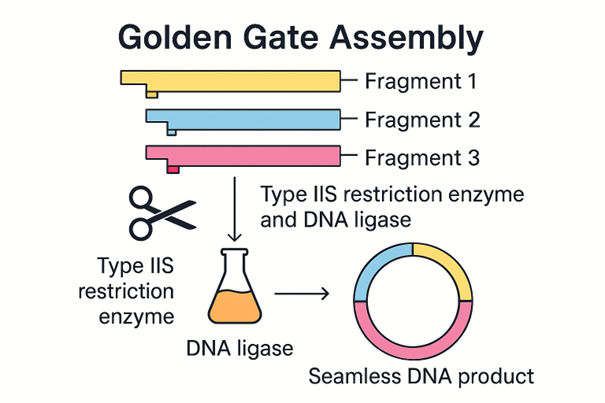
Made using M365 Copilot.
6.2 Model this assembly method with Benchling or Asimov Kernel.
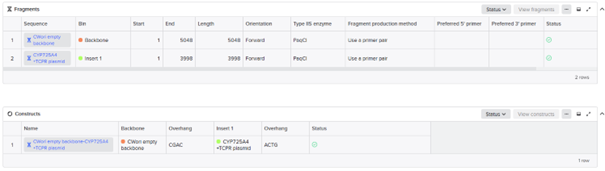
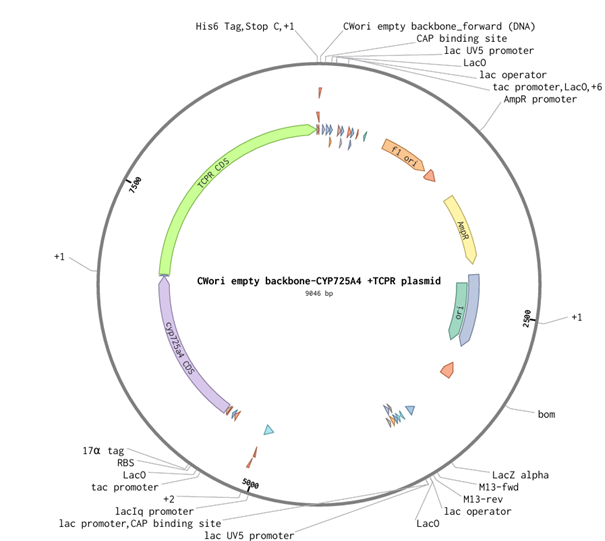
For this part of the assignment, I decided to use my final construct and designed the non-mutated cyp725a4 enzyme with induced expression, similiar to one of the articles I found (doi: 10.1016/j.pep.2017.01.008). I used Golden Gate Assembly in Benchling using the cwori backbone as the vector and the CYP725A4 + TCPR sequence as the insert. I first checked common Type IIS enzymes. BbsI, BsaI, and BsmBI were not ideal because they have internal cut sites in my construct, meaning they could cut inside the DNA instead of only at the assembly ends. I therefore chose PaqCI as a better enzyme to test because it has a longer recognition sequence and is less likely to occur internally. In a real experiment, I would add inward-facing PaqCI sites and designed overhangs to the backbone and insert using PCR primers.
Assignment: Asimov Kernel
Assignees for the following sections
| MIT/Harvard students | Required |
| Committed Listeners | Required |
Unfortunately, we never got Kernel access so I was not able to do this part as a commited listener