Week 9 — Cell-Free Systems
This week introduces synthesis of proteins using cellular machinery outside of a cell.
Homework — DUE BY START OF Apr 7 LECTURE
Homework Part A: General and Lecturer-Specific Questions
Assignees for the following sections
| MIT/Harvard students | Required |
| Committed Listeners | Required |
General homework questions
- Explain the main advantages of cell-free protein synthesis over traditional in vivo methods, specifically in terms of flexibility and control over experimental variables. Name at least two cases where cell-free expression is more beneficial than cell production.
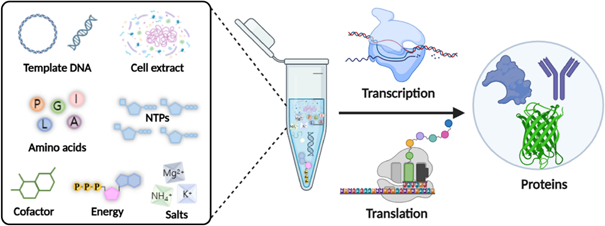
Cell-free protein synthesis is useful because proteins can be produced without needing to keep living cells alive. This gives more flexibility and control over experimental variables such as DNA concentration, energy supply, cofactors, salts, and reaction conditions.
Cell-free expression is especially beneficial for producing toxic proteins that would harm living cells, and for rapidly testing different enzymes, pathways, or genetic designs without needing to transform and grow cells each time.
- Describe the main components of a cell-free expression system and explain the role of each component.
A cell-free expression system contains a cell extract, a DNA or mRNA template, amino acids, nucleotides, an energy source, salts, and cofactors. The cell extract provides the ribosomes, polymerases, tRNAs, and enzymes needed for transcription and translation. The DNA template encodes the protein of interest. Amino acids are used to build the protein, while ATP and other energy molecules drive the reaction. Cofactors such as magnesium and potassium help maintain enzyme and ribosome activity.
- Why is energy provision regeneration critical in cell-free systems? Describe a method you could use to ensure continuous ATP supply in your cell-free experiment.
Energy regeneration is critical because transcription and translation use ATP and other nucleotides very quickly. If ATP is depleted, ribosomes, polymerases, and other enzymes stop working, so protein synthesis decreases or stops.
One method to maintain ATP supply is to add an energy regeneration system such as phosphoenolpyruvate (PEP) with pyruvate kinase. In this setup, PEP helps regenerate ATP from ADP, allowing the reaction to keep producing protein for a longer time.
- Compare prokaryotic versus eukaryotic cell-free expression systems. Choose a protein to produce in each system and explain why.
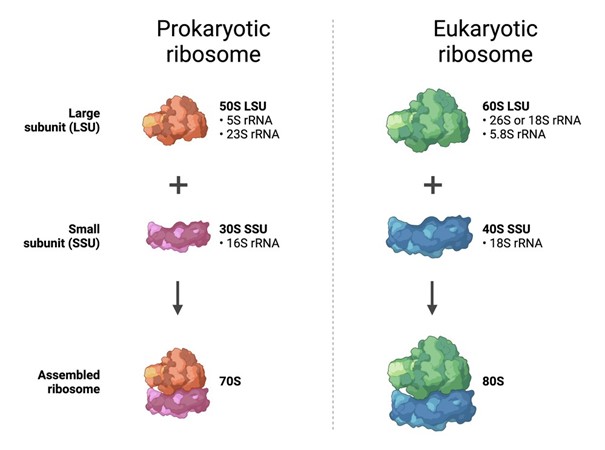
Prokaryotic cell-free systems, such as E. coli extracts, are usually faster, cheaper, and easier to use. They are best for simple proteins that do not need complex folding or eukaryotic post-translational modifications.
Eukaryotic cell-free systems, such as wheat germ, insect, or mammalian extracts, are usually more expensive and slower, but they are better for proteins that need more complex folding, disulfide bonds, or eukaryotic processing.
For a prokaryotic system, I would produce a bacterial enzyme such as β-galactosidase because it is a simple bacterial protein and does not need eukaryotic modifications.
For a eukaryotic system, I would produce a human membrane receptor such as a GPCR because it requires a more complex folding environment and membrane-like conditions to function correctly.
- How would you design a cell-free experiment to optimize the expression of a membrane protein? Discuss the challenges and how you would address them in your setup.
To optimize expression of a membrane protein, I would run a cell-free reaction with the DNA template for the target protein and include membrane-like structures such as liposomes, nanodiscs, or detergent micelles. These would give the protein a hydrophobic environment where it can insert and fold more correctly.
A major challenge is that membrane proteins can misfold or aggregate when they are produced without a membrane. I would address this by testing different membrane mimetics, changing the lipid composition, lowering the reaction temperature, and adding cofactors or chaperones if needed. I would compare the conditions by measuring both protein yield and protein activity.
- Imagine you observe a low yield of your target protein in a cell-free system. Describe three possible reasons for this and suggest a troubleshooting strategy for each.
Reason 1: Poor DNA template quality or incorrect DNA concentration
Troubleshooting: Check the DNA quality and test a range of DNA concentrations to find the best expression level.Reason 2: Energy supply is depleted too quickly
Troubleshooting: Improve the energy regeneration system by adding components such as PEP or another ATP-regeneration substrate.Reason 3: The protein is misfolding or aggregating
Troubleshooting: Lower the reaction temperature, add chaperones, or include liposomes/nanodiscs if the protein needs a membrane-like environment.
Homework question from Kate Adamala
Design an example of a useful synthetic minimal cell as follows:
Pick a function and describe it.
a. What would your synthetic cell do? What is the input and what is the output?
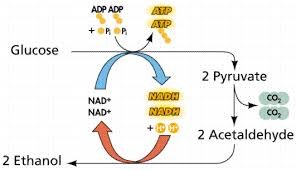
My synthetic minimal cell would produce ethanol from glucose. The input would be glucose, and the output would be ethanol. This is useful because ethanol is easy to measure and can be used as a biofuel or chemical product.
b. Could this function be realized by cell-free Tx/Tl alone, without encapsulation?
Yes, this could be done in a bulk cell-free Tx/Tl reaction because the enzymes needed for ethanol production can work outside living cells. However, encapsulation makes the system more cell-like and allows better control over what enters and leaves the system.
c. Could this function be realized by genetically modified natural cell?
Yes, ethanol production is already commonly done using organisms such as yeast or engineered bacteria. However, a synthetic minimal cell gives more direct control over the reaction conditions and avoids some competing pathways found in living cells.
d. Describe the desired outcome of your synthetic cell operation.
The desired outcome is controlled conversion of glucose into ethanol, with predictable ethanol output and minimal side products.
Design all components that would need to be part of your synthetic cell.
a. What would be the membrane made of?
The membrane would be made from phospholipids such as POPC and POPG, with cholesterol added to improve membrane stability.
b. What would you encapsulate inside? Enzymes, small molecules.
Inside the vesicle, I would encapsulate an E. coli-based cell-free Tx/Tl system, DNA templates for the main ethanol-production enzymes, amino acids, nucleotides, ATP-regeneration components, salts, magnesium, potassium, and cofactors such as NAD⁺/NADH.
c. Which organism your Tx/Tl system will come from? Is bacterial OK, or do you need a mammalian system for some reason?
A bacterial Tx/Tl system from E. coli would be sufficient because ethanol-production enzymes are simple metabolic enzymes and do not require mammalian post-translational modifications.
d. How will your synthetic cell communicate with the environment?
Glucose would enter through a membrane pore, and ethanol can diffuse out because it is small and membrane-permeable. To improve glucose entry, I would include a pore-forming protein such as α-hemolysin.
Experimental details
a. List all lipids and genes.
Lipids:
- POPC — main membrane lipid
- POPG — adds negative charge to the membrane
- Cholesterol — improves membrane stability
Genes:
- hla — encodes α-hemolysin pore for small-molecule transport
- pdc from Zymomonas mobilis — converts pyruvate to acetaldehyde
- adhB from Zymomonas mobilis — converts acetaldehyde to ethanol
To keep the system simpler, I would provide glucose-processing metabolites or use enzymes already present in the extract instead of encoding the entire glycolysis pathway.
b. How will you measure the function of your system?
I would measure ethanol production using an alcohol dehydrogenase-based ethanol assay, where ethanol conversion produces NADH that can be measured by absorbance at 340 nm. I could also measure glucose decrease as a second readout.
Homework question from Peter Nguyen
Freeze-dried cell-free systems can be incorporated into all kinds of materials as biological sensors or as inducible enzymes to modify the material itself or the surrounding environment. Choose one application field — Architecture, Textiles/Fashion, or Robotics — and propose an application using cell-free systems that are functionally integrated into the material.
One-sentence pitch:
I propose a smart textile patch containing freeze-dried cell-free biosensors that change fluorescence when exposed to sweat biomarkers linked to dehydration or heat stress.
How will the idea work?
The textile would contain small dried spots of cell-free reactions embedded into a wearable patch. When sweat reaches the patch, it would rehydrate the reaction and activate protein expression or a biosensor response. If the target biomarker is present, the patch would produce a visible fluorescent signal. This could be checked with a small fluorescence viewer or phone-based imaging system.
What societal challenge or market need will this address?
This could help athletes, outdoor workers, or soldiers monitor heat stress and dehydration early. It would be useful because it gives a low-cost and wearable biological readout without needing a laboratory.
How do you envision addressing the limitation of cell-free reactions?
The cell-free system would be freeze-dried to improve storage stability. The patch would stay inactive until sweat provides water. Since the reaction is likely one-time use, the patch would be designed as a disposable sensor strip.
Homework question from Ally Huang
Freeze-dried cell-free reactions have great potential in space, where resources are constrained. For this assignment, the proposal should incorporate the BioBits® cell-free protein expression system.
- Provide background information that describes the space biology question or challenge you propose to address. Explain why this topic is significant for humanity, relevant for space exploration, and scientifically interesting. Maximum 100 words.
Long-duration space missions need simple ways to monitor microbial contamination in spacecraft water. Microbes can affect astronaut health and damage closed life-support systems. Sending samples back to Earth is slow, so astronauts need compact tools that can work directly in space. BioBits® is useful because it is freeze-dried and can produce proteins without living cells after adding water and DNA instructions. The Genes in Space toolkit also includes the P51 fluorescence viewer, which can visualize fluorescent biomolecules in small tubes. 12
- Name the molecular or genetic target that you propose to study. Maximum 30 words.
A bacterial 16S rRNA gene sequence from a simulated spacecraft water sample.
- Describe how your molecular or genetic target relates to the space biology question or challenge your proposal addresses. Maximum 100 words.
The 16S rRNA gene is commonly used to identify bacteria, so detecting it would show whether bacterial contamination may be present in spacecraft water. This relates directly to space biology because spacecraft are closed environments where microbial growth must be monitored carefully. A BioBits® cell-free reaction could be used as a simple biosensor that produces a fluorescent signal when the bacterial target is present. Previous ISS work showed that BioBits® cell-free reactions can function in space and produce fluorescence-based biosensor readouts. 34
- Clearly state your hypothesis or research goal and explain the reasoning behind it. Maximum 150 words.
My hypothesis is that a BioBits® cell-free biosensor can detect a bacterial 16S rRNA target in a space-compatible experiment. If the target sequence is present, the biosensor should produce a fluorescent signal that can be viewed with the P51 Molecular Fluorescence Viewer. This is useful because it avoids the need to grow living cells and uses compact tools suitable for spacecraft. Since BioBits® reactions have already been tested aboard the ISS and shown to produce fluorescent outputs, a similar approach could be used for simple microbial monitoring during future missions. 13
- Outline your experimental plan. Maximum 100 words.
I would test a simulated spacecraft water sample using a BioBits® cell-free reaction designed to detect a bacterial 16S rRNA target. A positive control would contain the target DNA or RNA, and a negative control would contain no target. If the target is present, the reaction should produce fluorescence. The P51 Molecular Fluorescence Viewer would be used to compare fluorescence between the sample and controls. A stronger signal in the sample or positive control would indicate successful detection of bacterial contamination. 15
Homework Part B: Individual Final Project
Assignees for the following sections
| MIT/Harvard students | Required |
| Committed Listeners | Required |
- Provide Aim 1.
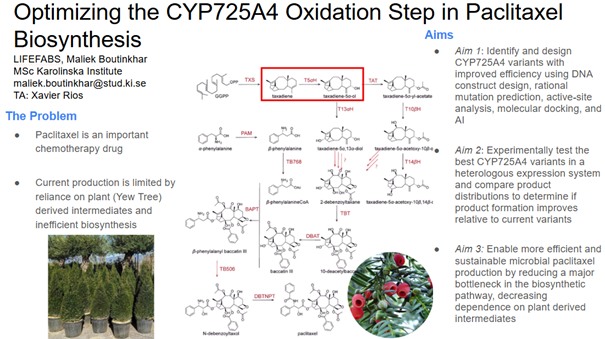
Aim 1: Identify and design CYP725A4 variants with improved efficiency using DNA construct design, rational mutation prediction, active-site analysis, molecular docking, and AI