Week 11 — Bioproduction & Cloud Labs
Homework — DUE BY START OF APR 28 LECTURE
Part A: The 1,536 Pixel Artwork Canvas | Collective Artwork
Assignees for the following sections
| MIT/Harvard students | Required |
| Committed Listeners | Required |
Contribute at least one pixel to this global artwork experiment before the editing ends on Sunday 4/19 at 11:59 PM EST.
Make a note on your HTGAA webpages including:
- what you contributed to the community bioart project,
- what you liked about the project, and
- what about this collaborative art experiment could be made better for next year.
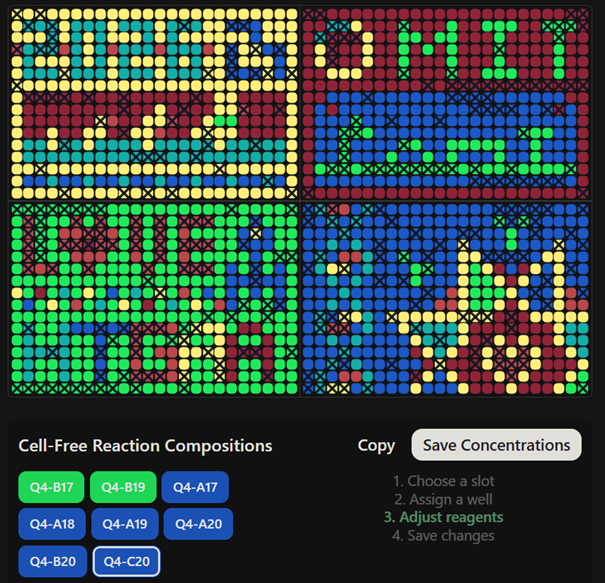
I tried to make a smiley face in the bottom right quarter but I sadly had limited spots. To me I had never considered using biology and art so it was interesting to see experiments like this unfold to this scale and to have such open opportunities for all CLs. Personally, I think smaller group project could be useful, for example, if each node or small grojps in the node have their own access to a art experiment like this it could be personalised to each person and allow us to have more individual impact as its now quite difficult to have a meaningful change in the big art project.
Part B: Cell-Free Protein Synthesis | Cell-Free Reagents
Assignees for the following sections
| MIT/Harvard students | Required |
| Committed Listeners | Required |
Referencing the cell-free protein synthesis reaction composition, provide a 1-2 sentence description of what each component’s role is in the cell-free reaction.
E. coli Lysate
- BL21 (DE3) Star Lysate (includes T7 RNA Polymerase)
Salts/Buffer
- Potassium Glutamate
- HEPES-KOH pH 7.5
- Magnesium Glutamate
- Potassium phosphate monobasic
- Potassium phosphate dibasic
Energy / Nucleotide System
- Ribose
- Glucose
- AMP
- CMP
- GMP
- UMP
- Guanine
Translation Mix (Amino Acids)
- 17 Amino Acid Mix
- Tyrosine
- Cysteine
Additives
- Nicotinamide
Backfill
- Nuclease Free Water
E. coli lysate (BL21 DE3 Star, includes T7 RNA polymerase):
Provides all cellular machinery (ribosomes, enzymes, tRNAs) for transcription and translation; T7 RNA polymerase transcribes DNA into mRNA.
Salts / Buffer
Potassium glutamate:
Maintains intracellular-like ionic conditions needed for ribosome activity.
HEPES-KOH pH 7.5:
Keeps pH stable so enzymes and proteins function properly.
Magnesium glutamate:
Provides Mg²⁺ ions required for ribosome function and RNA stability.
Potassium phosphate (mono + dibasic):
Acts as a buffer and supplies phosphate for metabolic reactions.
Energy / Nucleotide System
Ribose:
Precursor for rebuilding nucleotides.
Glucose:
Provides long-term energy via metabolic pathways.
AMP, CMP, GMP, UMP:
Nucleotide building blocks that are converted into active triphosphates for transcription.
Guanine:
Converted into GMP through salvage pathways to support RNA synthesis.
Translation Mix
17 amino acid mix:
Supplies most amino acids needed for protein synthesis.
Tyrosine:
Added separately due to solubility/stability issues.
Cysteine:
Added separately because it is reactive and easily oxidized.
Additives
Nicotinamide:
Supports enzyme activity and redox balance during long reactions.
Backfill
Nuclease-free water:
Adjusts volume without degrading DNA or RNA.
- Describe the main differences between the 1-hour optimized PEP-NTP master mix and the 20-hour NMP-Ribose-Glucose master mix shown in the Google Slide above. (2-3 sentences)
The 1-hour PEP-NTP system directly supplies ATP and NTPs along with PEP for immediate energy, enabling fast but short-lived protein production. The 20-hour system uses cheaper NMPs plus ribose and glucose, relying on enzymatic recycling to gradually regenerate energy and nucleotides, allowing longer, more sustainable protein expression.
- Bonus question: How can transcription occur if GMP is not included but Guanine is?
Guanine can be converted into GMP through salvage pathways in the lysate. Once GMP is regenerated, it can contribute to the nucleotide pool needed for RNA synthesis.
Part C: Planning the Global Experiment | Cell-Free Master Mix Design
Assignees for the following sections
| MIT/Harvard students | Required |
| Committed Listeners | Required |
Given the 6 fluorescent proteins we used for our collaborative painting, identify and explain at least one biophysical or functional property of each protein that affects expression or readout in cell-free systems.
Hint: options include maturation time, acid sensitivity, folding, oxygen dependence, etc. (1-2 sentences each)
sfGFP:
Fast maturation and strong folding efficiency → produces fluorescence quickly.
mRFP1:
Slower maturation and lower brightness → weaker signal over time.
mKO2:
pH-sensitive → fluorescence decreases if reaction becomes acidic.
mTurquoise2:
Very high quantum yield → strong signal even at lower expression.
mScarlet-I:
High brightness but moderate acid sensitivity → may lose signal in long runs.
Electra2:
Blue emission and good brightness → useful for multi-color separation but can depend on oxygen for chromophore formation.
- Create a hypothesis for how adjusting one or more reagents in the cell-free mastermix could improve a specific biophysical or functional property you identified above, in order to maximize fluorescence over a 36-hour incubation. Clearly state the protein, the reagent(s), and the expected effect.
For mKO2, increasing buffer strength (more HEPES or phosphate) will stabilize pH during long incubation. Since mKO2 is pH-sensitive, maintaining neutral pH should preserve fluorescence and increase total signal over 36 hours.
- The second phase of this lab will be to define the precise reagent concentrations for your cell-free experiment. You will be assigned artwork wells with specific fluorescent proteins and receive an email with instructions this week. You can begin composing master mix compositions here.
This was the cell free master mix from RC donovans proposal:
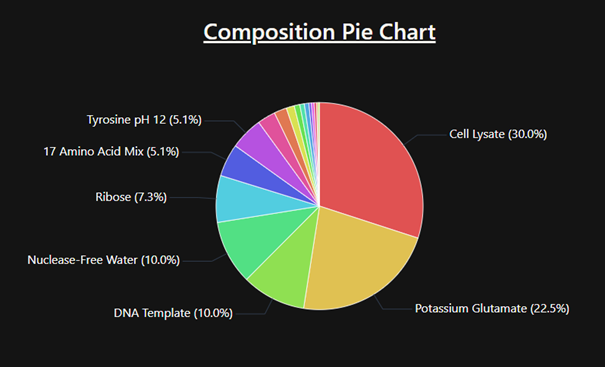
- The final phase of this lab will be analyzing the fluorescence data we collect to determine whether we can draw any conclusions about favorable reagent compositions for our fluorescent proteins.
The reaction composition for each well will be as follows:
- 6 μL of Lysate
- 10 μL of 2X Optimized Master Mix from above
- 2 μL of assigned fluorescent protein DNA template
- 2 μL of your custom reagent supplements
Total: 20 μL reaction
Part D: Build-A-Cloud-Lab | Optional Bonus Assignment
Assignees for the following sections
| MIT/Harvard students | Optional |
| Committed Listeners | Optional |
- Use this simulation tool to create an interesting looking cloud lab out of the Ginkgo Reconfigurable Automation Carts.
I did not complete the optional bonus assignment to try and focus on my final project