Week 3 HW: Lab Automation
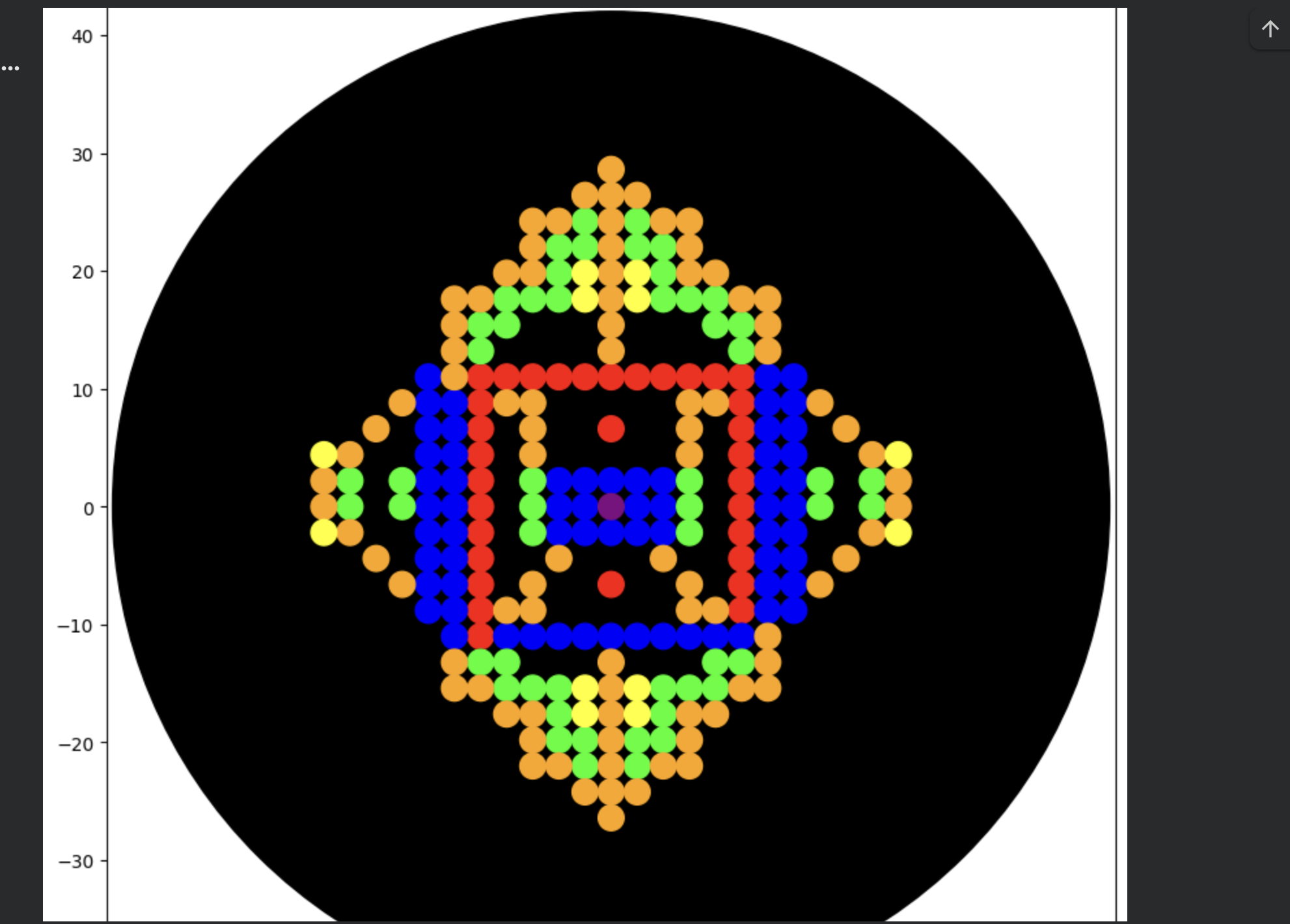
The design above was made using the platform graciously programmed by Ronan. The design is inspired by golden pieces made by Colombian craftsman. I was in Colombia at the time and had the privilege of seeing El Museo del Oro (The Gold Museum) and aimed to replicate some of the features here.
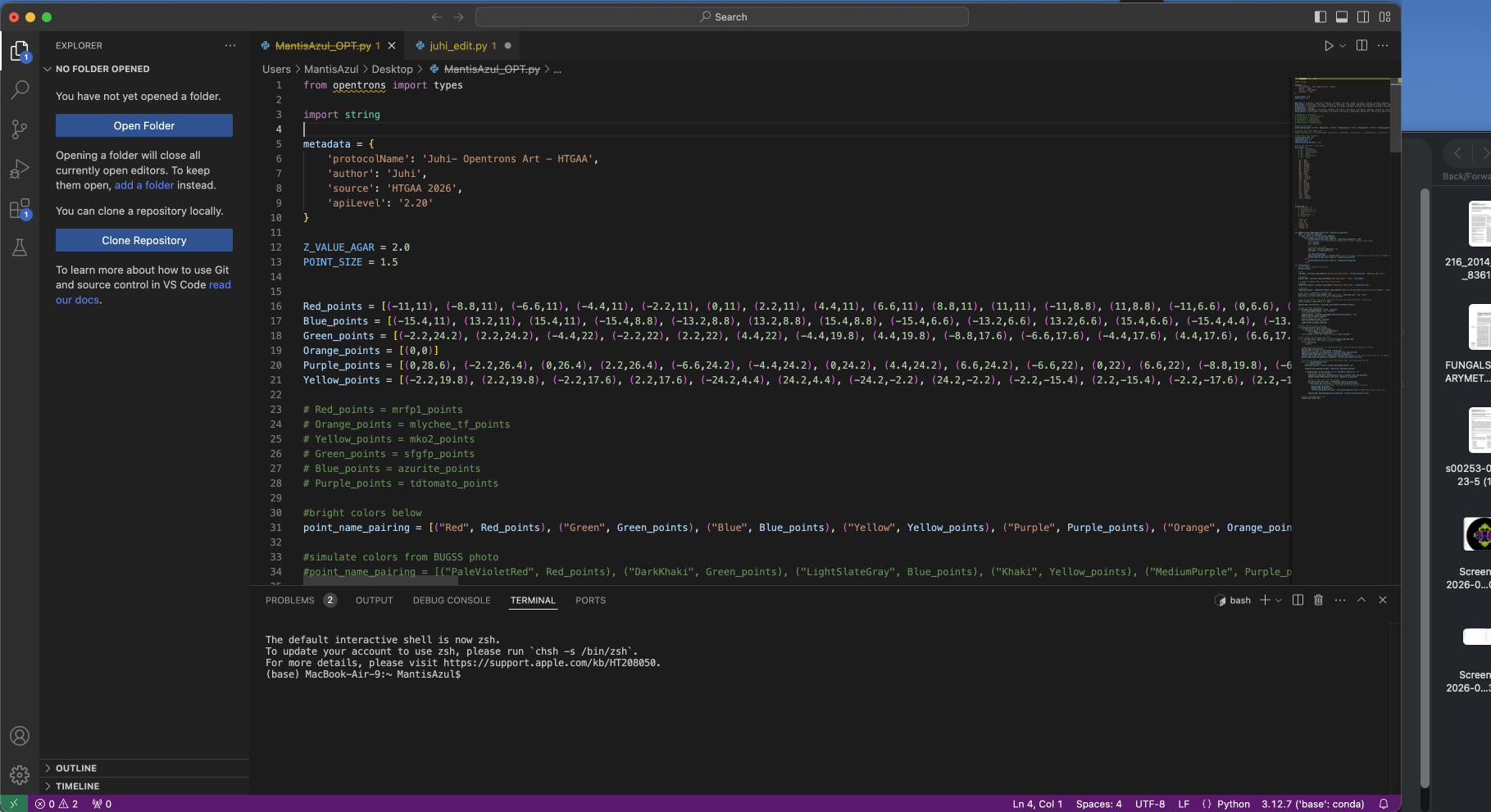
I input the coordinates from Ronan’s program into the opentrons file as seen above. There was quite a bit of trouble shooting as the equipment stated in the code was different from BUGSS supply. That caused some coordination issues within the opentrons that was eventually solved. During the lab, the majority of the time was dedicated to trouble shooting these minute bugs and I wasn’t able to run my script. However, Amanda and Joel (our instructor and TA! ((Thank you guys so much)) ran the script after lab hours which yielded this result:
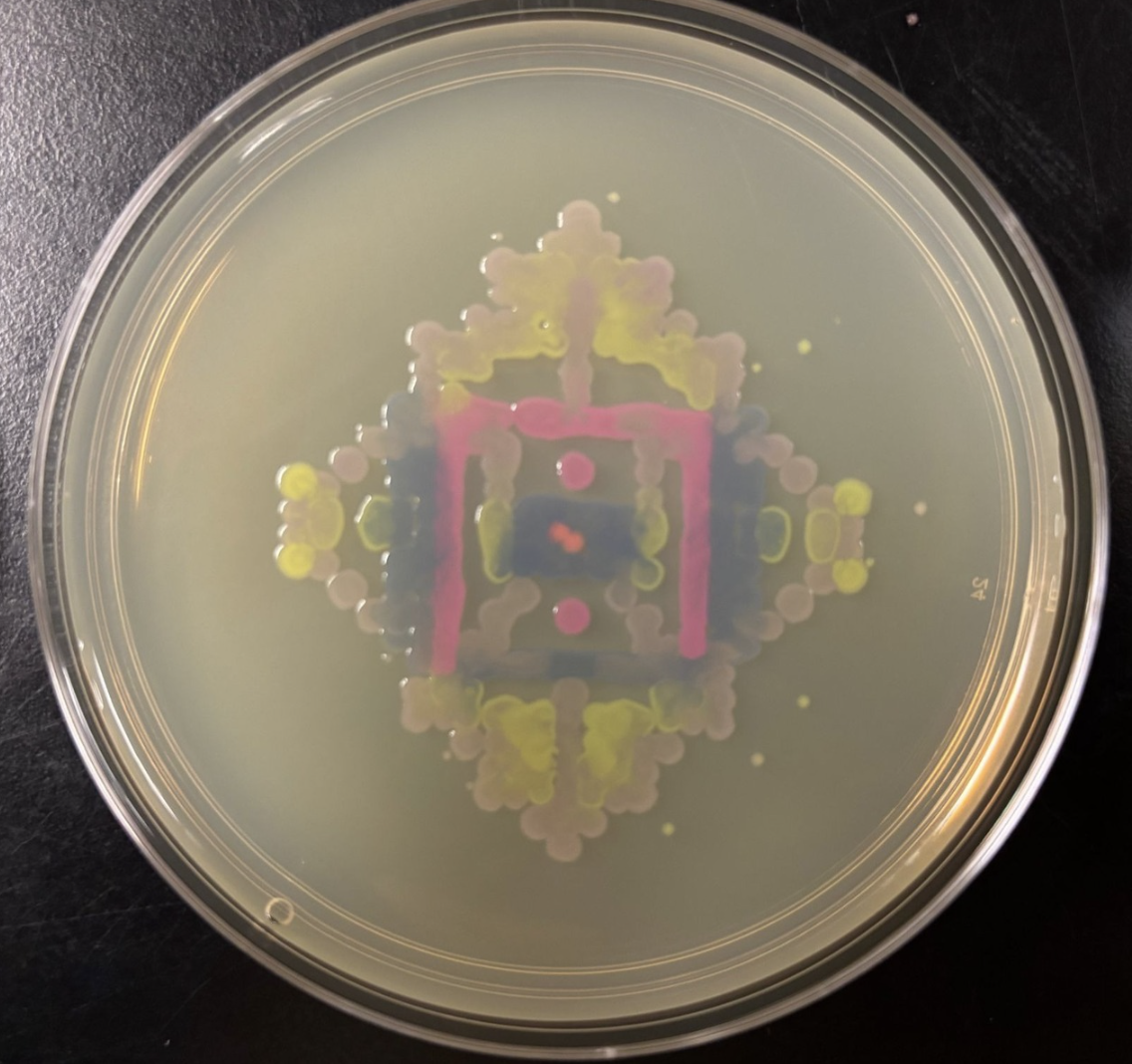
I find the bleeding of the colonies incredibly striking. There are moments where a colony will pool into another simulating layered watercolor droplets on paper.
One of the great parts about having an automated robot is being able to precisely mix, deposit, and run reactions without much intervention, and design and deploy experiments remotely.
For this week, we’d like for you to do the following:
Find and describe a published paper that utilizes the Opentrons or an automation tool to achieve novel biological applications.
https://link.springer.com/article/10.1007/s10489-025-06334-3
https://www.sciencedirect.com/science/article/pii/S2472630325000263
https://pubs.acs.org/doi/10.1021/acssuschemeng.4c05494
3D Printed Cellulose-Based Fungal Battery
Carolina Reyes, Erika Fivaz, Zsófia Sajó, Aaron Schneider, Gilberto Siqueira, Javier Ribera, Alexandre Poulin, Francis W. M. R. Schwarze, and Gustav Nyström ACS Sustainable Chemistry & Engineering 2024 12 (43), 16001-16011 DOI: 10.1021/acssuschemeng.4c05494
3D printing technology is one of the most formally recognized and utilized automation tools in fabrication and design. Electronics are vital to our daily way of life, and have become passive pieces of hardware rarely itching at our conscience. However, e-waste is a growing issue as proper methods of disposal are difficult and inefficient. Let alone the components of electronics are not easily recyclable if at all. Researchers are beginning to investigate the world beneath our feat to find the answer to combating e-waste. Microbial fuel cells are bio-electrochemical devices that convert chemical energy to electrical energy using micro-organisms. The interest in MFCs as functional alternatives to electronics is growing and yielding some powerful results.
In the article 3D Printed Cellulose-Based Fungal Battery, the 3D printer becomes an automated wet lab tool to create a bio-degradable fungal battery in response to building more ecologically focused electronics. The 3D printer’s role is to extrude the contents of the cellulose hydrogel (mixed with carbon black and graphite flakes to conduct electricity), structural additives and yeast (or white rot mycelia). The form is a fungal ink that acts as the electrode within a microbial fuel cell sandwiched between Cathode, PEM and anode layers. The 3D printer’s design and function allows for multiple iterations of the experiment to be conducted with precision and reproducibility.
Write a description about what you intend to do with automation tools for your final project. You may include example pseudocode, Python scripts, 3D printed holders, a plan for how to use Ginkgo Nebula, and more. You may reference this week’s recitation slide deck for lab automation details.
The aligned candidate automation tool is the OT-2 due to its liquid handling capabilities, customization (designing custom 3D printed parts and scripts) and accessibility. Since I am new to lab automation and wet lab workflows, the OT-2 is more familiar as a tool to begin solo experimental designs.
General Ideas for OT-2 Tool Implementation:
Idea one:
A final project idea is working with life to preserve cultural heritage objects. This is already being done in large scale applications, but what about small scale i.e. ceramics? My first series of tests would be testing the proper concentration of mineralization media for S.pasteurii is needed to fill macro-cracks in ceramic pieces in different clay bodies. Make ceramic slabs and treat with various degradation methods.
- 3D print custom “seats” for ceramic samples to ensure stability in the OT-2 during operation with enough depth to contain S.pasteurii in mineralization media.
- Customize a python script to renew the mineralization media every 24 hours.
Idea Two:
I am interested in the pigment Xylindein from C.aeruginascens and would like to express this pigment in another host due to the slow growth times and poor solubility. The goal would be to heterologously express the Xylindein pathway in S.cerevisiae. Xylindein is made from a multi-fragment pathway. To ensure expression, I would start with creating constructs that individually contain one gene within the pathway. This would ensure the individual genes are capable of expression in yeast. Next, I would design two constructs each containing 3 fragments from the pathway with different selectable markers.
- OT-2: Liquid handling of the samples into a 96 well plate
- Plateloc: Seal the 96 well plate (Plate sealing would be necessary again if Xylindein pigment production is visible and can move forward to OD600 and centrifugation steps for absorbance spectroscopy)
- Inheco: Incubation at 26C
- ATC thermocycler: Perform PCR for the samples in well plates
- Xpeel: Removes the seal from the 96 well plates