Week 11-12 HW: Bioproduction
Referencing the cell-free protein synthesis reaction composition (the middle box outlined in yellow on the image above, also listed below), provide a 1-2 sentence description of what each component’s role is in the cell-free reaction.
E. coli Lysate
BL21 (DE3) Star Lysate (includes T7 RNA Polymerase)
  - The strain of E.coli used to lysate and extract all of the needed cellular components like polymerases for transcription and ribosomes for translation. There is reduced chromosomal degradation.
Salts/Buffer
Potassium Glutamate
  - Mimics cellular environment via K+ ions
HEPES-KOH pH 7.5
  - pH buffer to maintain a suitable environment for the cell free reactions.
Magnesium Glutamate
  - Ribosome stability
Potassium phosphate monobasic
  - pH buffer to maintain a suitable environment for the cell free reactions.
Potassium phosphate dibasic
  - pH buffer to maintain a suitable environment for the cell free reactions.
Energy / Nucleotide System
Purpose:
Ribose
  - Ribose is the sugar in the backbone of DNA
  - Combines with nucleobases to become RNA
Glucose:
  - The carbon source. Glucose drives metabolic energy regeneration. Essentially, the food to keep going.
AMP
  - Adenosine monophosphate
CMP
  - Cystoisine Monophosphate
GMP
  - Guanosine Monophosphate
UMP
  - Uridine Monophosphate
Guanine
  - Nucelobase
Monophosphates:
  - NMP→NDP→NTP
      Supplies all components needed for energy and transcription
Translation Mix (Amino Acids)
17 Amino Acid Mix
  - Standard amino acids! Made available in the solution so transcription can occur with accessible AA products
Tyrosine
  - Mixed separately because unstable in a mixed solution
Cysteine
  - Mixed separately because unstable in a mixed solution
  - Core protein building blocks
Additives
Nicotinamide
  - Extends reaction and metabolic activity
  - Vitamin B3
Backfill
  - Nuclease Free Water
      The nuclease free water has been treated to eliminate any RNAses that could degrade the DNA and RNA in the sample. Typically, water is the solvent to get the mix to the proper concentration and acts as the body of the reaction.
Describe the main differences between the 1-hour optimized PEP-NTP master mix and the 20-hour NMP-Ribose-Glucose master mix shown in the Google Slide above. (2-3 sentences).
The main differences between the two mixes are the energy systems, phosphate concentrations and additives. For energy, the ATPs are immediately supplied to expedite immediate growth. Over time the metabolic pathway will be exhausted and the overall system will become unstable. The addition of spermidine at 937mM boosts protein synthesis,which works for a 1 hour reaction, but will become unstable as the hours progress as synthesis uses more and more energy that is not sustained.
Bonus question: how can transcription occur if GMP is not included but Guanine is?
GMP is the guanine monophosphate and guanine can become GMP which gets converted into energy. GMP→GDP→GTP
Planning the Global Experiment | Cell-Free Master Mix Design Given the 6 fluorescent proteins we used for our collaborative painting, identify and explain at least one biophysical or functional property of each protein that affects expression or readout in cell-free systems (hint: options include maturation time, acid sensitivity, folding, oxygen dependence, etc) (1-2 sentences each).
The amino acid sequences are shown in the HTGAA Cell-Free Benchling folder.
- sfGFP
- mRFP1
- mKO2
- mTurquoise2
- mScarlet_I
- Electra2
Create a hypothesis for how adjusting one or more reagents in the cell-free mastermix could improve a specific biophysical or functional property you identified above, in order to maximize fluorescence over a 36-hour incubation. Clearly state the protein, the reagent(s), and the expected effect.
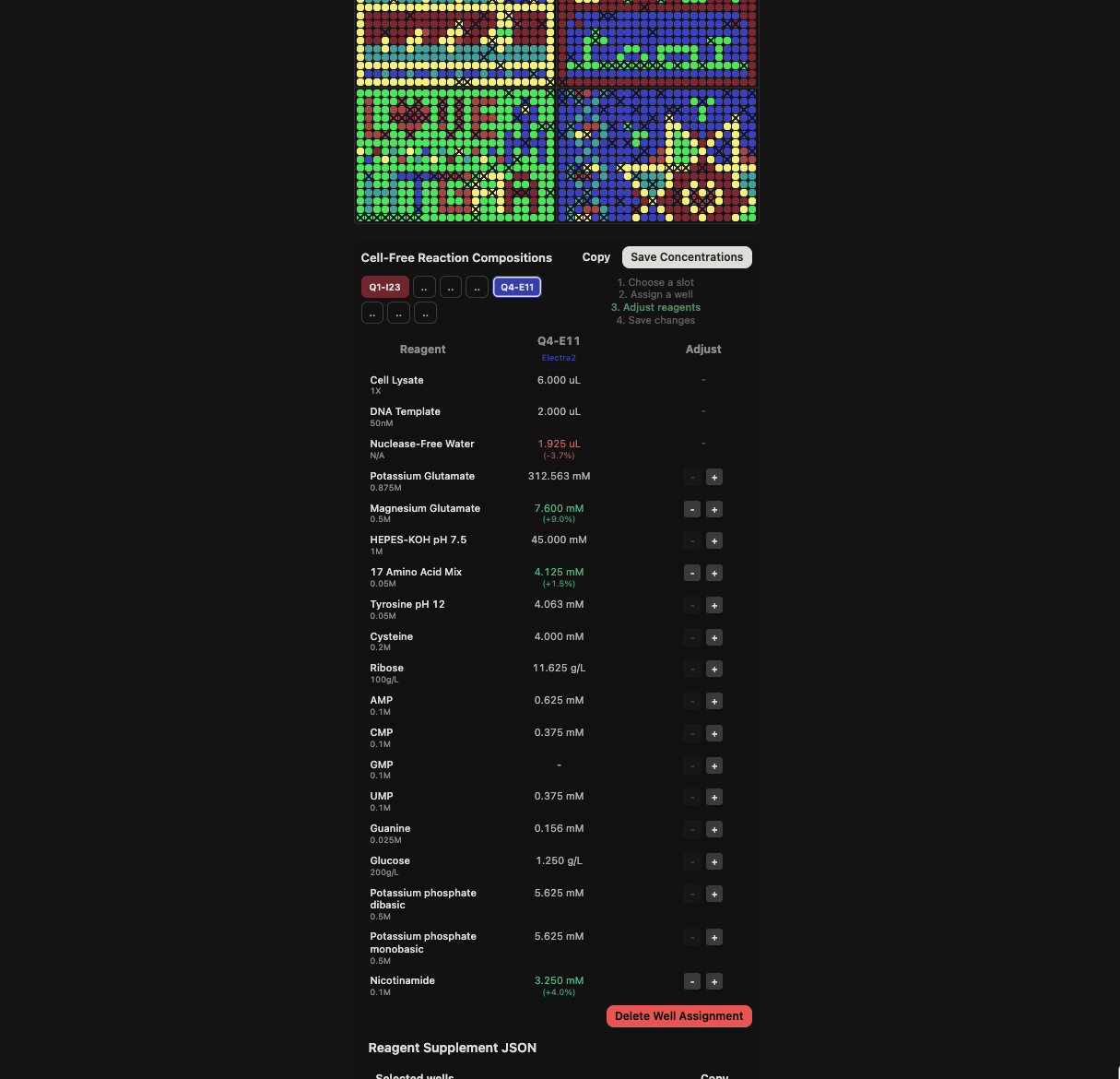
Q4-E11 Electra 2
17 AA: 4.123mM
Magnesium Glutamate: 7.402mM
Nicotinamide: 3.152mM
The goal of maximizing fluorescence over a 36 hour incubation resulted in increasing the amino acid mix, magnesium glutamate and nicotinamide. Magnesium glutamate supports ribosomal stability which in tandem with increased amino acid support and nicotinamide (extends reaction and metabolic activity) will support long term incubation. My thought process is in increasing translational machinery and maintenance of the post-translational activity in the solution.
Post Lab Questions | Mandatory for All Students
Which genes when transferred into E. coli will induce the production of lycopene and beta-carotene, respectively?
Lycopene (pLAC-LYC): red pigment found in tomatoes. Microbes produce lycopene via a 3-enzyme pathway transferred/introduced into E.coli that can convert FPP into lycopene.
Beta-Carotene (pAC-BETA): an orange pigment altered from lycopene via a singular gene(enzyme) difference of CrtY. The genes that will induce lycopene and beta-carotene respectively are CrtE, Crtl, and crtB with the differentiating gene creating Beta Carotene being Crt Y. CrtY is from the organism Erwinia Herbicola
Why do the plasmids that are transferred into the E. coli need to contain an antibiotic resistance gene?
Plasmids transferred into E.coli need an antibiotic resistance gene (yeast selectable markers) as a way to identify E.coli that grow with the respective gene insert. E.coli with your gene (with the resistance of the antibiotic in the media) should be the only organism to grow on the plate.
What outcomes might we expect to see when we vary the media, presence of fructose, and temperature conditions of the overnight cultures?
Fructose and 37C will lead to higher yield because 37 mimics the natural environmental temperature of E.coli. Fructose is an additional carbon source which will provide more energy for cellular growth and function.
Generally describe what “OD600” measures and how it can be interpreted in this experiment.
OD600 measures the amount of cellular growth in a substance. Bacteria, overnight, create a saturated medium that looks murky. As the cells divide during their phases of growth, the media becomes noticeably “denser”. Therefore, optical density works by sending out wavelengths of light. The reduction of light passing through the sample is used to estimate cellular growth.
The increase of bacterial growth directly increases the absorbance factor.
What are other experimental setups where we may be able to use acetone to separate cellular matter from a compound we intend to measure?
Creatively, acetone can be used to create a pigmented solution from cells by being a method that breaks up the cell via resuspension and centrifugation. You would only get the pigment within this final product.
Within the same breath, acetone can be used to precipitate proteins as acetone decreases the solubility of the proteins. If you have a gene of interest with a protein output, you can estimate the yield via centrifuging the cells into a pellet causing your desired compound from the protein to remain suspended in the acetone solution. The left supernatant then contains your protein output in the acetone solution (like carotenoids in the lab example).
OR you can use the protein precipitate in other downstream applications and analysis. Hydrophobicity! Lipids + proteins classic!
Why might we want to engineer E. coli to produce lycopene and beta-carotene pigments when Erwinia herbicola naturally produces them?
Though Erwinia Herbicola produces lycopene and beta-carotene pigments, the bacteria does not prioritize the production of these pigments. By engineering E.coli, selecting for the production of lycopene can produce higher yields and also generate more consistent production.
Post Lab Questions | For Committed Listeners Only
You may need the following papers to answer these questions:
Gene expression pattern analysis of a recombinant Escherichia coli strain possessing high growth and lycopene production capability when using fructose as carbon source
Improvement of Biomass Yield and Recombinant Gene Expression in Escherichia coli by Using Fructose as the Primary Carbon Source
Let’s get in touch with our metabolic pathway
What are the enzymes of the carotene pathway?
The enzymes in the carotene pathway are FPP, GGPP CrtE, Crtl, and CrtB
Within this pathway, which is the rate determining step (the step that takes the longest)? Which enzyme is responsible for this step? Farnesyl diphosphate (FPP) enzyme that makes lycopene downstream. (?)
Recitation: Phytoene Synthase → Knockout experiments
https://pmc.ncbi.nlm.nih.gov/articles/PMC9039723/
https://www.youtube.com/watch?v=65EQViMyMR0&t=359s
https://www.youtube.com/watch?v=evWgPUc7200&t=87s
Notes for design of a DNA construct for bioproduction
The first thing to do is to decide what organism you are going to use for this (E. coli or S. cerevisiae) for production. Which would you choose and why (emphases on production differences)? Things to initially Consider: 1. Is the intended host in the same kingdom? Prokaryote, eukaryote, Archea etc… 2. What is the protein of interest and how does that function express in the cell? 3. Rate of growth desired? 4. Length of gene insert? More post-translational difficulty and maintenance in the cell? Can handle high copy inducible promoters!
Now choose one of the enzymes and lets outline the parts of the construct for expression
For E. coli lets create a expression vector that works as a plasmid
Origin of Replication, Promoter for antibiotic, antibiotic gene, Promoter, RBS, Start codon, gene insert, stop codon, terminator.
Now, for making a functional construct there are a variety of biological parts needed for this, like ribosome binding sites, terminators, operators and promoters. The last ones are the most important in terms of enzyme or protein production. Let’s elaborate further on this biopart.
With the links below we are going to answer a few questions and think about the correct use of promoter: (https://blog.addgene.org/plasmids-101-the-promoter-region,
https://www.addgene.org/mol-bio-reference/promoters/, https://blog.addgene.org/plasmids-101-repressible-promoters
https://blog.addgene.org/plasmids-101-inducible-promoters
What is the function of a promoter?
A promoter is a gene/DNA sequence upstream of the RBS and gene insert that initiates transcription of the sequence. It “promotes” the polymerase to read the DNA script.
What types of promoters do we have?
Promoters are specific to a class of organism. Prokaryotic and Eukaryotic organisms will use different sets of promoters as the promoter calls upon the cell machinery to initiate transcription. There are inducible and constitutive promoters.
https://byjus.com/biology/difference-between-inducible-and-constitutive-promoter/
If we wanted to turn off the transcription of a gene in response to a metabolite, what type of promoter would be most useful? What if we wanted this to increase in the presence of the metabolite?
An inducible promoter because an inducible promoter is regulated by a metabolite, pH, temperature etc! If increase of the metabolite was desired, you would use a constitutive promoter because the pathway does not receive a signal to stop under specific conditions and is thus “always on”
Now choose one of the genes of the metabolic pathway previously described (Carotene/lycopene )and choose one enzyme to make an expression construct. What promoter could you use for this? Why did you choose it?
CrtE with the constitutive promoter T7 (with T7 RNA polymerase). I chose the T7 promoter because it is widely used and drives high levels of transcription.
With the links below we are going to answer a few questions and think about the correct use of origin of rep:
https://blog.addgene.org/plasmid-101-origin-of-replication, https://blog.addgene.org/plasmids-101-plasmid-incompatibility,
https://blog.addgene.org/plasmids-101-ebook-4th-edition
What is the origin of replication?
The origin of replication is the gene/sequence that initiates replication of the plasmid in the cell. Without the origin of replication, the plasmid would not be replicated autonomously into the host cell. Though the origin of replication still relies on the host’s cell internal resources and machinery to be replicated in the cell. The ori has more A-T pairings due to bases being boned with two hydrogen bonds rather, making the sequence “easier” to denature and replicate downstream.
What types of origin of replication do we have?
Relaxed: regulated only by the DNA in the plasmid, and there is no need for host cell initiation proteins. These tend to be high copy as they are not competing with other necessities of the cell to be transcribed!
Stringent: Stringent relies on the host’s chromosome to start replication via the initiation proteins. These tend to be low copy! Always use different origins of rep. When adding several plasmids to your host to minimize competition for host machinery and transcription.
(Extra) What are compatibility groups?
Compatibility groups in response to plasmids are the compatibility factors to ensure multiple plasmids being introduced into the host cell can be read and translated into the host. Having the same replicons on different plasmids causes the issue of competition for the cells machinery which can cause a plasmid to get lost/ignored by the cell.
In plasmids, there is the negative regulation system that distinguishes its plasmid from other plasmids in the cell. This system is based on iterons, repeated sequences in the ori that bind the initiation host machinery to begin transcription.
Now for the previously chosen promoter and gene what will be the best origin or replication?
I am choosing the pUMB1 origin in E.coli because it is a high copy origin and is only regulated from the DNA in the plasmid. With the T7 promoter and pUMB1 origin, the plasmid will be highly regulated in the host cell causing minimal complications with host machinery and high yield of the enzyme crtE.
(Mandatory for Global listeners, Optional MIT/Harvard) Elaborate further on other bioparts like RBS, terminators, operators you would use for a correct design and further bioproduction?
Ribosome Binding Site: the sequence that recruits the ribosome to bind to the RNA and begin translation. RBS typically contain a start codon prior to the gene insert to initiate direct translation of the gene and synthesis.
Terminators: the sequence that ends transcription. This process releases the RNA to begin translation. The Stop codon comes before the terminator.
https://blog.addgene.org/plasmids-101-terminators-and-polya-signals
Operators: sequence within the promoter that controls gene expression by acting like a switch.