Individual Final Project
Abstract
Xylindein is a blue-green pigment produced naturally by the fungi Chlorociboria aeruginascens and C. aeruginosa. The color has been used since the 15th century and is historically relevant to wood workers of the renaissance who used wood dyed with Xylindein in Intarsia pieces. Artists and Fungi enthusiasts alike still dye logs with Xylindein to craft functional ware and experiment with the properties of Chlorociboria aeruginascens. As aesthetically whimsical and charming the Xylindein pigment is from the little Blue elf cup, xylindein is also a semi-conductor making it useful in opto-electronic applications such as solar cells.
For such a beautiful pigment and organism, xylindein is considerably difficult to grow, produce and extract, taking researchers up to 24 weeks to get substantial growth. Regardless, a 2025 study identified the biosynthetic gene cluster responsible for xylindein production in Chlorociboria aeruginascens and C. aeruginosa. In the article, researchers attempted heterologous expression of three of the genes within the BGC identified (XLNfas1, XLNfas2, and XLN pks) in Aspergillus Oryzae. However, the transformation was unsuccessful as critical genes were unincorporated in the pathway to express the pigment.
The proposed project will initially attempt expression of 4 primary genes within the metabolic pathway (XLNfas1, XLNfas2, XLNlac and XLN pks) in Saccharomyces cerevisiae. These four genes demonstrated the highest levels of expression during xylindein production. Though the entire BGC contains all the critical genes for synthesis and expression, beginning with the minimal amount of genes needed will reduce time, cost and experimentally ‘optimize’ the process.
Project Aims
Aim 0.5 - For my preparatory aim, I will be ordering the XLNlac gene from Twist. The main issue that arises within my project is the size of each individual gene alongside multiple fragments then assembled and inserted into yeast. Researchers have successfully expressed a fungal biosynthetic gene cluster as found in the literature, however, the complication remains. From guidance from Amanda Mainello, our original solution was to cut the XLNpks gene via restriction cut sites (BamHII and SacI). This would make the single fragment split into 3 genes for order, both under the 5kb Twist Bioscience limit. The XLNpks gene is ~8kb. However, we pivoted to the XLNlaccase gene as it is only ~2kb in length. XLNlac, due its size and it high expression during the later stages of Xylindein growth, makes it a powerful candidate to test expression.
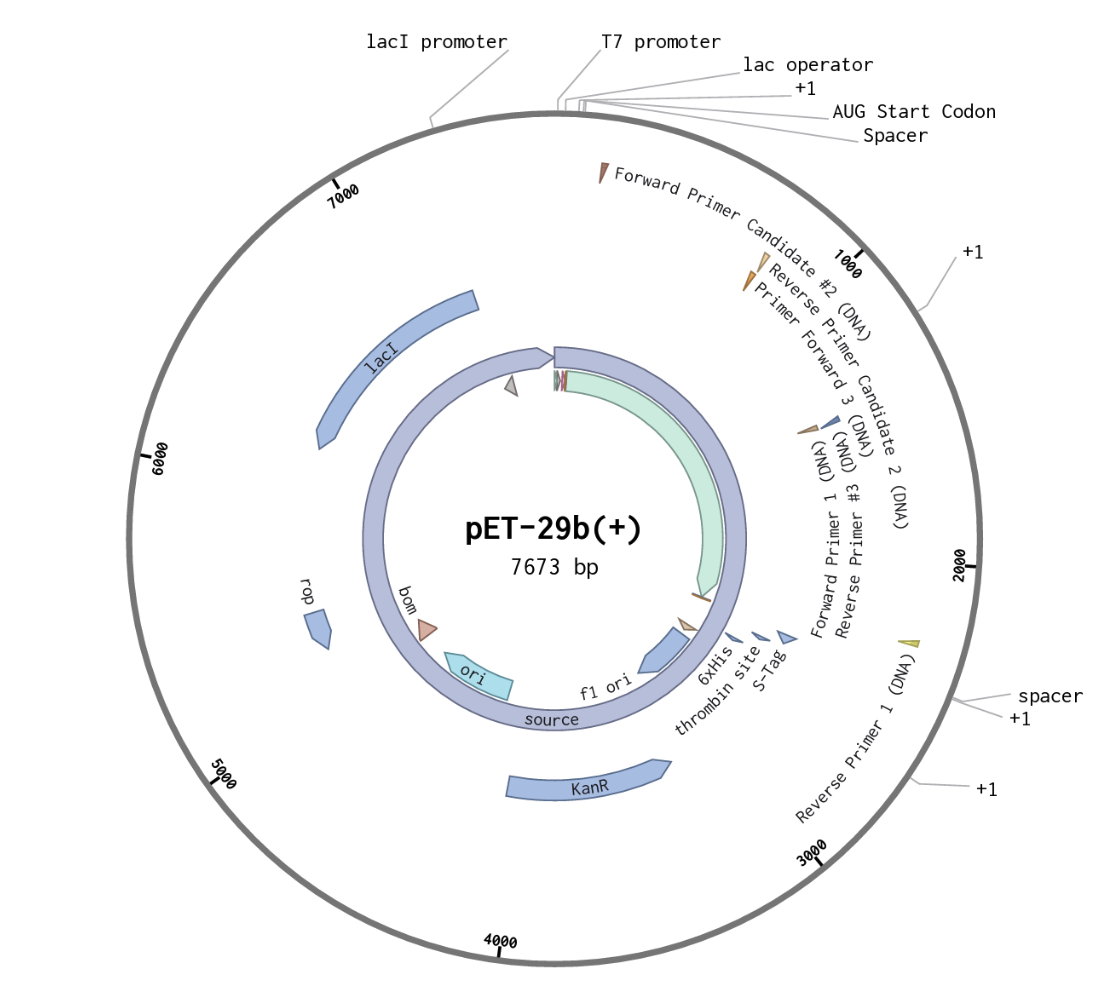
Aim 0.75 - After receiving the DNA from Twist, I will also order the custom primers demonstrated below within my benchling construct to amplify the sequence through PCR. expression of the assembled gene in the shuttle vector and host will be validated via gel electrophoresis.
Aim 1 - After proof of XLNlac expression, I will design two multi-fragment gene cassettes for yeast of the Xylindein biosynthetic pathway.
Aim 3 - VISIONARY AIM: Expression of all seven genes via constructed cassettes for S.cerevisiae proven by pigment production, OD600 and Absorbance spectroscopy from pigment. The goal in expression of the complete biosynthetic pathway is to ensure pigment production for textile dyeing.
Evolutions of the visionary Aim: Evaluating any bottlenecks in the genetic pathway to minimize the number of required genes in the pathway to express xylindein If pigment is yielded: improve the solubility of xylindein pigment Test the light fast properties of xylindein (has been proven to be incredibly UV stable!) Dye multiple types of fabric to test adhesion to fibers and longevity
Literature Review
A Highly Characterized Yeast Toolkit for Modular, Multipart Assembly Michael E. Lee, William C. DeLoache, Bernardo Cervantes, and John E. Dueber ACS Synthetic Biology 2015 4 (9), 975-986 DOI: 10.1021/sb500366v Addgene: MAddgene: MoClo-YTKoClo-YTK
Saccharomyes Cerevisiae has been used in synthetic biology applications due to its fully sequenced genome, tunable properties and ability to express multi-fragment cassettes. However, there is a staunch barrier of entry in working in synthetic biology, let alone in yeast. The MO-CLO yeast tool kit is a comprehensive framework detailing the parts and elements for yeast assembly. The toolkit serves as a guide to eliminate the barrier of entry so researchers can focus on their experimental design.
Notes:
Articulates and recommends an iterative methodology in designing yeast constructs, most notably, multi-fragment cassettes. Identification of promoters, terminators etc for use dependent on the experiment. A detailed how to approach as I began researching yeast constructs
Pathway engineering in yeast for synthesizing the complex polyketide bikaverin. Zhao, M., Zhao, Y., Yao, M. et al. Nat Commun 11, 6197 (2020). https://doi.org/10.1038/s41467-020-19984-3
Pathway engineering in yeast for synthesizing the complex polyketide bikaverin | Nature Communications
In Pathway engineering in yeast for synthesizing the complex polyketide bikaverin, researchers successfully inserted a multi-gene cassette into yeast using endogenous promoters with the goal to express the complex polyketide bikaverin. Bikaverin is a biosynthetic pathway in the Fusarium genus. Bikaverin is a secondary metabolite (SM) in Fusarium that produces a rich red pigment and contains anti-biotic and anti-cancer products. Due to the pharmaceutical potential and application of this SM, researchers embarked to express the pathway in yeast due to yeast’s rapid reproductive cycle, as a model organism, and a sequenced and understood genome.
Notes:
A successful attempt to get a fungal secondary metabolic pathway into S.cerevisiae via a GFP mapping strategy to confirm Bikaverin protein expression. Identified similar issues regarding the size of the fragments and proposed solutions via I am using the backbone proposed in this paper pRS15 and pRS416
Identification of a Biosynthetic Gene Cluster for the Production of the Blue-Green Pigment Xylindein by the Fungus Chlorociboria aeruginascens Yanfang Guo, Jorge Navarro-Muñoz, Caroline Rodenbach, Elske Dwars, Chendo Dieleman, Bart van den Hout, Bazante Sanders, Miaomiao Zhou, Ayodele Arogunjo, Russell J. Cox, Arnold J. M. Driessen, and Jérôme Collemare Journal of Natural Products 2025 88 (2), 233-244 DOI: 10.1021/acs.jnatprod.4c00350
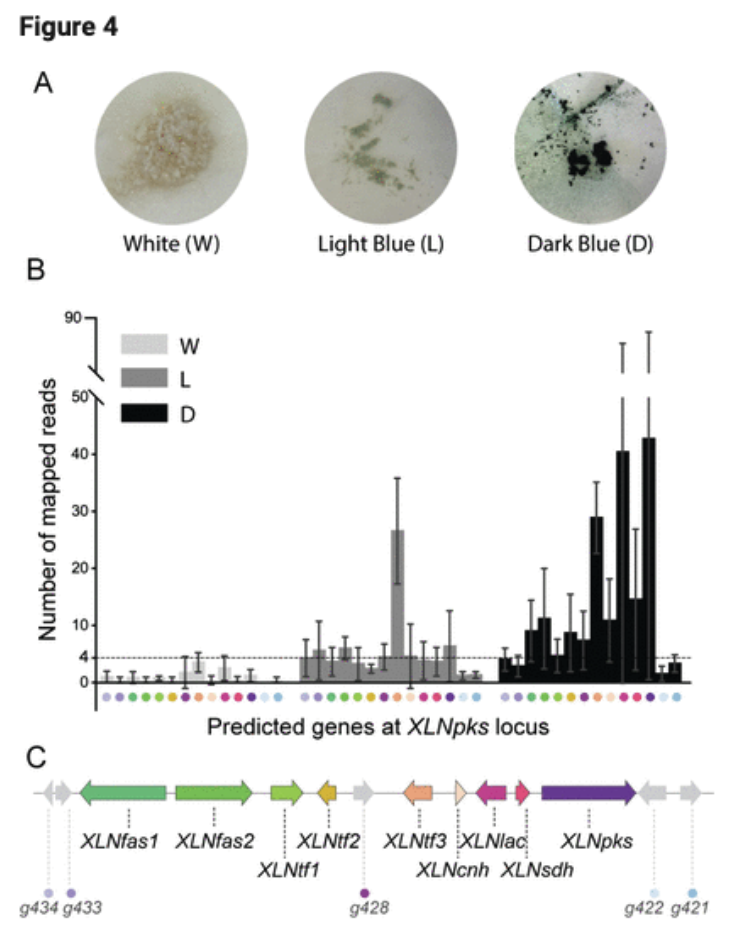
Fortunately, half the battle of my project has already been done with the article Identification of a Biosynthetic Gene Cluster for the Production of the Blue-Green Pigment Xylindein by the Fungus Chlorociboria aeruginascens in which a candidate gene pathway for xylindein was found. Guo et al. attempted to express three genes in Aspergillus Oryzae, XLNfas1, XLNfas2 and XLNpks. The expression of these three genes alone is due to several reasons: the genetic pathway contains large gene fragments as polyketide SMs are noted to be the largest known SM pathways, and a majority of the genes in the pathway are not highly expressed during late blue-green stages of growth and last but not least, XLNfas1 and Xlnfas2 are hypothesized to be the starter units for XLNpks (polyketide synthase) which catalyzes the pathway. However, this cassette yielded no results. I hypothesize this is due to absence of XLNlac, the laccase encoding gene, which in Figure 4 is also identified as highly expressed during the late stage blue-green phase.
Identification of a Biosynthetic Gene Cluster for the Production of the Blue-Green Pigment Xylindein by the Fungus Chlorociboria aeruginascens
Notes: The paper that catalyzed the possibility of my experiment by being the first to identify the entire biosynthetic gene cluster that produced xylindein. The core reference for the project is hypothesizing next steps, necessary genes and experimental set up. Yeast was used as the shuttle vector organism.
Additional Literature Referenced in the Formation of this Project
Role of Hydroxyl Groups in the Photophysics, Photostability, and (Opto)electronic Properties of the Fungi-Derived Pigment Xylindein Gregory Giesbers, Taylor D. Krueger, Jonathan D. B. Van Schenck, Ryan Kim, Ray C. Van Court, Seri C. Robinson, Christopher M. Beaudry, Chong Fang, and Oksana Ostroverkhova The Journal of Physical Chemistry C 2021 125 (12), 6534-6545 DOI: 10.1021/acs.jpcc.0c09627
Xylindein: Naturally Produced Fungal Compound for Sustainable (Opto)electronics Gregory Giesbers, Jonathan Van Schenck, Alexander Quinn, Ray Van Court, Sarath M. Vega Gutierrez, Seri C. Robinson, and Oksana Ostroverkhova ACS Omega 2019 4 (8), 13309-13318 DOI: 10.1021/acsomega.9b01490 https://www.docbrown.info/page06/spectra/0spectra-uv-visible-theory.htm#15.5.2
https://www.futurematerialsbank.com/material/blue-elf-cup/
Innovation and Significance
Pigments are a substantial part of synthetic biology and have been used as reporter systems in constructs, revolutionized contemporary art practices, and educational accessibility to understand biology. The illustrious history of pigments in synthetic biology has created a robust working mechanism that has inspired my project: Heterologous Expression of Xylindein in Saccharomyces Cerevisiae. The textile dye industry is contributing to a global waste crisis that is destroying the environment and human health. For example, liquid waste from large dyeing operations is contaminating the water system(s) of which people rely on by releasing metal and chemical hazards. The release of various powders causes air pollutants and a whole slew of other issues. Xylindein is a natural pigment produced by and secreted from Chlorociboria Aeruginascens. Artisans have used xylindein before, but not significantly as a separated dye due the time of growth and poor solubility. By expressing Xylindein in S.cerevisiae, hypothetically, the pigment would be produced faster eliminating what would be months of cultivation to a week. Xylindein is also being investigated for its semi-conductive properties and has electron mobility up to 0.4 cm²/(Volt seconds) in amorphous films with organic compounds typically exhibiting only electron mobility of 0.1 cm²/(Volt seconds). This makes Xylindein a promising candidate for opto-electronics like solar cells.
Further, the project itself is a novel attempt in expressing xylindein in another as other attempts did not yield any results. https://www.sciencedirect.com/science/article/pii/S2452072119300413
Bioethical Considerations
Xylindein is hypothesized to be a toxin for other microorganisms as it secretes this biochemical from its body into the surrounding substrate. Due to the secretion quality of the pigment, artists since the 14th century have used xylindein stained wood for intarsia wood pieces. This legacy is still rich with contemporary craftsmen, however, if the pigment will be used for textiles and possible other industries, a full toxicological report is pertinent. This would ensure the pigment causes no substantial harm to human health and the environment. Additionally, if downstream commercial applications are pursued, intellectual property strategies should be designed to maintain accessibility for academic researchers and small-scale dyers, preventing monopolization of a naturally occurring compound.
Though artisans and mycologists alike have worked with Blue Elf Cup outside of a Bio Safety Level designated lab, all research regarding the organism and the pigment will be done in a BSL-1 lab. This will help mitigate any possible risks considering introducing the pathway into yeast can produce random mutations and occurrences. The process is unpredictable and best controlled in a lab where the proper practices are already followed.
EXPERIMENTAL DESIGN The Complete Xylindein Biosynthetic Pathway

BUTANOYL-CoA SYNTHESIS: XLNfas1 + XLNfas2 (Fatty Acid Synthase α/β subunits) ↓ [Provides butanoyl-CoA starter unit]
POLYKETIDE ASSEMBLY: XLNpks (Non-reducing iterative PKS) + 6× Malonyl-CoA ↓ [Releases first aromatic intermediate — monomer precursor]
FIRST TAILORING STEP: XLNsdh (Short-chain dehydrogenase/reductase) ↓ [Reduces the pyranone ring of the monomer intermediate]
DIMERIZATION TO XYLINDEIN: XLNlac (Laccase — multicopper oxidase) + XLNcnh (Carbonic anhydrase homolog) ↓ [Oxidative phenol coupling + unique C–O bond formation]
XYLINDEIN (blue-green, MW = 332.06 Da)
REGULATION: XLNtf3 (Transcription factor — Zn(II)2Cys6 type) → Activates transcription of XLNfas1, XLNfas2, XLNpks, XLNsdh, XLNlac, XLNcnh
Claude Assisted to Understand Pathway
My project will consist of two multi-fragment vectors. These vectors will be introduced to S.cerevisiae S286C and expressed heterologously. The
Decision Framework for Vector Components: The CEN/ARS sequences are integrated into yeast backbones. These are two separate sequences that are often paired together. These sequences cue to the yeast that the plasmid will function autonomously as a separate chromosome. ARS stands for Autonomously Replicating Sequence and CEN stands for Centromere. The backbones chosen were pRS415 and pRS416. The choice of the backbones was determined by the research in Pathway engineering in yeast for synthesizing the complex polyketide bikaverin. Zhao et al was successful at expressing the large polyketide bikarverin pathway using pRS415. pRS416 was chosen as a sister plasmid to pRS415 in which the selectable markers are different ensuring the plasmids will get ready and expressed separately without competing for the same machinery in yeast.
Through the guidance of BUGSS Director Lisa Scheifele, Joel Tyson and Amanda Mainello-Land, alongside literature, the GAL promoter set was chosen due to its robust expression rate. GAL promoters are inducible promoters repressed in glucose and induced by galactose.
Heterologous expression was chosen over homologous recombination at this juncture due to the possibility of xylindein being a toxic product. CEN/ARS plasmids are low copy (1-2 copies per cell) allowing for downstream expression diagnostics without the accumulation of a possibly toxic product.
Custom primers for sequential read through and PCR amplification were designed through Primer-Blast: https://www.ncbi.nlm.nih.gov/tools/primer-blast/primertool.cgi?ctg_time=1779805480&job_key=radwz-WP6CfPGe0c4HzJLppn2By3dMMBtg
Down Below is a visual break down of the constructs:
VECTOR 1:
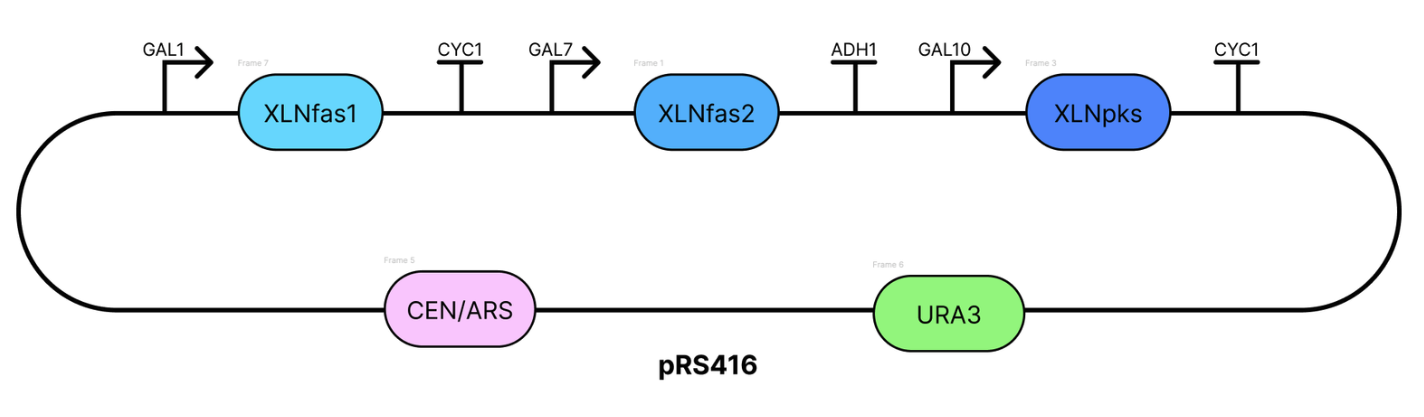
Gal1→RBS+Start Codon→XLNfas1→Stop codon+CYC1t
Gal7→RBS+Start Codon→XLNfas2→Stop codon+ADH1t
Gal10→RBS+Start Codon→XLNpks→stop codon+CYC1t
Vector backbone: pRS416
Low copy Stable Replicate as small independent chromosomes (CEN/ARS sequence) URA3 2 ORI Amp. Resistance (antibiotic Resistance vs a selectable marker)
https://blog.addgene.org/plasmids-101-yeast-vectors#:~:text=Yeast%20Centromere%20plasmids%20(YCp):,found%20as%20a%20single%20cop https://www.snapgene.com/plasmids/yeast_plasmids/pRS415
VECTOR 2:
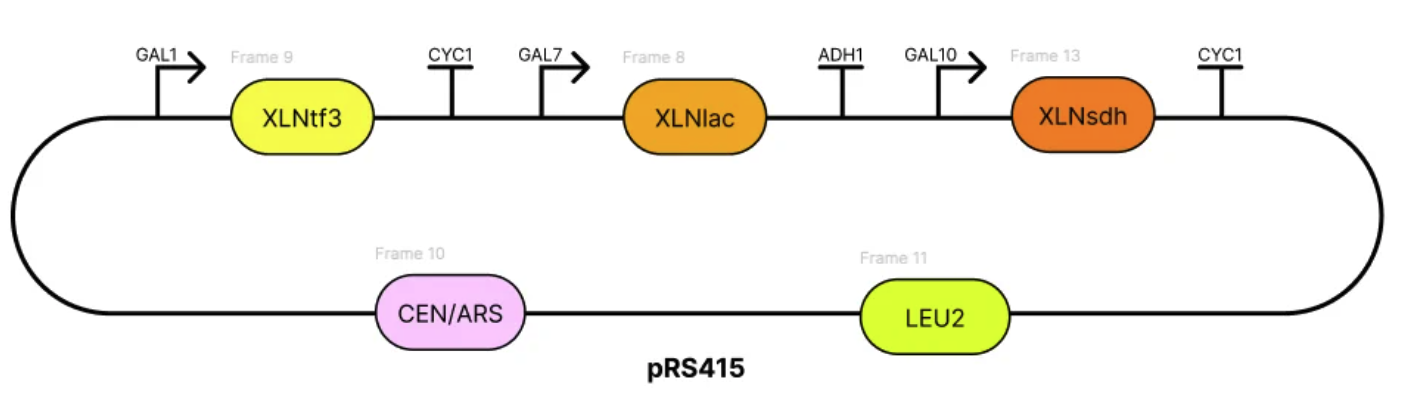
Gal1→RBS+Start Codon→XLNsdh→Stop codon+CYC1t
Gal7→RBS+Start Codon→XLNcnh→Stop codon+ADH1t
Gal10→RBS+Start Codon→XLNlac→stop codon+CYC1t
Vector backbone: pRS415
Typically used as a shuttle vector but can be used for transformation as used in https://www.nature.com/articles/s41467-020-19984-3#:~:text=Introduction,of%20fungal%20polyketides%20in%20S. LEU2 2ori Amp. resistance Low copy https://blog.addgene.org/plasmids-101-yeast-vectors#:~:text=Yeast%20Centromere%20plasmids%20(YCp):,found%20as%20a%20single%20copy https://www.snapgene.com/plasmids/yeast_plasmids/pRS416
TECHNIQUES, TOOLS, AND TECHNOLOGY Claude Assisted but Edited to the needs of the project:
Step 1: Sequence Retrieval, and Codon Optimization
IDEAL Method: Retrieve all seven XLN gene sequences from the C. aeruginascens genome (GenBank accession from Guo et al. 2025). Submit all seven CDS sequences to the Twist Bioscience codon optimization tool configured for S. cerevisiae CAI optimization. Use Benchling for construct map visualization and annotation.
Expected Result: Seven fully codon-optimized, intron-free CDS sequences ready for synthesis ordering. Reality: In the current stage of the project, I used expression vector pET29(+) to shuttle the XLNlac gene. The gene was codon optimized prior to the twist order using Vector Builder and Benchling.
XLNlac gene: atgggtttcttcaagcttgcgtggttggctatctacactttgattctttctgctactgctcttgtcactccagagcgtgttgaggaaagatggaacaaacaagataatgtacagagattgacattgacacttacatggggccctggtgcccctgatggaaacaatagagatctcatctataccaatggacagttccctggtccatcgcttgtttttgatgaaaatgatcaagttgaggtttgtcgaatatttaaccgtagacatctatcagtctgacagccttcagatcactgttctcaatctaatgccatttaacgccacagttcattggcatggccttttgtaaggaatcctcaaatcggaattatgagatcatgatgctcactggtgaacaggatggaagataccaattactctgatggagtgcctggcttgactcaaaagccaattgagccaagatcaagttatatttatcgtttctcggcttctcctcctggaacctactggtaactaatctgattttaaatgattaaacctcaactaagtttgattataggtatcattcacatacgcgcgctacattactagatggactctacggagccatctacattcggtttgtagaatacggacttaaatttctgaatcgaactaacaaatgcgcaggccgaaagcgggctcaccggctccatggtctctcatctccaatagtactaaagatataaaagccatgaccgcagcggctgcagatccgacattaattgtagtgtctgactggaataaatttacttcttgggactaccttgcggccgaagaagcatccaacttggatatcttgtacgtttaagaattcatatgacgcttcttcctgctaatacgtgaatagctgcagagatagtgtcctgatcaatgggaaaggaagcgtttactgccccggtcttgattatttgattccatttgttccagaacaacttgctgcaactctggataaccaaactgtcaatgataaagggttagtcattgatatccagcagtttttgagagcaaaaattaatattcatagatgtctcccatttgtctacggaacagagggtccctaccttccaggaaatccttccgcgataccccctggattacagtcaggatgcgtagcatctaatgggtctgtaccagtcgtcgaagtcgatgcatcttctgggtgggtaagtgtaaatctggttatggctgcaactttcatgtcctccgccgtatcaatagacgaccacgatctctggatctatgaagttgacggccactatatcgagccctacaaagcccaagctgtcttcatgtaccccggagaacggtacgccgccatggtgaaagtcgataagaaaccaggagattacactctgcgtgccccggcatccatttctcaaatttttgccgcatatggaatttttagatataaaaattctccacccaaaacacgctcgactcttcaagccggcgtcattcctaccggaggatacgttaattacggcggtgaacccactgctgataacgtgacgattttagatggtggatatacacatcttccgccattccctccaactccaccagcacaagaatccgatgacatgttcgtcttcagtctcgggcgcttcaccgcgccctggaaatggacattctctggcaagcaattgatgcctacggacgccagcgcctatgacccaatcctttacgatcctcacaatgacatcgccatgaaccccaacctgacaattcgcaccacgaatggcagctgggtggatctcgtgctccgtgttggtgcactcccgggcgaaccccaggaaatcaatcatgctatacataaacatggcagtaagatgtggtttattggtcaggggactggcatctggaattattcttcggtggcggagggcattgcagcggaaccggaaagctttaatttggtgaatcccacgtatagggacacgatcatgacgacatttacaggctccgcgtggtttgtgcttcgatatcaggttacgaaccctggtggtgagttgttcctatattatatacttccttagtgtatgaagctaatagtgagatagcctggttactacattgccacgtagagatccatctggcaggcggaatgggaattgcaatcttagacggcgttgataaatggcctcaaatcccacctgagtatgcgctgaatcaaaatggatatcccgtcggcggccataattacaactggggtggatggggggacattggttattatggcggacattaa
CODON OPTIMIZED for S.cerevisiae: atgggtttcttcaagcttgcgtggttggctatctacactttgattctttctgctactgctcttgtcactccagagcgtgttgaggaaagatggaacaaacaagataatgtacagagattgacattgacacttacatggggccctggtgcccctgatggaaacaatagagatctcatctataccaatggacagttccctggtccatcgcttgtttttgatgaaaatgatcaagttgaggtttgtcgaatatttaaccgtagacatctatcagtctgacagccttcagatcactgttctcaatctaatgccatttaacgccacagttcattggcatggccttttgtaaggaatcctcaaatcggaattatgagatcatgatgctcactggtgaacaggatggaagataccaattactctgatggagtgcctggcttgactcaaaagccaattgagccaagatcaagttatatttatcgtttctcggcttctcctcctggaacctactggtaactaatctgattttaaatgattaaacctcaactaagtttgattataggtatcattcacatacgcgcgctacattactagatggactctacggagccatctacattcggtttgtagaatacggacttaaatttctgaatcgaactaacaaatgcgcaggccgaaagcgggctcaccggctccatggtctctcatctccaatagtactaaagatataaaagccatgaccgcagcggctgcagatccgacattaattgtagtgtctgactggaataaatttacttcttgggactaccttgcggccgaagaagcatccaacttggatatcttgtacgtttaagaattcatatgacgcttcttcctgctaatacgtgaatagctgcagagatagtgtcctgatcaatgggaaaggaagcgtttactgccccggtcttgattatttgattccatttgttccagaacaacttgctgcaactctggataaccaaactgtcaatgataaagggttagtcattgatatccagcagtttttgagagcaaaaattaatattcatagatgtctcccatttgtctacggaacagagggtccctaccttccaggaaatccttccgcgataccccctggattacagtcaggatgcgtagcatctaatgggtctgtaccagtcgtcgaagtcgatgcatcttctgggtgggtaagtgtaaatctggttatggctgcaactttcatgtcctccgccgtatcaatagacgaccacgatctctggatctatgaagttgacggccactatatcgagccctacaaagcccaagctgtcttcatgtaccccggagaacggtacgccgccatggtgaaagtcgataagaaaccaggagattacactctgcgtgccccggcatccatttctcaaatttttgccgcatatggaatttttagatataaaaattctccacccaaaacacgctcgactcttcaagccggcgtcattcctaccggaggatacgttaattacggcggtgaacccactgctgataacgtgacgattttagatggtggatatacacatcttccgccattccctccaactccaccagcacaagaatccgatgacatgttcgtcttcagtctcgggcgcttcaccgcgccctggaaatggacattctctggcaagcaattgatgcctacggacgccagcgcctatgacccaatcctttacgatcctcacaatgacatcgccatgaaccccaacctgacaattcgcaccacgaatggcagctgggtggatctcgtgctccgtgttggtgcactcccgggcgaaccccaggaaatcaatcatgctatacataaacatggcagtaagatgtggtttattggtcaggggactggcatctggaattattcttcggtggcggagggcattgcagcggaaccggaaagctttaatttggtgaatcccacgtatagggacacgatcatgacgacatttacaggctccgcgtggtttgtgcttcgatatcaggttacgaaccctggtggtgagttgttcctatattatatacttccttagtgtatgaagctaatagtgagatagcctggttactacattgccacgtagagatccatctggcaggcggaatgggaattgcaatcttagacggcgttgataaatggcctcaaatcccacctgagtatgcgctgaatcaaaatggatatcccgtcggcggccataattacaactggggtggatggggggacattggttattatggcggacattaa
Step 2: Twist Bioscience DNA Order
Method: Design each gene as an individual expression cassette (promoter → CDS → terminator). Order all seven expression cassettes plus the two linearized plasmid backbones (pRS415 and pRS416 backbones) as whole constructs from Twist Bioscience using the Clonal Gene service in a pET23(+) carrier backbone
Step 3: PCR Amplification of Assembly Fragments
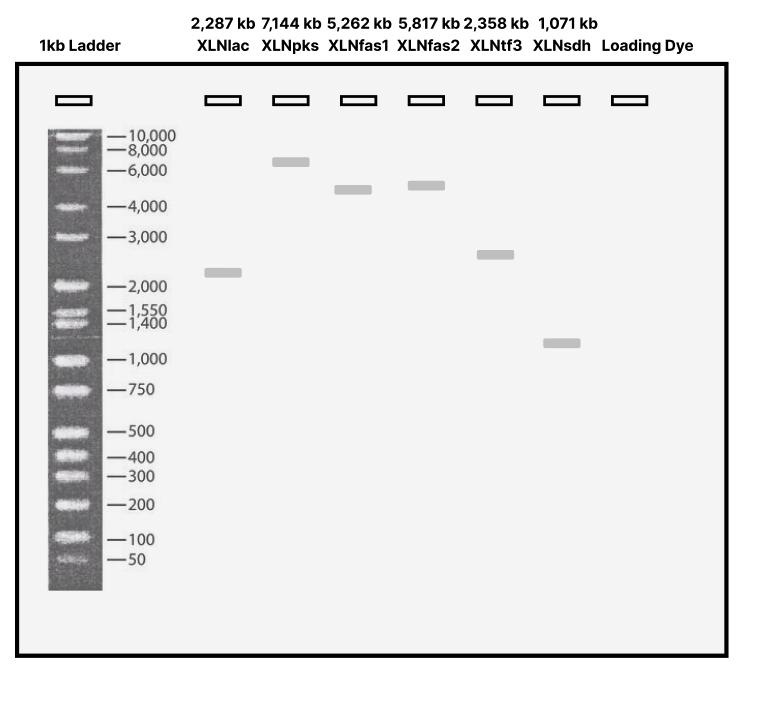
Method: PCR-amplify each of the seven gene expression cassettes from their Twist pET23(+) carriers using Q5 High-Fidelity Polymerase (NEB). Verify all PCR products by gel electrophoresis. Purify amplicons using a PCR cleanup kit. Gel-purify the linearized backbone PCR products (pRS416 and pRS415 backbones). Quantify all fragments by NanoDrop.
Step 4: Transformation of Yeast
Method: Co-transform S. cerevisiae S286C with the four assembly fragments (XLNfas1, XLNfas2, XLNpks cassette + linearized pRS416 URA3/2µ backbone) using the high-efficiency LiOAc/PEG/ssDNA carrier protocol. Yeast will assemble the plasmid in vivo via Heterologous expression. Plate on SC-Ura dropout agar and incubate 3 days at 30°C.
Step 5: Colony PCR Screening of pRS416 Assemblies
Method: Pick 24 Ura+ colonies into SC-Ura liquid in a 96-well deep well plate. Use Opentrons OT-2 to set up colony PCR reactions using primers spanning each internal gene cassette junction (4 junction-spanning primer pairs per plate). Run on ATC Thermal Cycler. Score by gel electrophoresis. Select 3 colonies showing all correct junction bands for plasmid prep and Sanger sequencing confirmation.
Step 6: Sequential Transformation of pRS416 Assembly Method: Take a confirmed pRS416 strain (Ura+) and transform with the five pRS415 assembly fragments (XLNsdh, XLNlac,nXLNtf3 cassettes + linearized pRS415 LEU2/2µ backbone). Plate on SC-Ura-Leu double dropout agar. This dual selection ensures cells carry both plasmids simultaneously.
Step 7: Colony PCR Screening of pRS415 Assemblies
Method: Pick 48 Ura+Leu+ colonies and perform junction-spanning PCR across all five pXYL-B cassette junctions. Score by gel electrophoresis. Select 3 colonies with all correct junctions as the primary experimental strains. Prepare glycerol stocks of all confirmed strains at -80°C.
Step 8: Induction Culture Setup and Pigment Production
Method: Inoculate 3 confirmed full-pathway strains, 3 partial-pathway controls (pRS415 only, pRS416 only, empty vector), and wild-type S286C into SC complete + 2% raffinose for 16 hours pre-growth. Transfer to SC complete + 2% galactose in 96-well deep well plates at OD600 = 0.2. Set up in biological triplicate using Opentrons OT-2. Seal with A4s breathable seals (Plateloc). Incubate in Cytomat shaking incubator at 30°C, 300 rpm for 72 hours. Inspect visually for blue-green pigmentation at 24h, 48h, and 72h.
Step 9: Cell Harvest and Pigment Extraction
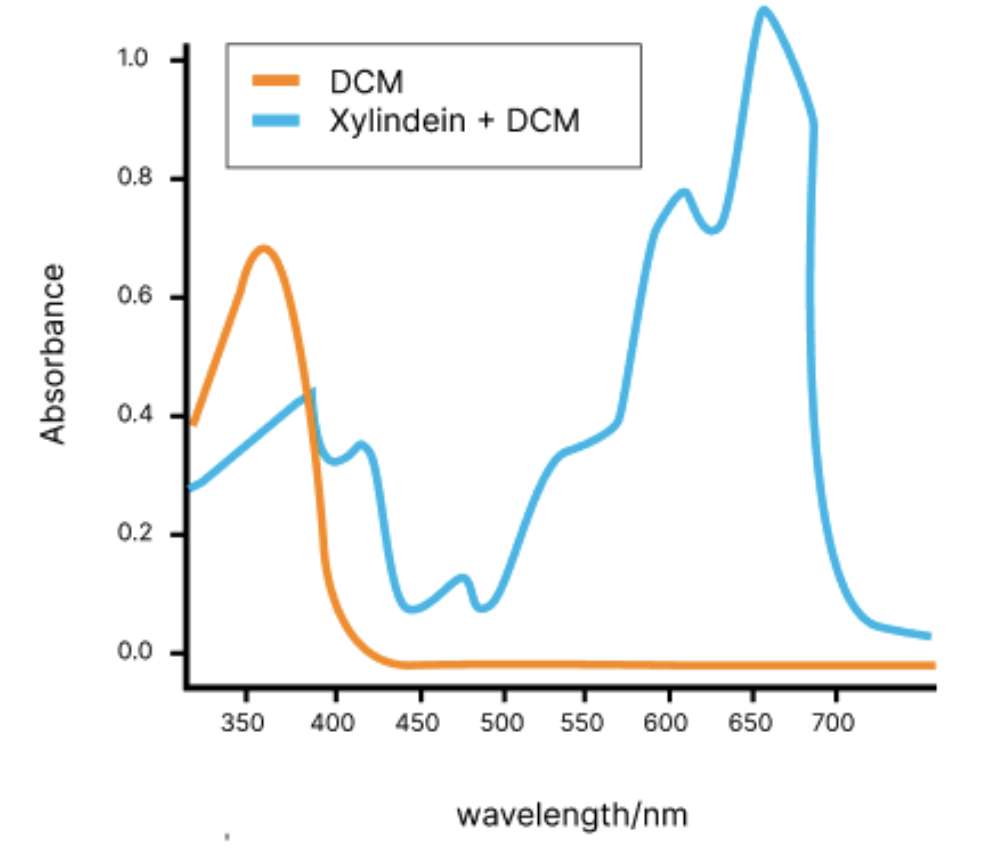
Method: Centrifuge deep-well plates using HiG Centrifuge at 3,000 × g, 10 minutes. Remove supernatant. Resuspend pellets in 200 µL DCM per well. Seal plates with Plateloc and shake on BioshakeD3000 at 1,200 rpm, 30°C for 30 minutes. Centrifuge again to remove cell debris. Transfer DCM supernatants (clarified extract) to a fresh 96-well deep well plate using Opentrons OT-2.
Step 11: Spark Plate Reader Absorbance Scan
Method: Read 384-well plates on the Spark Plate Reader at Ginkgo Bioworks. Perform full-spectrum absorbance scan from 400–750 nm for all wells. Record A680 (xylindein primary peak). Generate absorbance spectra overlays. Export all data to CSV. Use the standard curve to calculate estimated xylindein concentrations in µg/mL.
Step 12: Western Blot — PKS and FAS Protein Confirmation
Method: Lyse confirmed pigment-positive strains by bead beating in RIPA buffer + protease inhibitors. Run SDS-PAGE on clarified lysates. Transfer to PVDF membrane. Block with 5% milk/TBST. Probe with anti-6×His HRP-conjugated antibody (Thermo Fisher MA1-21315-HRP, 1:5000). Detect by SuperSignal West Pico PLUS chemiluminescence. Expected sizes: XLNfas1-His ~220 kDa (FAS α-subunit), XLNpks-His ~185 kDa (iterative PKS).
Expected Result: Bands at ~220 kDa and ~185 kDa in galactose-induced full-pathway strain; absent in glucose-grown or wild-type controls. Confirms PKS and FAS proteins are being translated at expected sizes.
Step 15: Data Analysis, Strain Ranking, and Hypothesis Assessment
Method: Compile A680 absorbance data, LC-MS xylindein confirmation, qPCR expression profiles, and western blot protein data across all strains. Assess the central hypothesis: Does expression of all seven genes (including XLNsdh, XLNlac, XLNtf3) yield xylindein where three-gene expression did not? Compare titer across biological replicates. Identify whether XLNtf3 co-expression improves or inhibits pathway output compared to controls. Generate Python/R analysis plots. Document findings for proposal reporting.
Expected Result: Clear demonstration that complete 7-gene expression enables xylindein production; systematic evidence that downstream tailoring genes are the critical missing components in prior expression failures.
A HUGE thank you to the amazing Baltimore Underground Science Space for hosting the HTGAA Baltimore team! A special thank you to Amanda Mainello-Land for being a wonderful instructor (thank you for the meetings and answering my “not dumb” questions!), Joel Tyson for being the guidance and support through out the labs and projects, and Lisa Scheifele, the director of BUGSS who supported our efforts and gave insightful directional feedback for my project!
And a tremendous thank you to my fellow node mates Juhi, Eric, Violeta and Marian! WE DID IT!!!
Bibliography:
Venil CK, Velmurugan P, Dufossé L, Devi PR, Ravi AV. Fungal Pigments: Potential Coloring Compounds for Wide Ranging Applications in Textile Dyeing. J Fungi (Basel). 2020 May 20;6(2):68. doi: 10.3390/jof6020068. PMID: 32443916; PMCID: PMC7344934.
Identification of a Biosynthetic Gene Cluster for the Production of the Blue-Green Pigment Xylindein by the Fungus Chlorociboria aeruginascens Journal of Natural Products 2025 88 (2), 233-244 DOI: 10.1021/acs.jnatprod.4c00350
https://ressources.unisciel.fr/tp_virtuels/Pigment_Extraction_Lab/co/module_Virtual%20Experiment_1.html Yanfang Guo, Jorge Navarro-Muñoz, Caroline Rodenbach, Elske Dwars, Chendo Dieleman, Bart van den Hout, Bazante Sanders, Miaomiao Zhou, Ayodele Arogunjo, Russell J. Cox, Arnold J. M. Driessen, and Jérôme Collemare
https://pubs.acs.org/doi/10.1021/acs.jpcc.0c09627#Abstract
Role of Hydroxyl Groups in the Photophysics, Photostability, and (Opto)electronic Properties of the Fungi-Derived Pigment Xylindein Gregory Giesbers, Taylor D. Krueger, Jonathan D. B. Van Schenck, Ryan Kim, Ray C. Van Court, Seri C. Robinson, Christopher M. Beaudry, Chong Fang, and Oksana Ostroverkhova The Journal of Physical Chemistry C 2021 125 (12), 6534-6545 DOI: 10.1021/acs.jpcc.0c09627
https://pubs.acs.org/doi/10.1021/acsomega.9b01490
Zhao, M., Zhao, Y., Yao, M. et al. Pathway engineering in yeast for synthesizing the complex polyketide bikaverin. Nat Commun 11, 6197 (2020). https://doi.org/10.1038/s41467-020-19984-3
Xylindein: Naturally Produced Fungal Compound for Sustainable (Opto)electronics Gregory Giesbers, Jonathan Van Schenck, Alexander Quinn, Ray Van Court, Sarath M. Vega Gutierrez, Seri C. Robinson, and Oksana Ostroverkhova ACS Omega 2019 4 (8), 13309-13318 DOI: 10.1021/acsomega.9b01490 https://www.docbrown.info/page06/spectra/0spectra-uv-visible-theory.htm#15.5.2
A Highly Characterized Yeast Toolkit for Modular, Multipart Assembly
Michael E. Lee, William C. DeLoache, Bernardo Cervantes, and John E. Dueber ACS Synthetic Biology 2015 4 (9), 975-986 DOI: 10.1021/sb500366v
Addgene: MAddgene: MoClo-YTKoClo-YTK
Bruno Lellis, Cíntia Zani Fávaro-Polonio, João Alencar Pamphile, Julio Cesar Polonio, Effects of textile dyes on health and the environment and bioremediation potential of living organisms, Biotechnology Research and Innovation, Volume 3, Issue 2,
Blue Elf Cup by Liene Kazaka – Future Materials Bank. Futurematerialsbank.com, 2026, www.futurematerialsbank.com/material/blue-elf-cup/.
Theory of Uv-Visible Spectroscopy Explaining Electronic Absorption Spectra Reflectance Spectra How an Absorption Spectrometer Works Organic and Inorganic Examples of Absorption Spectra Doc Brown’s Advanced Level Chemistry Revision Notes for Pre-University Organic Chemistry. Docbrown.info, 2026, www.docbrown.info/page06/spectra/0spectra-uv-visible-theory.htm#15.5.2. Accessed 28 May 2026.