Week 3 HW: Lab Automation
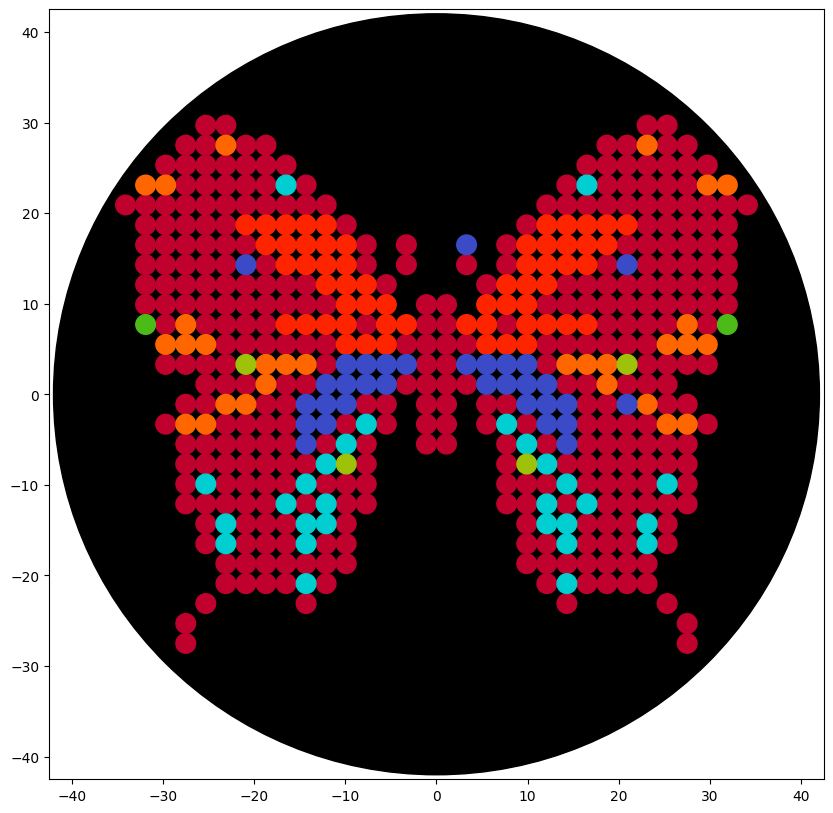
- Generate an artistic design using the GUI at opentrons-art.rcdonovan.com.

- Using the coordinates from the GUI, follow the instructions in the HTGAA26 Opentrons Colab to write your own Python script which draws your design using the Opentrons. You may use AI assistance for this coding — Google Gemini is integrated into Colab (see the stylized star bottom center); it will do a good job writing functional Python, while you probably need to take charge of the art concept. If you’re a proficient programmer and you’d rather code something mathematical or algorithmic instead of using your GUI coordinates, you may do that instead.
Google colab link: https://colab.research.google.com/drive/1CuzPdG5pSYIgSalc1o3C1FA-yUbnaW0_?usp=sharing
Post-Lab Questions
- Find and describe a published paper that utilizes the Opentrons or an automation tool to achieve novel biological applications.
paper: GPCR signaling measurement and drug profiling with an automated live-cell microscopy system
pdf: https://pmc.ncbi.nlm.nih.gov/articles/PMC9994309/pdf/nihms-1878342.pdf
doi: https://doi.org/10.1021/acssensors.2c01341
This paper addresses a key limitation in GPCR signaling measurement: typically, signals can only be measured one at a time and at a single time point, making it impossible to observe multiple signaling pathways or their dynamics over time. The authors used the Opentrons to automate drug delivery and imaging, allowing them to measure various signaling pathways simultaneously and track their changes over time rather than only capturing a final readout. This automation enabled the discovery that GPR68 cAMP responses are pH-dependent in a kinetic way, and that Ogerin has an unexpected off-target effect at high concentrations through phosphodiesterase inhibition.
- Write a description about what you intend to do with automation tools for your final project. You may include example pseudocode, Python scripts, 3D printed holders, a plan for how to use Ginkgo Nebula, and more. You may reference this week’s recitation slide deck for lab automation details.
While your description/project idea doesn’t need to be set in stone, we would like to see core details of what you would automate. This is due at the start of lecture and does not need to be tested on the Opentrons yet.
For my final project, I would automate the process of exposing GIST cells to different imatinib concentrations to observe how HSP90 dependence changes in response to the drug. I would automate this part because it requires testing many concentrations repeatedly, and automating it would reduce pipetting errors that could compromise the dilution series, while also saving time. Additionally, I would automate the biosensor signal readout across all wells, allowing me to track changes in HSP90 activity over time rather than capturing only a single final measurement