Week 1 HW: Principles and Practices
Bioindicator for Microplastic Contamination in Agricultural Soils
1. Biological Engineering Application
Project Description
The proposed biological engineering application is the development of a bioindicator for detecting contamination by microplastics and their chemical additives in agricultural soils.
The system would be based on a genetically modified soil bacterium (Pseudomonas spp.), a microorganism naturally associated with the rhizosphere of crops such as:
- Maize
- Wheat
Functional Concept
The engineered bacterium would be designed to:
- Detect stress caused by microplastic additives present in soil
- Produce a visible signal (e.g., fluorescence) when exposed to such stress
This mechanism would enable:
- Early detection of soil contamination
- Identification of potential stress conditions affecting crops
- On-site monitoring without exclusive reliance on laboratory-based analytical methods
Motivation
Microplastics are increasingly present in agricultural soils due to multiple sources, including agricultural plastics and contaminated inputs. Current detection methods are:
- Technically complex
- Costly
- Primarily limited to laboratory analysis
This project aims to provide a field-deployable, cost-effective biological monitoring tool to complement existing analytical techniques.
Governance and Policy Framework
2. Governance and Policy Goals
The following goals guide the evaluation of governance actions for this project.
Biosecurity
Ensure that the use of a genetically modified microorganism as a bioindicator:
Does not create biological or environmental risks
Protects sustainable soil use
Avoids negative impacts on:
- Soil ecosystems
- Crops (maize and wheat)
- Non-target organisms
Ethics
Ensure responsible and socially acceptable use of the technology by:
- Protecting local communities
- Promoting transparency
- Limiting the application strictly to environmental monitoring purposes
Other Considerations
- Ensure technical feasibility
- Consider economic costs
- Minimize burdens to stakeholders
- Avoid unnecessary impediments to scientific research
- Promote constructive and responsible applications of biotechnology
3. Potential Governance Actions
Action 1: Environmental Biosecurity Assessment Before Field Use
- Type: Regulatory requirement
- Actors: Academic researchers, environmental regulators
Purpose
Require a formal environmental biosecurity assessment prior to field application in order to prevent biological and ecological risks in agricultural soils.
Design
- Researchers prepare risk assessment protocols
- Regulatory or institutional bodies review and approve these protocols before field testing
Assumptions
- Laboratory experiments can reasonably predict environmental behavior and associated risks
Risks of Failure
- Long-term environmental effects may be underestimated
Risks of Over-Strict Implementation
- Excessively strict requirements may slow down research and innovation
Action 2: Technical Biological Containment Strategies
- Type: Technical strategy
- Actors: Researchers, technology developers
Purpose
Reduce environmental risks by limiting the survival or activity of the bioindicator microorganism outside controlled soil conditions.
Design
- Genetic containment mechanisms are incorporated during the design stage
- Containment is built directly into the microorganism’s genetic architecture
Assumptions
- Containment systems are stable and effective
- Containment does not significantly reduce bioindicator performance
Risks of Failure
- Containment mechanisms fail under real environmental conditions
Risks of Over-Strict Implementation
- Excessive biological control reduces detection sensitivity or functionality
Action 3: Transparency and Engagement with Local Farming Communities
- Type: Ethical governance / incentive mechanism
- Actors: Researchers, institutions, farmers
Purpose
Ensure ethical and socially responsible implementation by informing and engaging farming communities.
Design
Provide clear information regarding:
- Purpose of the bioindicator
- Operational limits
- Potential risks
Involve local communities in decision-making processes
Assumptions
- Transparency increases trust and acceptance
Risks of Failure
- Communication efforts may increase resistance or skepticism
Risks of Over-Expansion
- Broad acceptance may lead to unintended or expanded uses
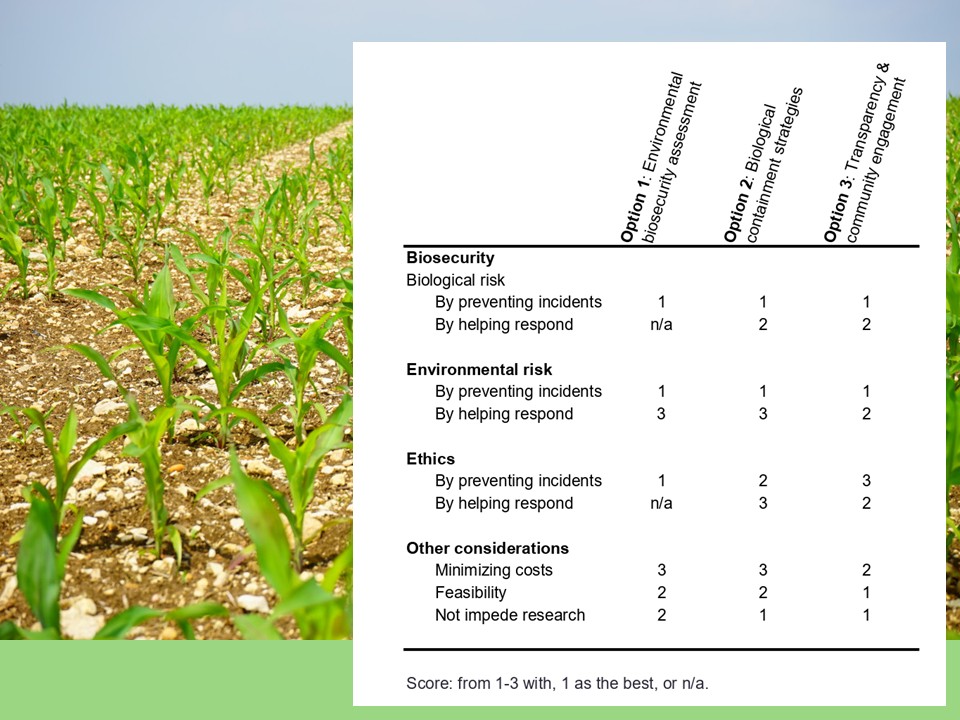
4. Comparative Evaluation
5. Prioritization of Governance Options
Based on the updated scoring table, a combination of:
- Option 1: Environmental Biosecurity Assessment
- Option 2: Biological Containment Strategies
is prioritized.
These two options are essential for project viability because they:
- Perform best in preventing biological and environmental risks
- Address core ethical concerns
- Strengthen long-term sustainability of the project
Although they may involve:
- Higher implementation costs
- Potential constraints on research
they are necessary to ensure responsible development.
Role of Option 3
Transparency and community engagement is not critical for technical viability but is essential for:
- Implementation in agricultural plantations
- Social acceptance
- Practical adoption by farming communities
Conclusion
A combined governance strategy integrating:
- Environmental biosecurity assessment
- Technical biological containment
- Community engagement
provides a balanced framework that aligns:
- Safety
- Technical feasibility
- Ethical responsibility
- Real-world applicability
This integrated approach supports the responsible development and deployment of a bioindicator system for detecting microplastic contamination in agricultural soils.
DNA Replication, Oligo Synthesis, and Molecular Coding Concepts
Questions from Professor Jacobson
1. Nature’s machinery for copying DNA is called polymerase. What is the error rate of polymerase? How does this compare to the length of the human genome. How does biology deal with that discrepancy?
Nature’s machinery for copying DNA is DNA polymerase, which has an error rate of approximately 1 in 10⁶ bases due to its 3’→5’ proofreading activity.
The human genome contains approximately 3 × 10⁹ base pairs. In principle, thousands of errors could occur during a complete replication cycle. However, biological systems maintain genomic integrity through multiple mechanisms:
- Polymerase proofreading activity
- Exonuclease activity
- DNA repair systems
Together, these systems significantly reduce the final mutation rate and preserve genomic stability.
2. How many different ways are there to code (DNA nucleotide code) for an average human protein? In practice what are some of the reasons that all of these different codes don’t work to code for the protein of interest?
There are approximately:
3400 ≈ 10190
possible DNA sequences that could encode an average human protein of 400 amino acids.
In practice, many theoretical sequences are non-functional due to constraints such as:
- Codon bias
- mRNA secondary structure
- Translation efficiency
- Splicing motifs
- Protein folding constraints
Thus, while the combinatorial sequence space is vast, functional protein-coding sequences represent only a small subset.
Questions from Dr. LeProust
1. What’s the most commonly used method for oligo synthesis currently?
The most widely used method for oligonucleotide synthesis today is solid-phase phosphoramidite chemistry (β-cyanoethyl phosphoramidite method).
It is performed on a solid support, typically:
- Controlled pore glass (CPG)
- Functionalized silica
The synthesis proceeds through iterative cycles consisting of:
- Coupling of a protected nucleoside phosphoramidite
- Capping of unreacted hydroxyl groups
- Oxidation of the phosphite triester to a phosphate triester
- DMT deprotection (deblocking)
This cycle is repeated until the desired sequence is assembled.
2. Why Is It Difficult to Synthesize Oligos Longer Than 200 nt?
Direct solid-phase phosphoramidite synthesis becomes inefficient beyond approximately 200 nucleotides because each nucleotide addition step is not 100% efficient (typically ~99%).
Since each step introduces a small loss, the total yield decreases exponentially with length.
Consequences include:
- Cumulative yield loss
- Exponential decrease in full-length product
- Accumulation of truncated sequences
- Increased error rates
- Increasingly difficult purification
For example, if each step is 99% efficient, after 200 cycles the overall yield is:
0.99^200
which results in a significant reduction of full-length product.
Therefore, beyond ~200 nt, direct synthesis becomes impractical.
3. Why Can’t a 2000 bp Gene Be Synthesized Directly?
A 2000 base pair gene cannot be synthesized by direct chemical oligo synthesis for the same reason: cumulative inefficiency.
Attempting 2000 consecutive synthesis cycles would result in:
- Negligible yield of full-length product
- Massive accumulation of truncated fragments
- Increased error rates
- Impractical purification requirements
Instead, modern approaches use high-throughput synthesis platforms (e.g., chip-based synthesis) to generate millions of short oligos (typically 60–150 nt) in parallel.
These shorter fragments are then assembled into full-length genes using methods such as:
- PCR-based assembly
- Gibson Assembly
This strategy allows efficient production of thousands of genes (e.g., 9,600 genes) in a practical and scalable way.
In summary, long genes are not synthesized directly because the chemistry is inefficient at that scale; instead, short oligos are synthesized and subsequently assembled.
Question from George Church
1. [Using Google & Prof. Church’s slide #4] What are the 10 essential amino acids in all animals and how does this affect your view of the “Lysine Contingency”?
The 10 Essential Amino Acids in Animals
The essential amino acids (those that must be obtained from the diet) are:
- Histidine
- Isoleucine
- Leucine
- Lysine
- Methionine
- Phenylalanine
- Threonine
- Tryptophan
- Valine
- Arginine (essential in many animals, especially during growth)
Implications for the “Lysine Contingency”
Since lysine is already an essential amino acid in animals, metabolic dependence on lysine is not unusual in biology.
However, lysine is naturally present in many environments and food sources. Therefore, engineering an organism to depend on lysine as a containment strategy may offer limited biosafety, because the amino acid is neither rare nor synthetic.
This suggests that dependence on a non-natural amino acid would provide a stronger and more reliable biocontainment strategy.
2. [Given slides #2 & 4 (AA:NA and NA:NA codes)] What code would you suggest for AA:AA interactions? Definitions:
- AA = Amino Acid
- NA = Nucleic Acid (DNA or RNA)
NA:NA Code
Refers to nucleic acid–nucleic acid interactions, specifically base-pairing rules:
- A–T (or A–U in RNA)
- C–G
These interactions govern information storage and replication.
AA:NA Code
Refers to the genetic code: codons in nucleic acids specify which amino acids are incorporated into a protein.
This code determines the primary amino acid sequence of a protein.
What Code Would Describe AA:AA Interactions?
AA:AA interactions refer to amino acid–amino acid interactions within or between proteins, including:
- Hydrophobic interactions
- Hydrogen bonds
- Ionic interactions
- Disulfide bonds
- Van der Waals forces
These interactions determine:
- Protein folding
- Three-dimensional structure
- Stability
- Function
Unlike the genetic code, AA:AA interactions do not form a simple digital code. Instead, they constitute a physicochemical interaction framework that governs protein behavior.
Using the AA:NA code, we can program the amino acid sequence of a protein. By selecting specific amino acids, we indirectly influence AA:AA interactions and therefore affect structure and function.
However, although protein sequences can be designed, final folding and functionality cannot always be predicted with certainty. Protein structure emerges from complex and sometimes unpredict