Week 11 HW: building genomes
Part A: The 1,536 Pixel Artwork Canvas | Collective Artwork
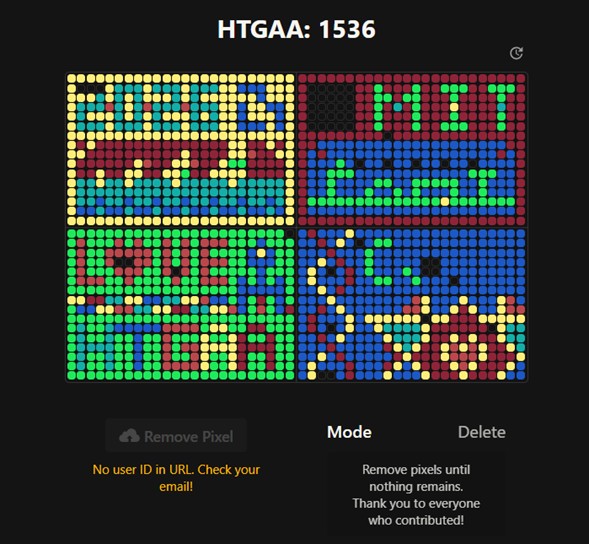
I was unable to contribute to the collaborative canvas on time — the deadline was April 19 at 11:59 PM EST, and I did not receive access to the personalized link in time. However, I reviewed the project and understand how it worked: each pixel in the 32×48 canvas corresponded to a real well in one of the four 384-well plates used by Ginkgo Nebula’s cloud lab to synthesize fluorescent proteins via CFPS.
What I liked about the project:
The idea that the “art” is literally biology — each aesthetic decision (which color/protein to place) is also a real experimental decision that the robot will execute. It is a very elegant way to connect collective creativity with reproducible science at scale.
What I would improve for next year:
- Send the personalized URL earlier, along with a clear reminder of the deadline
- Provide a preview of how the plate would appear under a fluorescence reader, not only as RGB colors
- Allow students without an active Discourse account to participate via an alternative link
Remiving pixel:
Part B: Cell-Free Protein Synthesis | Cell-Free Reagents
Role of each component in the cell-free reaction E. coli Lysate — BL21 (DE3) Star Lysate (includes T7 RNA Polymerase)
The E. coli lysate is the core of the reaction: it contains ribosomes, transcription/translation factors, aminoacyl-tRNA synthetases, and all the molecular machinery required for protein synthesis. The BL21 (DE3) Star strain includes T7 RNA polymerase, which recognizes the T7 promoter on the plasmid and drives highly efficient transcription of the gene of interest.
Salts / Buffer
Potassium Glutamate: Provides K⁺ ions necessary to stabilize ribosomes and promote translation; glutamate acts as an organic counterion that reduces ionic toxicity compared to KCl.
HEPES-KOH pH 7.5: Buffer that maintains the reaction pH at 7.5, optimal for enzymatic activity of ribosomes and other lysate components. Magnesium Glutamate: Mg²⁺ is an essential cofactor for ribosome assembly and enzymatic activity; its concentration directly affects translation efficiency.
Potassium Phosphate (monobasic/dibasic): Contributes to the buffering system (phosphate/HEPES) and provides phosphate groups that can be used for ATP regeneration in combination with the energy system.
Energy / Nucleotide System Ribose: A five-carbon sugar that serves as a precursor for de novo synthesis of nucleotide monophosphates (NMPs) in combination with nitrogenous bases.
Glucose: An additional energy source; it is metabolized via glycolysis using lysate enzymes to regenerate ATP and sustain long-term reactions. AMP, CMP, UMP: Monophosphate nucleotides that are phosphorylated by kinases in the lysate into their triphosphate forms (ATP, CTP, UTP), which are directly used by RNA polymerase during transcription.
GMP: Precursor of GTP; although set to 0 mM in the 36-hour formulation, its function is identical to other NMPs when included. Guanine: A free nitrogenous base that, combined with ribose and phosphate in the system, is enzymatically converted into GMP and subsequently into GTP, enabling transcription even in the absence of directly added GMP.
Translation Mix (Amino Acids) 17 Amino Acid Mix: Provides 17 of the 20 standard amino acids required for ribosomal polypeptide elongation.
Tyrosine: Added separately due to its low solubility in water (typically prepared at basic pH); essential for chromophore formation in fluorescent proteins.
Cysteine: Also added separately due to its tendency to oxidize; crucial for proteins containing disulfide bonds and for certain fluorescent proteins.
Additive Nicotinamide: Precursor of NAD⁺/NADH, essential redox cofactors for lysate metabolism; maintains redox balance and improves protein synthesis yield. Backfill Nuclease-Free Water: Completes the reaction volume to 20 µL without introducing RNases or DNases that could degrade mRNA or plasmid DNA, preserving template and product integrity.Differences between PEP-NTP (1 hour) and NMP-Ribose-Glucose (20 hours)
The 1-hour PEP-NTP master mix uses directly supplied nucleoside triphosphates (ATP, GTP, CTP, UTP) along with phosphoenolpyruvate (PEP) as a fast energy regeneration system, enabling very rapid protein synthesis but with short duration due to quick depletion.
In contrast, the 20-hour NMP-Ribose-Glucose master mix uses nucleotide monophosphates (AMP, CMP, UMP) along with ribose and glucose as slow-release energy sources. The lysate enzymes progressively phosphorylate NMPs into NTPs, generating a sustained energy supply that maintains the reaction for extended periods.
Additionally, the 1-hour system includes additives such as spermidine, DMSO, cAMP, and folinic acid to optimize short-term transcription and translation, whereas the 20-hour system prioritizes metabolic stability using nicotinamide and a gradual phosphorylation system.
- Bonus: How can transcription occur if GMP = 0 mM but guanine is present?
Free guanine in the mixture can be converted into GMP (and subsequently GDP and GTP) through the action of hypoxanthine-guanine phosphoribosyltransferase (HGPRT) and other purine salvage enzymes present in the E. coli lysate, using ribose-5-phosphate and ATP as substrates. Additionally, nucleoside kinases in the lysate can phosphorylate guanosine intermediates.
Thus, even without directly added GMP, guanine serves as a precursor that is enzymatically converted into GTP, which is then used by T7 RNA polymerase to initiate and elongate transcripts (since T7-initiated mRNAs begin with GTP).
Part C: Planning the Global Experiment | Cell-Free Master Mix Design
Question 1: Biophysical/Functional Properties of the 6 Fluorescent Proteins
- sfGFP
The defining property of sfGFP is its exceptional folding robustness, achieved through nine mutations (including S30R and Y39N) that stabilize the β-barrel and dramatically improve folding kinetics and resistance to aggregation. This variant exhibits 100% fluorescence recovery after refolding from the urea-denatured state, as well as faster refolding kinetics compared to Cycle3 GFP. PubMed Central In a cell-free system — which lacks chaperones and has a more crowded, variable environment compared to living cells — this makes sfGFP a reliable, high-yield reporter because newly translated protein is far more likely to fold productively into a fluorescent state rather than misfold or aggregate. - mRFP1
The key limiting property of mRFP1 is its low quantum yield and partial incomplete maturation, related to the monomerization mutations introduced from DsRed. mRFP1’s fluorescence quantum yield and extinction coefficient (0.25 and 44,000 M⁻¹cm⁻¹) are significantly lower than for other DsRed variants PNAS, and a notable fraction of the expressed protein retains a non-fluorescent green intermediate species (absorbing ~503 nm) that never fully matures to the red chromophore. In a cell-free reaction, this means a significant proportion of synthesized protein will not contribute to the red fluorescence readout — lowering effective signal relative to the amount of protein produced. - mKO2
mKO2 has a strong oxygen dependence for chromophore maturation, more so than many other fluorescent proteins. mKO2 exhibits a stronger dependence on oxygen tension than mAG, and mKO2 exhibits slower kinetics of oxidation following reoxygenation. Furthermore, mKO2 has a longer maturation half-time of around 135 min, largely due to a long-lived non-fluorescent intermediate state PLOS that precedes the final oxidation step. In a sealed or oxygen-limited cell-free reaction, these properties would substantially delay and reduce fluorescence output, especially early in the incubation. - mTurquoise2
mTurquoise2 exhibits slow, complex maturation kinetics. mTurquoise2 displayed a maturation half-time of 36.5 min Science in bacterial cells, and mTurquoise2 and other avGFP-derived FPs showed “complex maturation” kinetics — not fitting a simple single exponential — indicating the existence of multiple kinetic steps in the maturation process. In a cell-free context, this multi-step, slower maturation means fluorescence signal accumulates gradually and may not plateau until well into the incubation window, so endpoint reads at early timepoints will underestimate actual protein yield. - mScarlet-I
mScarlet-I’s key property relevant to cell-free readout is its fast maturation among red fluorescent proteins, combined with high intrinsic brightness. mScarlet-I is a fast-maturing variant with maturation speed measured as a minimal delay relative to co-produced mTurquoise2 in mammalian cells. This rapid chromophore formation means fluorescence signal appears early in a cell-free incubation and closely tracks the kinetics of protein synthesis, making it a reliable reporter of real-time expression dynamics. However, like all red FPs, it still requires molecular oxygen for the acylimine oxidation step of chromophore formation. - Electra2
Electra2 is a blue fluorescent protein derived from mRuby3 (an E. quadricolor RFP) through extensive rational engineering to shift emission to the blue range. Electra1 and Electra2 had very similar fluorescence spectra with excitation maxima at 402–403 nm and identical emission spectra with maximum at 456 nm. A practical concern in cell-free readout is inner filter effects and lower signal-to-noise: blue FPs generally suffer from higher autofluorescence background from the lysate components (NAD(P)H, flavins) at similar excitation wavelengths (~400 nm), which can reduce sensitivity of the fluorescence measurement compared to green or red channels. Additionally, as a heavily engineered variant derived from a red protein scaffold, its folding pathway in the minimal environment of a cell-free system may be less predictable than native GFP-family proteins.
Question 2: Hypothesis for Reagent Adjustment
Protein: mKO2
Property to address: Strong oxygen dependence for chromophore maturation and a long-lived non-fluorescent intermediate.
Hypothesis: Supplementing the cell-free mastermix with a creatine phosphate/creatine kinase energy regeneration system in addition to the ribose-glucose NMP system — and critically, performing the reaction in a loosely sealed or gas-permeable membrane plate rather than a fully sealed vessel — would increase dissolved oxygen availability throughout the 36-hour incubation. The expected effect is that sustained oxygen availability would accelerate the final oxidation step of mKO2 chromophore maturation, reducing the accumulation of the non-fluorescent folded intermediate and increasing the proportion of protein that reaches the fully fluorescent state. Alternatively, supplementing with a higher concentration of magnesium glutamate to optimize translation efficiency early in the reaction would ensure maximum protein is synthesized before oxygen becomes limiting, front-loading the pool available for maturation.
Notes on Question 3 (Master Mix Composition)
The reaction composition is fixed as:
- 6 µL Lysate
- 10 µL 2X Optimized Master Mix
- 2 µL FP DNA template
- 2 µL custom reagent supplements
Based on your mKO2 hypothesis above, for your 2 µL supplement you could consider: additional MgCl₂ (to fine-tune Mg²⁺ for translation), extra NMPs for sustained transcription, or a small amount of additional creatine phosphate as an energy buffer to extend active synthesis time during the 36-hour window.
Part D: Build-A-Cloud-Lab | (optional) Bonus Assignment
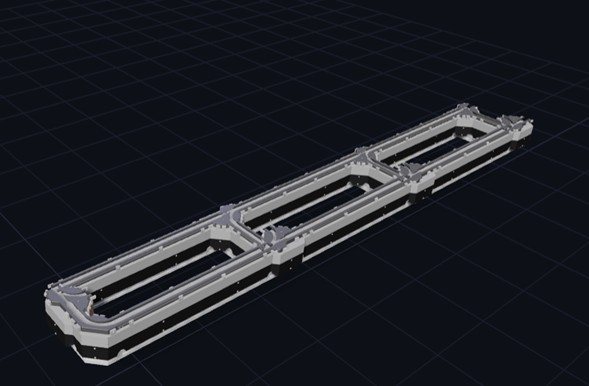
DNA form:
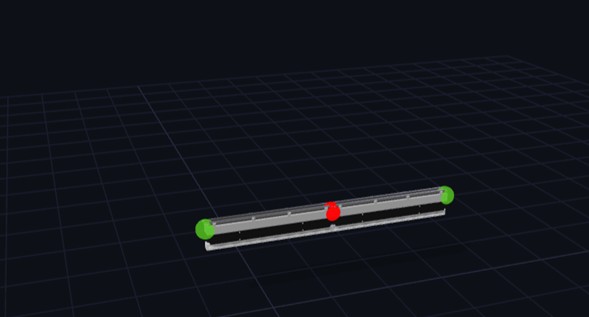
- Start with MM-1m (Line A, segment 1)
- Add MM-Switch → connected at the end
- (the Switch creates a Y-shaped junction)
- From the Switch branch, add a short MM-0.25m
- crossing over to Line B
- Continue Line B with MM-1m
- Repeat the pattern: 1m → Switch → 0.25m crossover → 1m
Conclusion
This week brought together two ideas that I had been thinking about separately: biology as a programmable system, and art as an interface for that system. The 1,536-pixel collaborative canvas was the most literal version of that connection I’ve encountered — each color choice was simultaneously aesthetic and experimental, and the robot executing the plate didn’t distinguish between the two. That blurring of creative and scientific decision-making is something I want to carry into how I think about design in my own project.