Week 1 HW: Principles and Practices
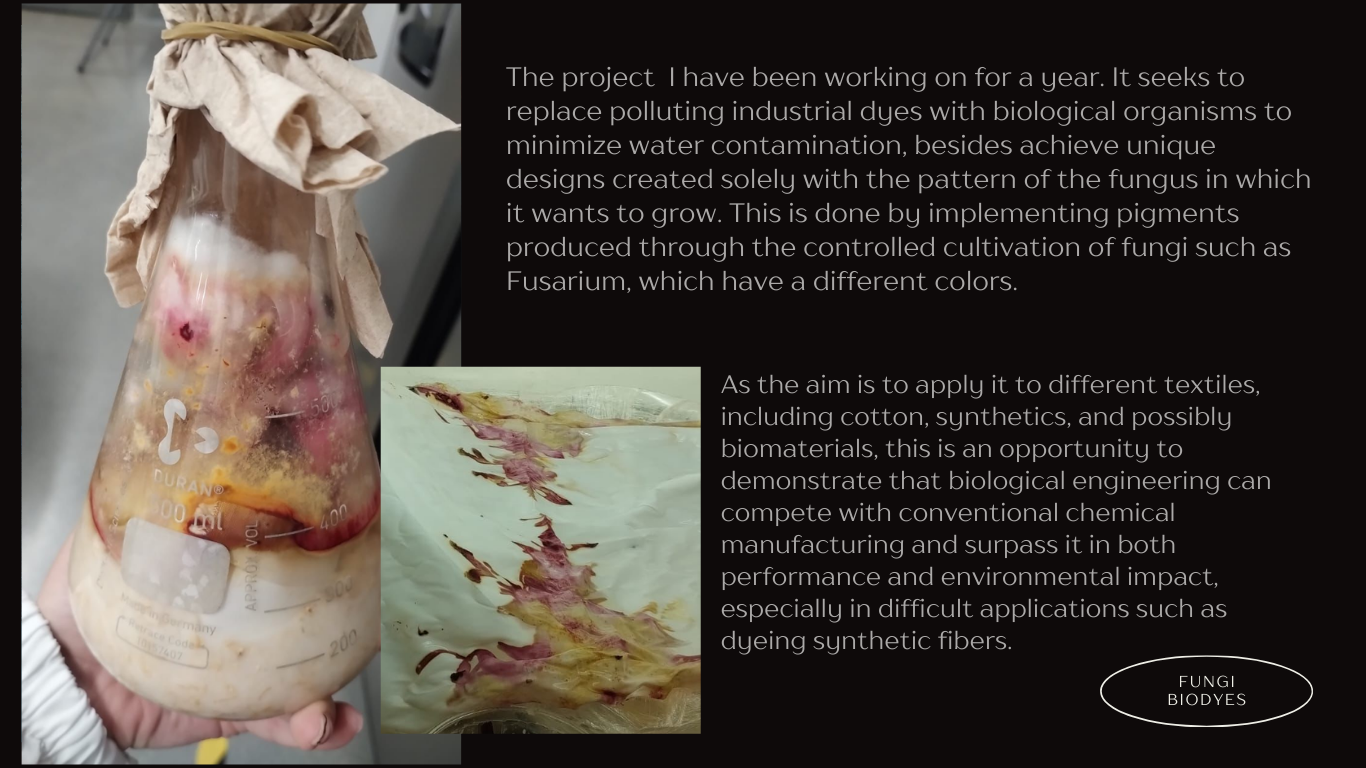
Name of the proyect: Fungi Biodyes
The project I am interested in working on focuses on the textile industry, which is responsible for 20% of global industrial water pollution, with approximately 200,000 tons of dyes lost annually in effluents during dyeing processes. More than 8,000 synthetic chemicals are used in textile dyeing, many of which are toxic and non-biodegradable. (Dutta, 2024)
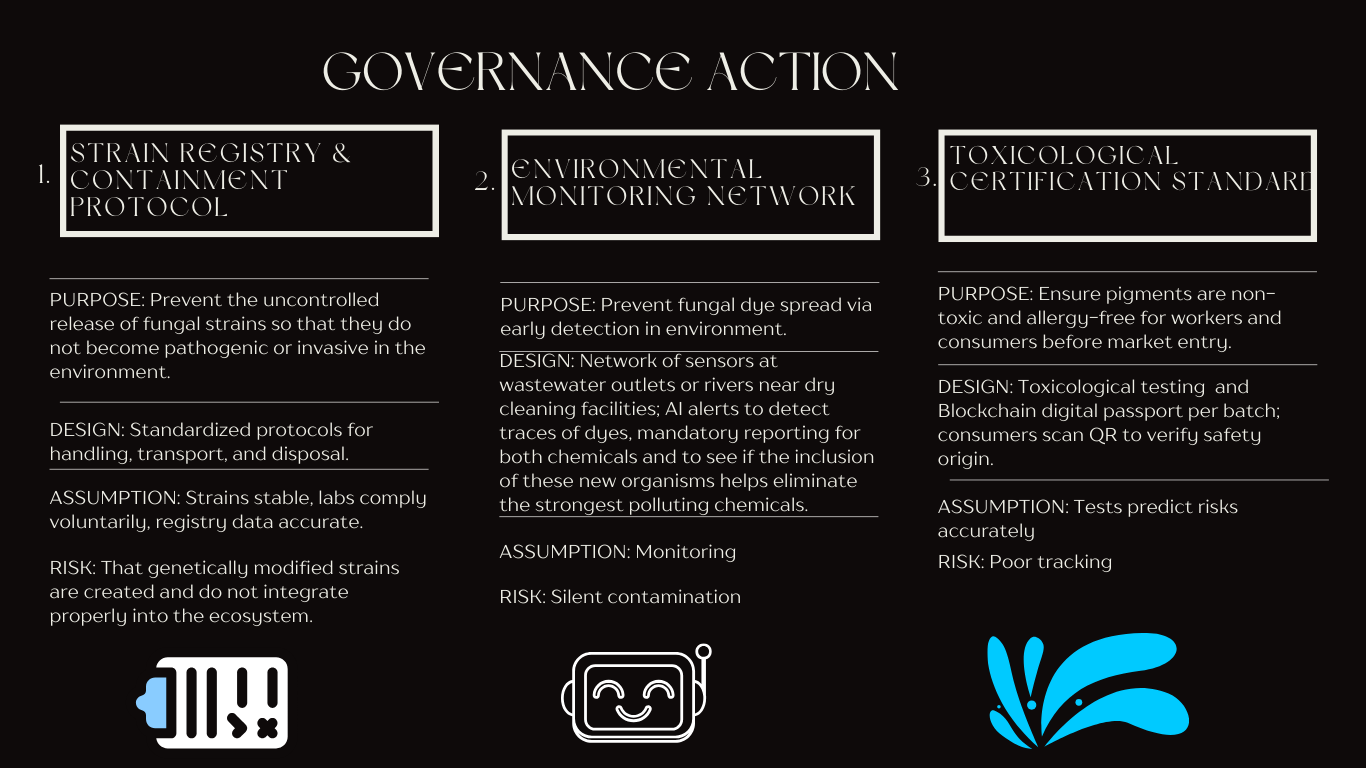
- I mainly want to focus on one governance policy objective
Ensuring safety and security:
Fundamentally, one of the precautions that must be taken into account with this project is avoiding the uncontrolled release of fungal strains into the environment that are actively pathogenic. It is also important to ensure that the pigments produced are not toxic or allergenic to textile workers and end consumers. Establish biosafety protocols for large-scale production.
- Actions:
| Does the option: | Option 1 | Option 2 | Option 3 |
|---|---|---|---|
| Enhance Biosecurity | |||
| • By preventing incidents | 2 | 3 | 1 |
| • By helping respond | 2 | 1 | 3 |
| Foster Lab Safety | |||
| • By preventing incident | 3 | 1 | 2 |
| • By helping respond | 2 | 1 | 3 |
| Protect the environment | |||
| • By preventing incidents | 1 | 3 | 2 |
| • By helping respond | 2 | 3 | 1 |
| Other considerations | |||
| • Minimizing costs and burdens to stakeholders | 3 | 2 | 1 |
| • Feasibility? | 2 | 3 | 1 |
| • Not impede research | 2 | 3 | 1 |
| • Promote constructive applications | 2 | 1 | 3 |
5 . Based on the scores and the analizys, I would prioritize option 2 as the initial governance approach, combining it with option 1.
The reason for starting with surveillance focused approaches as a governance action rather than prevention stems from the current state of fungal biological dyes technology. At this early stage, the industry is still in the experimental phase and there is no fully experimental data, the most it is theoretical. The Environmental Monitoring Network allows innovation to move forward while creating a knowledge base on environmental challenges, how they can help or how they can be integrated into the environment, and also, in the worst-case, the adverse effects they may have.
Besides, implementing community-based sensor networks and observation systems would have benefits beyond just monitoring bio-dyes, but also dyes that affect aquifers. However, it is important to ensure that they do not harm those who handle them and that there is flexibility to experiment with different fungal strains, cultivation conditions, and pigment extraction methods.
Research sources : 1.Sohini Dutta, Satadal Adhikary(2024). Contamination of textile dyes in aquatic environment: Adverse impacts on aquatic ecosystem and human health, and its management using bioremediation. Journal of Environmental Management, 352, 119936 https://www.sciencedirect.com/science/article/abs/pii/S0301479724000896 2. López, M. A., & García, J. L. (2023). The impact of natural dyes in the textile industry. In A. Pérez (Ed.), Sustainable dye trends (pp. 125-142). Springer Nature. DOI: 10.1007/978-981-19-8853-0_10