Week 7 hw: genetic circuits part ii
- Assignment Part 1: Intracellular Artificial Neural Networks (IANNs)
What advantages do IANNs have over traditional genetic circuits, whose input/output behaviors are Boolean functions?
Intracellular Artificial Neural Networks (IANNs) offer significant advantages over traditional genetic circuits that rely on Boolean logic. While Boolean circuits produce binary outputs (ON/OFF), IANNs can process continuous input signals and generate graded responses. This allows cells to integrate multiple inputs simultaneously and respond in a more flexible and nuanced way. Additionally, IANNs can assign different weights to inputs, enabling more complex decision-making processes compared to rigid Boolean logic gates. This makes them particularly useful in environments where signals are noisy or variable, as they can produce smoother and more adaptive outputs.
Describe a useful application for an IANN; include a detailed description of input/output behavior, as well as any limitations an IANN might face to achieve your goal.
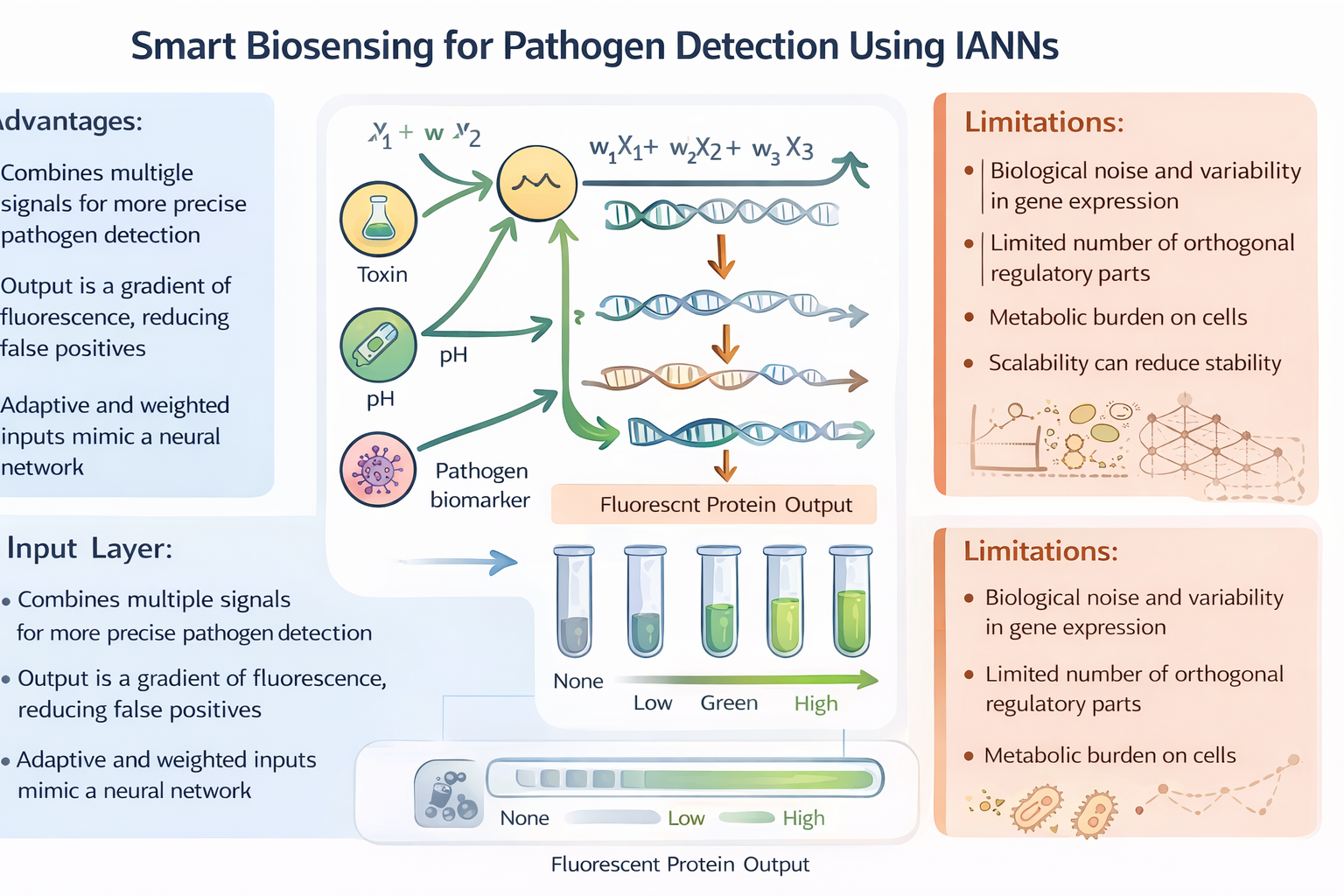
A useful application of an IANN is in smart biosensing for pathogen detection. In this system, multiple inputs (e.g., presence of toxins, pH changes, or pathogen-specific molecules) act as signals (X1, X2, X3). Each input is weighted differently depending on its importance, and the combined signal determines the level of expression of an output gene, such as a fluorescent protein.
For example, if a pathogen produces two biomarkers, the system can be designed so that one biomarker has a stronger influence than the other. The output would not simply be ON or OFF, but rather a gradient of fluorescence proportional to the combined inputs. This allows for more precise detection and reduces false positives.
However, IANNs also face limitations. These include biological noise, variability in gene expression, limited availability of orthogonal regulatory parts (such as endoribonucleases), and metabolic burden on the cell. Additionally, scaling to multiple layers increases complexity and may reduce system stability.
Below is a diagram depicting an intracellular single-layer perceptron where the X1 input is DNA encoding for the Csy4 endoribonuclease and the X2 input is DNA encoding for a fluorescent protein output whose mRNA is regulated by Csy4. Tx: transcription; Tl: translation.Draw a diagram for an intracellular multilayer perceptron where layer 1 outputs an endoribonuclease that regulates a fluorescent protein output in layer 2.
Below is a conceptual diagram of a two-layer intracellular perceptron:
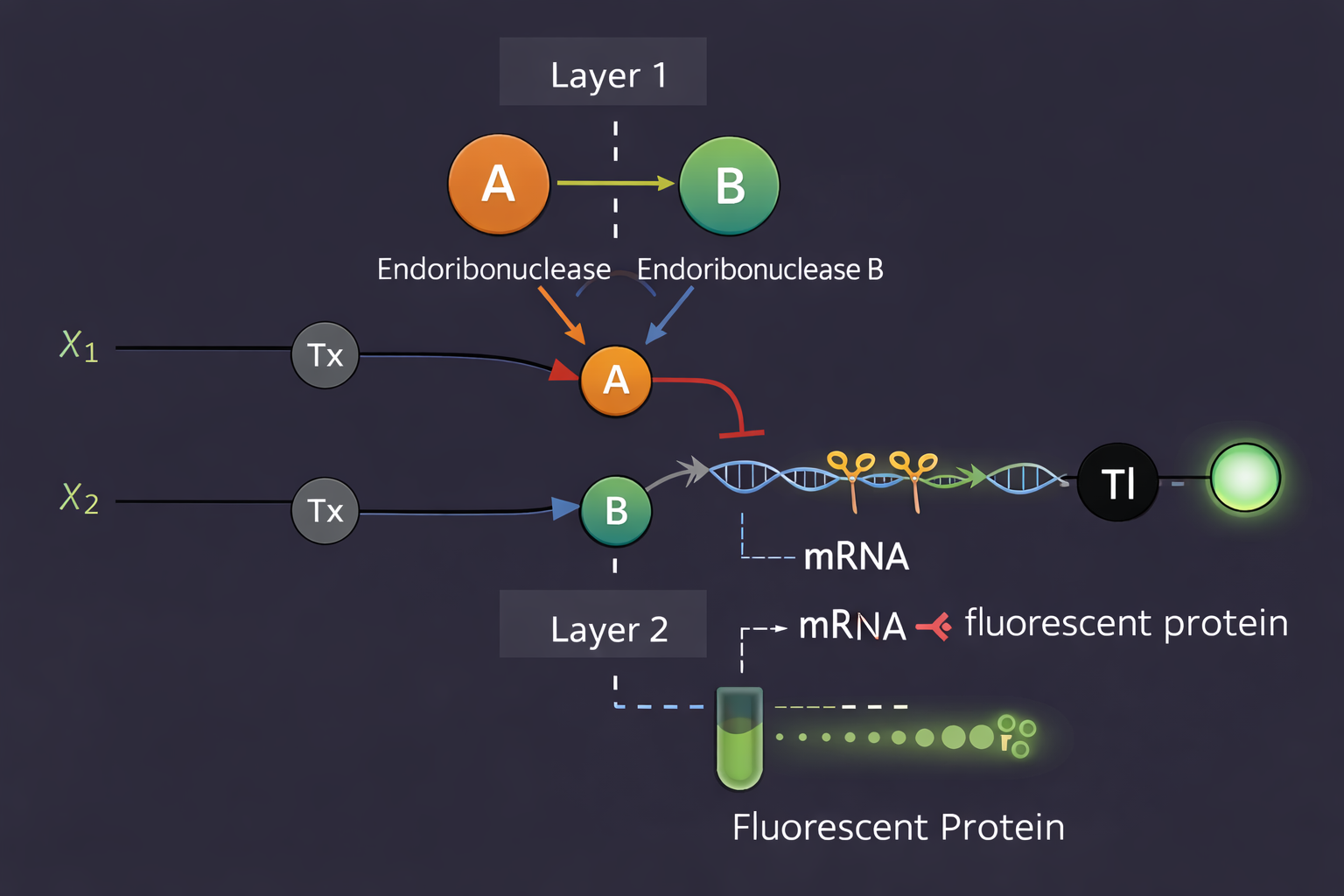
Layer 1 processes inputs and produces an intermediate regulator (endoribonuclease), which then controls the output in Layer 2.
- Assignment Part 2: Fungal Materials
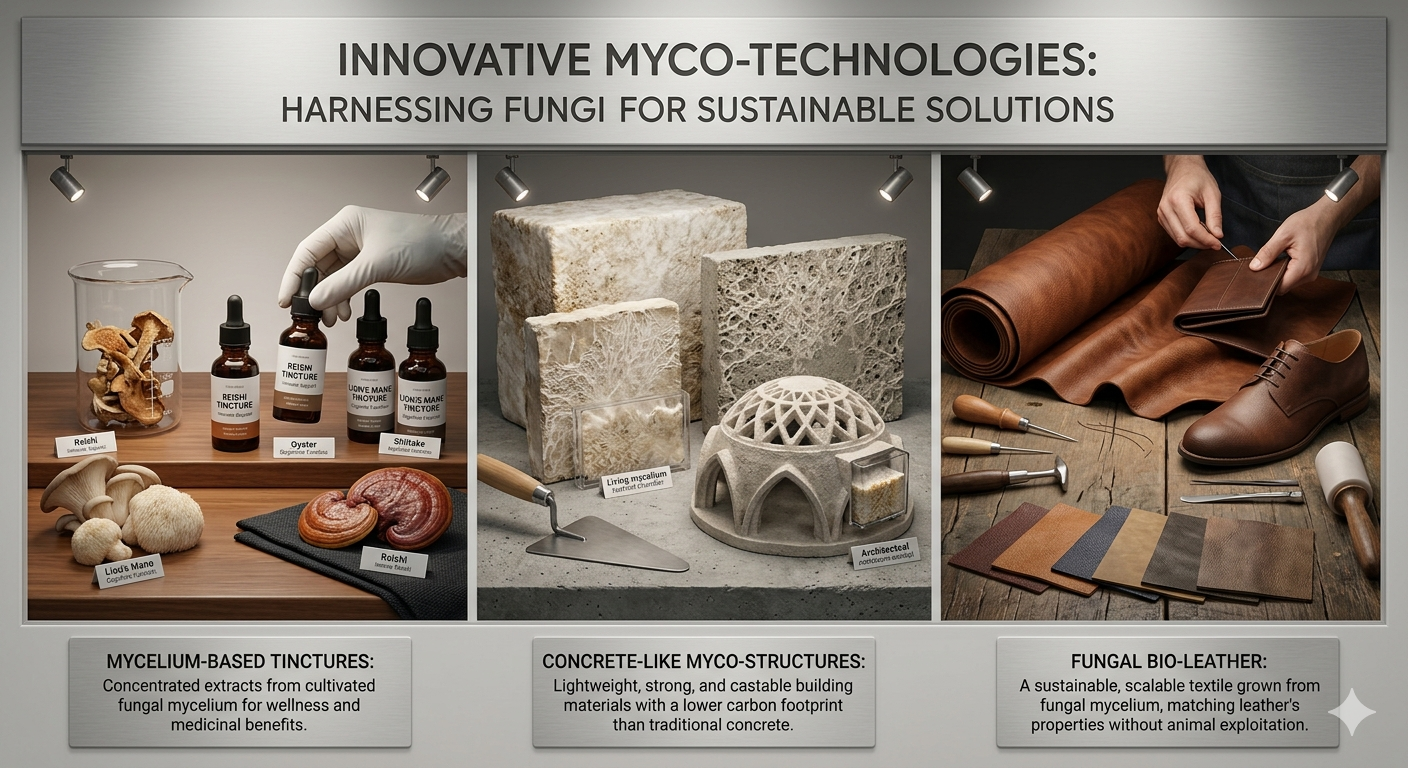
What are some examples of existing fungal materials and what are they used for? What are their advantages and disadvantages over traditional counterparts?
Fungal materials, particularly those derived from mycelium, are increasingly used as sustainable alternatives to traditional materials. One common example is mycelium-based packaging, which is used as a biodegradable alternative to polystyrene foam. Another example is mycelium leather, used in fashion as a substitute for animal leather. Additionally, fungal composites are used in construction materials such as insulation panels and lightweight bricks.
These materials offer several advantages over traditional counterparts. They are biodegradable, renewable, and can be produced using agricultural waste, significantly reducing environmental impact. Fungal materials also require less energy to produce compared to plastics or synthetic materials. However, they also have disadvantages, including lower mechanical strength, sensitivity to moisture, and challenges in large-scale manufacturing consistency.
What might you want to genetically engineer fungi to do and why? What are the advantages of doing synthetic biology in fungi as opposed to bacteria?
Fungi can be genetically engineered to produce a wide range of useful compounds or materials. For example, they could be engineered to enhance pigment production for biodyes, produce antimicrobial or antipathogenic compounds, or improve material properties such as strength and durability. Engineering fungi to control growth patterns could also allow for the development of more complex and functional biomaterials.
The motivation behind engineering fungi lies in their natural ability to produce complex metabolites and form structured materials like mycelium networks. By modifying their genetic pathways, it is possible to optimize yield, functionality, and performance for industrial or environmental applications.
Advantages of Synthetic Biology in Fungi vs Bacteria
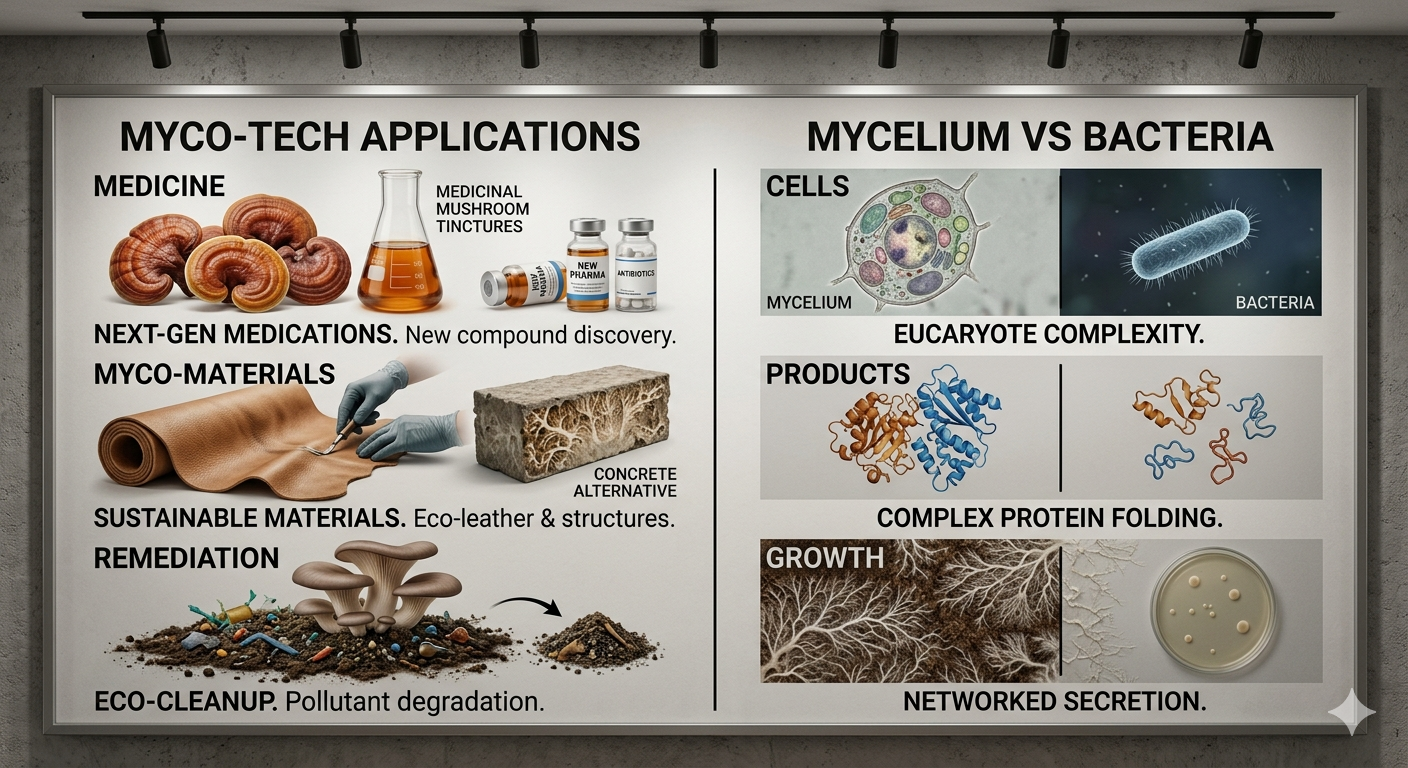
Fungi offer several advantages over bacteria in synthetic biology applications. As eukaryotic organisms, fungi are capable of performing more complex post-translational modifications, which are necessary for producing certain proteins and metabolites. They also naturally grow as filamentous networks, making them ideal for producing structural biomaterials. Additionally, fungi can secrete large amounts of enzymes and metabolites directly into their environment, simplifying downstream processing.
In contrast, bacteria are easier to manipulate genetically and grow faster, but they lack the ability to produce complex multicellular structures and certain high-value compounds. Therefore, fungi are often preferred when the goal is to produce materials, complex molecules, or structured biological systems.
- Assignment Part 3: First DNA Twist Order Review Part 3: DNA Design Challenge of the week 2 homework. Design at least 1 insert sequence and place it into the Benchling/Kernel/Other folder you shared in the Google Form above. Document the backbone vector it will be synthesized in on your website.