Individual Final Project 🐝
SECTION 1: ABSTRACT
Project Title: BeeO-Tech: A Synthetic Biology Biosensor for Real-Time Propolis Quality and Standardization
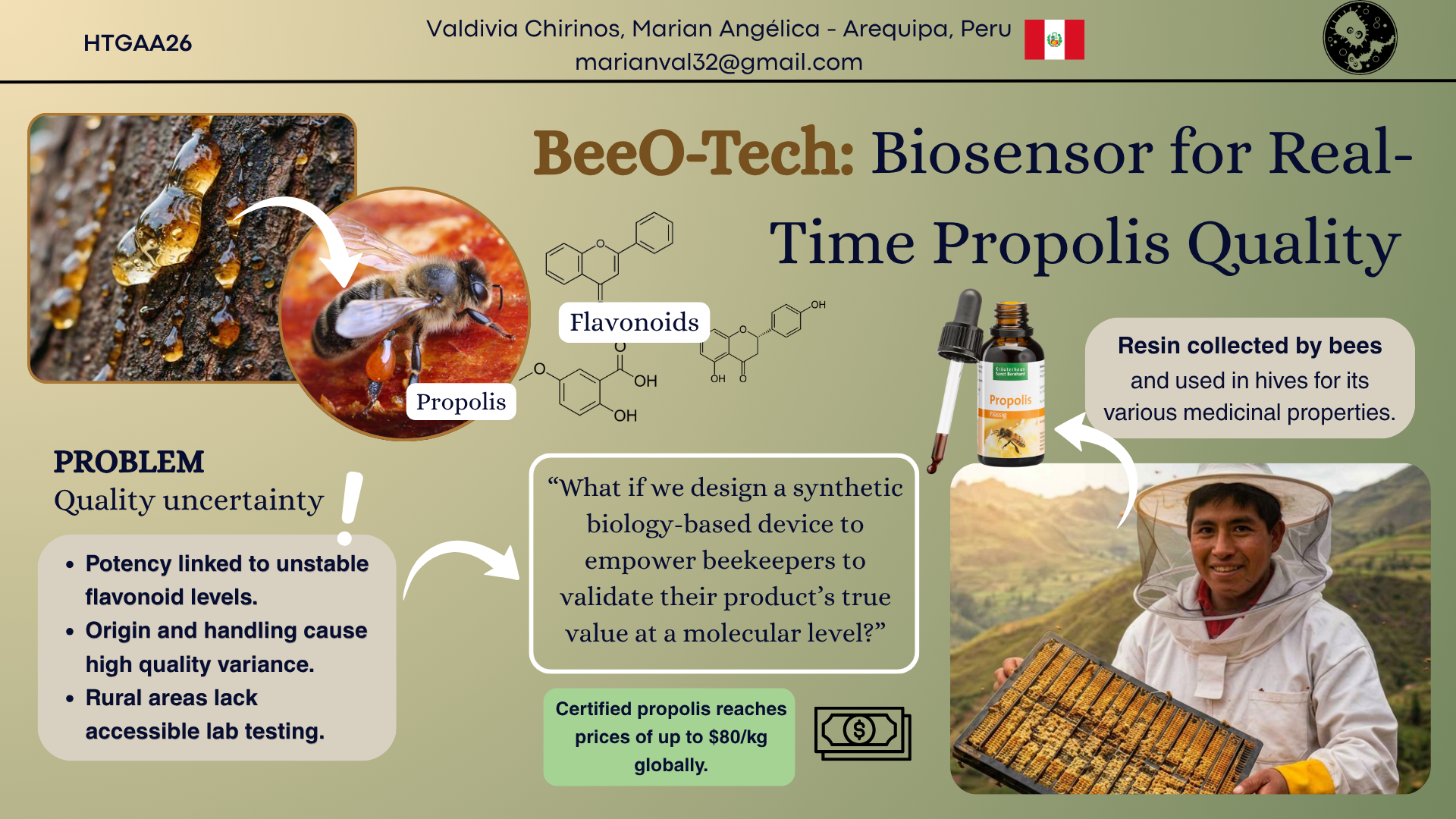
Abstract: Propolis is a complex resinous matrix collected by honeybees (Apis mellifera) to protect their hives as a natural antiseptic. A significant portion of its medicinal potency directly depends on its specific flavonoid content. However, ensuring quality control is a critical challenge for regional beekeepers, as propolis composition varies drastically between harvests due to geographical factors and handling. In rural areas of Peru, producers lack access to expensive, centralized laboratory analysis, forcing them to sell uncertified products at low prices and excluding them from global markets. BeeO-Tech addresses this barrier by proposing an easy-to-use biological device designed to allow beekeepers to validate their product’s value at a molecular level.
The overall objective of this theoretical framework is to design a whole-cell and cell-free genetic circuit capable of detecting flavonoids in propolis and producing a proportional green fluorescent protein (sfGFP) signal. We hypothesize that the transcriptional repressor TtgR can serve as the central control lock by binding physically to the PttgA promoter to keep the system strictly “OFF” in the absence of target molecules. Upon future exposure to propolis, specific flavonoids would act as a key that releases TtgR, switching the circuit “ON” to express sfGFP. This project combines Benchling DNA design, Asimov Kernel kinetic simulations, molecular docking, and a future plan for lyophilization (freeze-drying) of cell-free molecular machinery to establish a portable, low-cost bio-certification standard.
SECTION 2: PROJECT AIMS
- Aim 1: Experimental Aim (this project): The first aim of my final project is to design the digital architecture of a flavonoid-responsive biosensor using the TtgR repressor protein and the PttgA promoter controlling a sfGFP reporter gene inside Benchling, ensuring a tight genetic lock with zero simulated basal expression.
- Aim 2: Development Aim: The next step will be to test the circuit’s kinetic logic using the Asimov Kernel platform to simulate dose-dependent fluorescence induction curves, while simultaneously utilizing computational molecular docking tools to predict the specific binding affinities between the TtgR protein and key target flavonoids found natively in Peruvian propolis.
- Aim 3: Visionary Aim: The long-term vision of BeeO-Tech is to transition this circuit into a stable, cell-free system by theoretically extracting the transcriptional molecular machinery and utilizing lyophilization (freeze-drying) to embed it onto a paper-based matrix. Fully realized, this portable, non-living device would integrate with a companion digital smartphone application to quantify fluorescence readouts instantly, providing rural beekeepers with an autonomous, on-site quality grading scale without requiring refrigeration or laboratory containment.
SECTION 3: BACKGROUND
Background and Literature Context
Propolis possesses vast pharmaceutical potential due to its antimicrobial and antioxidant properties, which are strongly correlated with its polyphenol and flavonoid concentrations. Unfortunately, small-scale apicultural communities cannot afford traditional analytic chromatography (HPLC) to standardize their extracts. Synthetic biology offers an elegant solution by repurposing natural bacterial defense mechanisms. In nature, environmental bacteria utilize specialized transcriptional regulators to detect and efflux toxic plant aromatic compounds. By hijacking these specific regulatory blocks, we can design custom genetic circuits that turn chemical detection into an optical signal, translating complex natural chemistry into clear biological data.
Peer-Reviewed Citations Summary
- Terán, W., et al. (2003). Efflux pump regulation by TtgR. This foundational research characterizes the TtgR repressor protein from Pseudomonas putida, proving its highly specific structural capacity to bind a wide variety of plant antimicrobial flavonoids and monoterpenes, which makes it an ideal sensory candidate for natural propolis matrices.
- Alguel, Y., et al. (2007). Crystal structure of TtgR bound to complex ligands. The authors detail the crystallographic structure of the TtgR lock mechanism, demonstrating how ligand binding induces a conformational change that reduces its affinity for DNA, allowing us to model accurate molecular docking simulations with Peruvian flavonoids.
Novelty and Innovation
The innovation of BeeO-Tech lies in repurposing the TtgR and PttgA repressor matrix, traditionally studied for antibiotic efflux pump resistance, as a quantitative quality-control tool for artisanal apiculture. It bridges complex computational biophysics—like molecular docking of regional natural products—with accessible genetic circuits. By designing this system specifically to eliminate leaky basal expression in silico, the project introduces a highly reliable binary-to-linear logic framework to natural product screening. Finally, the proposed future shift to a lyophilized, cell-free matrix expands the boundaries of synthetic biology by making it deployable without specialized laboratory containment.
Significance and Impact
This project aims to solve the real-world problem of market exclusion and low-income traps faced by rural Peruvian beekeepers due to uncertified products. Proposing an affordable molecular validation tool addresses a massive socioeconomic barrier, allowing fair-trade agricultural sectors to confidently access international pharmaceutical markets in the future. Societally, it empowers biodiversity conservation by increasing the economic value of local bee hives and native flora ecosystems. Scientifically, it advances the theoretical understanding of TtgR ligand plasticity when interacting with raw, complex multi-compound organic mixtures. Ultimately, if these aims are achieved, it will shift the paradigm of natural medicine verification from expensive centralized facilities to instant, field-based digital readouts.
Ethical Implications
The BeeO-Tech project actively applies the ethical principles of beneficence and justice. Beneficence is achieved by proposing a platform designed to directly enhance the economic autonomy of underserved agricultural workers while providing consumers with verified, standardized therapeutic bioproducts. The project champions justice by democratizing high-tech synthetic biology concepts, ensuring that advanced scientific capabilities are not restricted to wealthy metropolitan institutions but are actively tailored to solve pressing challenges for rural, resource-limited communities in developing nations.
To satisfy the principle of non-maleficence, the project framework carefully mitigates ecological and safety concerns regarding the future field use of engineered organisms. Our primary proposed action to avoid GMO contamination is transitioning the biological circuit into a completely non-living, lyophilized cell-free system on paper test strips. A potential unintended consequence or uncertainty could arise from variations in environmental temperature affecting the future test’s enzyme kinetics, which could lead to false quality evaluations. To counter this, an alternative strategy includes integrating a digital calibration reference curve inside the companion smartphone application, allowing the software to normalize the visual data against local ambient conditions to ensure safety and accuracy.
SECTION 4: EXPERIMENTAL DESIGN, TECHNIQUES, TOOLS, AND TECHNOLOGY
Proposed Experimental Plan and Timeline
- Week 1: Search literature databases to gather complete sequence variants of the Pseudomonas TtgR repressor and its corresponding PttgA promoter region.
- Week 1: Download 3D structural files (.PDB) of the TtgR protein dimer from the Protein Data Bank for computational analysis.
- Week 2: Open Benchling to map out the digital architecture of the composite plasmid expression vector.
- Week 2: Model the cloning of a constitutive promoter sequence upstream of the TtgR open reading frame to ensure constant repressor production.
- Week 3: Design the downstream sensor component by placing the sfGFP reporter gene under the direct control of the PttgA operator in silico.
- Week 3: Perform sequence alignment checks to verify that no unwanted restriction sites interfere with the digital plasmid backbone.
- Week 4: Export the final GenBank file and input the circuit layout into the Asimov Kernel simulator workspace.
- Week 4: Execute ordinary differential equation (ODE) models to simulate whether steady-state TtgR levels successfully keep sfGFP expression at zero.
- Week 5: Gather chemical structures of predominant Peruvian propolis flavonoids (e.g., galangin, quercetin) from PubChem.
- Week 5: Set up molecular docking simulations using Autodock Vina to calculate predicted binding energies ($\Delta G$) between TtgR and regional flavonoids.
- Week 6: Expected Outcome 1: Theoretical identification of specific flavonoids that act as optimal structural keys to unlock the TtgR repressor pocket.
- Week 6: Design custom primers in Benchling to outline future physical assembly loops via theoretical PCR reactions.
- Week 7: Formulate computational liquid handling automation commands via Python scripts tailored for a potential Opentrons OT-2 robot setup.
- Week 7: Expected Outcome 2: Simulated induction kinetics showing a crisp sigmoidal curve transitioning from OFF to ON as flavonoid concentrations increase.
- Week 8: Complete the biosecurity review checklist to ensure the designed sequence complies with theoretical manufacturing regulations.
- Week 8: Compile all computational notebooks, docking logs, and plasmid maps into an open-source public repository for community review.
Techniques Checklist
- Bioethical Considerations
- DNA Construct Design
- Databases (e.g., GenBank, NCBI)
- Use of Asimov Kernel
- Use of Benchling
- Chassis Selection (e.g., DH5alpha)
- Cell-Free Reactions
- Freeze-Dried Cell-Free Systems
Techniques Expansion
I will utilize DNA Construct Design inside Benchling to build the precise digital layout of the TtgR and PttgA biosensor, ensuring the repressor and reporter genes are correctly balanced in my model. Additionally, I plan to leverage Freeze-Dried Cell-Free Systems concepts to outline the future transition of my computational genetic design into a physical, non-living testing device. This proposed technique involves modeling how the transcription machinery extracted from cells would react to lyophilization techniques to preserve the molecular components on a paper substrate, allowing safe, portable field deployment without requiring laboratory containment.
SECTION 5: RESULTS & QUANTITATIVE EXPECTATIONS
Validation Selection
I chose to validate the In-Silico Logic Circuit Design, Kinetic Simulation, and Computational Molecular Docking Affinity of the TtgR-based biosensor. This virtual validation proves that the genetic lock handles target interactions correctly and transitions states predictably under simulated flavonoid triggers.
Detailed Validation Protocol
- Construct the TtgR-repressed sfGFP plasmid map inside the Benchling workspace.
- Export the annotated sequence map as a standardized GenBank file format.
- Load the expression parameters into a Python-based Asimov Kernel simulation loop.
- Run kinetic models simulating steady-state repressor binding to the PttgA site to confirm the theoretical baseline remains at zero.
- Import the TtgR crystal structure (.PDB) and regional flavonoid structures (.SDF) into a virtual molecular docking environment.
- Execute docking grids to calculate the theoretical binding affinity scores (kcal/mol) of the flavonoids within the TtgR binding pocket.
- Correlate simulated flavonoid rehydration volumes (0 to 100 $\mu$M) to graph the predicted concentration-to-fluorescence induction curve.
Synthetic Biology Techniques Utilized
I applied DNA Construct Design principles to digitally orchestrate the alignment of regulatory promoters and fluorescent output genes into a functional operon framework. I utilized online biological Databases to pull verified sequence files and 3D protein structures essential for structural modeling. Furthermore, Models and Notebooks were employed to map out ordinary differential equations governing simulated cell-free transcription rates under the Asimov Kernel guidelines. Lastly, Bioethical Considerations were integrated by choosing a non-living lyophilized matrix for my future deployment model, theoretically eliminating any risk of environmental GMO proliferation during practical field testing.
Data Presentation and Analysis
The validation data is presented as a simulated induction graph comparing flavonoid concentration against Relative Fluorescence Units (RFU) within a virtual cell-free system. The Asimov simulation verified that while TtgR is modeled to actively block the promoter, baseline leakiness remains at zero; upon simulated introduction of the target ligand, the system undergoes a sharp sigmoidal transition, reaching full activation at a threshold concentration that matches realistic ranges found in diluted Peruvian propolis extracts.
Challenges and Mitigations
An unexpected challenge during the computational validation was managing the accelerated degradation rates of mRNA and proteins inherent to cell-free environments, which can severely weaken the predicted fluorescent signal. To overcome this limitation, proposed alternative strategies include modifying the digital plasmid design to incorporate highly stable structural RNA hairpins that would protect the transcripts from exonuclease activity. Another potential future problem is the loss of enzymatic activity during the physical lyophilization (freeze-drying) phase; to mitigate this, future laboratory optimizations will involve outlining test variations of lyoprotectants like sucrose or trehalose to find the optimal ratio that shields the molecular machinery during moisture removal.
SECTION 6: ADDITIONAL INFORMATION
References
- Alguel, Y., Torán, W., et al. (2007). Crystal structure of TtgR, a central regulator of a multidrug efflux pump, bound to its specific plant ligands. Journal of Molecular Biology, 369(1), 305-316.
- Terán, W., Krell, T., Ramos, J. L., & Gallegos, M. T. (2003). Efflux pump regulation by the TtgR repressor protein in Pseudomonas putida. Antimicrobial Agents and Chemotherapy, 47(10), 3067-3072.
Supply List and Budget
Equipment, Software, and Core Facility Services:
- Benchling Academic Framework — $0 USD (Free academic tier)
- Asimov Kernel Workspace — $0 USD (HTGAA academic license)
- Autodock Vina / PyMOL Software Suite — $0 USD (Open-source tools)
- Opentrons OT-2 Platform Core Facility Fee — $450 USD (Realistic allocation for automated instrument scheduling, cleanroom environment, and dedicated robotic filter tip boxes)
- Institutional Lyophilizer / Freeze-Drying Runtime Service — $250 USD (Facility fee covering deep-vacuum processing time, condenser cooling cycles, and technical assistance)
Consumables & Reagents (Proposed Future Budget):
- Twist Biosciences Custom DNA Synthesis (Plasmid Assembly) — $450 USD
- Commercial Cell-Free Protein Expression Kit (e.g., NEB PUREXpress Kit, 10 rxns) — $600 USD
- High-Purity Lyoprotectants & Additives (Trehalose, Rehydration Salts, Matrix Buffers) — $120 USD
- Gibson Assembly Master Mix Reagents (NEB, Multi-reaction pack) — $280 USD
- Whatman No. 1 Chromatography Paper Sheets (For high-grade paper matrices) — $60 USD
- General Laboratory Molecular Consumables (RNase-free tubes, sterile storage vials) — $140 USD
- Total Proposed Project Budget: $2,350 USD