Week 3 HW: Lab Automation
Python Script for Opentrons Artwork
I made an image for Opentrons Artwork based on the eye symbol from the Plantoverse project I’m involved with.
Google Colab: https://colab.research.google.com/drive/1NpGO1qk_Vl4jsJbpIHB6_8-z24hKodAW#scrollTo=pczDLwsq64mk&line=3&uniqifier=1
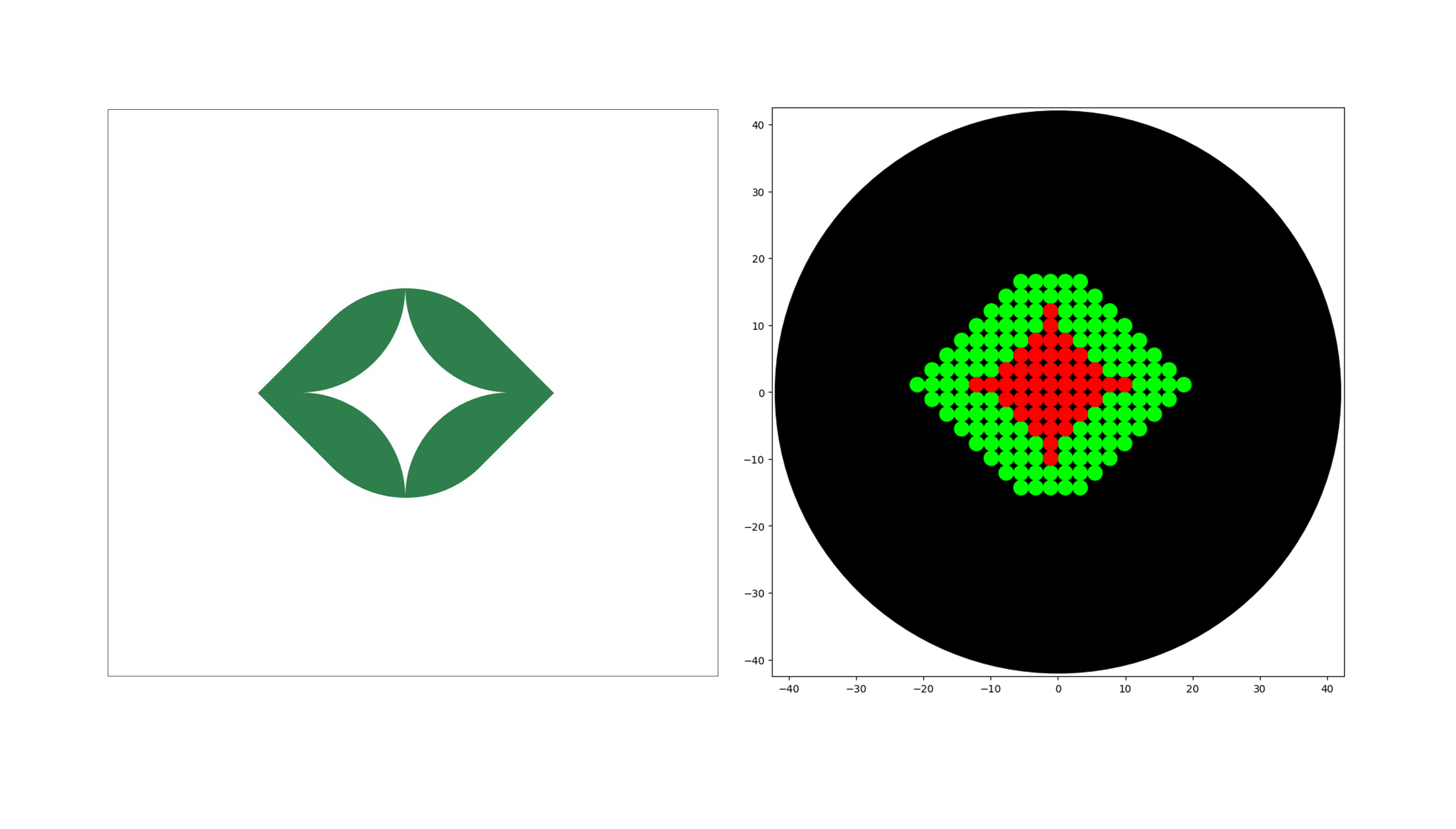 Concept and output
Comments: POINT_SIZE = 2 was used in the code, which made printing the image difficult. It is recommended to increase the pixel size for printing.
Lab automation
Automation in a scientific article
I am a member of the BioArt Team and a co-author of the article “Bioprinting in bioart and art-based research practices” (Burnusuz, A., Moshchenskaia, M., Prizova, V., Shalepo, M., Rider, M., Zakharov, V., … & Kadyrov, D. (2024). See the world from a plant’s perspective: on creating an interactive multimedia sculpture implying plant optics. Humanities and Social Sciences Communications, 11(1), 1-11.). This work describes a DIY bioprinter that was created by the technical department of our team, based in the BioArt Lab at the Art & Science Center of ITMO University. This device was developed for a course within the Bioart track of the master’s program.
The bioprinter can automatically deposit a bacterial suspension onto the surface of an agar nutrient medium. It allows printing of images, patterns or text using living microorganisms. The main parts of the project are:
- Arduino code that is responsible for parsing image data (in bytes), moving the motors, and activating the printhead via the InkShield board
- Python code to adapt a low‑resolution black‑and‑white image and send it through the serial port
The BioArt Team aims to develop the bioart community and make these technologies accessible. The code for this project is open source and available on GitHub at: github.com/strangerest/bioprinter_simple
Thus, this work shows how relatively simple and affordable automation tools can be used to solve complex problems at the intersection of biology, engineering and art.
Automation in my final project
As part of my final project, I plan to use this bioprinter to print images with E. coli bacteria.
Steps:
- As part of my final project, I plan to use this bioprinter to print images with E. coli bacteria
- Generate a raster image
- Prepare the printing suspension: E. coli in liquid LB medium for the cartridge
- Ensure sterility of the bioprinter work area and the cartridge
- Calibrate the bioprinter for the Petri dish and run test prints
- Run the code
- Print the image with E. coli bacteria on solid agar nutrient medium in a Petri dish
- Close the Petri dish and place it in an incubator for 24 hours at 37°C