Week 6 HW: Genetic Circuits Part I: Assembly Technologies
Assignment: DNA Assembly
Components of the Phusion High‑Fidelity PCR Master Mix and their purposes
The Phusion master mix (2×) contains:
- Phusion DNA polymerase – a high‑fidelity enzyme with 3′→5′ proofreading activity, minimising errors during amplification
- dNTPs (dATP, dTTP, dCTP, dGTP) – the building blocks for new DNA strands
- Optimised reaction buffer (HF or GC) – provides the correct pH and ionic conditions for the enzyme
- Mg²⁺ ions (MgCl₂) – an essential cofactor for polymerase activity
Factors determining primer annealing temperature during PCR
The optimal annealing temperature (Ta) depends on:
- Primer length – longer primers generally require higher Ta
- GC content – higher GC content increases the melting temperature (Tm, the temperature at which half of the DNA duplex dissociates) and thus Ta
- Primer sequence – certain bases or secondary structures can affect binding stability
- Salt concentration – higher salt stabilises the DNA duplex, raising the effective Tm
- A common rule of thumb is to set Ta about 3–5 °C below the calculated Tm of the primer
Comparison of PCR and restriction enzyme digests for generating linear DNA fragments
| Feature | PCR | Restriction digest |
|---|---|---|
| Protocol | Amplifies a specific DNA region using primers and a DNA polymerase. | Cuts DNA at specific recognition sites using restriction enzymes. |
| Advantages | Flexible; does not require specific restriction sites; allows mutagenesis via primers. | Highly predictable; produces defined sticky or blunt ends. |
| Disadvantages | Risk of polymerase errors (even with proofreading); limited product length (~10 kb). | Requires suitable restriction sites in the DNA; may leave “scars” in the sequence. |
| When preferable | When you need to amplify from complex mixtures, introduce mutations, or when no convenient restriction sites exist. | When you have a known vector with unique sites and want straightforward cut‑and‑ligate cloning. |
Ensuring DNA sequences are suitable for Gibson cloning
To be compatible with Gibson assembly:
- Design overlapping ends (20–40 bp) between adjacent fragments. These overlaps are added via PCR primers (the forward primer of one fragment contains a tail complementary to the previous fragment, etc.)
- Ensure the overlaps are complementary and free of strong secondary structures
- Maintain correct reading frame when assembling coding sequences
- Verify the absence of unintended mutations by sequencing or by using high‑fidelity polymerases
- Purify the fragments (e.g., gel extraction) to remove enzymes and primers before the assembly reaction
Entry of plasmid DNA into E. coli cells during transformation
Plasmid DNA enters competent E. coli through transient pores in the cell membrane:
- Heat‑shock transformation: Cells are treated with cold CaCl₂ to neutralise membrane charges. A sudden temperature increase (0 °C → 42 °C) creates pores through which DNA diffuses into the cytoplasm
- Electroporation: A short high‑voltage pulse generates temporary nanopores in the membrane, allowing DNA to enter
After transformation, cells are recovered in SOC medium and plated on selective antibiotics; only transformed cells survive.
Gibson Assembly method description
Gibson Assembly is a seamless cloning method that joins multiple DNA fragments with overlapping ends in a single isothermal reaction. The master mix contains three enzymes: a 5′ exonuclease, a DNA polymerase, and a DNA ligase. First, the exonuclease chews back the 5′ ends to create single‑stranded overhangs. Complementary overhangs of adjacent fragments anneal. Then the DNA polymerase fills the gaps, and the ligase seals the nicks in the sugar‑phosphate backbone. The result is a circular plasmid without extra sequences. Gibson Assembly is especially convenient for assembling 2‑6 fragments and does not require specific restriction sites.
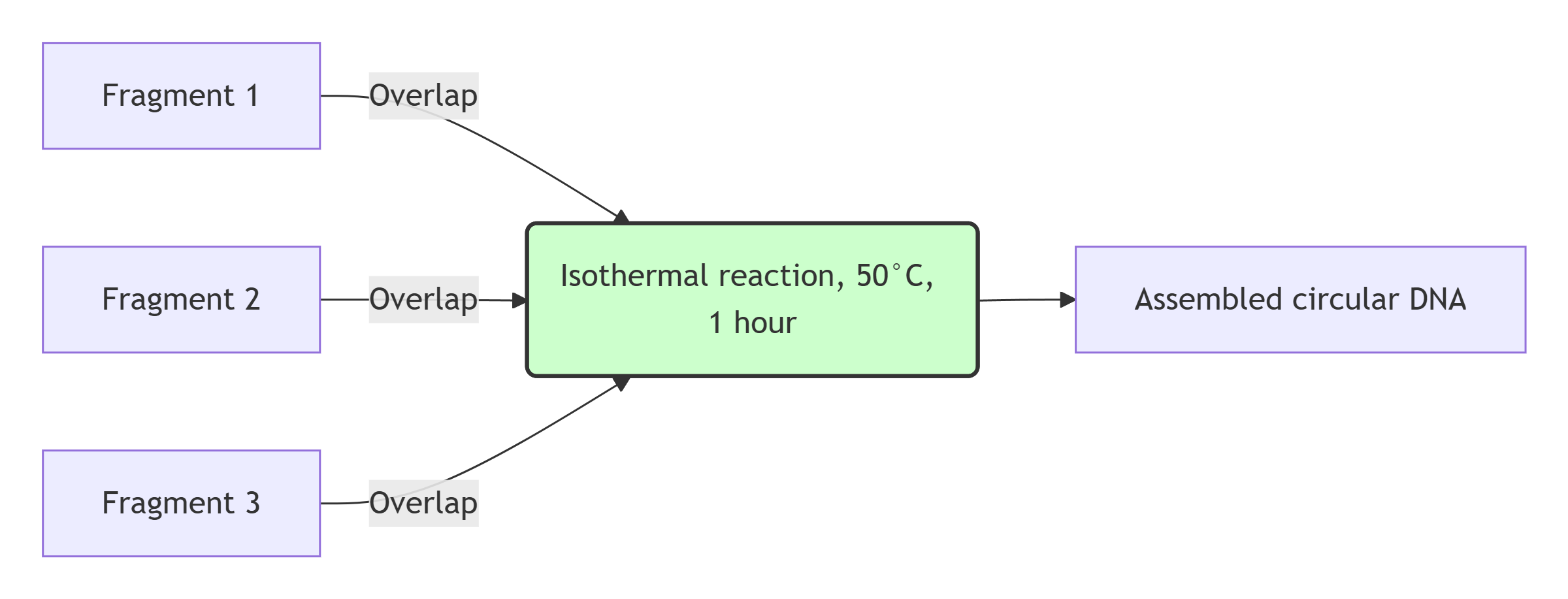 Gibson Assembly workflow
Simulation of the Gibson Assembly method in Benchling
In Benchling, a Gibson Assembly wizard was created. The backbone (sequence-489446, 2871 bp) and the insert (P_rprA-B0034-mScarlet-I-B0015, 918 bp) were added with 40 bp overlaps. The status “Ready to assemble” confirms that the assembly is possible. The screenshot illustrates the simulation process.
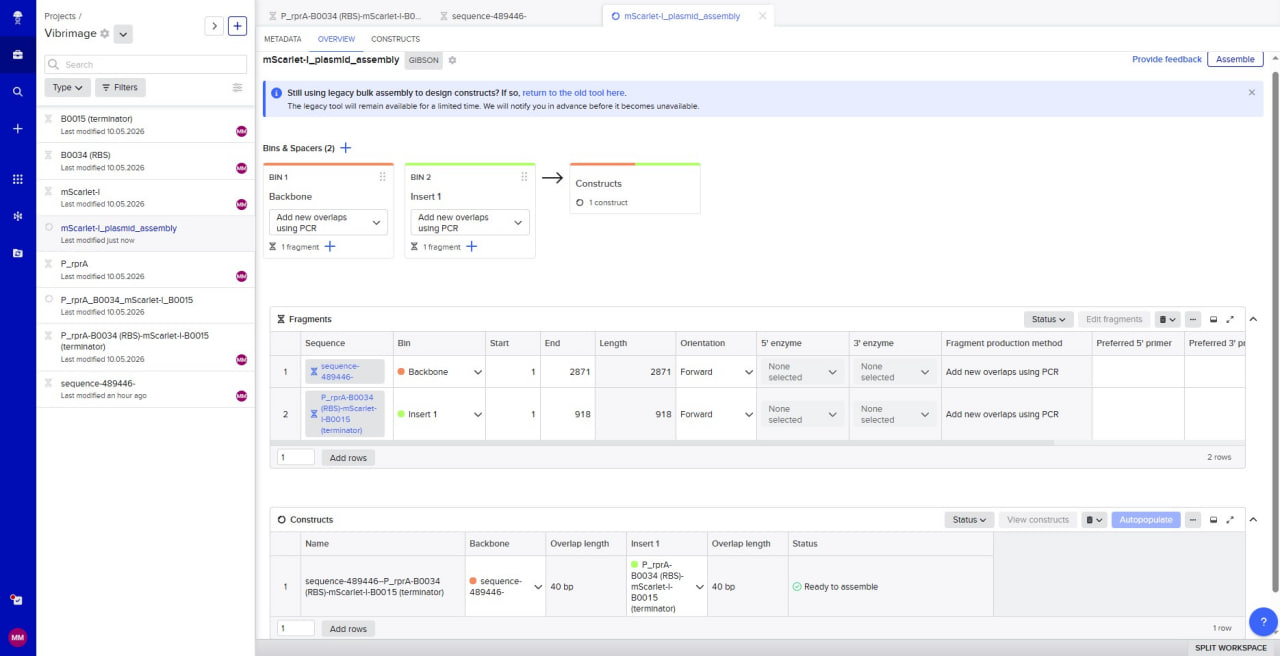 Simulation of Gibson Assembly in Benchling
Assignment: Asimov Kernel
Strong GFP expression - BBa_J23101
I examined the Strong GFP expression – BBa_J23101 construct. It consists of a constitutive promoter BBa_J23101, a ribosome binding site (RBS), a green fluorescent protein (GFP) gene, and a terminator. By design, this construct should provide constant, unregulated GFP expression.
Inducible GFP system
My construct consists of the pLac promoter (BBa_R0011), B0034 RBS (BBa_B0034), GFP gene (BBa_E0040), and B0015 terminator (BBa_B0015). The pLac promoter is activated only in the presence of the inducer IPTG. Without IPTG, GFP expression is repressed (LacI repressor binds the operator). Upon IPTG addition, the repressor is inactivated, and GFP synthesis begins. Fluorescence is expected to rise from zero to a high plateau within about 60 minutes.
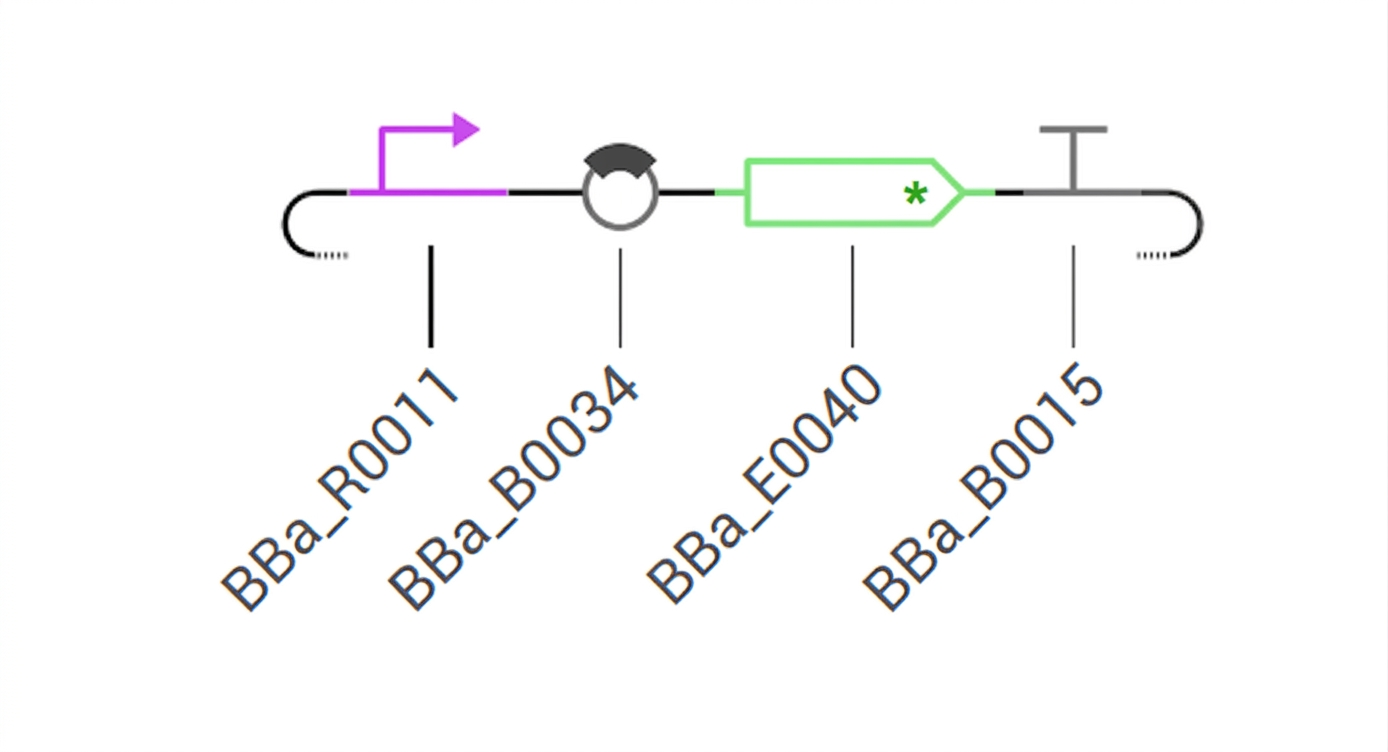
- Inducible GFP construct: pLac promoter, B0034 RBS, GFP gene, B0015 terminator*