Week 7 HW: Genetic Circuits Part II: Neuromorphic Circuits
Assignment Part 1: Intracellular Artificial Neural Networks (IANNs)
- Advantages of IANNs over Boolean genetic circuits
- Analog computation (continuous molecular concentrations)
- Weighted summation of multiple inputs
- Nonlinear activation (sigmoid via cooperativity)
- More compact (one neuron replaces many logic gates)
- Tunable weights (promoter/RBS strength)
- Application: cancer biomarker detection
Inputs: concentrations of miRNAs (e.g., miR‑21, miR‑155) Output: therapeutic protein or fluorescent reporter Limitations: noise, difficulty of weight tuning, latency (minutes to hours), metabolic load
- Intracellular multilayer perceptron
In Layer 1, input signals X1 and X2 (DNA encoding regulatory proteins) lead to the production of the endoribonuclease Csy4. In Layer 2, constitutive promoters drive transcription of mRNAs for fluorescent proteins (GFP, CFP). Csy4 cleaves these mRNAs, preventing the synthesis of the fluorescent proteins. Thus, the output of Layer 2 (fluorescence) is a function (logical NOT) of Csy4 activity.
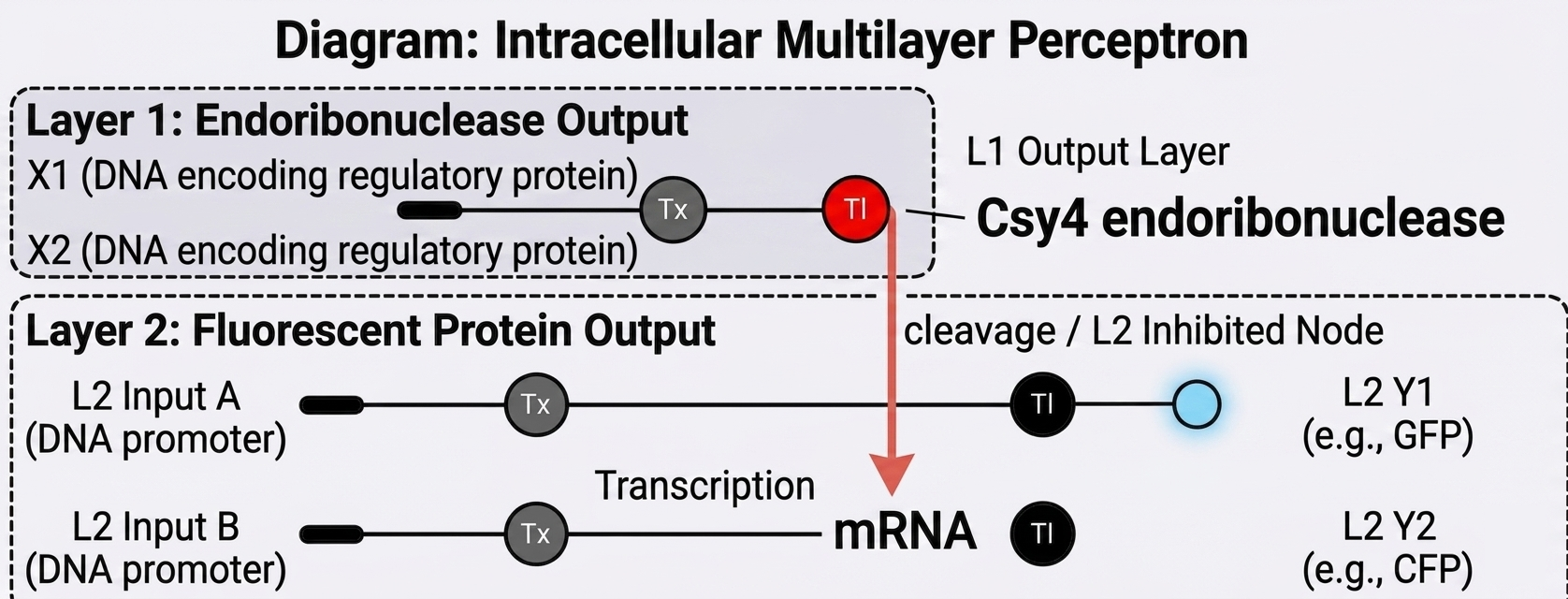 Layer 1 converts inputs X₁, X₂ into Csy4 endoribonuclease; layer 2 expresses fluorescent proteins whose mRNAs are cleaved by Csy4
Assignment Part 2: Fungal Materials
- Examples of Existing Fungal Materials
The most widespread fungal materials include mycelium-based composites (insulation, panels, furniture, packaging) and mycelium leather (vegan leather for fashion and upholstery). Their advantages are biodegradability, low cost, good thermal and acoustic insulation, fire retardancy, and renewable feedstock (agricultural waste). Disadvantages are low mechanical strength (semi‑structural only), high water absorption, and currently higher price at scale.
- Genetic Engineering of Fungi and Advantages over Bacteria
Fungi can be engineered to improve nutritional value (mycoprotein with meat‑like taste), bioproduction efficiency (enzymes, pharmaceuticals, bioplastics), and mycelial material properties (strength, hydrophobicity).
- Powerful secretion system – fungi secrete higher amounts of target proteins and enzymes
- Low‑cost substrate utilisation – grow on lignocellulosic waste instead of expensive media
- Mycelium as a ready‑made material – the hyphal network itself is the composite/leather, reducing downstream processing
- Non‑toxicity and food‑grade status – many fungi are safe for food and feed applications
Assignment Part 3: First DNA Twist Order
Vibrimage
A device for affecting the growth of bioprinted E. coli on solid agar medium using programmable acoustic exposure.
Genetic stress reporters visualise the cellular response to vibration. For my DNA design, I use the P_rprA promoter. It makes E. coli glow red in zones of acoustic exposure. This makes “sound sculpting” visible.
Final Project Aim:
To characterize the influence of frequency, amplitude, and duration of vibration on the morphology and stress response of E. coli colonies bioprinted on a solid agar medium to develop a protocol for mechanical reprogramming of the architecture of living material.
Link to Benchling: https://benchling.com/s/seq-RTX8FJ2UuKuwG8vXI98a?m=slm-NfaFCzPRJMbmbbexdtdi