Bioproduction & Cloud Labs
Part A: The 1,536 Pixel Artwork Canvas | Collective Artwork
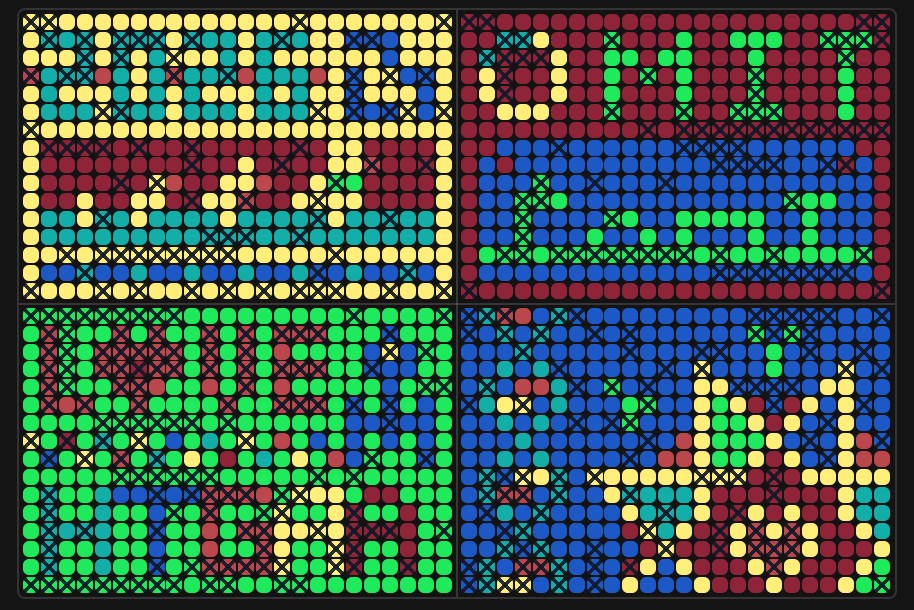
Collective image
Part B: Cell-Free Protein Synthesis | Cell-Free Reagents
- Roles of components in the 20‑hour cell‑free reaction (yellow box) E. coli Lysate (BL21 (DE3) Star) – provides the cellular machinery (ribosomes, tRNAs, polymerases, translation factors) required for transcription and translation. The BL21 (DE3) strain supplies T7 RNA polymerase, enabling high‑efficiency transcription from T7 promoters.
Salts/Buffer – maintain optimal pH (HEPES), ionic strength, and cofactor availability. Potassium glutamate and magnesium glutamate stabilise ribosomes and enzyme activity; potassium phosphate buffers the reaction and supplies phosphate groups.
Energy / Nucleotide System – ribose and glucose are metabolised by endogenous enzymes to generate ATP and other NTPs. AMP, CMP, GMP, UMP and guanine are converted into the corresponding NTPs, providing a sustainable, long‑term energy supply.
Translation Mix (Amino Acids) – supplies the 20 proteinogenic amino acids (17‑amino acid mix plus tyrosine and cysteine) as building blocks for the synthesised protein.
Additives (Nicotinamide) – acts as a cofactor for certain metabolic enzymes and may help reduce inhibitory by‑products, extending the reaction lifetime.
Backfill (Nuclease Free Water) – adjusts the final volume and ensures no contaminating nucleases degrade the DNA template or RNA.
- Main differences between the 1‑hour PEP‑NTP master mix and the 20‑hour NMP‑ribose‑glucose master mix The 1‑hour mix uses pre‑made NTPs (ATP, GTP, CTP, UTP) and phosphoenolpyruvate (PEP‑Mono) as an immediate energy source, allowing rapid protein synthesis but limiting reaction duration. The 20‑hour mix instead supplies ribose, glucose, and nucleotide monophosphates (AMP, CMP, UMP) plus guanine; endogenous bacterial enzymes convert these into NTPs and regenerate ATP over many hours, enabling sustained protein production for up to 20 hours. Consequently, the 1‑hour formulation is suitable for quick assays, while the 20‑hour formulation supports longer incubations and higher total protein yields.
Part C: Planning the Global Experiment | Cell-Free Master Mix Design
- Biophysical or functional properties of the six proteins sfGFP: matures very quickly (13.6 min) and folds robustly, ensuring fast and reliable fluorescence in cell‑free systems.
mRFP1: is a monomer with a maturation time of about 60 min and low acid sensitivity (pKa 4.5), reducing signal loss at low pH.
mKO2: is a bright, fast‑maturing orange protein with moderate acid sensitivity.
mTurquoise2: matures rapidly, has an extremely high quantum yield (0.93) and very low acid sensitivity, making it ideal for long incubations.
mScarlet‑I: matures in ~36 min (faster than most red proteins) and has moderate acid sensitivity, giving a strong signal in cell‑free setups.
Electra2: is a monomeric blue protein with optimized intracellular brightness and high photostability, ensuring a clear signal despite lower blue‑FP stability.
- Hypothesis for improving fluorescence over 36 h Protein: mScarlet‑I (or any protein limited by maturation).
Reagents: add a redox‑balancing system (e.g., DsbC/DsbG) and a chaperone cocktail (GroEL/ES) to the mastermix.
Expected effect: the redox reagents would improve chromophore maturation, while the chaperones would prevent aggregation, leading to a higher and more stable fluorescence signal throughout the 36‑h incubation.