Week 1 HW: Principles and Practices
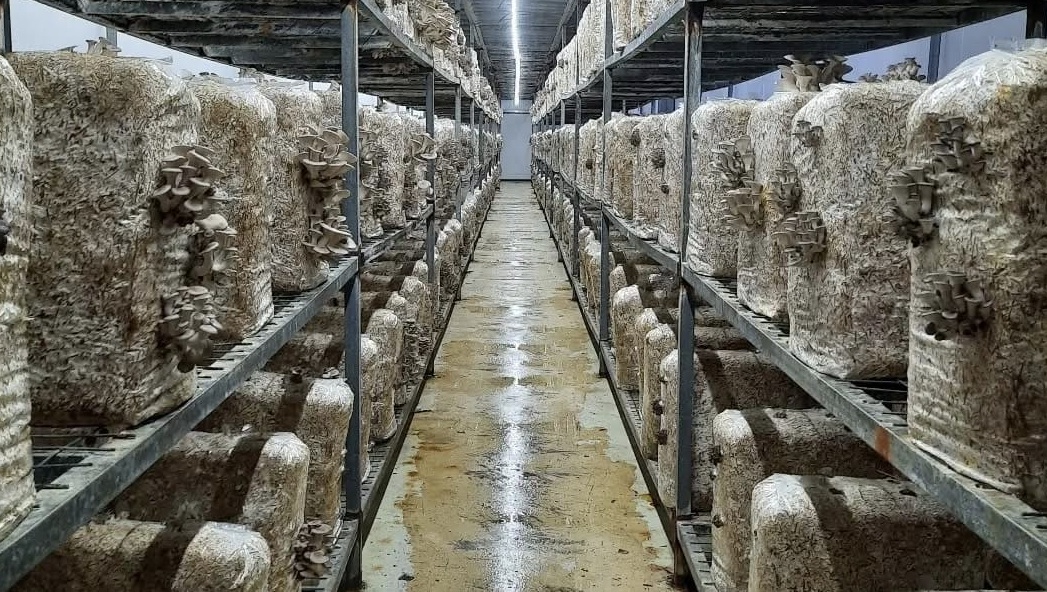
My visit at one of the 2 fungi farms in Cyprus in 2023
First weeks assignment
Describe a biological engineering application or tool you want to develop and why. This could be inspired by an idea for your HTGAA class project and/or something for which you are already doing in your research, or something you are just curious about.
Next, describe one or more governance/policy goals related to ensuring that this application or tool contributes to an “ethical” future, like ensuring non-malfeasance (preventing harm). Break big goals down into two or more specific sub-goals. Below is one example framework (developed in the context of synthetic genomics) you can choose to use or adapt, or you can develop your own. The example was developed to consider policy goals of ensuring safety and security, alongside other goals, like promoting constructive uses, but you could propose other goals for example, those relating to equity or autonomy.
Describe at least three different potential governance “actions” by considering the four aspects below (Purpose, Design, Assumptions, Risks of Failure & “Success”). Try to outline a mix of actions (e.g. a new requirement/rule, incentive, or technical strategy) pursued by different “actors” (e.g. academic researchers, companies, federal regulators, law enforcement, etc). Draw upon your existing knowledge and a little additional digging, and feel free to use analogies to other domains (e.g. 3D printing, drones, financial systems, etc.).
Purpose: What is done now and what changes are you proposing? Design: What is needed to make it “work”? (including the actor(s) involved - who must opt-in, fund, approve, or implement, etc) Assumptions: What could you have wrong (incorrect assumptions, uncertainties)? Risks of Failure & “Success”: How might this fail, including any unintended consequences of the “success” of your proposed actions?
- Next, score (from 1-3 with, 1 as the best, or n/a) each of your governance actions against your rubric of policy goals. The following is one framework but feel free to make your own:
| Does the option: | Option 1 | Option 2 | Option 3 |
|---|---|---|---|
| Enhance Biosecurity | |||
| • By preventing incidents | |||
| • By helping respond | |||
| Foster Lab Safety | |||
| • By preventing incident | |||
| • By helping respond | |||
| Protect the environment | |||
| • By preventing incidents | |||
| • By helping respond | |||
| Other considerations | |||
| • Minimizing costs and burdens to stakeholders | |||
| • Feasibility? | |||
| • Not impede research | |||
| • Promote constructive applications |
- Last, drawing upon this scoring, describe which governance option, or combination of options, you would prioritize, and why. Outline any trade-offs you considered as well as assumptions and uncertainties. For this, you can choose one or more relevant audiences for your recommendation, which could range from the very local (e.g. to MIT leadership or Cambridge Mayoral Office) to the national (e.g. to President Biden or the head of a Federal Agency) to the international (e.g. to the United Nations Office of the Secretary-General, or the leadership of a multinational firm or industry consortia). These could also be one of the “actor” groups in your matrix.
Reflecting on what you learned and did in class this week, outline any ethical concerns that arose, especially any that were new to you. Then propose any governance actions you think might be appropriate to address those issues. This should be included on your class page for this week.
An exploration into abandoned copper mines in Cyprus and the non existent restoration of toxic environments
I have been extremely interested in mycelium, plants and lichen. Lichen is a super queer and hybrid species that is a cross between fungi and algae. In recent years. Lichen are biosensors and bioindicators and some local plants are hyperaccumulators of heavy metals and they aid in bioremediation (through phytoremediation) and enviromental restoration of abandoned mines in Cyprus and other waste lands. Here you can find a conversation between the artist Helene Black and myself documenting my project We forgot how to forage as part of an artist residency. Helene Black is an artist, educator and cofounder of the interdisciplinary NGO, NeMe in Limassol, Cyprus. She has been researching abandoned copper mines and extractivism in Cyprus.
Here is a 3D scan of a cultivated petri dish. We tested the bodies of water of the river of abandoned Lefke mine.

As part of the Re(Grounding) program, myself and Ukrainian biohacker Dariia Dantseva of Yane lab completed a DIY biology workshop with a variety of groups of local citizens focusing on enviromental justice and restoration of abandoned copper mines through testing waters from Lefke mine river and Skouriotissa mine. We used readily available water test strips and then we proceeded with taking a water sample with a swab and trasfered it into the LB agar nutrient medium petri dishes. The participants used copper coins (british pennies and european cents) to test how resistant the existing micoorganisms in our water samples were to the copper inside the coin as as well as mixing samples from their microbiome (saliva, breath) with the contaminated water samples from the mines. The participants learned how to label their petri dishes, complete water pH tests with readily available test strips, and learned how to test fluids and swab them on petri dishes.
Lichen, plants and fungi for bioremediation, plastic degradation down plastics and monitoring enviromental changes and bioremediation
Alternatively, lichen and other endemic local plants are also being researched as biosensors or indicators of enviromental pollution and bioremediation of heavily pollutted environments. I live in Cyprus, where the british colonised us and started a bunch of copper mines that exported resources to nazi germany. After the 1974 war a lot of the mines were abandoned and some of them have been there since roman times. The mines have been abandoned and have never been rehabilitated and as a result the pollution still leaks through into our vegetables, fruit, drinking water and various bodies of water. I have completed a bunch of site specific visits to collect samples of water and to observe the flora and fauna of the abandoned mines. In the interview with Helene I talk about the local reseach around bioremediation of abandoned mines from Cypriot scientists.
1. A biological engineering application or tool you want to develop and why
MYCOREMEDIATION and SCAFFOLDS
Apart from my interest in bioremediation and phytoremediation, I am also extremely eager to explore a form of mycoremediation such as plastic or organic waste degrading mycelium for plastic pollution and waste management (mycoremediation). In the last 3 years I have been making a lot of biocomposite materials and working with crystallisation as well. The common root of crystallisation and mycelium cultivation is that both use scaffolds. Mycelium degrades organic or other material as a nutrient scaffold and as a helping hand in its cultivation journey and crystallisation can be combined with a scaffold that guides, support and induces the purification and formation of crystalline structure on pretty much made out of anything, organic or inorganic materials. Check my fabricademy page for more crystallisation scaffold techniques and tips.
I am quite curious as to which fungi can already break down and digest petroleum derived plastics and as to which fungi can be trained or modified. We have all heard about the fungi munching on radioactivity in Chernobyl and how mycelium is being utilised in bioremediation too! In addition, from my own research on abandoned mines and the flora and possible bioremediation of these sites I have discovered that some plants and organisms and microbes in soil and water have evolved to digest and breakdown different types of material waste and have evolved to accumulate heavy metals as well as bacteria in the polluted bodies of water have been evolved too.
In 1991, a species of fungi (Cladosporium sphaerospermum) was found growing inside the highly radioactive Chernobyl Exclusion Zone – an area deadly to most life. Fungi are already known for their extreme tolerance, often thriving in harsh environments, but this one does something scientifically compelling: it uses a process called radiosynthesis to absorb radiation (a form of energy, like sunlight) and uses it to fuel its cellular processes. found in petriandpen substack
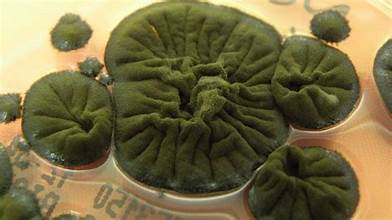
“Fungi such as Pestalotiopsis microspora, Pleurotus ostreatus (oyster mushrooms), and Parengyodontium album, use enzymes to break down plastics, converting them into organic nutrients or harmless byproduct, Coastal pollution toolbox.org”.
In order to be able to understand how mycoremediation works we need to study how fungi degrade plastic and other organic or agricultural materials, their enzyme and metabolic actions and the mechanisms in which they grow, adhere and break down the plastic. In plastic degradation the mycelium adheres to the plastic using is also as a scaffold. Then we can study different types of plastics and if the plastics need pre-treatments for the fungi to be able to degrade the surface.
Here is a list of papers on fungi that degrade plastic!
Myco-remediation of plastic pollution: current knowledge and future prospects
Pleurotus ostreatus and a novel fungal composite: Development and bioremediation of plastic wastes
Also!
Colonization: Fungi, such as Aspergillus terreus, Engyodontium album, and Pleurotus ostreatus (oyster mushroom), grow onto the plastic surface, often aided by pre-treatment (heat, UV light) to increase efficiency.
Enzymatic Degradation: Fungal mycelium secretes enzymes that hydrolyze and oxidize complex polymer chains (LDPE, polyurethane, PET) into simpler compounds.
Bioassimilation: The fungi consume these smaller molecules for energy and carbon, converting the plastic into organic biomass
2. Describe one or more governance/policy goals related to ethical futures
What are our governance or policy goals and our audience and what is the application of this idea?
Break big goals down into two or more specific sub-goals.
Governance or policy goals for our idea
- Household everyday DIY small scale level application- relating to equity, autonomy and empowerment of citizens to manage their own family waste in the comfort of their own homes or offices or businesses.
- Reproductibility of homeowners or business owners- the process, tools and resources need to be accessible using simple diy tech and in different environments.
- Protect the environment- Environmental Application- Researchers are exploring these fungi for use in landfills and specialized recycling, with studies showing significant degradation within weeks. While promising, scaling this technology for industrial use is a major focus for future research, with potential for implementation in 3–5 years. Helping respond to the management of tonnes of single plastic produced, not reused or upcycled and discarded every year.
- Promoting constructive uses.
3. Potential governance “actions”
By considering the four aspects below (Purpose, Design, Assumptions, Risks of Failure & “Success”) we can discuss potential governance actions for our idea :)
Action 1
Create and instruct workshops and create citizen science groups around mycoremediation and empower citizens to learn to degrade their own plastic waste anywhere. Another branch for a variety of actors in other sectors is to again create specially designed workshops and training sessions for companies, offices and other corporate actors.
- Purpose
Mycoremediation and alternative waste management processes are still quite unknown and are still being researched.
- Design
NGOs and environmental non profits as well citizens initiatives.
- Assumptions
That people are mentally ready to deal with their own plastic waste especially in an age where everything is bought ready made from food to clothes to anything.
- Risks of failure
People do not want to take responsibility and it might overwhelm them since it is a newish field.
- SUCCESS!!!
Increasing interest and autonomy from individual citizens to offices and businesses to manage their waste and become more sustainable and equitable.
Action 2
Enviromental and larger scale actions such as mycoremediating plastic waste landfills or other types of material waste on the stop in the affected sites.
- Purpose
Locally nothing is being done as far as mycoremediation or regenerative waste management.
- Design
Local governments, corporations, ngos, academic bodies for research and development.
- Assumptions
That people will be willing to try it.
- Risks of failure
Might be too costly and time consuming to get it right and need 3-5 years to scale up.
- SUCCESS!!!
Citizens, home and officer owners degrade and manage their own waste, easily, diy etc.
Action 3
Create a citizen science group that tackles environmental purposes and goals and disseminate knowledge, resources, diy tools to become stewards of environmental justice and more autonomous.
- Purpose
Not much is being done and locally there are not that many citizen science groups that are autonomous.
Design: What is needed to make it “work”? (including the actor(s) involved - who must opt-in, fund, approve, or implement, etc)
NGOS, non profits, research groups.
Assumptions: What could you have wrong (incorrect assumptions, uncertainties)?
Cannot really think right now!
Risks of Failure & “Success”: How might this fail, including any unintended consequences of the “success” of your
SUCCESS!!!
People become more autonomous.
4. Next, score (from 1-3 with, 1 as the best, or n/a) each of your governance actions against your rubric of policy goals. The following is one framework but feel free to make your own:
| Does the option: | Option 1 | Option 2 | Option 3 |
|---|---|---|---|
| Enhance Biosecurity | |||
| • By preventing incidents | |||
| • By helping respond | |||
| Foster Lab Safety | |||
| • By preventing incident | |||
| • By helping respond | |||
| Protect the environment | |||
| • By preventing incidents | * | ||
| • By helping respond | * | ||
| Other considerations | |||
| • Minimizing costs and burdens to stakeholders | * | ||
| • Feasibility? | |||
| • Not impede research | |||
| • Promote constructive applications | * | ||
| • Promote autonomy, equity | * |
5. Drawing upon this scoring, describe which governance option, or combination of options, you would prioritize, and why.
For example: Outline any trade-offs you considered as well as assumptions and uncertainties. For this, you can choose one or more relevant audiences for your recommendation, which could range from the very local (e.g. to MIT leadership or Cambridge Mayoral Office) to the national (e.g. to President Biden or the head of a Federal Agency) to the international (e.g. to the United Nations Office of the Secretary-General, or the leadership of a multinational firm or industry consortia). These could also be one of the “actor” groups in your matrix.
In our ideas case, I prioritize the household owners as main actors in my matrix; those who want to degrade and manage their personal plastic waste in the comfort of their own home and become more autonomous in managing their own waste without feeling like they are doing all the recycling and the waste management companies just burn them in a landfil. In the case of Cyprus this is what happens. People gather and recycle their waste but the companies are just burning them while charging people and the government.
Another idea is to create a mycoremediation start up that works similarly as a bio waste management company that goes around collecting the waste from users, businesses, offices etc and carry out the whole process in a “factory” but then the goal of equity, empowerment and autonomy in every household would not be valid, the goals will change once the main actors change.
New information
I took so many notes during the read, write and edit DNA lecture last night. Most of these concepts are new to me but I think I learned a bunch of new things that intrigued me and activated my curiosity. Below I will try to answer the homework questions with just going over the slides and doing some searching online if I must. Below you can find HW 2 PREP.
Homework Questions from Professor Jacobson
Q1. Nature’s machinery for copying DNA is called polymerase. What is the error rate of polymerase? How does this compare to the length of the human genome. How does biology deal with that discrepancy?
A1. Polymerase has a high error rate and in biological synthesis of DNA, DNA polymerase is used and the Error Rate is 1:10 ^6 and throughput 10 mS per Base Addition [Beese et al. (1993), Science, 260, 352-355.
.] The human genome consists of about 3 billion base pairs.
Biology has a way of dealing with discrepancies and errors through highly sophisticated processes of sensing, detecting, reporting, and repairing.
Q2. How many different ways are there to code (DNA nucleotide code) for an average human protein? In practice what are some of the reasons that all of these different codes don’t work to code for the protein of interest?
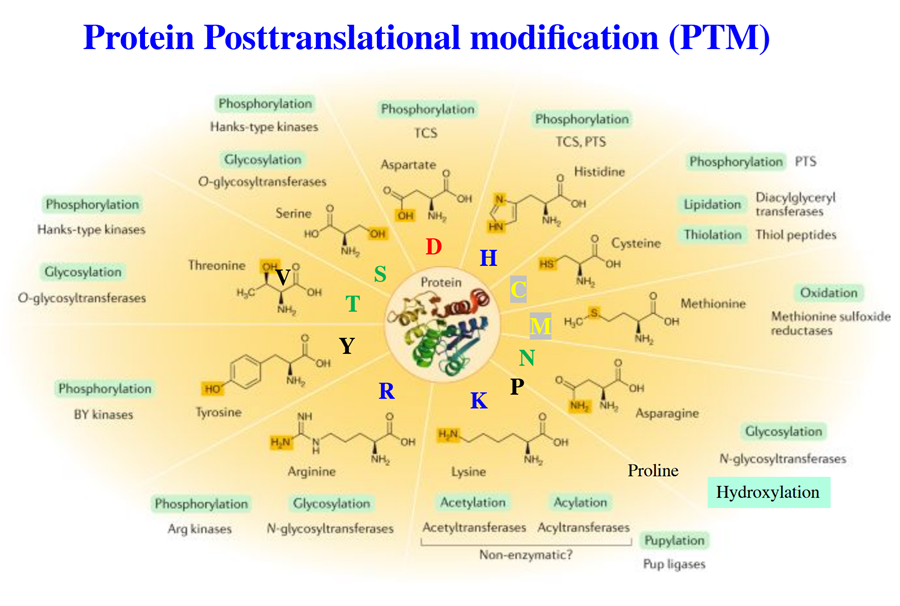
A2. There are multiple codons to express the same aminoacid which gives us abundant possibilities for coding for an average human protein. An average protein consists of 400-500 aminoacids and most aminoacids have similar codons among them so the possibilities of coding are extremely high with many combinations being created.
Homework questions from Dr. Natalie LeProust
Q1. What’s the most commonly used method for oligo synthesis currently?
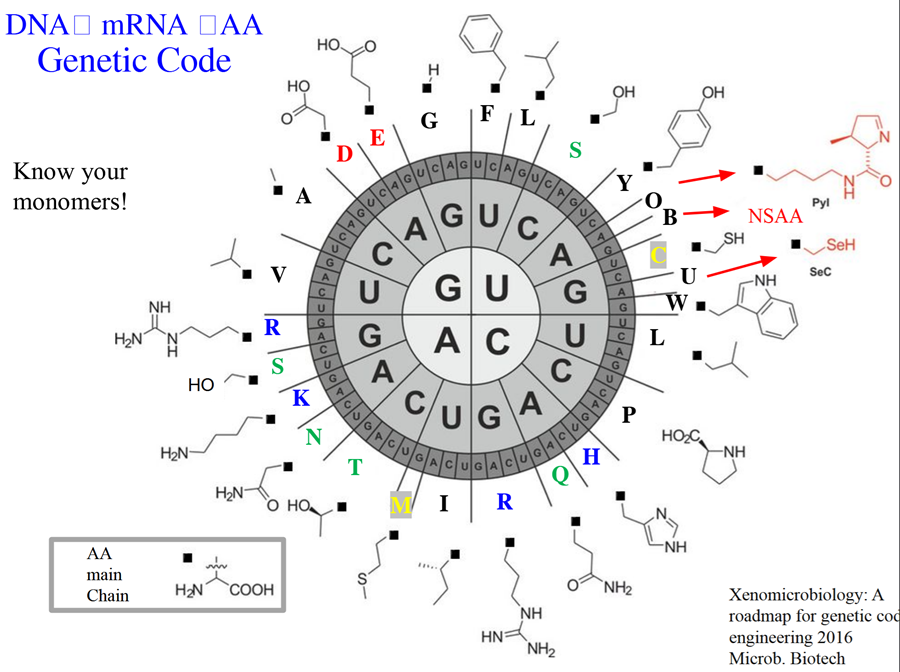
A1. The method that is still being used since the 80’s- phosphoramidite DNA synthesis cycle. It is a 4 step cycle and it is based on light based deprotection.
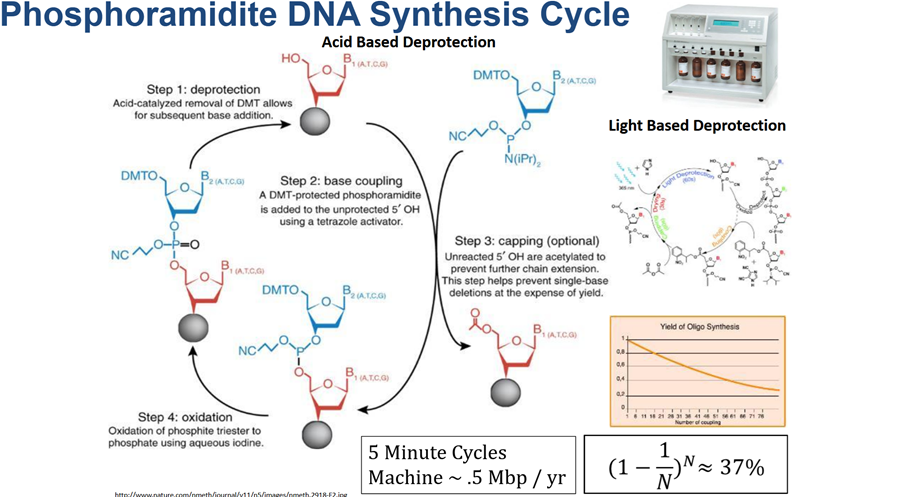
Q2. Why is it difficult to make oligos longer than 200nt via direct synthesis?
A2. If you look at the yield of the oligo sythesis on the graph on the image above you will notice that it is decreasing over time according to the number of coupling. More coupling more time passes the yield decreases and more errors are starting to accumulate. The longer the length of the oligonucleotide the more errors and discrepancies it will carry. Cumulative inneficiency, yield loss over time and increased errors.
Q3. Why can’t you make a 2000bp gene via direct oligo synthesis?
There are length constains in direct oligo synthesis, especially for one continuous strand and through this method we cannot create 2000bp genes. With direct oligosynthesis you can make up to 150 bases. As I mentioned above long chains have low yield, increased errors and will be incredibly hard to purify. Longer sequences >200 bp require different methods such as the Gibson assembly 2009.
Homework questions from Dr. George Church
Choose ONE of the following three questions to answer; and please cite AI prompts or paper citations used, if any. I chose question number 1 and used multiple sources from the internet and Prof. Church’s slide #4.
Q1. Using Google & Prof. Church’s slide #4, What are the 10 essential amino acids in all animals and how does this affect your view of the “Lysine Contingency”?
A1. The 10 essential amino acids in all animals are:
Arginine, Histidine, Isoleucine, Leucine, Lysine, Methionine, Phenylalanine, Threonine, Tryptophan, and Valine.
In addition, the Lysine Contintency Jurassic-pedia, is a foolproof fall-back plan in Jurassic Park in order to ensure that the animals never left the island. It is about Henry Wu in Jurassic park had to come up with a contingency plan in case the dinosaus decided to escape the island and made a genetic alteration in the dinosaur genome and switched off their ability to produce the aminoacid Lysine. As a result they could not produce their own Lysine inside their bodies and had to depend on a constant external supply of Lysine by humans and therefore to become dependent on humans, veterinarians etc. It is quite inhumane in my opinion.
The 10 essential aminoacids as named above affect my view of the Lysine contingency and makes me think what would happen to all animals including humans that depend on these essential amino acids to survive as the essential aminoacids have to be consumed through food intake and cannot produced by our own bodies. What if someone played with our food and gatekept these essential to life aminoacids to create a contingency plan? How would we as humans react? Our food is already genetically modified and empty in nutrients in some cases. Makes me wonder…