Week 1 HW: Principles and Practices
Class Assignment — DUE BY START OF FEB 10 LECTURE
- First, describe a biological engineering application or tool you want to develop and why
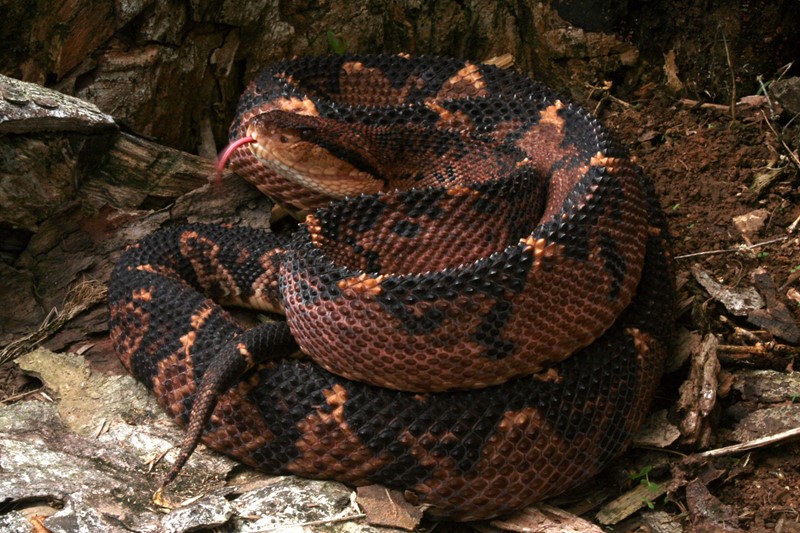
I want to create an antidote for the venom of the Lachesis acrochorda a South American snake, which is currently treated with antivenom serums. But I want to create one that is cheaper and more accessible. This would also help protect this snake species, which is endangered due to habitat loss and because it is potentially deadly to humans.
- Next, describe one or more governance/policy goals related to ensuring that this application or tool contributes to an “ethical” future, like ensuring non-malfeasance (preventing harm). Break big goals down into two or more specific sub-goals.
Goal 1: Biosafety in laboraotry.
Sub-goals: 1. Looking after the well-being of researchers. 2. Looking after the well-being of people who live near or are related to the laboratory
Goal 2: Protect snakes and their habitat.
Sub-goals: 1. Reduce the threat category of snakes. 2. Restore the snake’s habitat.
Goal 3: Protect and educate communities living near the snake habitats.
Sub-goals: 1. Make the snake no longer a potentially deadly threat to humans. 2. Help people stop seeing the snake as the enemy and understand the importance of protecting this species and its habitat.
- Next, describe at least three different potential governance “actions” by considering the four aspects below (Purpose, Design, Assumptions, Risks of Failure & “Success”).
Action 1. Demand stricter laboratory standards and protocols
Purpose: Standard norms and protocols exist, but they need to be updated to take into account new technologies.
Design: It is necessary to involve the government, laboratory technicians, and national and international health regulatory organizations. Such as: World Health Organization and Agencia Nacional de Regulación, Control y Vigilancia Sanitaria of Ecuador Assumptions: That all actors will cooperate efficiently
Risks of Failure & “Success”: By demanding overly strict regulations, very few people can comply with them, hindering research.
Action 2. Ban the killing of snakes and deforestation
Purpose: There are certain prohibitions, but the regulations need to be specified.
Design: The legislative and environmental sectors of the government must develop an action plan
Assumptions: That people accept change
Risks of Failure & “Success”: The snake is protected, but people are put in danger.
Action 3.Mass media communication about the importance of snakes in the ecosystem
Purpose: to change people’s perception of snakes so that they do not exterminate them.
Design: Communicating through television, the internet, and schools
Assumptions: That people are going to change the beliefs they’ve always had
Risks of Failure & “Success”: Failure to achieve effective communication
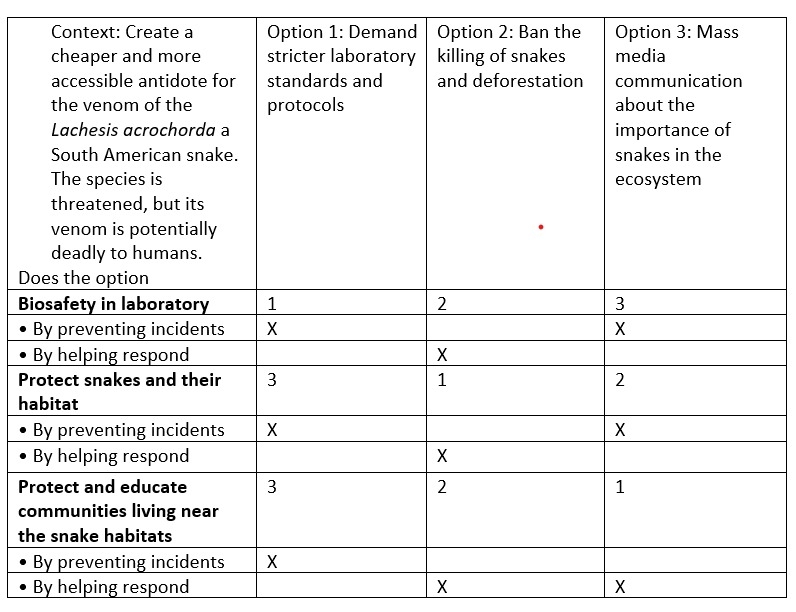
- Next, score (from 1-3 with, 1 as the best, or n/a) each of your governance actions against your rubric of policy goals. The following is one framework but feel free to make your own:
- Last, drawing upon this scoring, describe which governance option, or combination of options, you would prioritize, and why. Outline any trade-offs you considered as well as assumptions and uncertainties.
I would prioritize stricter laboratory standards and protocols for the safety of researchers, laboratory personnel, and the general public. If things don’t go well, the community should be compensated financially with long-term plans or other strategies should be explored. The laboratory, the government, and the Ministry of Health should develop control protocols. Communities living near snakes should be actively involved.
Reflecting on what you learned and did in class this week, outline any ethical concerns that arose, especially any that were new to you. Then propose any governance actions you think might be appropriate to address those issues. This should be included on your class page for this week.
I think people should be compensated if the plan fails and there is collateral damage. To ensure a fair process, legislation should be applied by the government. Protocols must be followed to assess the appropriate compensation based on the extent of the damage.
Assignment (Week 2 Lecture Prep) — DUE BY START OF FEB 10 LECTURE
Homework Questions from Professor Jacobson
- Nature’s machinery for copying DNA is called polymerase. What is the error rate of polymerase? How does this compare to the length of the human genome. How does biology deal with that discrepancy?
The eror rate of polymerase is 1 in 100000 nucleotides which is high considring the human genome has 3.2 billion nucleotide pairs. There are repair mechanisms that reduce the number of errors in DNA.
2.How many different ways are there to code (DNA nucleotide code) for an average human protein? In practice what are some of the reasons that all of these different codes don’t work to code for the protein of interest?
There are three ways in average for each one of the 20 proteins. The reasons for these different codes don’t work to code for the protein of interest is because simply replicating the same codons is not enough; it is difficult to implement the post-transcriptional machinery and other regulatory elements.
Homework Questions from Dr. LeProust:
- What’s the most commonly used method for oligo synthesis currently?
Phosphoramidite method
- Why is it difficult to make oligos longer than 200nt via direct synthesis?
Cumulative efficiency small errors that, when repeated, affect overall performance.
- Why can’t you make a 2000bp gene via direct oligo synthesis?
It’s not functional; many errors accumulate.
Homework Question from George Church:
Choose ONE of the following three questions to answer; and please cite AI prompts or paper citations used, if any.
Using Google & Prof. Church’s slide #4 What are the 10 essential amino acids in all animals and how does this affect your view of the “Lysine Contingency”?
The 10 essential amino acids for animals—Phenylalanine, Valine, Threonine, Tryptophan, Isoleucine, Methionine, Histidine, Arginine, Leucine, and Lysine—are those that cannot be synthesized endogenously and must be acquired through diet. When viewed through the lens of the “Lysine Contingency” from Jurassic Park, this biological reality reveals a major plot hole: since almost all vertebrates (including humans) are already naturally “lysine contingent,” the fail-safe was essentially meaningless. The genetic code wheel in the image shows that Lysine (K) is a standard, universal building block encoded by AAA and AAG; because it is fundamental to life, it is widely available in nature through plants and other animals. For a contingency to actually work, as suggested by the NSAA (Non-Standard Amino Acids) highlighted in red on the right of your image, scientists would have had to engineer the organisms to require a synthetic, lab-grown monomer like Pyrrolysine (Pyl) or a unique chemical derivative not found in the wild. This would ensure the “monomer” required for survival couldn’t be scavenged from the environment, unlike the common Lysine
Prompt:Using this image anwer this question: What are the 10 essential amino acids in all animals and how does this affect your view of the “Lysine Contingency”? Write in in a paragrapgh
Assignment (Your HTGAA Website) — DUE BY START OF FEB 10 LECTURE
- Begin personalizing your HTGAA website in in https://edit.htgaa.org/, starting with your homepage — fill in the template with information about yourself, or remove what’s there and make it your own. Be creative!
Done