Week 6: Genetic circuits part I
Part I. Assignment: DNA Assembly
Answer these questions about the protocol in this week’s lab: https://docs.google.com/document/d/e/2PACX-1vSqMqA8QkKJu9eOM310hXPj_28e5JKeDNEceKAWwG--3JV_9v510vQguSCiRqvxJVnQ2Gdx2btXpeDT/pub
- What are some components in the Phusion High-Fidelity PCR Master Mix and what is their purpose?
Using Copilot I got the following answere and did some editions: Phusion High‑Fidelity PCR Master Mix is a 2X ready‑to‑use mix designed to simplify PCR setup while providing extremely high fidelity. There are five componets for specific porpuses:
| Component | Purpose |
|---|---|
| Phusion DNA Polymerase | High‑fidelity, proofreading DNA synthesis |
| HF or GC Buffer | Optimizes reaction conditions; HF for fidelity, GC for difficult templates |
| MgCl₂ | Required cofactor for polymerase activity |
| dNTPs | Nucleotide building blocks for DNA amplification |
| DMSO (optional) | Enhances amplification of GC‑rich or structured templates |
- What are some factors that determine primer annealing temperature during PCR?
Primer Annealing Temperature: The primer melting temperature is the estimate of the DNA-DNA hybrid stability and critical in determining the annealing temperature. Too high Ta will produce insufficient primer-template hybridization resulting in low PCR product yield. Too low Ta may possibly lead to non-specific products caused by a high number of base pair mismatches,. Mismatch tolerance is found to have the strongest influence on PCR specificity. *This information was taken from:*https://www.premierbiosoft.com/tech_notes/PCR_Primer_Design.html
- There are two methods from this class that create linear fragments of DNA: PCR, and restriction enzyme digests. Compare and contrast these two methods, both in terms of protocol as well as when one may be preferable to use over the other.
Promp Copilot: In simple terms compare PCR and and restriction enzyme digests to créate linear fragments of DNA and explain when one may be preferable to use over the other and what are the protocol diferences. Copilot answere: PCR creates DNA fragments by copying a specific region using primers and a polymerase. Restriction digests cut DNA at specific short sequences using restriction enzymes. PCR is best when you want to amplify or create a fragment that doesn’t already exist as a clean piece. Restriction digestion is best when you want to cut an existing plasmid or DNA sample at precise known sites.
- How can you ensure that the DNA sequences that you have digested and PCR-ed will be appropriate for Gibson cloning?
Following the lab protocol here are some considerations to be taken when PCR is uded to amplify regions of DNA:
Length: 18–22 bp core binding region, plus overhang if needed. Tm Range: ~52–58 °C for optimal annealing; pairs should be within 5 °C. GC-clamp: Add G or C bases at the 3’ end of primers (GC clamp) to promote specific binding. More than 3 G’s or C’s should be avoided in the last 5 bases at the 3’ end of the primer. Secondary Structures: Avoid strong hairpins or dimers (check with software).
- How does the plasmid DNA enter the E. coli cells during transformation?
Following the lab protocol there are to main methods to be considered:
1.Heat shock: Generate pores in bacterial cell wall with an abrupt temperature change
2.Electroporation: Generate pores in bacterial cell wall with high electrical voltage
In either of these methods, we shock the cells (either by applying an electrical shock or heat shock) which causes the cell membrane to “open up”. The plasmid now enters the cells by diffusion. After the shock, the cells are fed with SOC growth media and incubated for 1 hour in 37C. That one hour incubation filled with nutrients allows the cells to recover and to start multiplying, some with the plasmid inside. Last, we plate the transformed cells onto a selective media plate, which contains antibiotics.
Only cells that had successfully received the plasmid will survive the antibiotics and grow. After 1-2 days, we should see the colors expressed by our inserted gene.
Describe another assembly method in detail (such as Golden Gate Assembly)
Explain the other method in 5 - 7 sentences..
Promp Copilot: Explain how the Golden gate assembly Works in an short way
Golden Gate assembly is a one‑pot DNA cloning method that uses Type IIS restriction enzymes (like BsaI or BsmBI) to cut outside their recognition site, creating custom overhangs that fit together like puzzle pieces.
🧬 Short, simple explanation
- Type IIS enzymes cut outside their recognition sequence, generating overhangs you design.
- Each DNA fragment is built with matching overhangs, so they assemble in a specific order.
- The reaction cycles between:
- 37°C → enzyme cuts and creates overhangs
- 16°C → ligase joins the fragments
- Because the recognition sites are removed during assembly, the enzyme cannot cut the final product again, making the reaction self‑correcting.
- The result is a seamless, scarless, correctly ordered DNA construct assembled from many parts in a single tube.
In short: Golden Gate lets you assemble multiple DNA fragments in a precise order in one reaction, without extra scars or leftover restriction sites.
…plus diagrams (either handmade or online).
Copilot:
    [Fragment A]        [Fragment B]        [Fragment C]
 ┌──────────────┐   ┌──────────────┐   ┌──────────────┐
 |  BsaI site    |   |  BsaI site    |   |  BsaI site    |
 |   + designed  |   |   + designed  |   |   + designed  |
 |   overhangs   |   |   overhangs   |   |   overhangs   |
 └──────┬────────┘   └──────┬────────┘   └──────┬────────┘
        |                    |                    |
        v                    v                    v
    BsaI cuts           BsaI cuts           BsaI cuts
(cuts outside site) (cuts outside site) (cuts outside site)
        ┌──────────────┐ ┌──────────────┐ ┌──────────────┐
        |   A overhang  | |   B overhang  | |   C overhang  |
        └──────┬────────┘ └──────┬────────┘ └──────┬────────┘
               |                 |                 |
               |  Matching       |  Matching       |
               |  overhangs      |  overhangs      |
               v                 v                 v

             DNA Ligase joins matching pieces
             (like puzzle pieces snapping together)

                     ┌──────────────────────────────┐
                     |   Final assembled product     |
                     |  A — B — C (correct order)    |
                     └──────────────────────────────┘
Important:
- The BsaI recognition sites are removed during assembly.
- Final product cannot be cut again → reaction becomes self‑correcting.
Assignment: Asimov Kernel
Kernel is a service provided by Asimov, wich is An integrated suite of cells, genes, and software to power advanced genetic design: https://www.asimov.com/ Asimov Kernel Integrated software for data-driven genetic design
Kernel connects Asimov’s models, bio-tools, and expertise into one interface for designing and optimizing genetic constructs—enabling scientists to independently design, optimize, and deploy high-performing expression systems: https://www.asimov.com/kernel
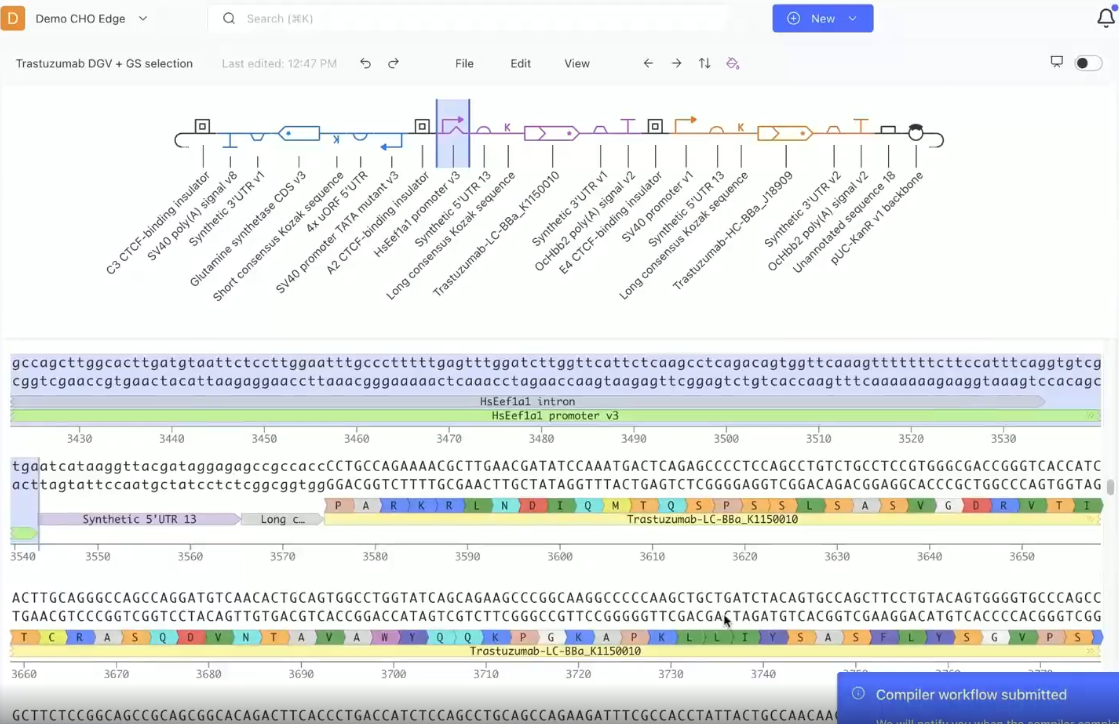
Create a Repository for your work Create a blank Notebook entry to document the homework and save it to that Repository Explore the devices in the Bacterial Demos Repo to understand how the parts work together by running the Simulator on various examples, following the instructions for the simulator found in the “Info” panel (click the “i” icon on the right to open the Info panel) Create a blank Construct and save it to your Repository
Recreate the Repressilator in that empty Construct by using parts from the Characterized Bacterial Parts repository
Search the parts using the Search function in the right menu
Drag and drop the parts into the Construct
Confirm it works as expected by running the Simulator (“play” button) and compare your results with the Repressilator Construct found in the Bacterial Demos repository
Document all of this work in your Notebook entry - you can copy the glyph image and the simulator graphs, and paste them into your Notebook
Build three of your own Constructs using the parts in the Characterized Bacterials Parts Repo
Explain in the Notebook Entry how you think each of the Constructs should function
Run the simulator and share your results in the Notebook Entry
If the results don’t match your expectations, speculate on why and see if you can adjust the simulator settings to get the expected outcome