Week 1 HW: Principles and Practices
- First, describe a biological engineering application or tool you want to develop and why.
I am working on the epidemiology and development of management practices of Aster Yellows Phytoplasma (AYP) in the Plant Molecular Virology Laboratory at University of Minnesota. AYP was first detected in garlic in Minnesota in 2012, with outbreaks recorded in 2017 and 2021, and spread to planting material in 2018 and 2022. In 2024, infestations were detected throughout Minnesota. However, there are no precise data on its incidence. AYP is an obligate type of bacteria that resides in the phloem and it is transmitted by leafhoppers. AYP is a concern for production, because there are not available effective treatments for this emergent pathogen in Minnesota’s garlic crops, and current diagnostic methods are time-consuming and costly. There is a need to develop biotechnological tools for the detection and management of this plant pathogen.
One of the objectives of my research is to develop a low-cost, field-deployable biosensing platform to detect AYP and growers can have access to this test. The idea is to create a platform free of lab equipment, user-friendly, rapid detection and programmable. The biosensor is a cell-free system that integrates a nucleic acid extraction step with minimal sample preparation, a pre-amplification step (multiplexed RPA reaction for internal control and AYP) to improve sensitivity and specificity and detection step by CRISPR Cas12a or Toehold switch technology. Lateral flow assay could be adapted to visualize the results inside of a microfluidic chip or another Point-of-care testing (POCT) device. The technology will be validated to detect AYP in other potential hosts in Minnesota like grapevines, pennycress and camelina.
- Next, describe one or more governance/policy goals related to ensuring that this application or tool contributes to an “ethical” future, like ensuring non-malfeasance (preventing harm). Break big goals down into two or more specific sub-goals. Below is one example framework (developed in the context of synthetic genomics) you can choose to use or adapt, or you can develop your own. The example was developed to consider policy goals of ensuring safety and security, alongside other goals, like promoting constructive uses, but you could propose other goals for example, those relating to equity or autonomy.
The development of field-deployable diagnostic devices has several ethical risk categories that I consider in the policy governance goals and subgoals to promote safety and security in this area.
Prevent economic loss from false results Describe performance thresholds such as limit of detection “LoD”, specificity and sensitivity that must be met before use in the field. Further validation with additional phytoplasma samples and off-target effects of unrelated species. Establish an internal extraction/amplification control lane in every test to differentiate correctly inhibited samples from negative samples. Confirm results using other detection methods such as qPCR to avoid crop destruction, spread of plant material such as cloves, and unnecessary quarantines. Determine contamination prevention practices such as workflow separation inside the device. Establish clear result categories like negative, positive and invalid.
Support equitable access and benefits Low-cost platform and user-friendly allow farmers, growers and research laboratories to use the platform. Training materials provided to growers and researchers. Inform and explain about results, findings and the technology to farmers. Participation in events, festivals and extension programs, field days to disseminate findings.
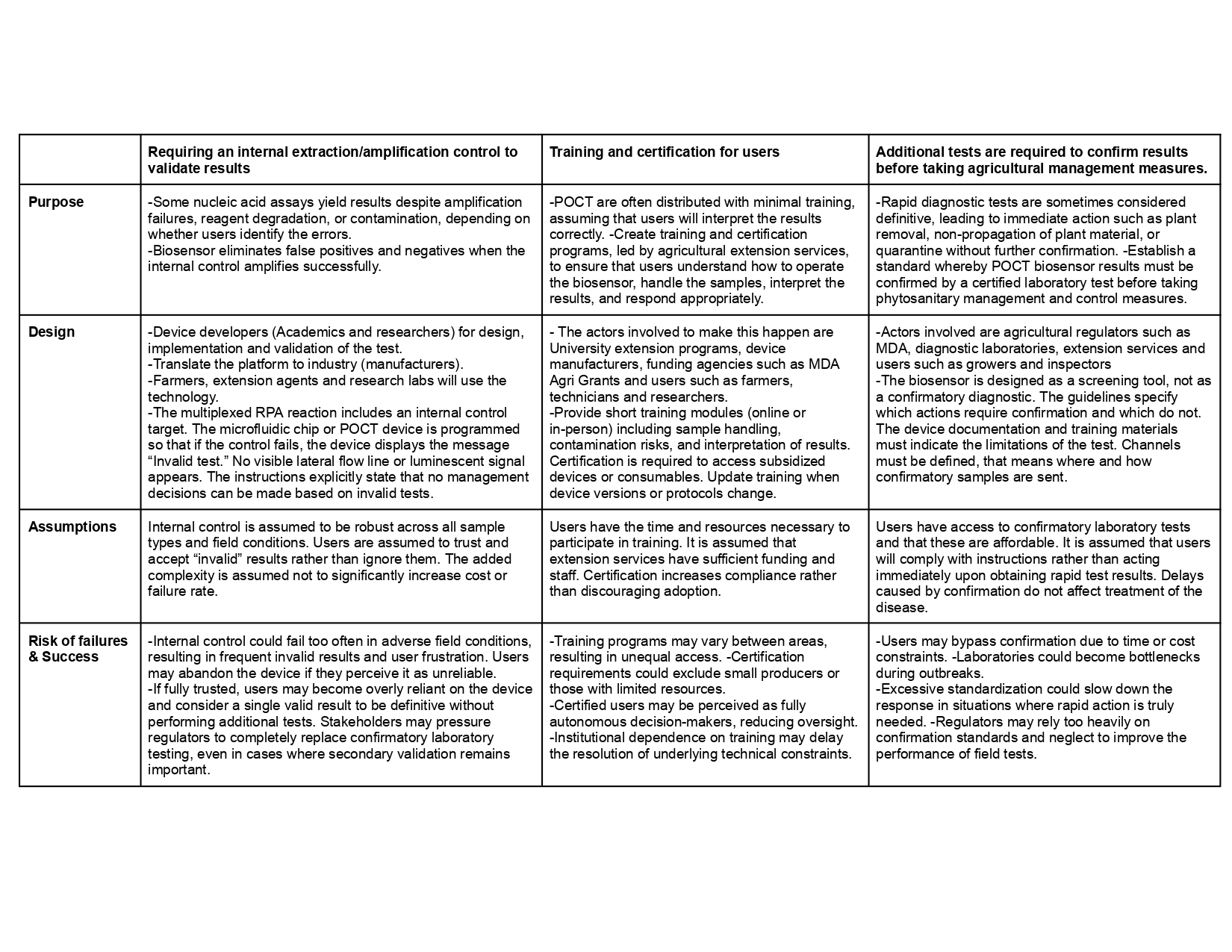
Next, describe at least three different potential governance “actions” by considering the four aspects below (Purpose, Design, Assumptions, Risks of Failure & “Success”). Try to outline a mix of actions (e.g. a new requirement/rule, incentive, or technical strategy) pursued by different “actors” (e.g. academic researchers, companies, federal regulators, law enforcement, etc). Draw upon your existing knowledge and a little additional digging, and feel free to use analogies to other domains (e.g. 3D printing, drones, financial systems, etc.). Purpose: What is done now and what changes are you proposing? Design: What is needed to make it “work”? (including the actor(s) involved - who must opt-in, fund, approve, or implement, etc) Assumptions: What could you have wrong (incorrect assumptions, uncertainties)? Risks of Failure & “Success”: How might this fail, including any unintended consequences of the “success” of your proposed actions?
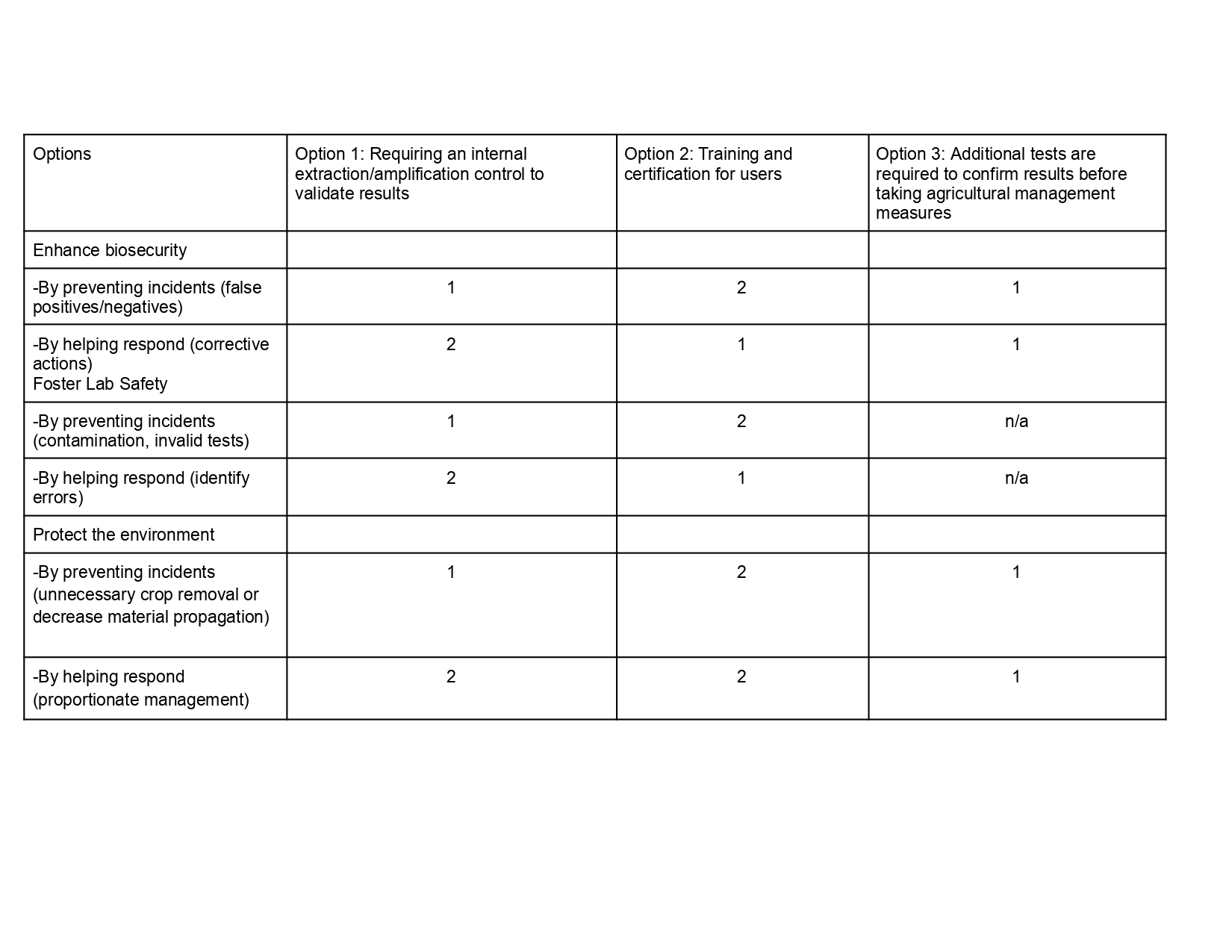
- Next, score (from 1-3 with, 1 as the best, or n/a) each of your governance actions against your rubric of policy goals. The following is one framework but feel free to make your own:
Governance Goal 1: Prevent economic loss from false results
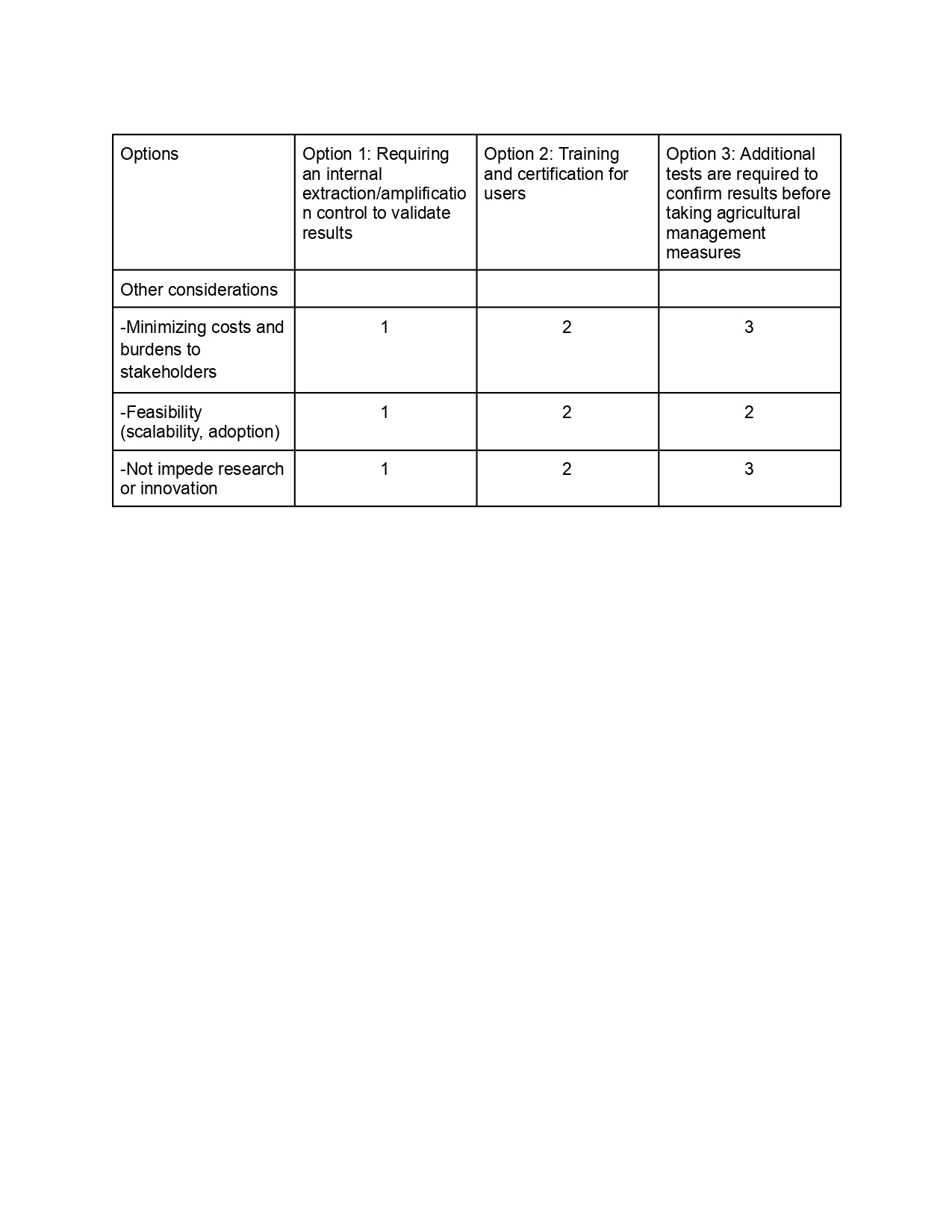
Governance Goal 2: Support equitable access and benefits
- Last, drawing upon this scoring, describe which governance option, or combination of options, you would prioritize, and why. Outline any trade-offs you considered as well as assumptions and uncertainties. For this, you can choose one or more relevant audiences for your recommendation, which could range from the very local (e.g. to MIT leadership or Cambridge Mayoral Office) to the national (e.g. to President Biden or the head of a Federal Agency) to the international (e.g. to the United Nations Office of the Secretary-General, or the leadership of a multinational firm or industry consortia). These could also be one of the “actor” groups in your matrix. Reflecting on what you learned and did in class this week, outline any ethical concerns that arose, especially any that were new to you. Then propose any governance actions you think might be appropriate to address those issues. This should be included on your class page for this week.
Based on the scoring analysis, the prioritized governance approach includes Option 1 with Option 3. The internal control supports the goal of preventing economic loss by reducing false negative results. Additional tests such as gold standard qPCR are required to validate results in uncertainty scenarios ensuring proper management practices. This prioritization involves balancing speed, cost, and confidence. Although confirmatory testing can cause delays and access difficulties, these are justified by the reduction of irreversible economic damage. The approach is based on the assumption that internal controls are robust in field conditions and that the infrastructure for confirmatory testing is accessible through agricultural agencies or extension services. There may be uncertainty in user behavior, particularly in terms of how people respond to invalid results or delays in procedures. A major ethical concern is the risk of dependence on POCT, where users may consider the results as definitive. To address this issue, it will implement measures such as clear communication of the limitations of the tests and feedback mechanisms to report unexpected results.
Slides Homework
- Nature’s machinery for copying DNA is called polymerase. What is the error rate of polymerase? How does this compare to the length of the human genome? How does biology deal with that discrepancy?
Error rate of a proofreading polymerase is around 1 in 10⁶ per base. Considering that the human genome is around 3.2 billion base pairs it will be around 3200 errors in every cell division. There are some different repair mechanisms post replication as MutS mechanism. This protein recognizes and binds regions that were not fixed during replication proofreading.
- How many different ways are there to code (DNA nucleotide code) for an average human protein? In practice what are some of the reasons that all of these different codes don’t work to code for the protein of interest?
As we know the genetic code is degenerate, which means one amino acid could be encoded by multiple codons. There are 61 sense codons that encode 20 aa, that means a ratio of 3. An average human protein of 500 aa could have around 3 to the power of 500. There are several reasons all of these different codes do not work to code for the protein. One is that organisms do not use synonymic codons equally, instead preferring some codons rather than others and that depends on tRNA abundance and other factors. mRNA secondary structure and GC content can produce hairpins which affect the availability of ribosomes to translate the protein of interest.
- What’s the most commonly used method for oligo synthesis currently?
Gold standard method is Phosphoramidite Chemistry.
- Why is it difficult to make oligos longer than 200nt via direct synthesis?
Coupling and capping can fail and produce short sequences which decrease the abundance of full-length molecules and makes it difficult to purify. The larger the oligonucleotide, the more errors accumulate and the lower the percentage of correct oligo size.
- Why can’t you make a 2000bp gene via direct oligo synthesis?
For the same reasons of question 2, you will have a lot of truncated molecules with a lot of error accumulations which make it impossible to synthesize a gene.
Choose ONE of the following three questions to answer; and please cite AI prompts or paper citations used, if any. [Using Google & Prof. Church’s slide #4] What are the 10 essential amino acids in all animals and how does this affect your view of the “Lysine Contingency”?
The essential amino acids are methionine, valine, tryptophan, threonine, lysine, histidine, leucine, arginine, isoleucine, and phenylalanine. Lysine contingency is a term introduced in Jurassic Park to control dinosaurs and states that dinosaurs can survive only if they are supplemented with diets rich in lysine. However, this strategy is unrealistic because dinosaurs that escape could survive by eating other sources of lysine, such as plants and animals.
[Given slides #2 & 4 (AA:NA and NA:NA codes)] What code would you suggest for AA:AA interactions? [(Advanced students)] Given the one paragraph abstracts for these real 2026 grant programs sketch a response to one of them or devise one of your own: