Week 7 HW — Genetic Circuits Part 2
Intracellular Artificial Neural Networks (IANNs)
1. Advantages of IANNs over Boolean Genetic Circuits
Traditional genetic circuits operate based on Boolean logic, where outputs are typically binary (ON/OFF). While this approach is useful for simple decision-making, it is limited in representing complex and graded biological behaviors.
Intracellular Artificial Neural Networks (IANNs), on the other hand, offer several advantages:
Analog computation
Instead of binary outputs, IANNs can produce continuous responses, allowing finer control of gene expression.Multi-input integration
IANNs can process multiple inputs simultaneously and weigh their relative contributions, similar to neural networks.Non-linear behavior
They enable more complex decision-making beyond simple logic gates.Adaptability and tunability
System behavior can be adjusted by modifying promoter strengths, RNA interactions, or enzyme activity levels.
In this sense, IANNs transform genetic circuits from rigid logic systems into dynamic, responsive networks.
2. Application Proposal — Bio-Responsive Environment Interface
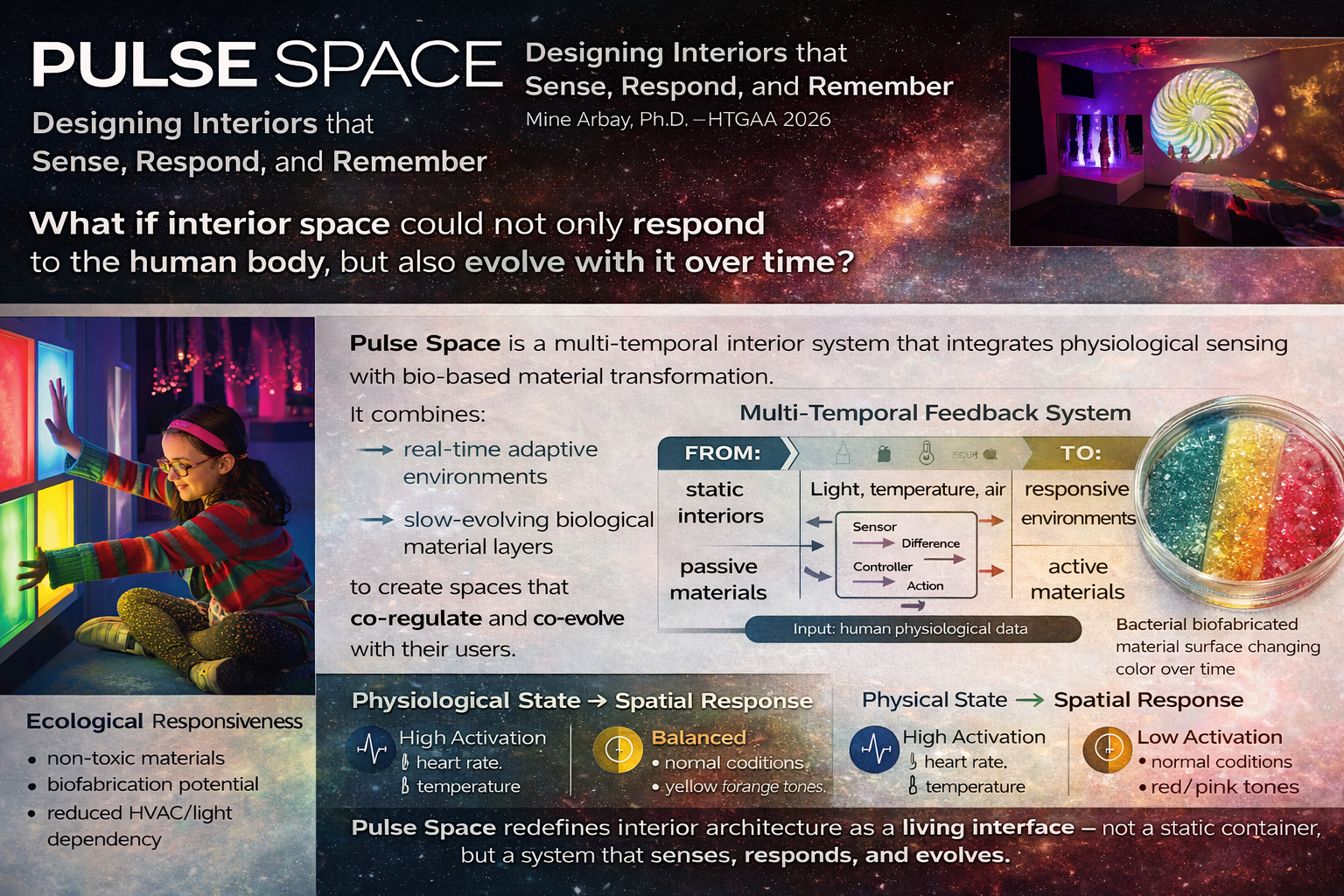
For this assignment, I propose an application inspired by my research project Pulse Space, which explores environments that respond to human physiological signals.
Concept
An intracellular neural network embedded within a biological or bio-hybrid material could act as a signal interpreter, converting multiple physiological inputs into a graded visual output.
Inputs (X₁, X₂, X₃)
- X₁: temperature-related signal
- X₂: biochemical stress marker (e.g., pH or metabolite level)
- X₃: light or environmental stimulus
These inputs are encoded as DNA constructs that produce regulatory molecules (such as endoribonucleases or transcription factors).
Processing
The IANN integrates these signals through weighted interactions, where:
- some inputs amplify expression
- others suppress it
- interactions are non-linear
Output
- Fluorescent protein expression (color intensity or shift)
- This could represent a real-time visualization of physiological state
Interpretation
Instead of a simple ON/OFF signal, the system produces a continuous output, reflecting the combined influence of multiple inputs.
This allows the biological system to behave more like a sensorial interface, rather than a switch.
Limitations
Despite their potential, IANNs face several challenges:
Noise in biological systems
Gene expression is inherently stochastic.Limited scalability
Increasing network depth adds complexity and unpredictability.Crosstalk between components
Biological parts may interfere with each other.Slow response time
Compared to electronic systems, transcription/translation processes are slower.
Design Reflection
From a design perspective, IANNs represent a shift from discrete control toward continuous, adaptive systems.
Rather than defining fixed outcomes, the system interprets multiple signals and produces a behavior that emerges from their interaction.
This aligns closely with spatial and material design approaches, where environments are not static, but responsive, layered, and context-dependent.
Intracellular Multilayer Perceptron
Input Layer
Layer 1
(Csy4)
Layer 2
(Output)
Layer 1 produces regulatory molecules (endoribonucleases) that control translation of the output gene in Layer 2.
Intracellular Artificial Neural Networks (IANNs) suggest a radically different way of thinking about materials and environments.
Instead of designing spaces as static structures, this approach opens the possibility of creating living or semi-living systems that can sense, interpret, and respond to multiple inputs in real time.
In traditional architecture, control systems are often external and binary — lights turn on or off, temperature is increased or decreased. In contrast, IANN-based systems enable continuous and adaptive behavior, where responses are not predefined but emerge from the interaction of multiple signals.
This has significant implications for future architecture:
- Materials could act as distributed sensing networks, rather than passive surfaces
- Spaces could respond to human physiology (temperature, stress, movement) in graded and dynamic ways
- Environmental systems could shift from centralized control to localized, responsive intelligence
From this perspective, architecture becomes less about fixed form and more about behavior over time.
For my project Pulse Space, this is particularly relevant. IANNs provide a conceptual and technical model for how environments might not only react, but interpret complex human states and translate them into spatial or visual feedback.
In this sense, intracellular neural networks are not just a biological innovation — they are a design paradigm, pointing toward a future where architecture is responsive, adaptive, and deeply integrated with living systems.
Fungal Materials
1. Existing Fungal Materials
Fungal materials are typically derived from mycelium, the root-like network of fungi. Mycelium can grow by binding organic substrates such as agricultural waste into cohesive structures, forming lightweight and biodegradable materials.
Some existing applications include:
Packaging materials
Companies like :contentReference[oaicite:0]{index=0} produce mycelium-based packaging as an alternative to polystyrene foam.
Building materials
Mycelium has been used to create bricks, panels, and insulation elements in experimental architecture projects.
Textiles and leather alternatives
Brands such as :contentReference[oaicite:1]{index=1} and :contentReference[oaicite:2]{index=2} develop fungal-based leather-like materials.
Advantages
- Biodegradable and compostable
- Low energy production compared to synthetic materials
- Grown rather than manufactured
- Can utilize waste substrates (e.g., agricultural byproducts)
Disadvantages
- Mechanical limitations compared to traditional materials
- Sensitivity to moisture and environmental conditions
- Limited durability for long-term structural applications
- Variability due to biological growth conditions
2. Genetic Engineering of Fungi
Beyond passive materials, fungi can be engineered to become active and responsive systems.
Proposed Direction
I would explore engineering fungi to:
- Produce color-changing pigments in response to environmental or physiological signals
- Modify their growth patterns based on stimuli (temperature, humidity, biochemical signals)
- Express proteins that allow dynamic material behavior, such as stiffness change or light emission
This aligns closely with my research interest in bio-responsive environments.
Why Fungi?
Fungi offer several advantages over bacteria in synthetic biology applications:
Structural scale
Fungi naturally form macroscopic structures, making them suitable for material and spatial applications.
Material integration
Unlike bacteria, fungi can directly become the material itself, not just a producer of molecules.
Mechanical properties
Mycelium networks create fibrous, interconnected structures, which can provide mechanical integrity.
Spatial growth
Fungal growth is inherently three-dimensional and adaptive, making it relevant for architectural applications.
Limitations
- Genetic manipulation in fungi is often slower and more complex than in bacteria
- Growth cycles are longer
- Less standardized toolkits compared to bacterial systems
Design Reflection
Fungal materials represent a shift from designing objects → designing growth processes.
Instead of shaping inert matter, we begin to define:
- growth conditions
- environmental inputs
- and biological behavior
This transforms material design into a form of co-design with living systems.
For my project Pulse Space, fungi offer a compelling medium where structure, color, and responsiveness could be integrated into a single living material system. Fungal materials suggest a future where architecture is not assembled, but grown.
Fungal Materials and Pigment-Based Systems
This topic strongly connects to my ongoing research on bio-based pigment production from organic waste, particularly using substrates such as coffee waste.
While my previous experiments focused on bacterial pigment production, working with fungi opens up a different scale and possibility: instead of extracting pigments from microorganisms, the material itself could become both the structure and the color system.
In this context, mycelium-based materials could be engineered to:
- produce pigments during growth
- respond to environmental conditions by shifting color
- embed color directly into the material rather than applying it as a surface layer
This suggests a transition from color as a coating → color as a living process.
From a design perspective, this is highly compelling. It allows the creation of surfaces that are not only biodegradable and grown, but also visually responsive and temporally dynamic.
For Pulse Space, this opens up the possibility of environments where material, color, and sensing are no longer separate systems, but integrated into a single living substrate that evolves over time. Color is no longer applied to the surface — it emerges from within the material itself.
Final Project Title: Pulse Space:Designing Ecological and Physiological Responsiveness in Interior Space
Pulse Space is an eco-responsive interior system that integrates sustainable bio-based materials with real-time physiological sensing to create environments that adapt to their users. The system provides immediate spatial feedback through lighting and microclimate adjustments, while incorporating biofabricated or living material layers that evolve slowly over time. By combining fast computational responses with long-term material transformation, it redefines interior space as a dynamic and co-regulating environment rather than a static design. The first aim of my final project is to develop a conceptual and prototype-level system that collects human physiological data (such as heart rate and skin temperature) and translates it into immediate spatial responses within an interior environment. While similar biofeedback systems already exist, they remain primarily computational and temporary. This project extends these approaches by introducing a secondary layer of bio-based material systems—such as bacterial cellulose or pigment-infused biocomposites—that evolve over longer timescales. By combining fast computational feedback with slow material transformation, the project proposes a shift from passive environmental reaction to intentional, human-informed material evolution, enabling interior space to become a cumulative and adaptive system.
https://benchling.com/s/seq-HvPSJOGRRsfce8poHTfp?m=slm-fZ9SJ9R1fzPv5Au5TOpu