Week 12 HW — bioproduction
Pulse Space — Research Evolution & System Formation
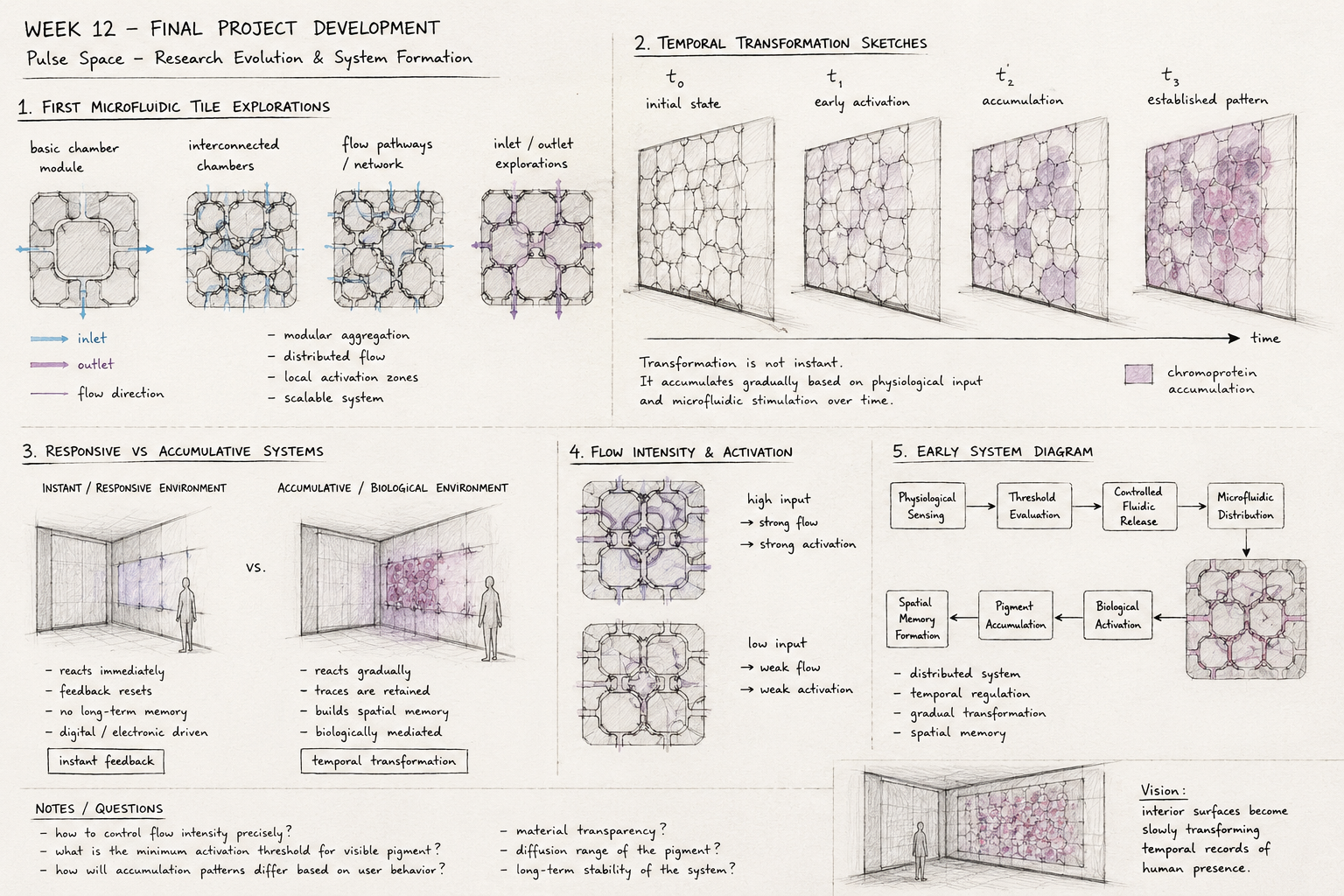
Final Project Development
This week focused on transforming Pulse Space from a speculative responsive environment concept into a more structured biological-material system.
Rather than designing a conventional smart interior, the project began investigating how biological systems might operate as slow temporal infrastructures capable of accumulating physiological traces over time.
The research shifted from immediate reaction toward questions of:
- temporal regulation
- distributed biological transformation
- spatial accumulation
- microfluidic control
- biologically mediated material behavior
The goal became not simply to create responsive feedback, but to investigate whether interior surfaces could gradually transform through controlled biological processes.
From Responsive Interiors to Biological Temporal Systems
Initial Direction
The project initially explored responsive environments that adapt instantly through lighting, HVAC systems, and digital feedback mechanisms.
However, these systems generally reset after each interaction and rarely preserve long-term traces of human presence.
Shift in Research Question
The project gradually shifted toward investigating whether interiors could accumulate biological traces over time rather than only reacting momentarily.
This introduced a new design question:
Could interior materials behave as slow spatial memory systems rather than instantaneous interfaces?
Emerging System Logic
To address this, the project began integrating:
- physiological sensing
- threshold-based data evaluation
- microfluidic distribution systems
- biological activation mechanisms
- gradual chromoprotein accumulation
This transition reframed the project from “responsive architecture” toward biologically regulated material transformation.
Microfluidics as a Translation Layer
Why Microfluidics?
One of the key developments this week was identifying microfluidics as the missing translation layer between physiological data and biological transformation.
Rather than directly controlling color output, the system investigates how physiological conditions could regulate fluid distribution intensity across a sealed biological network.
Microfluidics became important because it allows:
- controlled spatial distribution
- temporal modulation
- localized activation
- scalable network behavior
- delayed transformation patterns
The project therefore began treating the microfluidic layer not as a simple transport system, but as a temporal regulation infrastructure.