Week 7 HW: Genetic Circuit Part 2
Advantages of IANNs over Boolean genetic circuits
Traditional genetic circuits (AND/OR/NOT) are great when the world can be cleanly thresholded into ON/OFF inputs and you only need discrete outputs. IANNs (genetic implementations of artificial neural networks) are useful when biology is messy—inputs are continuous, noisy, and correlated
Analog, not just digital
IANNs naturally support graded responses (continuous input → continuous output), not only Boolean truth tables. That lets you encode “how much” and “how confident,” not just “yes/no.”Multi-input pattern classification
Boolean circuits scale poorly as you add inputs (truth tables explode). IANNs can combine many weak signals into a robust classification—closer to how real cells integrate signals.Tolerance to noise and variability
Neural-style weighted sums + thresholds can be more forgiving than logic gates when promoter strengths drift, copy number varies, or environments fluctuate.Decision boundaries beyond simple logic
Boolean circuits implement crisp logic partitions. IANNs can implement complex nonlinear decision boundaries (e.g., “positive if this cocktail of biomarkers matches a pattern”), which is often what you want in diagnostics or environmental sensing.Compact representations for complex behaviors
For some tasks, an IANN can represent a complex mapping with fewer distinct regulatory parts than an equivalent explicit logic circuit that enumerates all cases.Potential for tunability/adaptability
In principle, weights (interaction strengths) can be tuned to adjust behavior without redesigning the whole circuit (though “learning in vivo” is still a hard frontier; most are trained/tuned ex vivo and then built).
A useful application: a living classifier for inflammatory disease states (multi-biomarker diagnostic)
Goal
Engineer a probiotic E. coli (or a gut commensal chassis) that detects an IBD-like inflammatory state in the gut and produces an output only when the overall biomarker pattern matches “inflammation,” not when any single marker spikes.
Inputs (example set)
Let the cell sense 5 gut-associated signals (each continuous, noisy, and not individually decisive):
x1: nitrate / reactive nitrogen species proxy (inflammation-associated)
x2: thiosulfate/tetrathionate proxy (inflammation-associated sulfur metabolism)
x3: pH shift signal
x4: oxygen tension proxy (higher oxygen near inflamed mucosa)
x5: a host-derived inflammatory metabolite (or a quorum/metabolite proxy correlated with dysbiosis)
Each sensor produces a graded transcriptional signal proportional to concentration (not a binary “present/absent”).
Key point: the IANN outputs high only when the pattern matches, not when one input is high. That reduces false positives compared with an OR gate.
Why an IANN is better than Boolean here
A Boolean circuit would require you to pre-decide exact logic, but real biology doesn’t cleanly separate signals into ON/OFF. The IANN can implement a soft decision. i.e. multiple moderate signals can sum to a confident positive, and one spurious spike may not be enough.
Limitations an IANN might face (practical constraints)
Parts burden and cellular load
More regulators, promoters, and wiring increases metabolic burden, slows growth, and can destabilize behavior.Context dependence and drift
Promoter strength changes with growth phase, media, host environment, plasmid copy number, and mutations—effectively changing “weights” over time.Noise and signal coupling
Sensors can cross-react; hidden nodes may inadvertently respond to unrelated metabolites, shifting the decision boundary.Training/tuning is nontrivial
Unlike silicon, you can’t easily backprop in cells. Most designs require careful calibration of transfer functions and iterative build-test cycles.Dynamic timescales
Many biological responses are slow (minutes–hours). If the goal needs fast decisions, performance may be limited.Scaling limits (orthogonality bottleneck)
Large IANNs need many orthogonal regulators/sensors that don’t interfere—still a major constraint in genetic engineering.Safety and containment (for therapeutic outputs)
If the output is a drug/effector, you need fail-safes (kill switches, dependency circuits, containment). These add complexity and can interact with the IANN.
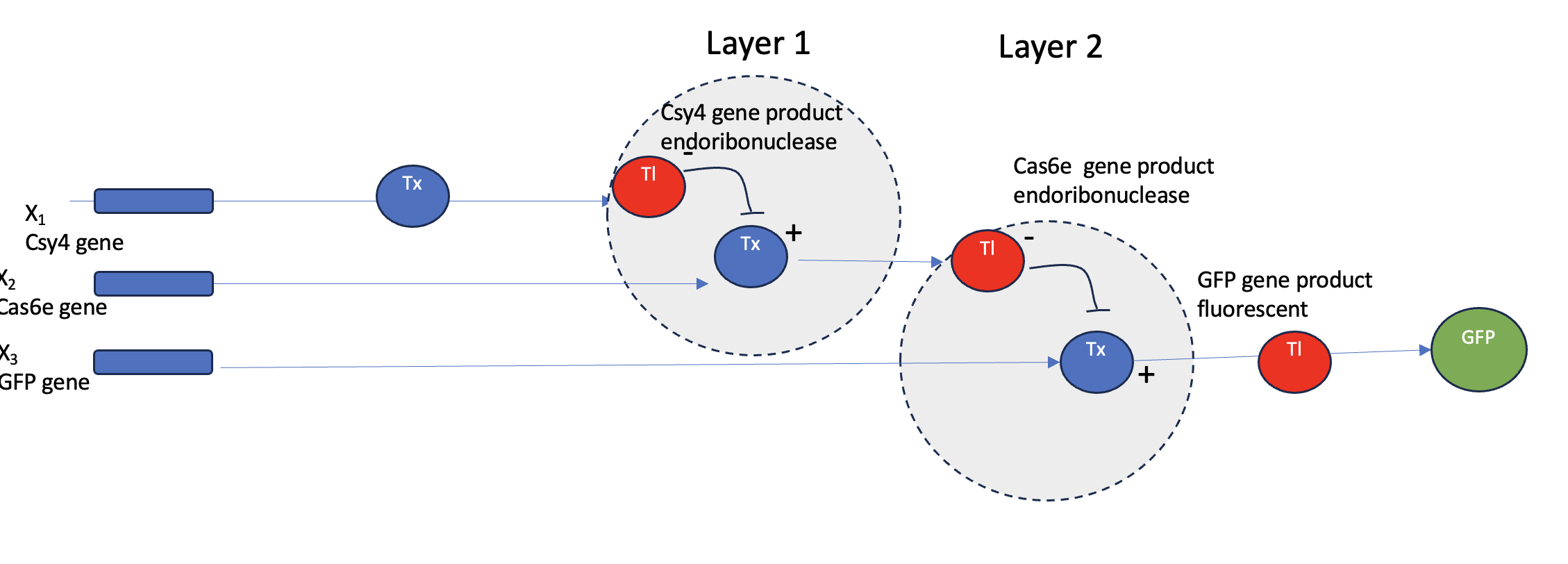
Multilayer Perceptron
Fungal Materials and Synthetic Biology
Fungal materials like mycelium composites, mushroom-based leather, packaging, and insulation are increasingly used as sustainable alternatives to traditional materials. Mycelium composites serve as building insulation, bricks, packaging that replaces Styrofoam, and leather alternatives for fashion, all produced in just 7 days using agricultural waste like straw. These materials offer significant advantages: they are biodegradable, compostable, store CO₂, require minimal energy, are fire-resistant (burning cleanly to water and CO₂), and are ethical animal-free alternatives. However, they have notable disadvantages including lower structural strength (30 psi vs. 4000 psi for concrete), making them unsuitable for load-bearing structures, sensitivity to moisture and deformation in rain, degradation over time that limits long-distance shipping, and still-high costs at small scales requiring standardization for industry adoption.
Genetic engineering of fungi focuses on enhancing their capabilities as cell factories and material producers. Key goals include improving production of bioactive compounds like artemisinin, insulin, vitamins, and astaxanthin; tailoring mycelium materials with specific structural properties like higher compressive strength and moisture resistance; enhancing waste degradation enzymes for biofuel and bioremediation; implementing synthetic transcriptional regulation for programmable gene networks; and engineering novel metabolic pathways for high-value chemicals difficult to synthesize chemically. These engineering efforts leverage fungi’s natural ability to produce complex secondary metabolites and their established industrial use for enzymes and organic acids.
Synthetic biology in fungi offers distinct advantages over bacteria, particularly because fungi are eukaryotes with organelles enabling proper post-translational modifications like glycosylation and protein folding, which bacteria cannot perform adequately. Fungi excel at efficiently secreting proteins (ideal for industrial enzymes), naturally produce complex secondary metabolites like antibiotics, and have industrial track records for producing vitamins and organic acids. Filamentous fungi uniquely form mycelium networks for material applications that bacteria cannot replicate, and they are more robust to industrial stress conditions. While bacteria offer faster growth and simpler genetic manipulation, fungi are superior for eukaryotic protein production, complex natural products, and bio-based materials, making them ideal for cell factory applications and material science applications aligned with synthetic biology advances.