Week 11 HW: Bioproduction and Cloudlabs
Part A: The 1,536 Pixel Artwork Canvas | Collective Artwork
Make a note on your HTGAA webpages including:
- what you contributed to the community bioart project
I change 3 pixels during the lecture, I wish I got a screen shot!
- what you liked about the project, and
I like the real-time collaboration on something artistic
what about this collaborative art experiment could be made better for next year.
It could be introduced at the beginning when we do gel art
Part B: Cell-Free Protein Synthesis | Cell-Free Reagents
The lysate makes the whole process work: it contains the ribosomes and all the enzymes that do transcription and translation outside the cell. Using BL21 (DE3) Star matters because it’s built for high expression and mRNA stability, and it already brings T7 RNA polymerase so T7 templates get transcribed strongly and consistently.
The salts and buffers are there to recreate the intracellular conditions the machinery expects. Potassium glutamate sets the main ionic environment, HEPES-KOH keeps pH steady around 7.5, magnesium glutamate supplies Mg²⁺ which ribosomes absolutely depend on, and the monobasic/dibasic phosphate pair strengthens buffering and supports longer reactions.
The energy/nucleotide system is what keeps the reaction alive for hours rather than minutes. Ribose and glucose feed the extract’s metabolism so ATP and GTP can keep being regenerated, while AMP/CMP/GMP/UMP and guanine act as nucleotide building blocks that the lysate can recycle back into usable NTPs for transcription and energy use.
The amino acids are simply the raw materials for protein. The 17-amino-acid mix covers most of what translation needs, while tyrosine (kept soluble at high pH) and cysteine (often unstable/limiting) are supplied separately so they don’t become the bottleneck.
Nicotinamide supports cofactor/redox balance (it necessary to keep the extract’s metabolism steady so it can keep regenerating energy and running properly).
Nuclease-free water is important for the environment of the reactions: it sets final concentrations without introducing DNases/RNases that would otherwise finish off the templates.
Describe the main differences between the 1-hour optimized PEP-NTP master mix and the 20-hour NMP-Ribose-Glucose master mix shown in the Google Slide above. (2-3 sentences)
The 1-hour PEP–NTP mix is built for fast transcription and translation The NTPs are ready-to-use NTPs and there is a high-power energy donor (PEP-based). There are other additives such a spermidine and cAMP that boost short-run performance. The 20-hour NMP–ribose–glucose mix is masde for slower steadier transcription and translation. Instead of adding NTPs directly, it feeds the lysate basic precursors (NMPs + ribose + glucose + guanine) so the extract’s enzymes can regenerate nucleotide triphosphates and energy over time, using fewer “boost” additives. A different buffer/ionic balance helps to stay stable for long incubations.
- Bonus question: How can transcription occur if GMP is not included but Guanine is? Since there are precursors in the lysate, guanine can be used by such enzymes and components to make GMP, which can undergo phosphorylation to become GDP and GTP as needed.
Part C: Planning the Global Experiment | Cell-Free Master Mix Design
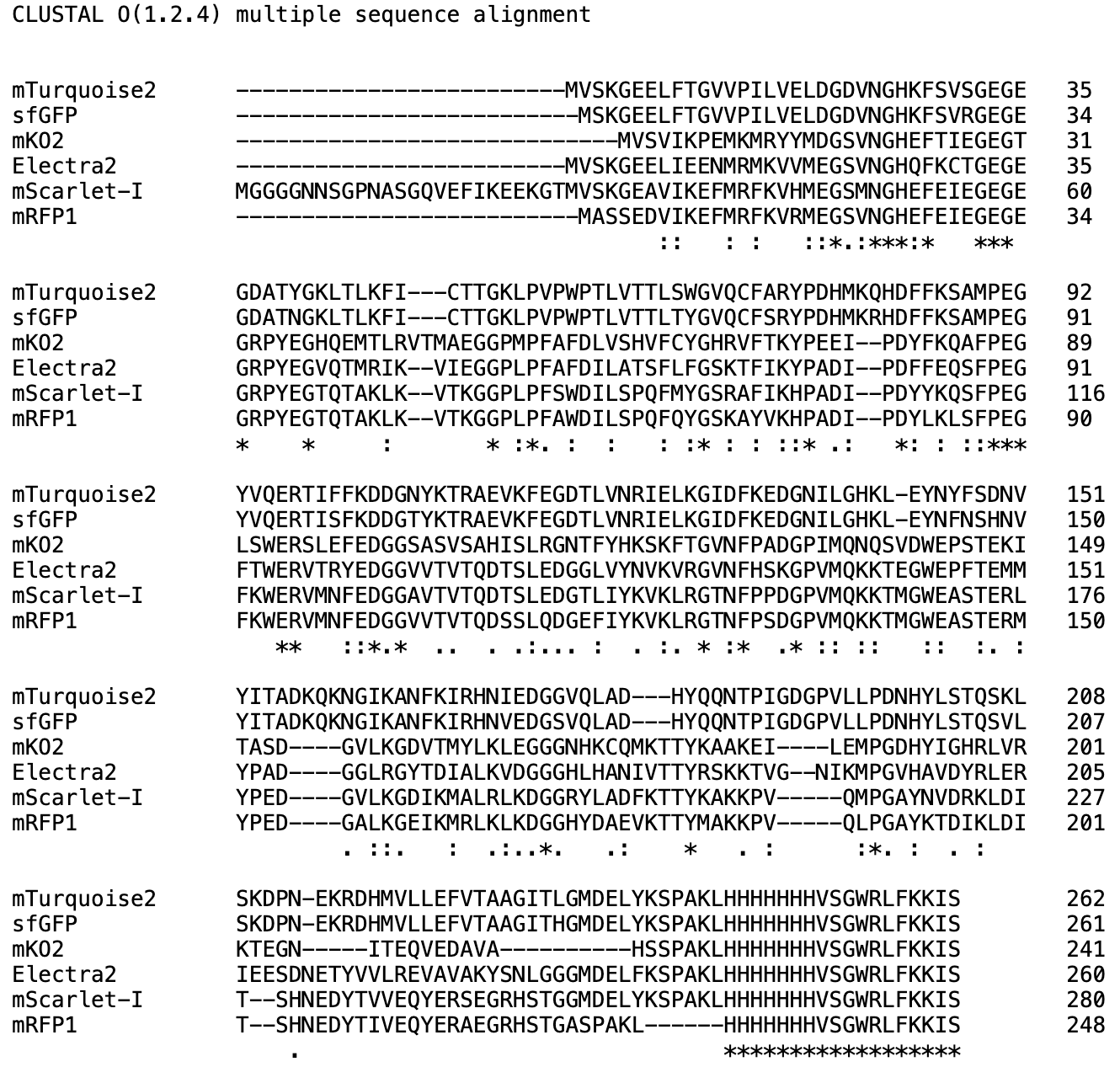
The proteins share the same beta-barrel core so the baseline constraints are shared
All six sequences have long conserved blocks and similar length through the core. That basically implies “same fold”: the classic fluorescent protein beta-barrel with the chromophore buried inside.
Practical implication in cell-free: they all depend on the same broad requirements — decent folding conditions, enough time to fold/mature, and oxygen to finish the chromophore chemistry.The biggest functional divergence is at the chromophore-forming motif. The early region in the alignment shows where the proteins diverge sharply:
sfGFP / mTurquoise2 are extremely close to each other and keep the classic GFP lineage context.
mKO2, Electra2, mScarlet-I, mRFP1 share a different conserved backbone which is consistent with the DsRed derived families.
sfGFP
sfGFP folds efficiently and matures relatively fast, hence the name super folding GFP. Like all GFP-like proteins it still needs oxygen for chromophore maturation, so low oxygen can delay or limit fluorescence.mRFP1
mRFP1 matures more slowly than many modern reds fluorescent proteins, so the readout can lag behind actual expression in short reactions. It’s also generally dimmer than newer red variants, so it can look as thought the yeild is low even when protein is present.mKO2
mKO2 is a bright orange protein with fairly quick maturation, which is good for cell-free systems. Its fluorescence can be pH-sensitive can suffer from photobleaching under strong light.mTurquoise2
mTurquoise2 is a bright cyan FP with strong signal, but cyan proteins can be more sensitive to photobleaching and background. If there isn’t enough oxygen, it may not express to the optimal degree.mScarlet_I
mScarlet-I is engineered to be a true monomer with fast maturation and high brightness, which usually makes it one of the most reliable reds in cell-free. The main constraint is still oxygen dependence for chromophore formation, so sealed/low-oxygen conditions can reduce signal.Electra2
Electra2 is photoswitchable, so the readout depends strongly on the illumination.
- Create a hypothesis for how adjusting one or more reagents in the cell-free mastermix could improve a specific biophysical or functional property you identified above, in order to maximise fluorescence over a 36-hour incubation. Clearly state the protein, the reagent(s), and the expected effect.
Protein: mRFP1
Biophysical property to improve: slow maturation (and therefore a delayed/underreported red signal)
Reagent to adjust: increase the experimantal duration by strengthening the ribose-glucose-NMP energy regeneration module, and increase nicotinamide so more cofactor is able to support the duration.
Expected effect: keeping nucleotide pools and ATP/GTP regeneration stable for longer should maintain transcription/translation pressure over many hours, while improved cofactor/redox support should reduce premature stalling and give the mRFP1 chromophore more time and capacity to mature, producing a higher final red fluorescence at 36 hours.