Week 1 HW: Principles and Practices

First, describe a biological engineering application or tool you want to develop and why. This could be inspired by an idea for your HTGAA class project and/or something for which you are already doing in your research, or something you are just curious about.
As a biodesign practitioner, I have been exploring how living systems respond to environmental stimuli. I set up multiple mycelium cultures and exposed them to variable conditions to observe how these factors influence growth, including experiments where different frequencies appeared to affect growth rates. Watching how responsive and adaptive these organisms are, made me curious about a deeper question: how do living networks process information, and what might it mean to engineer those capabilities? This has drawn me towards the intersection of bio-computation, synthetic biology, and material science.
My earlier work showed that external cues such as vibration and sound frequency can shift mycelial growth and morphology, as demonstrated in recent research on acoustic stimulation enhancing fungal development (Robinson et al., 2024). This led me to wonder whether living networks could be guided to do more than simply grow. While reading further about unconventional computing and biohybrid systems, I learned how physical and biological materials can act as information-processing substrates beyond traditional silicon architectures (Adamatzky, 2016).
Mycelium naturally produces electrical spikes as part of its internal activity, and these patterns shift in response to environmental changes (Adamatzky et al., 2018). I am interested in what might happen if we work directly with this electrical language. Could applying controlled AC or DC signals at different frequencies influence both its signalling patterns and its growth behaviour? I would like to explore whether these responses could be used to build very simple living logic systems; probably, a small mat of living mycelium connected to electrodes, where electrical inputs shape activity and the resulting voltage spikes are read as outputs. This could open up possibilities for biohybrid sensing or unconventional computing, while also helping us understand living networks as adaptive, information-processing systems.
I know this is ambitious and technically beyond where I am right now, but I’m excited to begin with a proof-of-concept and develop the work through experimentation and learning. I’m particularly looking forward to exploring this during HTGAA, especially with its focus on neuromorphic and genetic circuits and unconventional computing.
Key concepts: mycelium programming, AC/DC frequency response, living logic gates, biohybrid electronics, environmental sensing.
Next, describe one or more governance/policy goals related to ensuring that this application or tool contributes to an “ethical” future, like ensuring non-malfeasance (preventing harm). Break big goals down into two or more specific sub-goals.
A. Ensure safety and non-malfeasance
Prevent harm from living fungal systems used in bioelectronic or sensing applications.
Sub-goals
A1. Biological containment – Prevent unintended environmental release or spread of modified or lab-cultured fungal strains.
A2. Bioelectrical safety – Ensure electrical stimulation (AC/DC signals, pressure sensing setups) does not create hazardous lab conditions or unpredictable biological responses.
A3. Dual-use risk awareness – Reduce risk that knowledge about fungal signal control or sensing could be misapplied in harmful surveillance or environmental manipulation contexts.
B. Promote equitable and constructive applications
Ensure mycelium bio-computing is broadly shared across disciplines and used for beneficial, sustainable purposes.
Sub-goals
B1. Environmental benefit – Prioritise applications like pollution sensing, soil monitoring, and low-energy computing rather than purely novelty or extractive tech uses.
B2. Accessibility of knowledge – Prevent concentration of myceliotronic knowledge only in well-funded labs or private patents. Making the information available in non-science background friendly language
C. Support responsible innovation
Allow creative and experimental research while maintaining oversight.
Sub-goals
C1. Do not overburden early experimental research (limitations of knowledge)
C2. Encourage transparent reporting of failures and unexpected biological behaviours
C3. Foster interdisciplinary standards across biology, electronics, and materials research
Next, describe at least three different potential governance “actions” by considering the four aspects below (Purpose, Design, Assumptions, Risks of Failure & “Success”). Try to outline a mix of actions (e.g. a new requirement/rule, incentive, or technical strategy) pursued by different “actors” (e.g. academic researchers, companies, federal regulators, law enforcement, etc). Draw upon your existing knowledge and a little additional digging, and feel free to use analogies to other domains (e.g. 3D printing, drones, financial systems, etc.). Purpose: What is done now and what changes are you proposing? Design: What is needed to make it “work”? (including the actor(s) involved - who must opt-in, fund, approve, or implement, etc) Assumptions: What could you have wrong (incorrect assumptions, uncertainties)? Risks of Failure & “Success”: How might this fail, including any unintended consequences of the “success” of your proposed actions?
1: Biosafety & Bioelectrical Review Requirement (Regulatory)
Purpose Currently, fungal art/science and bioelectronics often fall between biosafety and engineering oversight (Smyth et al., 2023). I propose that projects using living mycelium with electrical stimulation undergo a light but formal biosafety + ethics review.
Design Actors: Universities, Institutional Biosafety Committees (IBC), ethics boards
- Containment plan for fungal strains
- Electrical stimulation limits and monitoring plan
- Disposal and deactivation protocols for living materials
Assumptions .
- fungal systems could be meaningfully risk-assessed like other biological materials
- low-risk creative research would not be blocked by review delays
Risks of Failure & Success Risk of failure: DIY and art-science communities work outside institutions → no oversight at all Risk of success: Over-formalisation discourages experimental and artistic research
2: Public Funding & Incentives for Environmental Mycelium Applications (Incentive)
Purpose Most funding bodies often favour high-tech computing (readily useable on large scale), not slow biological systems. I propose incentives for environmental sensing and low-energy biohybrid systems using fungi.
Design Actors: Research councils, climate innovation funds, universities
- Grants prioritising ecological monitoring or remediation uses
- Funding bonuses for open-source hardware + biological protocols
Assumptions assumption that directing funding toward environmentally beneficial applications will meaningfully influence the direction of mycelium-based research (though in practice prestige, profit, and existing research cultures may still steer innovation elsewhere.)
Risks of Failure & Success Risk of failure: increase in projects that frame themselves as “green” without meaningful ecological impact Risk of success: Rapid scaling of fungal tech in ecosystems before long-term ecological interactions are fully understood
3: Open Data & Reporting Norms for Mycelial Behaviour (Norm / Technical)
Purpose Mycelial electrical behaviour is poorly standardised and often not reproducible. I propose shared reporting standards for:
- Growth conditions
- Electrical stimulation parameters
- Observed signal patterns and failures (in response to stimuli)
Design Actors: Academic consortia, journals, open-science platforms conditions or incentives that encourage the actors to participate in the system:
- Publication standards
- Eligibility for certain grants
Assumptions
- Labs are willing to share detailed negative and messy results (transparency)
- Common measurement standards can be agreed
Risks of Failure & Success Risk of failure: Incomplete datasets, inconsistent measurement tools (no repeatability) Risk of success: Smaller labs or individual enthusiasts lack equipment to meet reporting standards → exclusion
Next, score (from 1-3 with, 1 as the best, or n/a) each of your governance actions against your rubric of policy goals.
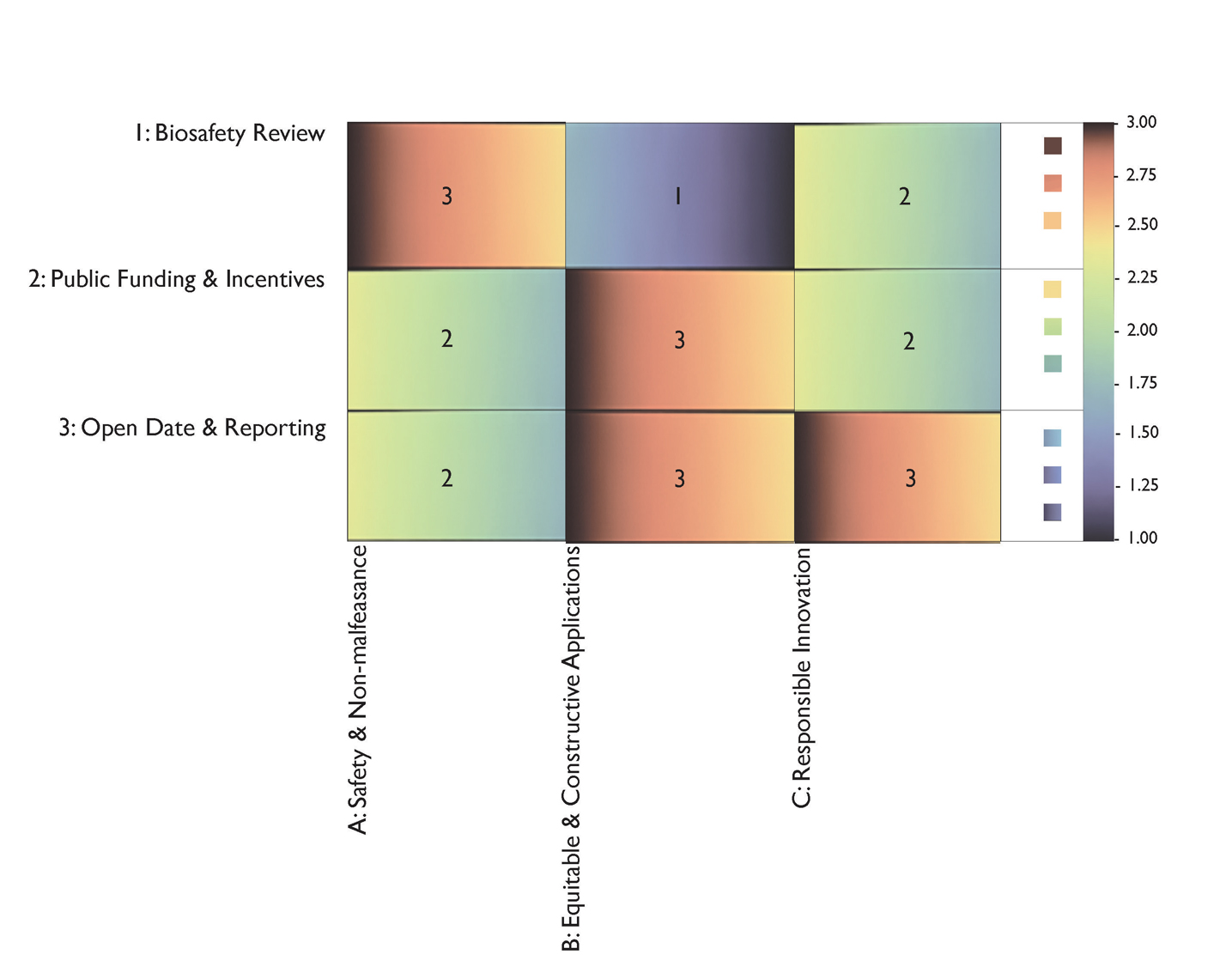
Governance actions x rubric of policy goals scores: 3 (most effective), 2 (moderately effective), 1 (least effective).
| Governance Action | A: Safety & Non-Malfeasance | B: Equitable & Constructive Applications | C: Responsible Innovation |
|---|---|---|---|
| 1: Biosafety & Bioelectrical Review Requirement | 3 (Directly addresses containment, electrical safety, and dual-use risk) | 1 (Focused on safety, not accessibility or environmental benefits) | 2 (Provides oversight but may limit experimental freedom) |
| 2: Public Funding & Incentives for Environmental Mycelium Applications | 2 (Indirectly supports safety by encouraging “low-risk” ecological uses) | 3 (Strongly encourages equitable, beneficial, and sustainable applications) | 2 (Encourages responsible innovation by guiding research direction) |
| 3: Open Data & Reporting Norms for Mycelial Behaviour | 2 (Improves safety indirectly by making results more reproducible and transparent) | 3 (Promotes accessibility and knowledge-sharing) | 3 (Encourages transparency, iterative experimentation, and interdisciplinary learning) |
Governance Action Effectiveness Across Policy Goals (3 = most effective, 1 = least effective)
Last, drawing upon this scoring, describe which governance option, or combination of options, you would prioritize, and why. Outline any trade-offs you considered as well as assumptions and uncertainties. For this, you can choose one or more relevant audiences for your recommendation, which could range from the very local (e.g. to MIT leadership or Cambridge Mayoral Office) to the national (e.g. to President Biden or the head of a Federal Agency) to the international (e.g. to the United Nations Office of the Secretary-General, or the leadership of a multinational firm or industry consortia). These could also be one of the “actor” groups in your matrix.
Action 2 > Action 3 > Action 1 I would prioritise Public Funding & Incentives for Environmental Mycelium Applications (Action 2) and Open Data & Reporting Norms (Action 3), while keeping a lightweight Biosafety Review (Action 1) as a baseline. This combination encourages sustainable and equitable research, fosters transparency and reproducibility (of experiments despite natural variability in living mycelium), and supports responsible innovation without overburdening early experimental work.
Trade-offs include: potential “greenwashing” and access barriers for smaller labs These can be mitigated through clear grant criteria and support for open participation.
Target audiences: National research councils, Universities, and Open-science platforms.
Reflecting on what you learned and did in class this week, outline any ethical concerns that arose, especially any that were new to you. Then propose any governance actions you think might be appropriate to address those issues. This should be included on your class page for this week.
One ethical issue that stood out to me this week was how human-centric much of my initial thinking was. Before starting the Biodesign course, most of my research and ideas were focused on solving human needs. However, as I began working with organisms and observing their growth and behaviour, I started to appreciate principles that extend beyond the human perspective. This shift made me realise that I don’t want my projects to treat non-human organisms merely as tools; I want the process to feel like a collaborative exchange between humans and non-humans. Because of this, even though I had multiple potential ideas for the HTGAA course, I struggled to settle on a final project, partly because I wanted it to reflect more-than-human principles rather than a purely human-centred goal.
Another concern that arose relates to the knowledge gap between designers and scientists when it comes to ethical governance. While I understand trust is central to ethical research, I realised that I don’t yet have a clear understanding of the specific rules, committees, and step-by-step processes that currently govern ethical work in biology and gene-editing. As a designer moving into the biological domain, I need to equip myself with this knowledge to ensure my practice aligns with existing regulations and ethical standards. To address this gap, I think there should be more accessible scientific communication and guidance targeted at interdisciplinary practitioners and this would help build trust and ensure ethics are not only a principle but a practical framework embedded in research.
To address these ethical concerns, one appropriate governance action would be to create interdisciplinary ethics resources specifically for designers and artists working with biological systems. These would clearly explain the relevant rules, committees, and step-by-step procedures that scientists follow, helping bridge the knowledge gap, build trust, and ensure that projects respect both human and more-than-human considerations.
References
- Adamatzky, A. (2016) Unconventional Computing: A Volume of the Handbook of Natural Computing. Cham: Springer.
- Adamatzky, A., Gandia, A., Chiolerio, A. and De Lacy Costello, B. (2018) ‘On spiking behaviour of oyster fungi pleurotus djamor’, Scientific Reports, 8, 7873.
- Robinson, J. M., Annells, A., Cando-Dumancela, C. & Breed, M. F. (2024) Sonic restoration: acoustic stimulation enhances soil fungal biomass and activity of plant growth-promoting fungi, Biology Letters, 20(10), 20240295.
- Smyth, S. J., et al. (2023). Governing biotechnology to provide safety and security and address ethical, legal, and social implications. Frontiers in Bioengineering and Biotechnology.